Wound care coding requires more than simply identifying that a wound exists. The right ICD-10-CM code can depend on the wound’s type, anatomical location, laterality, stage, severity, cause, and other clinical details documented in the patient’s record. From pressure ulcers and diabetic foot ulcers to chronic non-pressure ulcers and traumatic wounds, accurate diagnosis coding helps ensure that the patient’s condition is represented correctly on the claim.
Even a small documentation or coding error can create confusion, claim delays, or avoidable billing issues. Exploring the commonly used wound care ICD-10 codes and the documentation behind them can help providers, coders, and billing teams maintain cleaner claims while supporting appropriate reimbursement.
What Are Wound Care ICD-10 Codes?
Wound care ICD-10 codes are diagnosis codes used to describe the medical condition responsible for a patient’s wound or ulcer. Depending on the condition, the applicable code may identify the wound type, anatomical site, laterality, stage, severity, or other clinical characteristics.
Wound-related diagnoses appear across different ICD-10-CM categories. For example, pressure ulcers are reported from the L89 category, while non-pressure chronic ulcers are generally reported from L97. Traumatic open wounds are typically found within the injury chapters, and diabetic wound cases may require diabetes codes along with additional codes describing the associated condition.
The correct code should always be selected from the provider’s documentation and the ICD-10-CM code set applicable to the date of service. CMS publishes the annual ICD-10-CM files and official coding guidelines.
Commonly Used Wound Care ICD-10 Codes
The most appropriate wound care ICD-10 code depends on the documented diagnosis. The following categories represent some of the wound-related codes commonly encountered in clinical and billing settings.
| Wound condition | Common ICD-10-CM series | Key coding details |
| Pressure ulcers | L89.- | Site, laterality, and stage |
| Diabetic foot ulcers | E10/E11.- + applicable L97.- | Diabetes type plus ulcer site and severity |
| Other diabetic skin ulcers | E10.622/E11.622 | Diabetes type and associated skin ulcer |
| Non-pressure chronic ulcers | L97.- | Site, laterality, and severity |
| Varicose ulcers | I83.- + applicable L97.- | Venous condition plus ulcer characteristics |
| Traumatic/open wounds | S00-T14 | Injury type, location, and encounter |
| Postprocedural wound complications | T81.- | Specific complication and encounter |
| Surgical aftercare | Z48.- | Reason for postoperative aftercare |
These examples should be treated as reference points rather than a substitute for reviewing the complete ICD-10-CM code description, tabular instructions, and provider documentation.
Pressure Ulcers (L89 Series)
Pressure ulcer codes are reported from the L89.- category. One of the most important characteristics of this code family is its level of specificity. The code can identify the anatomical site, laterality, and pressure-ulcer stage.
Pressure ulcer documentation may distinguish:
- Stage 1
- Stage 2
- Stage 3
- Stage 4
- Unstageable pressure ulcer
- Pressure-induced deep tissue damage
- Unspecified stage
For example, CMS materials list L89.210 through L89.219 for pressure ulcers of the right hip, including unstageable, stages 1 through 4, pressure-induced deep tissue damage, and unspecified stage.
Common Pressure Ulcer ICD-10 Examples
- L89.151: Pressure ulcer of sacral region, stage 1
- L89.000: Pressure ulcer of unspecified elbow, unstageable
- L89.309: Pressure ulcer of unspecified buttock, unspecified stage
- L89.211: Pressure ulcer of right hip, stage 1
- L89.214: Pressure ulcer of right hip, stage 4
- L89.219: Pressure ulcer of right hip, unspecified stage

The distinction between an unstageable pressure ulcer and one with an unspecified stage is important. An unstageable ulcer has a specific clinical meaning under ICD-10-CM, whereas unspecified stage indicates that the stage has not been documented. CMS coding guidance addresses these distinctions and the reporting of pressure-ulcer stages.
Why Pressure Ulcer Stage Matters
The stage should come from the provider’s clinical documentation. A coder should not determine the stage simply by looking at the treatment performed or making an independent clinical judgment.
Clear documentation should identify the pressure-ulcer site and stage whenever clinically applicable. If a pressure ulcer progresses or its stage changes during care, the documentation and coding should reflect the condition being treated during the encounter.
Diabetic Foot Ulcers and Skin Ulcers (E10/E11 Series)
Diabetes-related wounds require particular attention because the diabetes diagnosis and the associated ulcer may both need to be represented.
For diabetic foot ulcers, ICD-10-CM includes combination diabetes codes that identify the diabetes and the foot-ulcer relationship. An additional code may then be needed to identify the specific ulcer site and severity.
Common Diabetic Wound ICD-10 Codes
- E10.621: Type 1 diabetes mellitus with foot ulcer
- E10.622: Type 1 diabetes mellitus with other skin ulcer
- E11.621: Type 2 diabetes mellitus with foot ulcer
- E11.622: Type 2 diabetes mellitus with other skin ulcer
CMS materials identify E10.621 and E11.621 for diabetes with foot ulcer and E10.622 and E11.622 for diabetes with other skin ulcer.
Additional Coding for Diabetic Foot Ulcers
When a diabetic foot ulcer is documented, the diabetes code does not necessarily provide all the information needed to describe the wound itself.
An additional code from the L97.- series may identify details such as:
- Exact anatomical location
- Right or left side
- Depth or severity
- Fat layer exposure
- Muscle involvement or necrosis
- Bone involvement or necrosis
For example, a documented type 2 diabetic patient with a non-pressure chronic ulcer of the right heel may require E11.621 together with the applicable L97.41- code describing the heel ulcer’s severity.
The medical record should support the relationship between diabetes and the ulcer before applying diabetes-with-ulcer coding.
Non-Pressure Chronic Ulcers (L97 Series)
The L97.- category covers many non-pressure chronic ulcers of the lower extremities. These codes are particularly detailed because they identify both the ulcer’s location and its severity.
The L97 structure can distinguish sites such as:
- Thigh
- Calf
- Ankle
- Heel and midfoot
- Other parts of the foot
- Other portions of the lower leg
It can also identify different levels of tissue involvement, including breakdown of skin, exposed fat layer, muscle necrosis, bone necrosis, muscle involvement without necrosis, and bone involvement without necrosis.
Common L97 ICD-10 Examples
- L97.311: Non-pressure chronic ulcer of right ankle limited to breakdown of skin
- L97.312: Non-pressure chronic ulcer of right ankle with fat layer exposed
- L97.313: Non-pressure chronic ulcer of right ankle with necrosis of muscle
- L97.314: Non-pressure chronic ulcer of right ankle with necrosis of bone
- L97.413: Non-pressure chronic ulcer of right heel and midfoot with necrosis of muscle
- L97.414: Non-pressure chronic ulcer of right heel and midfoot with necrosis of bone
CMS’s current code listings confirm these distinctions for right ankle and right heel/midfoot ulcers.
Understanding L97 Severity
The final characters in many L97 codes communicate the ulcer’s severity. Depending on the anatomical site, the code may distinguish:
Limited to breakdown of skin: The ulcer is limited to skin breakdown.
Fat layer exposed: The ulcer extends beyond the skin and exposes subcutaneous fat.
Necrosis of muscle: The documentation identifies muscle necrosis.
Necrosis of bone: The documentation identifies bone necrosis.
Muscle or bone involvement without evidence of necrosis: The applicable codes also distinguish involvement where necrosis is not documented.
Other specified or unspecified severity: These options may apply when the documentation supports those classifications.
This is why a statement such as “right ankle ulcer” may not be enough to select the most specific L97 code.
Venous and Varicose Ulcer ICD-10 Codes
Venous disease is another important source of chronic lower-extremity wounds. When varicose veins are documented with an ulcer, the I83.0- category may be applicable.
One example is:
- I83.00: Varicose veins of unspecified lower extremity with ulcer
More specific I83 codes can identify the affected side and the anatomical location of the ulcer. The ICD-10-CM classification also instructs users to add an L97 code to identify the severity of the ulcer where applicable.
For example, documentation of varicose veins of the right lower extremity with an ankle ulcer may require an I83 code identifying that condition together with an appropriate L97 code describing the ulcer’s characteristics.
What Should Be Documented for Venous Ulcers?
Documentation should make the clinical relationship clear and, when applicable, identify:
- The underlying venous condition
- Right or left lower extremity
- Ulcer location
- Ulcer severity
- Associated complications
- Other relevant clinical findings
Avoid reducing a documented venous ulcer to a generic “leg wound” diagnosis when the medical record contains more specific information.
Acute and Traumatic Wounds (S00-T14 Series)
Acute wounds caused by trauma are generally reported using injury codes from the S00-T14 range, depending on the type and location of the injury.
Examples include lacerations, puncture wounds, open wounds, bites, and other injuries.
Common Traumatic Wound ICD-10 Examples
- S01.01XA: Laceration without foreign body of scalp, initial encounter
- S01.00XA: Unspecified open wound of scalp, initial encounter
- W54.0XXA: Bitten by dog, initial encounter
CMS documentation confirms the description of S01.01XA as a laceration without foreign body of the scalp, initial encounter. CMS also lists W54.0XXA as “Bitten by dog, initial encounter.”
An important distinction is that an external-cause code such as W54.0XXA describes the circumstance that caused the injury. It does not replace the diagnosis code describing the actual wound.
Encounter Characters for Traumatic Wounds
Many injury codes require a seventh character:
- A: Initial encounter: Active treatment is being provided.
- D: Subsequent encounter: The patient is receiving routine care during the healing or recovery phase.
- S: Sequela: The encounter concerns a condition resulting from the original injury.
The meaning of these characters is based on the ICD-10-CM definitions, not simply whether the patient is visiting the provider for the first time. The FY 2027 official guidelines specifically explain that “initial encounter” refers to active treatment and that “subsequent encounter” applies after active treatment has been completed and routine healing or recovery care is being provided.
Post-Procedural and Surgical Wounds (T81 and Z48 Series)
Wounds associated with surgery require careful differentiation between routine postoperative aftercare and an actual postoperative complication.
Two encounters involving a surgical wound may therefore require completely different diagnosis codes.
Surgical Aftercare
One applicable code is:
- Z48.817: Encounter for surgical aftercare following surgery on the skin and subcutaneous tissue
This type of code can apply when the encounter is for routine surgical aftercare rather than treatment of a complication.
Postprocedural Wound Complications
When a postoperative wound has a documented complication, a T81 code may be appropriate.
Examples include:
- T81.30XA: Disruption of wound, unspecified, initial encounter
- T81.40XA: Infection following a procedure, unspecified, initial encounter
- T81.41XA: Infection following a procedure, superficial incisional surgical site, initial encounter
- T81.42XA: Infection following a procedure, deep incisional surgical site, initial encounter
- T81.43XA: Infection following a procedure, organ and space surgical site, initial encounter
CMS lists T81.30XA for disruption of wound, unspecified, and provides separate T81.40-, T81.41-, T81.42-, and T81.43- codes for different types of postprocedural infection.
A routine healing surgical wound should not automatically be treated as a traumatic injury. The FY 2027 guidelines specifically state that traumatic injury codes are not used for normal healing surgical wounds or to identify complications of surgical wounds.
Wound Infection and Cellulitis ICD-10 Codes
Not every wound is infected. A wound may be chronic, draining, painful, or require extensive treatment without automatically meeting the documentation requirements for an infection diagnosis.
When infection or cellulitis is clinically diagnosed and documented, the appropriate additional diagnosis code should be considered.
Relevant ICD-10-CM categories include L00-L08, which cover infections of the skin and subcutaneous tissue. These include conditions such as cellulitis, cutaneous abscesses, and other localized skin infections.
The important point is that infection should be based on provider documentation rather than inferred solely from the existence or appearance of a wound.
How Wound Location Affects ICD-10 Coding
Anatomical location is one of the most important details in wound coding.
For chronic ulcers, the difference between an ankle ulcer, calf ulcer, heel ulcer, midfoot ulcer, or another foot ulcer can lead to a different L97 code.
Similarly, pressure-ulcer coding distinguishes sites such as:
- Hip
- Elbow
- Buttock
- Sacral region
- Back
- Ankle
- Heel
- Other documented sites
For example, CMS lists separate L89 codes for right hip pressure ulcers and unspecified buttock pressure ulcers, with additional distinctions based on stage.
A documentation statement such as “lower-extremity wound” may therefore be insufficient when the applicable code requires a more specific site.
How Laterality Affects Wound Care Coding
Laterality identifies whether the wound is on the right or left side when the code set provides that distinction.
This is particularly important for:
- Pressure ulcers
- Lower-extremity chronic ulcers
- Diabetic foot ulcers
- Venous ulcers
- Traumatic wounds
For example, L97.311 identifies a right ankle ulcer, while separate codes identify left and unspecified ankle ulcers.
Providers should consistently document laterality in the clinical record when it is relevant to the condition.
How Wound Severity and Tissue Involvement Affect Coding
Wound severity can significantly change the diagnosis code.
For non-pressure chronic ulcers, the documentation may identify:
- Skin breakdown
- Exposed fat layer
- Muscle involvement
- Muscle necrosis
- Bone involvement
- Bone necrosis
- Other specified severity
- Unspecified severity
For example, L97.413 identifies a right heel and midfoot ulcer with necrosis of muscle, while L97.414 identifies one with necrosis of bone.
The clinical documentation should support the level of tissue involvement reported. Coders should not infer depth or severity simply from the procedure performed.
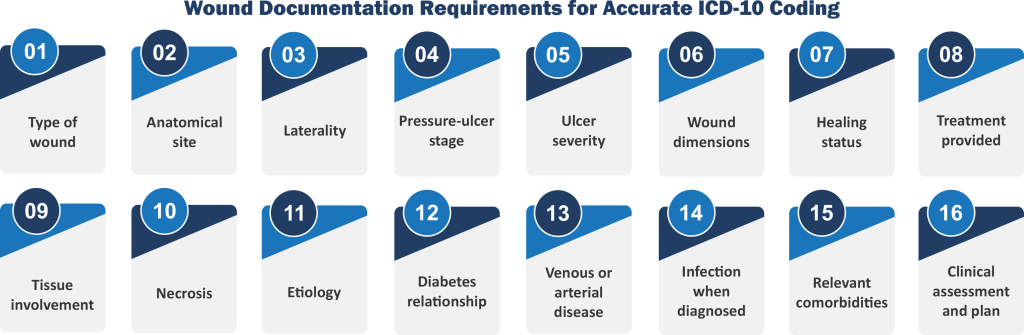
Wound Documentation Requirements for Accurate ICD-10 Coding
Accurate wound coding begins with detailed clinical documentation.
Depending on the wound type, documentation may need to identify:
- Type of wound
- Anatomical site
- Laterality
- Pressure-ulcer stage
- Ulcer severity
- Wound dimensions
- Tissue involvement
- Necrosis
- Etiology
- Diabetes relationship
- Venous or arterial disease
- Infection when diagnosed
- Healing status
- Relevant comorbidities
- Treatment provided
- Clinical assessment and plan
Examples of Documentation That Can Create Coding Problems
Consider the difference between:
“Leg wound.”
and:
“Non-pressure chronic ulcer of the right ankle with fat layer exposed.”
The second description provides substantially more information for determining the applicable diagnosis code.
Likewise:
“Pressure sore.”
does not provide the same coding specificity as:
“Stage 3 pressure ulcer of the right hip.”
Clear documentation allows the coding process to reflect the patient’s actual clinical condition rather than forcing the claim into an unnecessarily vague category.
Wound Care Billing Services
Accurate diagnosis coding is only one part of a successful wound care revenue cycle. Claims must also be submitted correctly, payments posted accurately, denials followed up on, and outstanding balances managed efficiently.
Practices looking to strengthen these processes can explore our Wound Care Billing Services to learn how specialized billing support can help manage the financial side of wound care.
Conclusion
Wound care ICD-10 coding requires attention to far more than the simple presence of a wound. Pressure ulcers in the L89 series depend heavily on anatomical site and stage, while diabetic foot ulcers may require diabetes codes such as E10.621 or E11.621 together with an applicable ulcer code. Non-pressure chronic ulcers in the L97 series can require precise information about location, laterality, and tissue involvement. Traumatic wounds use injury codes with encounter characters where applicable, while postoperative conditions may require T81 complication codes or Z48 aftercare codes.
The most reliable coding starts with complete clinical documentation. When providers clearly document the wound type, location, laterality, stage or severity, etiology, and relevant complications, coders have the information needed to select the appropriate diagnosis code.