Wound care coding is more than assigning the right CPT code, it directly impacts reimbursement, compliance, and the financial health of your practice. Even a small coding error, incorrect debridement selection, incomplete documentation, or improper modifier usage can result in denied claims, delayed payments, compliance audits, and lost revenue.
As wound care procedures become increasingly complex, providers and medical billers must understand not only which CPT codes to use but also when and how to apply them correctly.
Whether you’re coding selective debridement, surgical debridement, negative pressure wound therapy (NPWT), or skin substitute applications, every service must be supported by clear documentation and medical necessity.
What Are Wound Care CPT Codes?
Wound Care CPT Codes are standardized medical procedure codes used to report wound evaluation, treatment, debridement, dressing changes, and advanced wound management services for reimbursement. These codes help healthcare providers communicate the exact procedure performed to insurance companies, Medicare, and other payers while ensuring accurate billing and compliance.
It’s important to understand that CPT codes only describe what procedure was performed. They do not explain why the procedure was medically necessary. That’s where ICD-10 diagnosis codes come into play. Together, these coding systems create a complete picture of the patient’s condition and the treatment provided.
Here’s how they work together:
| Coding System | Purpose | Example |
| CPT Codes | Identify the medical procedure or service performed | 97597, 11042 |
| ICD-10 Codes | Describe the patient’s diagnosis or medical condition | L97.512, E11.621 |
| HCPCS Codes | Report medical supplies, skin substitutes, and certain medications not included in CPT | Q-codes for skin substitutes |
Types of Wound Care CPT Codes
Wound care encompasses a wide range of procedures, from routine evaluations to complex surgical debridement and advanced therapies. Each service has a specific CPT code based on the type of treatment performed, tissue depth, wound size, and clinical complexity. Understanding these categories helps providers select the correct code while avoiding undercoding or overcoding.
The most commonly used wound care CPT codes fall into the following categories:
- Evaluation and Management (E/M) Services
- Active Wound Care Management
- Non-Selective Debridement
- Surgical Debridement
- Negative Pressure Wound Therapy (NPWT)
- Skin Substitute Applications
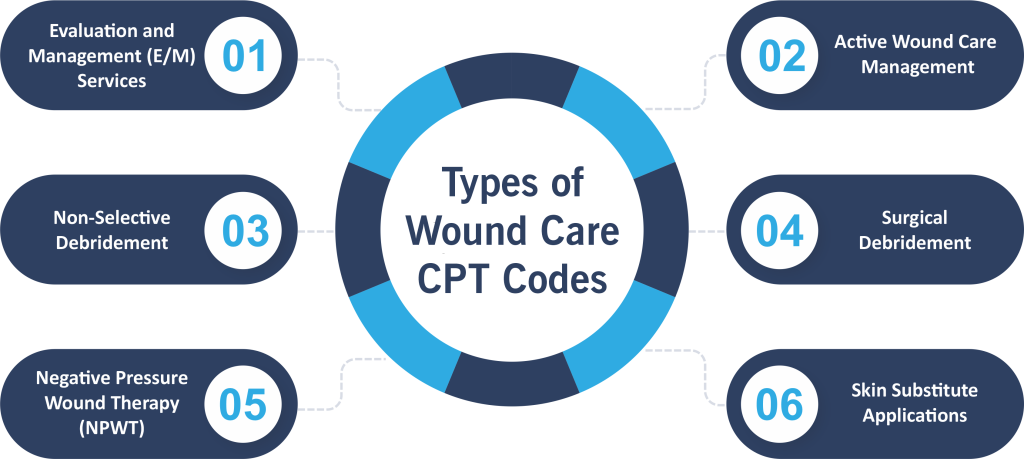
Each category has unique coding requirements, documentation expectations, and billing rules that directly affect reimbursement.
Evaluation and Management (E/M) Codes
Evaluation and Management (E/M) codes are used when the provider performs a medically necessary assessment of the patient’s condition. These services may include reviewing the patient’s history, examining the wound, determining the treatment plan, discussing risks, and coordinating follow-up care.
Common E/M Codes
| CPT Code | Description |
| 99202–99205 | New patient office visits |
| 99211–99215 | Established patient office visits |
An E/M service is not automatically billable every time wound care is performed. If the visit is solely for a scheduled wound treatment, the evaluation is generally considered part of the procedure.
However, a separate E/M code may be reported when the provider performs a significant and separately identifiable evaluation that influences clinical decision-making, such as assessing a new wound, identifying an infection, modifying the treatment plan, or evaluating unrelated medical concerns.
To support a separately billable E/M service, documentation should include:
- A comprehensive patient assessment
- Clinical findings beyond the procedure itself
- Medical decision-making
- Updated treatment plan
- Reason the evaluation was distinct from the wound procedure
Accurate documentation is essential because improper use of E/M codes is one of the most common reasons for payer audits and claim denials.
Active Wound Care Management CPT Codes
Active wound care management involves selective debridement, where the provider removes nonviable tissue while preserving healthy tissue to promote wound healing. These procedures require skilled clinical judgment and are reported based on the total surface area treated.
Common Active Wound Care CPT Codes
| CPT Code | Description |
| 97597 | Selective debridement, first 20 sq cm or less |
| 97598 | Each additional 20 sq cm or part thereof (add-on code) |
CPT Code 97597
CPT 97597 is reported when selective debridement is performed on wounds measuring up to 20 square centimeters. The procedure may involve removing devitalized tissue such as:
- Fibrin
- Slough
- Biofilm
- Necrotic tissue
- Exudate
Debridement is typically performed using instruments such as curettes, forceps, scalpels, or scissors while preserving viable tissue.
CPT Code 97598
When the total wound surface area exceeds 20 square centimeters, CPT 97598 is reported in addition to 97597 for each additional 20 square centimeters or portion thereof.
Example:
- Total wound size: 45 sq cm
- Coding:
- 97597 (first 20 sq cm)
- 97598 × 2 (remaining 25 sq cm)
Documentation should include:
- Exact wound measurements
- Surface area calculation
- Tissue removed
- Debridement technique
- Instruments used
- Patient response
- Medical necessity
Accurate measurement and documentation are critical because reimbursement is directly tied to the treated surface area.
Non-Selective Debridement CPT Codes
Non-selective debridement removes necrotic tissue without distinguishing between viable and nonviable tissue. Unlike selective debridement, these procedures do not require the same level of clinical precision and generally involve mechanical or enzymatic methods.
| CPT Code | Description |
| 97602 | Non-selective wound debridement using methods such as wet-to-moist dressings, enzymatic agents, abrasion, or irrigation |
Common techniques include:
- Wet-to-dry or wet-to-moist dressings
- Mechanical irrigation
- Whirlpool therapy (when appropriate)
- Enzymatic debridement
Providers should not report CPT 97597 when the treatment performed is non-selective. Choosing the wrong code is a frequent billing error that can lead to denied claims or reimbursement issues.
Documentation should clearly identify:
- The debridement method used
- Wound location
- Wound measurements
- Clinical indication for treatment
- Patient tolerance
- Follow-up care instructions
Distinguishing between selective and non-selective debridement ensures accurate coding, proper reimbursement, and compliance with payer documentation requirements.
Surgical Debridement CPT Codes
Surgical debridement is performed when deeper tissue removal is necessary to promote wound healing or control infection. These procedures involve excising devitalized tissue using surgical instruments and are coded according to the deepest level of tissue removed, not simply the appearance of the wound.
Common Surgical Debridement CPT Codes
| CPT Code | Tissue Level |
| 11042 | Subcutaneous tissue (first 20 sq cm or less) |
| 11045 | Each additional 20 sq cm (add-on to 11042) |
| 11043 | Muscle and/or fascia (first 20 sq cm or less) |
| 11046 | Each additional 20 sq cm (add-on to 11043) |
| 11044 | Bone (first 20 sq cm or less) |
| 11047 | Each additional 20 sq cm (add-on to 11044) |
Negative Pressure Wound Therapy (NPWT) CPT Codes
Negative Pressure Wound Therapy (NPWT), commonly known as wound VAC therapy, promotes healing by applying controlled suction to a wound through a sealed dressing. The therapy helps remove excess fluid, reduce edema, improve blood flow, and stimulate the formation of healthy granulation tissue.
CPT coding for NPWT depends primarily on the wound surface area being treated and whether a durable or disposable system is used.
| CPT Code | Description |
| 97605 | NPWT using durable medical equipment (DME), total wound(s) surface area 50 sq cm or less |
| 97606 | NPWT using durable medical equipment (DME), greater than 50 sq cm (add-on to 97605) |
| 97607 | Disposable NPWT system, total wound(s) surface area 50 sq cm or less |
| 97608 | Disposable NPWT system, greater than 50 sq cm (add-on to 97607) |
| 97610 | Low-frequency, non-contact, non-thermal ultrasound therapy for wound care |
When to Use These Codes
The correct CPT code depends on two factors:
- The total wound surface area treated
- Whether the provider uses a durable NPWT device or a disposable system
For example:
- A patient receiving durable NPWT for a 35 sq cm diabetic foot ulcer would typically be reported with 97605.
- If the treated wound area totals 75 sq cm, report 97605 and 97606.
- When a disposable NPWT device is applied to a 40 sq cm wound, 97607 is appropriate.
- If the disposable system is used for a wound exceeding 50 sq cm, report 97607 with 97608.
Documentation Requirements
Proper documentation should include:
- Wound diagnosis
- Exact wound measurements
- Total surface area treated
- Type of NPWT device used
- Dressing application details
- Suction settings, when applicable
- Patient response to treatment
- Ongoing medical necessity
Incomplete documentation is one of the leading causes of NPWT claim denials. Providers should clearly demonstrate why negative pressure therapy is clinically appropriate and how it contributes to wound healing.
Skin Substitute Application CPT Codes
Skin substitute applications are commonly performed for chronic wounds that have not responded to conventional wound care. These procedures involve placing a biologic or synthetic skin replacement over the wound to promote tissue regeneration and accelerate healing.
The CPT code selection is determined by:
- Anatomical location
- Total wound surface area
- Whether additional square centimeters require add-on codes
| CPT Code | Anatomical Site |
| 15271 | Trunk, arms, legs – first 25 sq cm or less |
| 15272 | Each additional 25 sq cm (add-on) |
| 15273 | Total wound surface area 100 sq cm or greater (certain anatomical sites) |
| 15274 | Each additional 100 sq cm (add-on) |
| 15275 | Face, scalp, eyelids, mouth, neck, ears, hands, feet, genitalia – first 25 sq cm or less |
| 15276 | Each additional 25 sq cm (add-on) |
| 15277 | Large surface area applications for these anatomical sites |
| 15278 | Additional large surface area (add-on) |
How to Choose the Correct Wound Care CPT Code
Selecting the appropriate wound care CPT code involves much more than identifying the procedure performed. Providers must evaluate the wound characteristics, treatment method, tissue depth, and total surface area while ensuring documentation supports medical necessity.
The following decision process can help simplify code selection.
Step 1: Was Debridement Performed?
If No:
- Consider evaluation and management services or other wound care procedures.
If Yes:
- Continue to determine the type of debridement.
Step 2: Identify the Debridement Type
Ask yourself:
- Was only nonviable tissue selectively removed while preserving healthy tissue?
- Report 97597–97598.
- Was tissue removed without selective discrimination using mechanical or enzymatic methods?
- Report 97602, when applicable.
- Was surgical excision performed into subcutaneous tissue, muscle, fascia, or bone?
- Use the 11042–11047 code family.
Step 3: Determine the Deepest Tissue Removed
Always code according to the deepest tissue actually debrided.
For example:
- Epidermis/Dermis → Selective debridement codes
- Subcutaneous tissue → 11042 series
- Muscle/Fascia → 11043 series
- Bone → 11044 series
Do not select codes based solely on the wound’s depth before treatment. The determining factor is the deepest tissue removed during the procedure.
Step 4: Calculate Total Surface Area
Measure:
Length × Width = Surface Area
When multiple wounds are debrided:
- Combine wounds of the same tissue depth.
- Report wounds of different tissue depths separately.
Accurate measurements directly affect reimbursement because many wound care CPT codes are based on treated surface area.
Step 5: Consider Additional Procedures
Determine whether other billable services were performed, such as:
- Negative Pressure Wound Therapy
- Skin Substitute Application
- Separate Evaluation and Management service
- Other medically necessary procedures performed during the same encounter
Following this structured approach helps reduce coding errors, improve documentation accuracy, and minimize payer denials.
Documentation Requirements for Wound Care Billing
Documentation is the foundation of successful wound care billing. Even when the correct CPT code is selected, claims may be denied if the medical record does not clearly demonstrate the procedure performed, the patient’s condition, and the medical necessity for treatment. Thorough documentation also protects providers during payer audits and supports compliance with Medicare and commercial insurance policies.
The following elements should be included whenever wound care services are billed:
| Documentation Element | Why It Matters |
| Patient diagnosis | Supports medical necessity |
| Wound location | Identifies the treated wound |
| Laterality (Right/Left) | Prevents coding ambiguity |
| Wound measurements | Determines correct CPT code |
| Surface area calculation | Required for size-based coding |
| Tissue depth | Supports debridement code selection |
| Type of tissue removed | Differentiates selective and surgical debridement |
| Debridement technique | Confirms the procedure performed |
| Instruments used | Supports surgical coding when applicable |
| Bleeding and hemostasis | Documents procedural complexity |
| Dressing applied | Records post-procedure care |
| Patient tolerance | Demonstrates procedure completion |
| Follow-up treatment plan | Supports continuity of care |
| Provider signature and date | Required for claim validity |
Common Modifiers Used in Wound Care Billing
Modifiers provide additional information about a procedure without changing the CPT code itself. Correct modifier usage helps payers understand the circumstances surrounding a service and reduces unnecessary claim denials.
Below are the modifiers most frequently used in wound care billing.
| Modifier | When to Use |
| 25 | Significant, separately identifiable Evaluation and Management service performed on the same day as a procedure |
| 24 | Unrelated Evaluation and Management service during a postoperative period |
| 59 | Distinct procedural service when procedures would otherwise be bundled |
| XS | Separate anatomical structure |
| XE | Separate encounter on the same date |
| XP | Separate practitioner performed the service |
| XU | Service does not overlap the usual components of the primary procedure |
| 51 | Multiple procedures performed during the same encounter |
| 76 | Repeat procedure by the same provider |
| 77 | Repeat procedure by another provider |
| RT | Procedure performed on the right side of the body |
| LT | Procedure performed on the left side of the body |
Real-World Wound Care Coding Examples
Applying CPT codes correctly becomes much easier when you see how coding decisions are made in real clinical scenarios. The following examples illustrate common wound care situations and the appropriate coding approach.
Scenario 1: Selective Debridement of a Small Wound
Clinical Scenario
A patient presents with a diabetic foot ulcer measuring 18 square centimeters. The provider selectively removes slough and necrotic tissue using a curette while preserving healthy tissue.
Correct CPT Code
- 97597
Why This Code Applies
Selective debridement was performed, and the total treated surface area does not exceed 20 square centimeters.
Scenario 2: Large Selective Debridement
Clinical Scenario
A chronic venous leg ulcer measuring 45 square centimeters requires selective debridement.
Correct CPT Codes
- 97597
- 97598 × 2
Why This Code Applies
The first 20 square centimeters are reported with 97597. The remaining 25 square centimeters require two units of the add-on code 97598.
Scenario 3: Surgical Debridement to Subcutaneous Tissue
Clinical Scenario
A pressure ulcer requires surgical removal of devitalized subcutaneous tissue over a 15 square centimeter area.
Correct CPT Code
- 11042
Why This Code Applies
The deepest tissue removed was subcutaneous tissue, and the treated area does not exceed 20 square centimeters.
Scenario 4: Surgical Debridement to Muscle
Clinical Scenario
An infected lower-extremity ulcer requires excision into muscle tissue. The treated wound measures 18 square centimeters.
Correct CPT Code
- 11043
Why This Code Applies
The procedure involved debridement to the muscle layer, making the 11043 code family appropriate.
Scenario 5: Bone Debridement
Clinical Scenario
A patient with osteomyelitis undergoes surgical debridement involving exposed bone over a 12 square centimeter wound.
Correct CPT Code
- 11044
Why This Code Applies
Bone was surgically debrided, and the wound size falls within the first 20 square centimeters.
Scenario 6: Multiple Wounds at Different Tissue Depths
Clinical Scenario
A patient has:
- Foot ulcer: 14 sq cm, debrided to subcutaneous tissue
- Heel ulcer: 10 sq cm, debrided to muscle
Correct CPT Codes
- 11042
- 11043
Why This Code Applies
The wounds were treated at different tissue depths. Their surface areas should not be combined.
Scenario 7: Negative Pressure Wound Therapy
Clinical Scenario
A provider applies durable NPWT to a chronic wound measuring 42 square centimeters.
Correct CPT Code
- 97605
Why This Code Applies
Durable NPWT was provided for a wound measuring 50 square centimeters or less.
Scenario 8: Skin Substitute Application
Clinical Scenario
A chronic diabetic leg ulcer measuring 22 square centimeters receives a skin substitute application.
Correct CPT Code
- 15271
Why This Code Applies
The wound is located on the leg and falls within the initial surface area threshold for this code series.
Scenario 9: Multiple Subcutaneous Wounds
Clinical Scenario
Three lower-leg ulcers are surgically debrided to subcutaneous tissue.
- Wound 1: 8 sq cm
- Wound 2: 7 sq cm
- Wound 3: 9 sq cm
Total Surface Area
24 square centimeters
Correct CPT Codes
- 11042
- 11045
Why This Code Applies
Because all wounds were debrided to the same tissue depth, their surface areas are combined. The first 20 square centimeters are reported with 11042, while the remaining area is reported with the add-on code 11045.
Scenario 10: Separate Evaluation and Management Service
Clinical Scenario
A patient presents for scheduled wound debridement but also develops a new wound infection requiring additional evaluation, medication adjustments, and a revised treatment plan.
Correct CPT Codes
- Appropriate E/M code (with Modifier 25, if applicable)
- Debridement CPT code
Why This Code Applies
The evaluation was significant and separately identifiable from the procedure, supporting separate reimbursement when fully documented.
Summary
Providers must carefully evaluate the type of wound, determine the deepest tissue debrided, calculate the total treated surface area, and maintain thorough documentation that supports medical necessity. When CPT codes are paired with the appropriate ICD-10 diagnosis codes and supported by complete clinical records, practices can improve claim accuracy, reduce denials, and receive timely reimbursement.
Whether you’re reporting selective debridement, surgical debridement, negative pressure wound therapy, or skin substitute applications, following current coding standards and payer-specific requirements is essential for maintaining compliance.
Regular coding audits, ongoing staff education, and consistent documentation practices can further strengthen your revenue cycle and minimize audit risks.