Radiology plays a critical role in modern healthcare, but without accurate coding, even the most precise imaging results can lead to denied claims and lost revenue. That’s where ICD-10 codes for radiology procedures come in. These codes don’t just document a patient’s condition; they justify the medical necessity behind every X-ray, CT scan, MRI, or ultrasound performed.
Whether you’re a medical coder, radiologist, billing specialist, or healthcare provider, understanding how to correctly use radiology ICD-10 codes is essential for compliance, reimbursement, and efficiency. From identifying common diagnosis codes to navigating abnormal findings and interventional radiology coding, this guide is designed to simplify the complexities and help you code with confidence.
By the end of this article, you’ll not only understand the most commonly used ICD-10 radiology codes but also learn best practices, guidelines, and insider tips to reduce errors, avoid claim denials, and optimize your workflow.
What Are Radiology ICD-10 Codes?
Radiology ICD-10 codes are part of the ICD-10-CM (Clinical Modification) system used to describe the reason or diagnosis behind an imaging procedure. In simple terms, these codes explain why a patient needs an X-ray, CT scan, MRI, ultrasound, or other imaging service.
Unlike procedure codes (such as CPT), which describe the imaging test performed, ICD-10 codes focus on the patient’s symptoms, conditions, or suspected diagnoses. For example, if a patient undergoes a chest X-ray due to persistent chest pain, the ICD-10 code will reflect the symptom (e.g., chest pain), not the imaging itself.
Radiology ICD-10 codes are essential because they:
- Establish medical necessity for imaging procedures
- Support insurance claims and reimbursement
- Ensure compliance with healthcare regulations
- Provide a standardized way to document patient conditions
Radiology ICD-10 codes are essential because they establish medical necessity and support insurance reimbursement. However, because these codes explain the ‘why’ behind a scan, any mismatch with the procedure code can trigger an instant denial. Many practices partner with professional medical billing services to ensure that every claim is scrubbed for this specific alignment, preventing the revenue gaps that occur when diagnosis codes don’t support the imaging performed
In radiology, coders often work with limited clinical information, relying heavily on physician orders and imaging reports. That’s why selecting the correct ICD-10 code requires both accuracy and attention to detail.
Common ICD-10 Codes for Radiology (With Examples)
Certain ICD-10 codes are used frequently in radiology because they correspond to common symptoms that require imaging evaluation. These codes help justify diagnostic procedures when a definitive diagnosis has not yet been established.
Here are some of the most commonly used radiology ICD-10 codes:
| ICD-10 Code | Description |
| R07.9 | Chest pain, unspecified |
| R10.9 | Abdominal pain, unspecified |
| R51 | Headache |
| R42 | Dizziness and giddiness |
| R55 | Syncope and collapse |
| R06.02 | Shortness of breath |
Why These Codes Matter
These codes are widely used because radiology often deals with initial diagnosis and symptom investigation. For instance:
- A patient with a headache (R51) may need a CT or MRI of the brain
- Abdominal pain (R10.9) often leads to ultrasound or CT imaging
- Shortness of breath (R06.02) may require chest imaging
In many cases, radiologists do not confirm a final diagnosis. Instead, they document findings, making symptom-based ICD-10 codes critical for accurate billing.
Abnormal Radiology ICD-10 Codes
In radiology, it’s common to encounter cases where imaging reveals abnormal findings without a definitive diagnosis. In such situations, specific ICD-10 codes are used to represent these abnormalities.
Common Abnormal Findings Codes
| ICD-10 Code | Description |
| R93.0 | Abnormal findings on imaging of skull and head |
| R91.8 | Other nonspecific abnormal findings of lung |
| R93.5 | Abnormal findings on imaging of abdomen |
When to Use Abnormal Codes
Abnormal radiology ICD-10 codes should be used when:
- Imaging results show unexpected or unclear findings
- There is no confirmed diagnosis yet
- The radiologist cannot definitively interpret the condition
For example, if a CT scan shows a suspicious lung shadow but no confirmed disease, coding R91.8 (abnormal lung finding) is appropriate.
Important Coding Insight
One of the most important rules in radiology coding is:
Do not code unconfirmed diagnoses.
Instead, coders should:
- Use symptoms or abnormal findings codes
- Avoid assumptions or speculative diagnoses
- Follow official ICD-10 coding guidelines
This ensures compliance, reduces audit risks, and improves claim acceptance rates.
Following official ICD-10 guidelines is the only way to ensure compliance and reduce audit risks. If your practice is seeing frequent denials for ‘lack of medical necessity,’ it may be time for medical coding audit services. A professional audit can identify if your team is incorrectly coding speculative diagnoses (like ‘rule out’) instead of the required symptom-based codes, protecting your practice from recoupment risks
Radiology ICD-10 Coding Guidelines (Must Know)
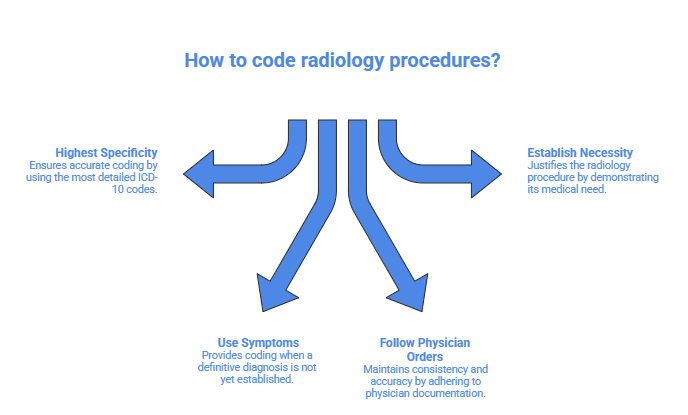
Accurate radiology coding isn’t just about selecting a code; it’s about following standardized guidelines that ensure compliance, reduce denials, and improve reimbursement. Understanding these core rules can make a significant difference in coding accuracy.
1. Code to the Highest Level of Specificity
ICD-10 requires detailed and precise coding. Whenever possible:
- Use specific codes instead of unspecified ones
- Include laterality (left, right, bilateral)
- Capture severity and location
Example: Instead of a general abdominal pain code, use a more specific code if documentation allows.
2. Use Symptoms When No Diagnosis Is Confirmed
Radiology often deals with early-stage investigations, meaning a final diagnosis may not yet exist.
- If the report states “rule out tumor,” → Do NOT code tumor
- Instead → Code the presenting symptom (e.g., headache, pain)
This is one of the most critical rules in radiology coding and helps prevent compliance issues.
3. Follow Physician Orders and Documentation
Radiology coders rely heavily on:
- Referring physician’s order
- Clinical history provided
- Imaging report findings
If documentation is incomplete or unclear, it can lead to:
- Incorrect coding
- Claim denials
- Compliance risks
Always ensure documentation supports the selected ICD-10 code.
4. Establish Medical Necessity
Every imaging procedure must be justified with a valid ICD-10 code.
- Insurance providers require proof that the imaging was necessary
- Incorrect or weak diagnosis codes can lead to claim rejection
Strong, accurate ICD-10 coding directly impacts reimbursement success.
Interventional Radiology ICD-10 Codes
Interventional radiology (IR) involves minimally invasive, image-guided procedures used for both diagnosis and treatment. Coding in this area is slightly more complex because it may involve both diagnosis and procedural classifications.
What Makes Interventional Radiology Different?
Unlike diagnostic radiology, IR includes procedures such as:
- Angioplasty and stent placement
- Image-guided biopsies
- Drainage of abscesses or fluid collections
- Embolization procedures
Coding Structure in Interventional Radiology
Interventional radiology uses two ICD-10 systems:
- ICD-10-CM: Describes the patient’s condition (diagnosis)
- ICD-10-PCS: Describes inpatient procedures
Important distinction:
- Outpatient radiology → Primarily ICD-10-CM + CPT
- Inpatient radiology → Includes ICD-10-PCS codes
If a patient undergoes an image-guided biopsy:
- ICD-10-CM → Indicates the suspected condition (e.g., abnormal mass)
- ICD-10-PCS → Describes the procedure performed
Radiology ICD-10 Codes List by Category
To simplify coding, radiology ICD-10 codes can be grouped into common categories based on clinical use.
1. Pain & Symptom Codes
These are the most frequently used in diagnostic imaging:
- R07.9: Chest pain
- R10.9: Abdominal pain
- R51: Headache
- R42: Dizziness
These codes justify initial imaging when the cause is unknown.
2. Screening Codes
Used when imaging is performed as part of preventive care:
- Z12.31: Breast cancer screening (mammogram)
- Z12.2: Lung cancer screening
Screening codes are essential for preventive healthcare services.
3. Vascular & Circulatory Codes
Commonly used in ultrasound and Doppler studies:
- I82.401: Deep vein thrombosis (right leg)
- I83.91: Varicose veins
These codes are often linked to vascular imaging procedures.
Challenges in Radiology ICD-10 Coding
Despite its importance, radiology ICD-10 coding comes with several challenges that can impact accuracy and reimbursement if not handled properly.
Limited Patient Interaction: Radiologists typically do not interact directly with patients. Instead, they rely on:
- Physician orders
- Clinical history
- Imaging findings
This lack of direct information can make it difficult to assign the most accurate ICD-10 code.
Incomplete or Vague Documentation: One of the biggest issues in radiology coding is insufficient documentation.
- Missing clinical details
- Unclear physician notes
- Lack of specificity
This often leads to:
- Use of unspecified codes
- Increased claim denials
- Compliance risks
Incomplete documentation and vague physician notes often lead to the use of unspecified codes, which are a primary target for payer rejections. Transitioning to specialized radiology billing services helps solve this by providing coders who understand the nuances of imaging reports, ensuring that even with limited patient interaction, your claims are submitted with the highest level of specificity possible.
Coding Uncertainty in Reports: Radiology reports frequently include terms like:
- “Possible”
- “Suspicious for”
- “Cannot rule out”
These uncertain diagnoses cannot be coded as confirmed conditions, forcing coders to rely on symptoms or abnormal findings instead.
Constant Updates in ICD-10 Codes: ICD-10 codes are updated regularly, which means:
- Coders must stay current
- Outdated codes can lead to claim rejections
Keeping up with annual updates is essential for compliance and accuracy.
Best Practices for Accurate Radiology Coding
To overcome these challenges and improve coding outcomes, following best practices is essential.
Always Verify Physician Orders: Ensure the ICD-10 code matches the reason for the imaging study. Cross-check clinical indications before assigning codes
Avoid Unspecified Codes When Possible: Use detailed codes whenever documentation allows. Specific coding improves claim acceptance rates
Maintain Strong Documentation: Encourage complete and clear physician notes. Ensure imaging reports support the selected codes
Cross-Check ICD-10 and CPT Codes: ICD-10 → Why the procedure is performed. CPT → What procedure is performed
Proper alignment ensures smoother billing and fewer denials.
Stay Updated with ICD-10 Changes: Review yearly updates. Use updated coding manuals or software. Staying current helps avoid compliance issues and errors.
Conclusion
Accurate use of ICD-10 codes for radiology procedures is essential for ensuring proper billing, compliance, and reimbursement. From common symptom-based codes to abnormal findings and interventional radiology coding, every detail matters when it comes to selecting the right code.
By following established coding guidelines, maintaining strong documentation, and staying updated with ICD-10 changes, healthcare professionals can significantly reduce errors and improve claim success rates.
In a field where precision is everything, mastering radiology ICD-10 coding is critical for financial success. If you are already struggling with a backlog of unpaid imaging claims, integrating robust denial management services can help you pinpoint exactly where your coding is falling short, allowing you to recover lost revenue and optimize your workflow for the future.