Claim denials continue to place pressure on healthcare revenue cycles, especially when billing teams search for answers such as “What is the CO 24 denial code and why was my claim denied?” In 2026, the average initial claim denial rate is estimated at around 11% to 12%, meaning nearly 1 out of every 9 claims is denied on first submission.
When the CO 24 denial code appears, it usually indicates that the service was already covered under a capitation agreement or should have been billed to a managed care organization instead of the submitted payer. If not handled correctly, it can lead to delayed reimbursements, increased rework for billing teams, and avoidable revenue loss. Industry data shows that U.S. healthcare providers lose billions annually due to unresolved or incorrectly handled denials, with a large portion linked to eligibility and payer routing errors.
This guide explains the CO 24 denial code in clear terms and shows how billing teams can address it using a structured approach. You will learn how to identify the root cause, correct claim submission errors, and prevent repeat denials.
What is the CO 24 Denial Code?
CO 24 denial code is a common claim adjustment reason used by payers when services are covered under a capitation agreement or managed care plan. Billing teams often see this denial and ask why payment was not issued even when services were correctly performed. In most cases, the issue is not clinical care but payer routing, plan structure, or contract rules.
CO 24 Denial Code Meaning
CO 24 denial code means the payer considers the service already included in a fixed payment arrangement. This is usually a capitation model or managed care contract where providers receive a per-member-per-month payment.
Key points:
- Payment for the service is already included in a bundled agreement
- Separate reimbursement is not allowed for the denied claim
- The responsibility shifts based on contract terms, not service delivery
Where It Appears in Billing
CO 24 denial code appears during claim adjudication when the payer processes the submitted claim. It is commonly seen in:
- ERA 835 electronic remittance advice
- Explanation of Benefits (EOB) statements
- Managed care and Medicare Advantage claims
Common billing triggers include:
- Claim sent to the wrong payer (e.g., Original Medicare instead of Medicare Advantage)
- Service is already covered under the capitation agreement
- Missing or incorrect coordination of benefits (COB) data
CO 24 Denial Code Causes
Understanding the root causes of the CO 24 denial code helps reduce repeated rejections and improve claim accuracy. Each cause is linked to specific breakdowns in insurance verification, coordination of benefits, or plan restrictions.
Incorrect Payer Submission
Incorrect payer submission is one of the most frequent causes of the CO 24 denial code. This occurs when the claim is sent to the wrong insurance entity.
Common situations include:
1. Claim sent to Original Medicare instead of the Medicare Advantage plan
2. Managed care organization not identified during registration
3. Secondary payer billed before primary payer validation
Impact on billing:
- The claim is rejected under contractual obligation rules
- Rework increases for billing and follow-up teams
- Payment delay due to resubmission requirement
Capitation Agreement Coverage
CO 24 denial code also appears when services fall under a capitation agreement. In this model, providers receive a fixed payment per patient instead of per service.
Key points:
- Services are included in a per-member-per-month payment
- Separate billing for included services is not allowed
- Claims for bundled services are automatically denied
Common issue:
- Billing teams submit fee-for-service claims for capitated patients without checking the contract scope
Action required:
1. Review the capitation contract terms before billing
2. Identify included vs excluded services (carve-outs)
Coordination of Benefits (COB) Errors
COB errors occur when payer responsibility is not correctly established. This directly leads to the CO 24 denial code in managed care environments.
Common causes:
1. Missing or outdated insurance information
2. Incorrect primary and secondary payer order
3. Failure to update patient coverage changes
Billing impact:
- Claim routed to the incorrect payer
- Automatic denial due to eligibility mismatch
- Delays in the reimbursement cycle
Authorization and Referral Issues
Some managed care plans require prior authorization or referrals before services are rendered. Missing these requirements can trigger the CO 24 denial code.
Common scenarios:
1. Service performed without prior authorization
2. Referral not obtained from primary care provider
3. Authorization exists but is not linked to a claim
Billing outcome:
- Claim denied due to plan rule violation
- Service is considered non-billable under contract terms
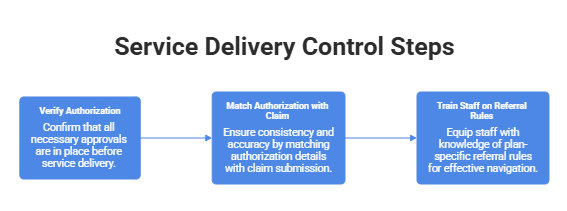
Required control steps:
1. Verify authorization before service delivery
2. Match authorization details with claim submission
3. Train staff on plan-specific referral rules
How to Fix CO 24 Denial Code (Step-by-Step)
CO 24 denial code creates repeated rework in billing operations when the payer responsibility is not identified correctly. Most cases are not caused by clinical errors but by incorrect payer routing, eligibility gaps, or unmanaged capitation rules. Fixing this denial requires a structured review of claim data and payer rules before resubmission or appeal.
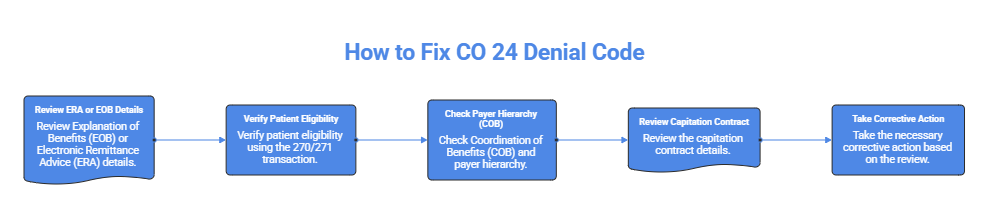
This section explains a step-by-step method used in revenue cycle workflows. Each step focuses on identifying the exact failure point and selecting the correct corrective action.
Step 1: Review ERA or EOB Details
Start by reviewing the ERA (835) or EOB to understand the payer’s exact reason for the CO 24 denial code. This helps confirm whether the issue is contractual, eligibility-related, or routing-based. Without this step, correction efforts may target the wrong problem.
1. Check the CO 24 denial code message and remarks
2. Identify payer-specific adjustment details
3. Confirm if the denial is contractual or administrative
Step 2: Verify Patient Eligibility (270/271)
Eligibility verification confirms whether the patient was enrolled in the correct plan at the time of service. Many CO 24 denials occur due to outdated or incorrect insurance data. This step ensures the claim is linked to valid coverage.
1. Confirm active coverage on the date of service
2. Check managed care or Medicare Advantage enrollment
3. Validate insurance updates before claim submission
Step 3: Check Payer Hierarchy (COB)
COB errors are a common cause of the CO 24 denial code when claims are sent to the wrong payer. Proper payer sequencing ensures claims are processed by the correct insurance first. This step prevents routing-related denials.
1. Confirm primary, secondary, and tertiary payer orders
2. Verify COB information is current and accurate
3. Ensure the claim matches the correct payer responsibility
Step 4: Review Capitation Contract
Capitation contracts define which services are included in fixed payments. If a service is already covered under PMPM payment, separate billing will trigger the CO 24 denial code. Understanding contract terms is critical before resubmission.
1. Identify included vs excluded services (carve-outs)
2. Check PMPM coverage rules
3. Confirm billing restrictions under contract terms
Step 5: Take Correct Action
After identifying the root cause, select the correct resolution path. Incorrect action leads to repeated denials and delays in reimbursement. Each case must follow payer-specific rules.
1. Redirect claim to the correct payer if misrouted
2. Write off charges covered under capitation
3. Submit an appeal for incorrectly denied services
4. Correct and resubmit the claim with updated data
CO 24 vs CO 18 Denial Code
CO 24 and CO 18 denial codes are often confused in medical billing because both relate to claim payment issues and prior processing rules. However, they represent different denial logic in payer adjudication. Understanding the distinction helps billing teams avoid incorrect corrections and repeated denials.
This section explains how each code works in practice. It focuses on payment structure, claim behavior, and how billing staff should respond to each scenario.
CO 24 Denial Code
CO 24 denial code indicates that the service is covered under a capitation agreement or managed care plan. This means payment is already included in a fixed reimbursement arrangement, and separate billing is not allowed. The issue is typically related to payer routing or plan enrollment.
- Linked to capitation or managed care contracts
- Claim sent to the incorrect payer or system
- Payment is already included in the PMPM arrangement
- Requires payer verification before resubmission
CO 18 Denial Code
CO 18 denial code indicates that the claim or service has already been processed or is a duplicate submission. This is not related to capitation but to claim frequency or repetition. It is triggered when the payer identifies the same service billed more than once.
- Indicates duplicate claim or service
- Previously processed claim exists in the payer system
- Often linked to resubmission without correction
- Requires claim history review before correction
Conclusion
CO 24 denial code is primarily linked to managed care rules, capitation agreements, and incorrect payer routing. Understanding the root cause helps billing teams reduce repeated denials and improve claim accuracy across the revenue cycle. A structured review of eligibility, COB, and contract terms is essential before resubmission or appeal.
Effective handling of the CO 24 denial code depends on consistent verification processes and correct claim routing from the start. When billing teams follow payer rules and validate coverage details, they reduce revenue delays and improve first-pass claim acceptance. This approach supports a more stable and accurate reimbursement workflow.
FAQs
What does the CO 24 denial code mean?
CO 24 denial code means the claim was denied because the service is covered under a capitation agreement or managed care plan. The payer considers the service already included in a fixed payment arrangement.
Why does the CO 24 denial code occur?
It usually occurs due to incorrect payer submission, missing coordination of benefits (COB), eligibility errors, or services already included in a capitation contract. Billing to the wrong payer is a frequent trigger.
Can the CO 24 denial code be appealed?
Yes, but only in specific cases. If the service is excluded from the capitation agreement or billed to the wrong payer, an appeal with contract proof or corrected details may be submitted.
How can the CO 24 denial code be prevented?
Prevention includes verifying patient eligibility, confirming payer hierarchy, checking COB details, and reviewing capitation contract terms before claim submission. Front-end checks reduce repeat denials.
Who is responsible for the CO 24 denial code errors?
Responsibility usually lies in billing and registration workflows where payer selection, eligibility checks, or COB updates are missed. It is not typically related to clinical documentation or service delivery.