Dog bite cases are more common than many realize, and when it comes to medical billing and documentation, even a small coding mistake can lead to claim denials or compliance issues. That’s why understanding the correct ICD-10 codes for dog bites is not just helpful, it’s essential.
Whether you’re a medical coder, healthcare provider, or billing specialist, you’ve likely searched for specific codes like dog bite right hand ICD-10 or dog bite left leg code. The challenge? Dog bite coding isn’t just one code; it requires a combination of external cause codes and injury-specific codes for complete accuracy.
In this article, you’ll find exact ICD-10 codes for every major body part, including hands, cheeks, forearms, and legs, along with expert coding tips to ensure you never miss a detail. By the end, you’ll have a clear, practical understanding of how to code dog bite injuries correctly and confidently.
ICD-10 Code for Dog Bite
When it comes to coding dog bite injuries, the most commonly used ICD-10 code is:
W54.0XXA – Bitten by dog, initial encounter
This code is used to indicate that a patient has been bitten by a dog and is receiving active treatment for the first time. It belongs to the category of external cause codes, which explain how an injury occurred rather than where it occurred.
However, it’s important to understand that W54.0XXA alone is not enough for complete medical coding. This code only identifies the cause of injury, it does not specify the location or severity of the wound.
Other Related Codes:
- W54.0XXD: Subsequent encounter (follow-up visits)
- W54.0XXS: Sequela (late effects or complications)
These variations allow coders to track the patient’s treatment journey over time, ensuring accurate clinical documentation and billing compliance.
Always confirm the encounter type (initial, subsequent, or sequela) before assigning the final character of the code.
ICD-10 Coding Structure for Dog Bites
To code a dog bite correctly, you must use a combination of codes, not just one. This is where many coding errors happen.
1. External Cause Code (Why the Injury Happened)
This is where W54.0XXA comes in. It answers the question:
What caused the injury?
Answer: A dog bite
2. Injury Code (Where the Injury Occurred)
This is equally important and identifies the specific body part affected. These codes typically come from the S00–S99 injury category.
For example:
- Hand injuries → S61 codes
- Face injuries → S01 codes
- Leg injuries → S81 codes
Why Dual Coding is Essential
Using both codes together provides a complete clinical picture:
- W54.0XXA → Explains the cause (dog bite)
- S61.451A (example) → Explains the injury location (right hand)
Without dual coding, your claim may be incomplete, denied by insurance, or non-compliant with coding standards. Because dog bite claims require this precise “Cause + Location” mapping, many high-volume clinics utilize professional medical billing services to manage the technical side. This ensures that the W54 and S-series codes are aligned perfectly with the patient’s insurance policy requirements, preventing avoidable revenue delays.
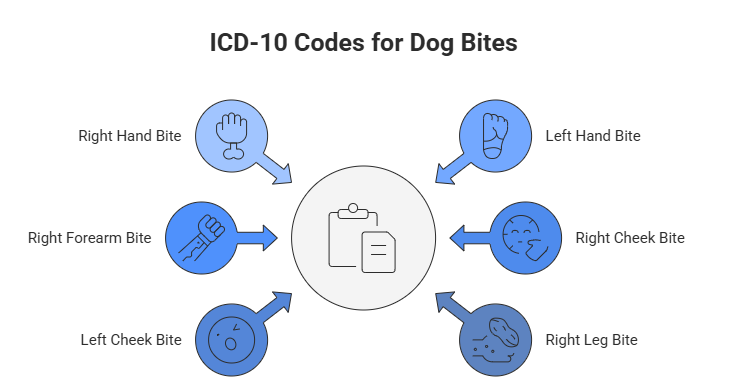
ICD-10 Codes for Dog Bites by Body Part (Complete List)
When coding dog bite injuries, specificity is critical. Each body part has its own ICD-10 injury code, which must be used alongside the external cause code W54.0XXA for complete and accurate documentation.
Below is a detailed breakdown of the most commonly searched and used ICD-10 codes for dog bites by body location:
1. ICD-10 Code for Dog Bite Right Hand
The correct code for a dog bite affecting the right hand is:
- S61.451A: Open bite of right hand, initial encounter
This code is used when:
- The injury involves a visible break in the skin
- The patient is receiving initial treatment
For follow-ups:
- S61.451D: Subsequent encounter
- S61.451S: Sequela
2. ICD-10 Code for Dog Bite Left Hand
For injuries to the left hand, use:
- S61.452A: Open bite of left hand, initial encounter
This code applies when:
- The bite results in an open wound
- Treatment is being provided for the first time
Related codes:
- S61.452D: Follow-up visit
- S61.452S: Late complications
3. ICD-10 Code for Dog Bite Right Forearm
Dog bites to the forearm may vary depending on documentation. A commonly used code is:
- S59.911A: Unspecified injury of right forearm, initial encounter
If the documentation clearly states an open bite, a more specific code should be selected when available. Always aim for the highest level of specificity.
4. ICD-10 Code for Dog Bite Right Cheek
Facial injuries require precise coding due to their complexity. For the right cheek:
- S01.451A: Open bite of right cheek, initial encounter
This includes:
- Soft tissue injuries
- Open wounds on the cheek area
5. ICD-10 Code for Dog Bite Left Cheek
For the left side of the face:
- S01.452A: Open bite of left cheek, initial encounter
Additional options:
- S01.452D: Subsequent encounter
- S01.452S: Sequela
6. ICD-10 Code for Dog Bite Right Leg
For bites affecting the right lower leg:
- S81.851A: Open bite of right lower leg, initial encounter
Used when:
- There is an open wound
- The injury is below the knee region
ICD-10 Code for Dog Bite Left Leg
For injuries to the left lower leg:
- S81.852A: Open bite of left lower leg, initial encounter
Related codes:
- S81.852D: Follow-up care
- S81.852S: Long-term effects
| Body Part | ICD-10 Code | Description |
| Right Hand | S61.451A | Open bite of right hand |
| Left Hand | S61.452A | Open bite of left hand |
| Right Forearm | S59.911A | Unspecified injury of right forearm |
| Right Cheek | S01.451A | Open bite of right cheek |
| Left Cheek | S01.452A | Open bite of left cheek |
| Right Leg | S81.851A | Open bite of right lower leg |
| Left Leg | S81.852A | Open bite of left lower leg |
Always pair the above injury codes with:
- W54.0XXA (initial encounter)
This ensures:
- Complete documentation
- Accurate reimbursement
- Compliance with ICD-10 guidelines
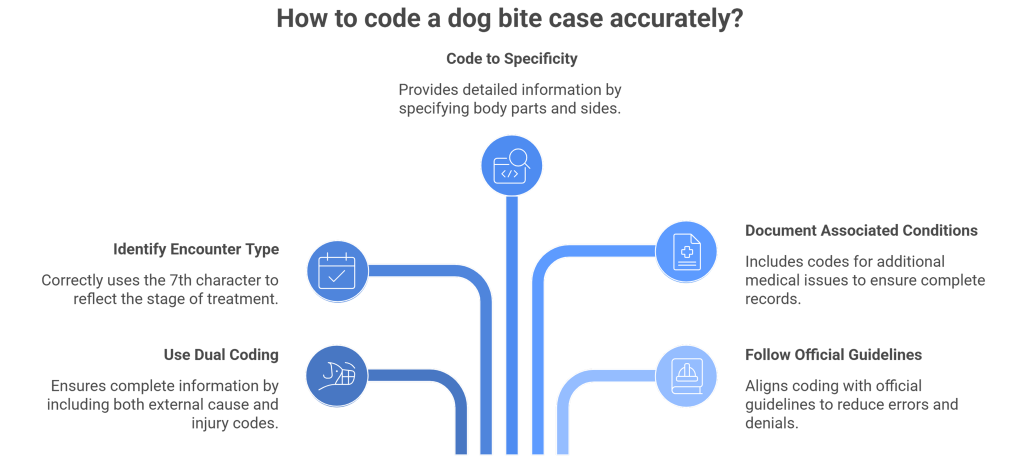
Key ICD-10 Coding Guidelines for Dog Bites
Accurate ICD-10 coding for dog bites goes beyond selecting a single code. To ensure compliance, avoid denials, and maintain proper documentation, you need to follow specific coding guidelines.
1. Always Use Dual Coding
Dog bite cases require at least two codes:
- External Cause Code → W54.0XXA (dog bite)
- Injury Code → Specifies the affected body part (e.g., hand, leg, cheek)
Using only one code provides incomplete information and can lead to claim rejections or audits.
2. Identify the Correct Encounter Type
ICD-10 codes use a 7th character to indicate the stage of treatment:
- A (Initial Encounter) → First time patient is treated
- D (Subsequent Encounter) → Follow-up visits during healing
- S (Sequela) → Long-term complications or conditions
Common mistake: Many coders incorrectly use “A” for every visit. Always verify the stage of care.
3. Code to the Highest Level of Specificity
The more detailed your code, the better:
- Specify right vs left
- Identify the exact body part
- Use open bite codes when applicable
Example: Instead of using a general injury code, choose:
- S61.451A (right hand) rather than a vague hand injury code
4. Document Associated Conditions
Dog bites often lead to additional medical issues. These may require separate ICD-10 codes, such as:
- Infection (e.g., cellulitis)
- Nerve damage
- Rabies exposure
- Tetanus risk
Proper documentation ensures:
- Complete patient records
- Higher reimbursement accuracy
5. Follow Official ICD-10 Guidelines
Always align your coding with:
- ICD-10-CM official guidelines
- Payer-specific requirements
- Clinical documentation standards
This reduces:
- Coding errors
- Claim denials
- Compliance risks
Common Mistakes in Dog Bite ICD-10 Coding
Even experienced coders make mistakes when dealing with dog bite cases. Avoid these common errors to improve accuracy and efficiency:
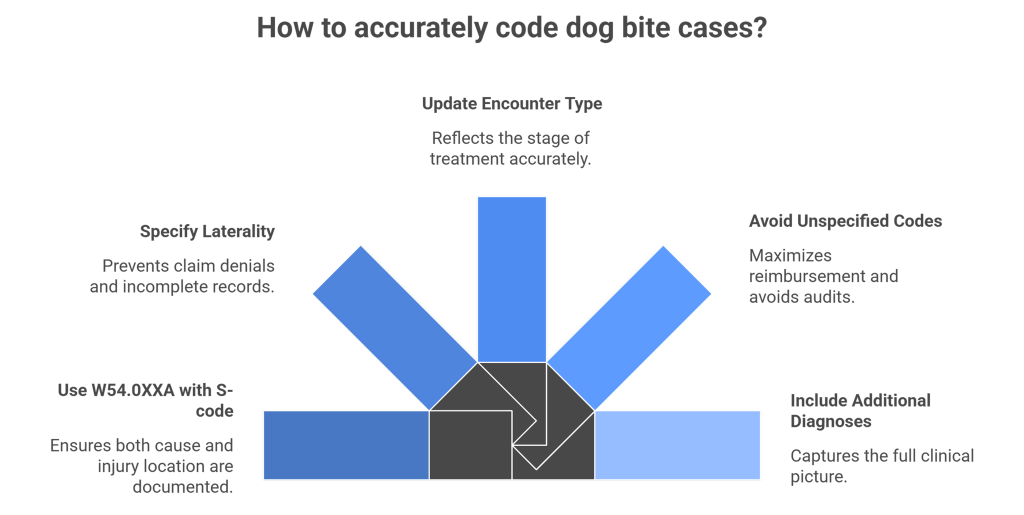
Using Only W54.0XXA: This is one of the biggest mistakes.
- Problem: W54.0XXA only explains cause, not injury location
- Solution: Always pair it with an S-code
Ignoring Laterality (Right vs Left): Failing to specify whether the injury occurred on the right or left side can lead to:
- Claim denials
- Incomplete records
Always choose codes like:
- Right hand → S61.451A
- Left hand → S61.452A
Not Updating Encounter Type: Using “A” for every visit is incorrect.
Correct approach: First visit (A), Follow-up (D), Complication (S). If your internal records show a pattern of using “Initial Encounter” codes for every follow-up visit, it could trigger a payer investigation. Medical coding audit services can help you spot these systemic errors across your patient charts, ensuring your team is using the correct 7th-character extensions to reflect the true stage of care and stay audit-ready.
Choosing Unspecified Codes: Unspecified codes should only be used when:
- Documentation is incomplete
- No specific code exists
Overusing them can:
- Reduce reimbursement
- Trigger audits
Missing Additional Diagnoses: Dog bites often involve more than just wounds.
Commonly missed codes:
- Infection
- Soft tissue damage
- Complications
Always review the full clinical picture before finalizing codes.
Summary
Accurate ICD-10 coding for dog bites requires a clear understanding of both external cause codes and injury-specific codes. While W54.0XXA identifies the cause, the real accuracy comes from selecting the correct body-part-specific S-code.
By following proper coding guidelines and using precise documentation, you can ensure faster claim approvals and full compliance. However, if you are currently facing a backlog of rejected injury claims, implementing specialized denial management services is the fastest way to recover that revenue. These specialists can dissect why a dog bite claim was rejected—whether for lack of medical necessity or a modifier error—and appeal the decision with the clinical documentation needed to win.
- Faster claim approvals
- Reduced denials
- Full compliance with ICD-10 standards
Whether you’re coding for hands, cheeks, forearms, or legs, this guide gives you everything you need to code dog bite cases accurately and confidently.