Every dermatology procedure performed, from a routine skin examination and biopsy to lesion destruction and Mohs surgery, must be supported by the correct CPT code to ensure accurate reimbursement. Yet, coding errors remain one of the most common reasons for claim denials, payment delays, compliance risks, and lost revenue in dermatology practices.
The challenge isn’t simply knowing a list of codes. Dermatology coding requires a clear understanding of procedure selection, documentation requirements, modifier usage, lesion measurements, and diagnosis-code linkage.
That’s why mastering Dermatology CPT Codes is essential for providers, medical coders, billers, and practice administrators who want to improve claim acceptance rates and optimize revenue cycle performance.
What Are Dermatology CPT Codes?
Dermatology CPT Codes are standardized medical billing codes used to report procedures, treatments, and services performed by dermatologists. CPT, which stands for Current Procedural Terminology, provides a universal language that allows healthcare providers, insurance companies, and government payers to accurately communicate the services delivered during a patient encounter.
These codes play a critical role in determining how claims are processed and reimbursed. Without proper coding, practices may face claim denials, delayed payments, compliance issues, and revenue loss.
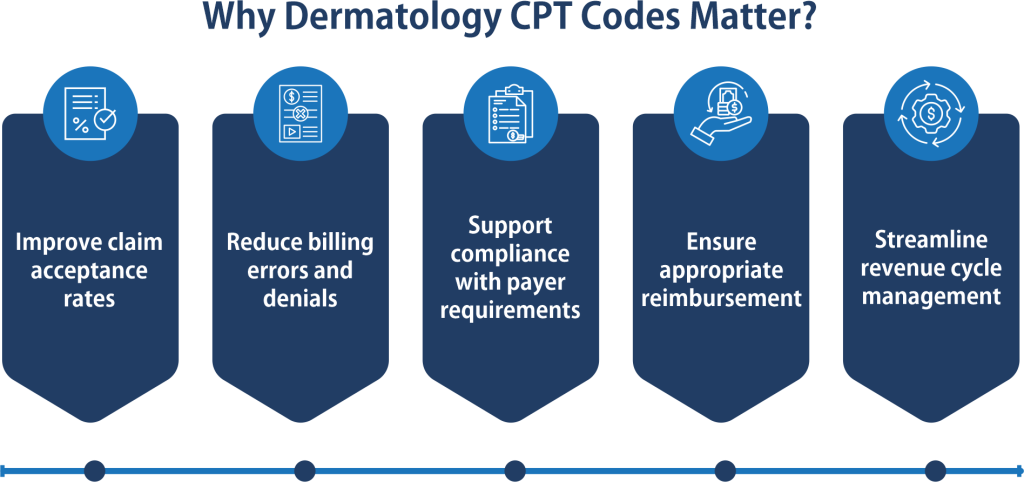
Why Dermatology CPT Codes Matter?
Accurate coding helps practices:
- Improve claim acceptance rates
- Reduce billing errors and denials
- Support compliance with payer requirements
- Ensure appropriate reimbursement
- Streamline revenue cycle management
As insurance regulations and documentation requirements continue to evolve, understanding Dermatology CPT Codes has become essential for providers, coders, billers, and practice managers alike.
How Dermatology CPT Codes Are Organized?
Dermatology encompasses a broad range of medical and surgical services. To simplify coding, CPT codes are categorized according to the type of service provided.
Evaluation and Management (E/M) Codes: These codes are used for patient office visits and consultations. They cover services such as patient evaluation, medical decision-making, treatment planning, and follow-up care.
Biopsy Codes: Biopsy codes are reported when tissue samples are collected for diagnostic evaluation. The selected code depends on the biopsy technique used.
Lesion Destruction Codes: These codes apply when lesions are removed through methods such as cryotherapy, laser treatment, electrosurgery, or chemical destruction.
Lesion Excision Codes: Excision codes are used when lesions are surgically removed with a scalpel, including surrounding margins when required.
Mohs Surgery Codes: Mohs surgery has its own dedicated code range because it combines surgical excision and microscopic tissue examination.
Repair and Closure Codes: When wound closure requires more than simple repair, additional CPT codes may be reported based on documentation.
Pathology and Laboratory Codes: These codes cover the examination and analysis of tissue specimens following biopsies and surgical procedures.
Most Common Dermatology CPT Codes Used in Daily Practice
Although dermatologists may use hundreds of procedure codes throughout the year, a small group of CPT codes accounts for a large percentage of patient encounters.
Office Visit CPT Codes
| CPT Code | Description |
| 99202 | New patient office visit |
| 99203 | New patient office visit |
| 99204 | New patient office visit |
| 99212 | Established patient office visit |
| 99213 | Established patient office visit |
| 99214 | Established patient office visit |
These codes are selected based on the complexity of medical decision-making and documentation.
Skin Biopsy CPT Codes
| CPT Code | Procedure |
| 11102 | Tangential biopsy, first lesion |
| 11103 | Additional tangential lesion |
| 11104 | Punch biopsy, first lesion |
| 11105 | Additional punch lesion |
| 11106 | Incisional biopsy, first lesion |
| 11107 | Additional incisional lesion |
Lesion Destruction CPT Codes
| CPT Code | Procedure |
| 17000 | First premalignant lesion |
| 17003 | Each additional lesion |
| 17004 | Fifteen or more lesions |
| 17110 | Benign lesion destruction (1–14 lesions) |
| 17111 | Benign lesion destruction (15+ lesions) |
Mohs Surgery CPT Codes
| CPT Code | Procedure |
| 17311 | First stage Mohs surgery |
| 17312 | Additional Mohs stages |
| 17313 | First stage on trunk, arms, or legs |
| 17314 | Additional stages |
These codes form the foundation of dermatology billing and are among the most frequently reported across dermatology practices.
Dermatology CPT Codes Cheat Sheet
Because dermatology billing often involves multiple procedures during a single patient encounter, having a quick-reference resource can significantly improve coding efficiency and reduce errors.
| Procedure | Common CPT Code |
| Established Patient Visit | 99213 |
| New Patient Visit | 99203 |
| Tangential Skin Biopsy | 11102 |
| Punch Biopsy | 11104 |
| Incisional Biopsy | 11106 |
| Destruction of First Actinic Keratosis | 17000 |
| Additional Actinic Keratosis | 17003 |
| Destruction of Benign Lesions (1–14) | 17110 |
| Destruction of Benign Lesions (15+) | 17111 |
| Benign Lesion Excision | 11400–11446 |
| Malignant Lesion Excision | 11600–11646 |
| Mohs Surgery First Stage | 17311 |
| Phototherapy Treatment | 96910 |
| Incision and Drainage of Abscess | 10060 |
Dermatology Modifier Cheat Sheet
Modifiers provide additional information about a procedure or service without changing the CPT code itself. In dermatology, modifiers are frequently used to clarify circumstances surrounding patient encounters and procedures.
Incorrect modifier usage can trigger claim denials, payment reductions, and payer audits.
Modifier 25: Modifier 25 indicates that a significant and separately identifiable Evaluation and Management (E/M) service was performed on the same day as a procedure.
Example: A dermatologist evaluates a suspicious lesion and performs a biopsy during the same visit.
Modifier 59: Modifier 59 identifies procedures that are separate and distinct from other services performed during the same encounter. It is commonly used when multiple procedures involve different lesions or anatomical locations.
Modifier 51: Modifier 51 indicates multiple procedures performed during the same operative session.
Modifier 24: Modifier 24 is used when an unrelated E/M service occurs during a postoperative period.
Modifier 57: Modifier 57 identifies an E/M service that results in the decision to perform surgery.
RT and LT Modifiers
These modifiers identify laterality.
- RT = Right side
- LT = Left side
Modifier Documentation Best Practices
To support modifier use, documentation should clearly identify:
- Medical necessity
- Distinct procedures performed
- Separate lesion locations
- Independent physician work
Strong documentation significantly reduces the likelihood of payer disputes.
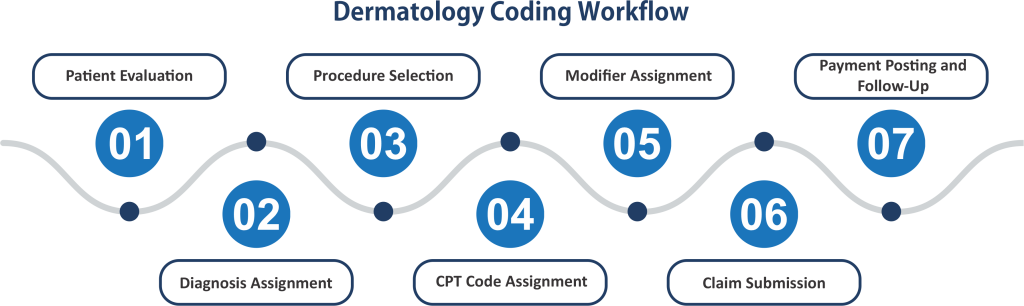
Dermatology Coding Workflow: From Patient Visit to Claim Submission
Successful dermatology billing follows a structured workflow. Understanding each step helps reduce coding errors, improve claim accuracy, and accelerate reimbursement.
Step 1: Patient Evaluation
The process begins with a patient encounter. During the visit, the dermatologist evaluates symptoms, reviews medical history, performs a physical examination, and develops a treatment plan.
At this stage, detailed clinical documentation is critical because all coding decisions will be based on the information recorded in the medical record.
Step 2: Diagnosis Assignment
Once the provider establishes a diagnosis, the appropriate ICD-10 code is assigned.
Examples may include:
- Psoriasis
- Acne
- Basal cell carcinoma
- Actinic keratosis
- Viral warts
Accurate diagnosis coding provides the medical necessity required for reimbursement.
Step 3: Procedure Selection
The next step involves identifying the services and procedures performed during the encounter.
Examples include:
- Office visits
- Biopsies
- Lesion destruction
- Excision procedures
- Mohs surgery
- Phototherapy
Each service must be supported by sufficient documentation.
Step 4: CPT Code Assignment
After identifying the procedure, the appropriate CPT code is selected based on:
- Procedure type
- Technique used
- Lesion size
- Anatomical location
- Number of lesions treated
Accurate code selection is essential for proper reimbursement.
Step 5: Modifier Assignment
If special circumstances apply, modifiers may be required to clarify the claim.
Examples include:
- Significant E/M services
- Multiple procedures
- Separate lesions
- Laterality indicators
Incorrect modifier use remains one of the most common causes of claim denials.
Step 6: Claim Submission
Once coding is complete, claims are submitted to the appropriate payer.
Before submission, billing teams should verify:
- CPT codes
- ICD-10 codes
- Modifiers
- Provider information
- Documentation completeness
Step 7: Payment Posting and Follow-Up
After claim adjudication, payments are posted and any denials or underpayments are reviewed.
A strong denial management process helps practices recover revenue and identify recurring coding issues that need correction.
Common Dermatology Coding Mistakes That Lead to Claim Denials
Even experienced coders can make mistakes that negatively impact reimbursement. Understanding the most common coding errors can help practices improve claim accuracy and reduce avoidable denials.
Incorrect Lesion Measurements
Many excision codes are selected based on lesion size. Failure to document accurate measurements can result in incorrect code selection and reimbursement issues.
Documentation should clearly include:
- Lesion diameter
- Margins removed
- Total excised diameter
Choosing the Wrong Procedure Code
A common error occurs when coders confuse:
- Biopsy vs. excision
- Excision vs. destruction
- Benign vs. malignant lesion removal
Each category has its own coding requirements and reimbursement rules.
Improper Modifier Usage
Modifiers are frequently overused, underused, or applied incorrectly.
Common issues include:
- Missing Modifier 25
- Inappropriate Modifier 59 usage
- Failure to document separate services
Payers closely scrutinize modifier usage, making proper documentation essential.
Incomplete Documentation
Insufficient documentation remains one of the leading causes of claim denials.
Missing details often include:
- Lesion size
- Procedure technique
- Anatomical location
- Medical necessity
If documentation does not support the service billed, reimbursement may be denied.
CPT and ICD-10 Mismatches
Claims are often rejected when diagnosis codes fail to support the reported procedure.
Before claim submission, practices should verify that every CPT code is linked to an appropriate diagnosis code.
Unbundling Errors
Some services are considered part of another procedure and cannot be billed separately.
Reporting bundled services independently can trigger:
- Claim denials
- Payment recoupments
- Compliance concerns
Regular coding audits can help identify and correct unbundling issues before claims are submitted.
Conclusion
From office visits and biopsies to lesion removal procedures and Mohs surgery, every service must be coded correctly and supported by detailed documentation. Understanding how CPT codes, ICD-10 diagnoses, and modifiers work together enables dermatology practices to submit cleaner claims, improve payment turnaround times, and strengthen overall revenue cycle performance.
By implementing proper coding workflows, conducting regular audits, and staying current with coding changes, providers and billing teams can reduce costly mistakes while ensuring that every service is reported accurately.