Denied claims can quietly drain a healthcare practice’s revenue, delay reimbursements, and create unnecessary administrative work. Among the most common payment issues providers face is the CO-16 denial code, a denial that indicates the claim is missing required information or contains errors that prevent proper claim processing.
While the denial may seem simple at first glance, the real challenge is identifying exactly what information is missing and how to correct it before timely filing deadlines become a bigger problem.
For providers, billing teams, and revenue cycle professionals, understanding the CO-16 denial code is essential for maintaining clean claims and protecting cash flow.
What Is the CO 16 Denial Code?
The CO 16 denial code means the claim contains missing, incomplete, or incorrect information required for claim adjudication. “CO” stands for Contractual Obligation, meaning the provider is responsible for correcting the issue before reimbursement can be processed.
In most cases, CO 16 denials are triggered by missing authorization numbers, invalid patient details, incorrect provider information, coding errors, or incomplete claim fields. This denial is commonly accompanied by a RARC (Remittance Advice Remark Code), which identifies the exact missing information.
Unlike claim rejections, CO 16 claims are received and processed by the payer, but cannot move forward until corrections are made.
| Term | Meaning |
| CO 16 | Missing or invalid claim information |
| Rejection | Claim not accepted for processing |
| Denial | Claim processed, but payment denied |
| Pending | Claim under payer review |
What Does “Claim Lacks Information” Actually Mean?
When a payer states that a claim lacks information, it means critical data required for payment is either missing, invalid, or inconsistent. Even small errors can trigger a CO 16 denial and delay reimbursement.
Common missing information includes:
- Patient demographics
- Subscriber ID numbers
- Prior authorization details
- Rendering provider NPI
- CPT or ICD-10 codes
- Required modifiers
- Referring physician information
For example, if a physical therapy claim is submitted without the required authorization number, the payer may deny the claim with a CO 16 code until the missing information is corrected and resubmitted.
Because the denial reason can vary by payer, reviewing the accompanying RARC code is essential for identifying the exact issue.
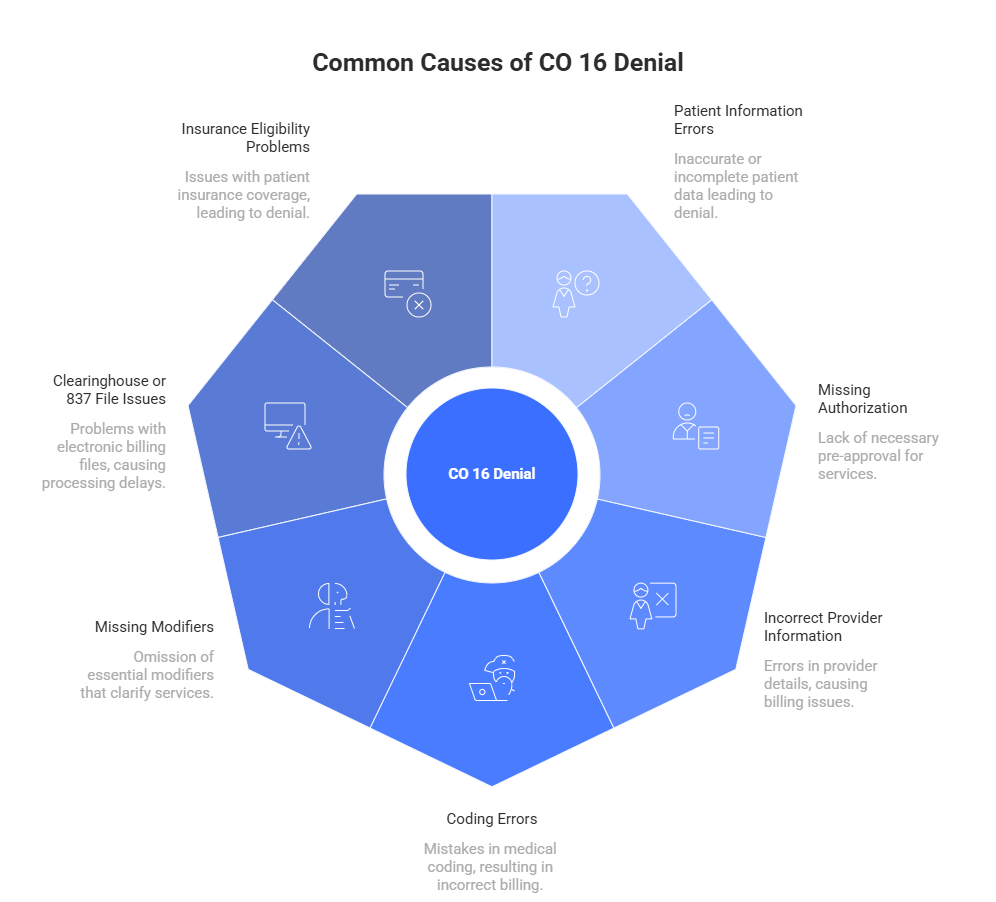
Common Causes of CO 16 Denial Code
Several billing and documentation issues can trigger a CO 16 denial. Identifying the root cause quickly helps reduce payment delays and avoid repeated denials.
Patient Information Errors: Incorrect patient names, dates of birth, or insurance IDs can cause claims to fail payer validation checks.
Missing Authorization: Many payers require prior authorization for specialty services, imaging, therapy, or procedures. Missing authorization numbers frequently trigger CO 16 denials.
Incorrect Provider Information: Invalid NPIs, taxonomy codes, or provider credentials can prevent proper claim processing.
Coding Errors: Incorrect CPT, HCPCS, or ICD-10 codes or mismatched diagnosis and procedure combinations may result in missing information denials.
Missing Modifiers: Certain procedures require modifiers to clarify billing circumstances. Omitting them can lead to claim denials.
Clearinghouse or 837 File Issues: Formatting problems during electronic claim submission may remove or alter required claim data before it reaches the payer.
Insurance Eligibility Problems: Inactive coverage or incorrect payer selection can also generate CO 16 denials during adjudication.
CO 16 Denial Code and RARC Codes
A CO 16 denial alone does not explain the exact problem with the claim. Payers typically include a RARC (Remittance Advice Remark Code) to identify the missing or invalid information causing the denial.
Understanding the accompanying RARC code helps billing teams resolve denials faster and avoid unnecessary resubmissions.
| RARC Code | Meaning | Recommended Fix |
| M51 | Missing provider ID | Add correct NPI or provider details |
| N290 | Missing rendering provider NPI | Update rendering provider information |
| MA27 | Missing provider address | Correct billing address on claim |
| N56 | Procedure code invalid | Review CPT/HCPCS coding |
| M15 | Missing authorization number | Add prior authorization information |
For accurate denial resolution, always review both the CO 16 denial code and the associated RARC code on the ERA or EOB.
Difference Between CO 16 and Other Denial Codes
CO 16 is often confused with other denial codes that also impact reimbursement. However, each denial has a different cause and resolution process.
| Denial Code | Meaning | Typical Resolution |
| CO 16 | Missing or invalid information | Correct and resubmit claim |
| CO 18 | Duplicate claim | Verify claim history before rebilling |
| CO 50 | Lack of medical necessity | Submit documentation or appeal |
| CO 97 | Service included in another procedure | Review bundling and modifiers |
| CO 109 | Claim not covered by payer | Verify insurance coverage |
Understanding these differences helps providers avoid incorrect appeals and reduce unnecessary billing delays.
How to Fix the CO 16 Denial Code?
Fixing a CO 16 denial requires identifying the missing or incorrect information on the claim and correcting it before resubmission. Following a structured process can help providers reduce delays and improve reimbursement success rates.
Step 1: Review the Denial Details Carefully
Start by reviewing the Explanation of Benefits (EOB) or Electronic Remittance Advice (ERA). CO 16 alone does not explain the exact issue, so check the accompanying RARC code for detailed denial information.
This step helps identify whether the problem involves:
- Missing authorization
- Invalid patient details
- Incorrect provider information
- Coding errors
- Missing modifiers
Step 2: Identify the Missing or Incorrect Information
Once the denial reason is clear, locate the exact field causing the issue. Compare the submitted claim with the patient record, payer requirements, and supporting documentation.
Common areas to review include:
- Patient demographics
- Insurance ID numbers
- Rendering provider NPI
- CPT and ICD-10 codes
- Referral or authorization numbers
- Billing modifiers
Even a small typo or missing field can trigger a CO 16 denial.
Step 3: Verify Insurance Eligibility and Authorization
Confirm that the patient’s insurance coverage was active on the date of service and verify whether prior authorization or referrals were required.
If authorization is missing:
- Contact the payer
- Obtain the correct authorization details
- Update the claim accordingly
Missing authorization numbers are one of the most common causes of CO 16 denials.
Step 4: Correct Coding and Provider Information
Review all coding and provider details for accuracy. Ensure that:
- CPT and ICD-10 codes match the documented services
- Required modifiers are included
- NPI and taxonomy codes are valid
- Referring or rendering provider details are complete
Incorrect coding combinations or incomplete provider information can prevent proper claim adjudication.
Step 5: Attach Supporting Documentation
Some payers require additional documents before processing claims. Include any missing records that support medical necessity or claim validation.
Supporting documents may include:
- Authorization approvals
- Physician referrals
- Medical records
- Operative notes
- Treatment plans
Submitting complete documentation reduces the risk of repeated denials.
Step 6: Submit a Corrected Claim
After making corrections, resubmit the claim using the payer’s corrected claim process. Many payers require a corrected claim frequency code, such as Frequency Code 7, to identify the submission as a replacement claim.
Before resubmission:
- Double-check all corrected fields
- Ensure attachments are included
- Verify payer-specific submission rules
Step 7: Monitor Claim Status and Follow Up
Track the corrected claim after submission to confirm that the payer processes it successfully. Delayed follow-up can result in missed timely filing deadlines and further payment delays.
If the claim is denied again:
- Review the updated denial reason
- Contact the payer if clarification is needed
- Escalate the issue through appeal only when appropriate
Consistent monitoring helps providers reduce recurring denials and maintain healthier cash flow.
Corrected Claim vs Appeal for CO 16
Most CO 16 denials require a corrected claim rather than a formal appeal. Since the denial is usually caused by missing or invalid information, providers must fix the issue and resubmit the claim for processing.
An appeal is generally necessary only when the payer incorrectly denied a clean claim or processed the claim inaccurately.
| Situation | Recommended Action |
| Missing authorization number | Corrected claim |
| Invalid patient information | Corrected claim |
| Missing modifier | Corrected claim |
| Payer processed claim incorrectly | Appeal |
| Incorrect denial issued by payer | Appeal |
When submitting a corrected claim, many payers require a corrected claim frequency code, such as Frequency Code 7, to indicate the claim is being resubmitted with corrections.
Providers should also monitor timely filing limits because delayed corrections may result in permanent claim denial.
How CO 16 Impacts Revenue Cycle Management?
CO 16 denials can create major disruptions across the revenue cycle if not resolved quickly. Even small claim errors can delay payments, increase administrative workload, and reduce overall financial performance.
Common impacts include:
- Delayed reimbursements
- Increased accounts receivable days
- Higher denial management costs
- Additional staff rework
- Reduced clean claim rates
- Lower cash flow stability
Repeated CO 16 denials may also indicate weaknesses in front-end registration, coding accuracy, eligibility verification, or claim submission workflows. Monitoring denial trends can help healthcare organizations identify operational gaps before they affect revenue at scale.
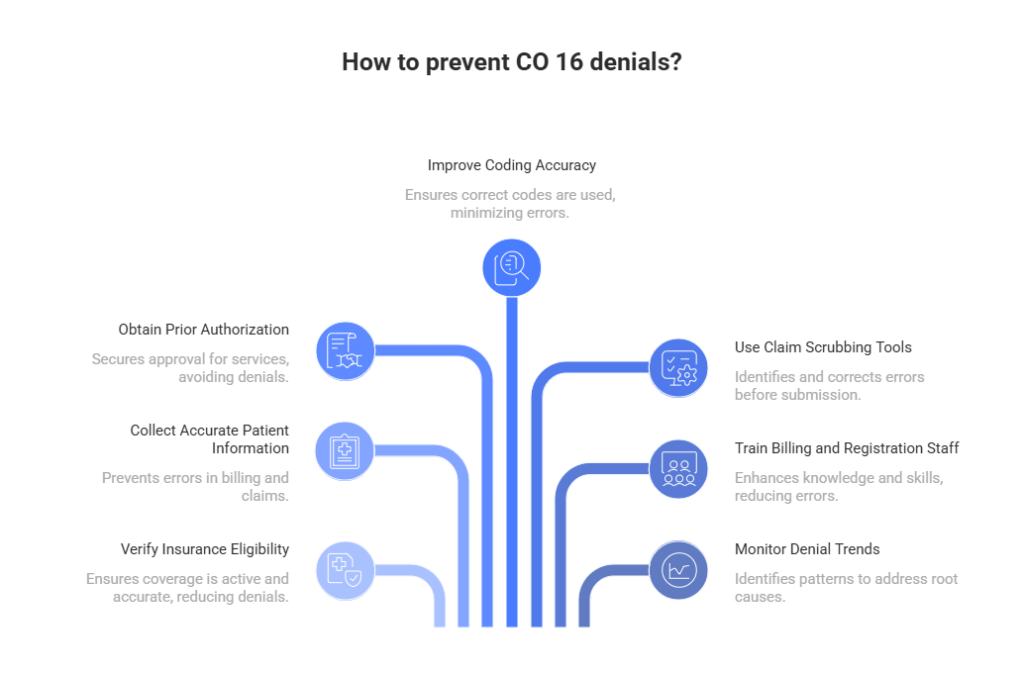
How to Prevent CO 16 Denials
Preventing CO 16 denials starts with improving claim accuracy before submission. Strong front-end processes and consistent claim validation can significantly reduce missing information errors.
Verify Insurance Eligibility: Confirm active coverage, payer requirements, and patient benefits before services are provided.
Collect Accurate Patient Information: Double-check demographics, subscriber IDs, and insurance details during registration.
Obtain Prior Authorization: Ensure required authorizations and referrals are secured before treatment.
Improve Coding Accuracy: Review CPT, HCPCS, ICD-10 codes, and modifiers to ensure claims meet payer guidelines.
Use Claim Scrubbing Tools: Automated claim scrubbing software can identify missing fields and formatting issues before submission.
Train Billing and Registration Staff: Regular staff education helps reduce repetitive errors and improve clean claim performance.
Monitor Denial Trends: Track recurring CO 16 denials by payer, provider, or department to identify root causes and improve workflows.
A proactive denial prevention strategy not only reduces administrative burden but also improves reimbursement speed and overall revenue cycle efficiency.
Department-Wise Responsibility for CO 16 Denials
Reducing CO 16 denials requires coordination across multiple departments. Since these denials are often caused by missing or inaccurate information, every stage of the revenue cycle plays a role in prevention.
| Department | Responsibility |
| Front Desk | Collect accurate patient demographics and insurance details |
| Eligibility Team | Verify active coverage and payer requirements |
| Authorization Team | Obtain referrals and prior authorizations |
| Coding Team | Ensure accurate CPT, HCPCS, ICD-10 codes, and modifiers |
| Billing Team | Review claim completeness before submission |
| Credentialing Team | Maintain updated provider NPI and enrollment records |
| Providers | Document services accurately and completely |
Assigning accountability to each department helps reduce recurring denials and improves clean claim rates.
CO 16 Denial Examples
Understanding real denial scenarios can help providers identify issues faster and prevent future claim errors.
Example 1: Missing Authorization Number
A radiology claim was denied because the required prior authorization number was not included on the claim form.
Fix: The billing team obtained the authorization details and submitted a corrected claim.
Example 2: Invalid Subscriber ID
A patient’s insurance ID was entered incorrectly during registration, causing the payer to reject claim processing.
Fix: Staff corrected the subscriber information and resubmitted the claim.
Example 3: Missing Rendering Provider NPI
A behavioral health claim was submitted without the rendering provider’s NPI.
Fix: The provider information was updated and the corrected claim was accepted.
Example 4: Missing Modifier
A procedure required a modifier to indicate distinct services, but the modifier was omitted.
Fix: The coding team added the appropriate modifier and resubmitted the claim.
These examples highlight how small billing mistakes can lead to payment delays and additional administrative work.
Specialty-Specific CO 16 Denials
Certain specialties experience CO 16 denials more frequently due to payer-specific documentation and authorization requirements.
Behavioral Health: Common issues include missing rendering provider information, authorization errors, and incomplete documentation.
Physical Therapy: Denials often occur because of missing plan-of-care details, authorization numbers, or therapy modifiers.
Radiology: Imaging claims may be denied for missing medical necessity documentation or prior authorization information.
DME Billing: Durable medical equipment claims frequently require supporting documentation, physician orders, and detailed modifiers.
Cardiology: Incorrect procedure coding, missing referrals, and incomplete diagnostic information commonly trigger denials.
Best Practices to Reduce CO 16 Denials
Reducing CO 16 denials requires a proactive approach focused on claim accuracy, staff accountability, and payer compliance. Small workflow improvements can significantly reduce denial rates and improve reimbursement timelines.
Implement Real-Time Eligibility Verification: Verify insurance coverage, policy status, and payer requirements before each patient visit.
Standardize Patient Intake: Use structured registration workflows to reduce demographic and insurance entry errors.
Strengthen Authorization Workflows: Track authorization requirements by payer and confirm approvals before services are performed.
Perform Regular Coding Audits: Review claims for coding accuracy, modifier usage, and documentation completeness before submission.
Use Automated Claim Scrubbing: Claim scrubbing software can detect missing fields, invalid codes, and formatting issues prior to claim transmission.
Monitor Denial Analytics: Track denial trends by payer, provider, location, and denial reason to identify recurring problems.
Final Thoughts
The CO 16 denial code is one of the most common claim denials in medical billing, but it is also one of the most preventable. Missing patient information, authorization issues, coding mistakes, and incomplete claim details can quickly disrupt cash flow and increase administrative workload if not addressed early in the billing process.
By strengthening eligibility verification, improving coding accuracy, standardizing claim review workflows, and monitoring denial trends, providers can significantly reduce CO-16 denials and improve clean claim performance. A proactive denial management strategy not only accelerates reimbursements but also helps healthcare organizations maintain a healthier and more efficient revenue cycle.