Radiology CPT codes are the backbone of accurate medical billing, helping healthcare providers document and get reimbursed for imaging procedures like X-rays, CT scans, MRIs, and ultrasounds. Whether you’re a medical coder, billing specialist, or healthcare provider, understanding these codes isn’t just helpful; it’s essential for avoiding claim denials and maximizing revenue.
In this guide, you’ll discover everything you need to know about radiology CPT codes, including their complete range (70010–79999), commonly used codes, detailed descriptions, and step-by-step lookup methods.
What Are Radiology CPT Codes?
Radiology CPT codes are standardized procedure codes used to describe medical imaging services performed for diagnostic or therapeutic purposes. These codes are part of the broader Current Procedural Terminology (CPT) system developed by the American Medical Association (AMA), ensuring uniform communication between healthcare providers, insurers, and billing professionals.
Each code corresponds to a specific service, helping providers accurately document what was performed and ensuring proper reimbursement. However, managing these codes manually is a high-risk task. Many practices utilize expert medical billing services to automate the alignment of CPT codes with clinical documentation, ensuring that every X-ray or MRI is billed at the correct level of complexity to avoid under-coding and revenue leakage.
In radiology, CPT codes represent a wide range of imaging services, including X-rays, computed tomography (CT), magnetic resonance imaging (MRI), ultrasound, and nuclear medicine procedures. Each code corresponds to a specific service, helping providers accurately document what was performed and ensuring proper reimbursement.
Radiology CPT codes are typically divided into categories such as diagnostic radiology, interventional radiology, nuclear medicine, and radiation oncology. Understanding these categories is crucial because even small coding errors can lead to claim denials, compliance issues, or revenue loss.
Radiology CPT Codes Range (70010–79999)
The radiology CPT codes fall within a specific numerical range: 70010 to 79999. This range covers all imaging-related procedures, from basic diagnostic X-rays to advanced nuclear medicine and radiation therapy services.
Diagnostic Radiology Codes (70010–76499)
These codes include standard imaging procedures such as X-rays, CT scans, and MRIs used for diagnosing medical conditions. They represent the most commonly used radiology CPT codes in clinical practice.
Diagnostic Ultrasound Codes (76506–76999)
This category covers ultrasound procedures used to visualize internal organs, monitor pregnancies, and assess soft tissues without radiation exposure.
Radiologic Guidance Codes (77001–77032)
These codes are used when imaging is performed to guide other procedures, such as biopsies, catheter placements, or injections.
Mammography Codes (77046–77067)
These codes specifically relate to breast imaging procedures, including both screening and diagnostic mammograms.
Bone and Joint Studies (77071–77092)
These include specialized imaging techniques used to evaluate bone density, joint alignment, and skeletal abnormalities.
Radiation Oncology Codes (77261–77999)
This range includes codes for radiation therapy planning and treatment, commonly used in cancer care.
Nuclear Medicine Codes (78000–79999)
These codes cover advanced imaging techniques that use radioactive materials to diagnose and treat diseases, such as PET scans and thyroid imaging.
This range covers all imaging-related procedures, from basic diagnostic X-rays to advanced nuclear medicine. Because radiology has unique requirements—such as the “Professional” vs. “Technical” component split—many imaging centers choose specialized radiology billing services. These specialists understand the nuances of the 70010–79999 range, ensuring that modifiers are applied correctly so both the facility and the radiologist are paid accurately for their respective roles.
Radiology CPT Codes List
To better understand how radiology CPT codes are used in real-world scenarios, here’s a list of some common radiology CPT codes along with their descriptions:
1. Chest & Thoracic Imaging Codes
| CPT Code | Description | When It’s Used |
| 71045 | Chest X-ray, single view | Routine chest evaluation, infections |
| 71046 | Chest X-ray, two views | More detailed lung and heart analysis |
| 71047 | Chest X-ray, three views | Complex diagnostic cases |
| 71250 | CT thorax without contrast | Lung disease, trauma |
| 71260 | CT thorax with contrast | Tumors, vascular conditions |
These are among the most common radiology CPT codes used in emergency and outpatient settings.
2. Spine & Musculoskeletal Imaging Codes
| CPT Code | Description | When It’s Used |
| 72040 | Cervical spine X-ray | Neck pain, injury |
| 72100 | Lumbar spine X-ray | Lower back pain |
| 72148 | MRI lumbar spine without contrast | Disc issues, nerve compression |
| 72158 | MRI lumbar spine with contrast | Tumors, infections |
| 77073 | Bone length studies | Orthopedic assessments |
3. Abdominal & Pelvic Imaging Codes
| CPT Code | Description | When It’s Used |
| 74018 | Abdominal X-ray (KUB) | Kidney stones, bowel obstruction |
| 74176 | CT abdomen without contrast | Acute abdominal pain |
| 74177 | CT abdomen & pelvis with contrast | Tumors, infections |
| 76856 | Pelvic ultrasound (non-obstetric) | Reproductive organ evaluation |
| 76830 | Transvaginal ultrasound | Detailed pelvic imaging |
4. Brain & Head Imaging Codes
| CPT Code | Description | When It’s Used |
| 70450 | CT head without contrast | Trauma, stroke |
| 70460 | CT head with contrast | Tumor detection |
| 70551 | MRI brain without contrast | Neurological disorders |
| 70553 | MRI brain with and without contrast | Advanced diagnostics |
| 70150 | Skull X-ray | Fractures, abnormalities |
5. Breast Imaging (Mammography) Codes
| CPT Code | Description | When It’s Used |
| 77065 | Diagnostic mammography (unilateral) | Breast abnormalities |
| 77066 | Diagnostic mammography (bilateral) | Further evaluation |
| 77067 | Screening mammography | Routine cancer screening |
| 77049 | Breast MRI with contrast | High-risk patients |
6. Ultrasound Imaging Codes
| CPT Code | Description | When It’s Used |
| 76700 | Complete abdominal ultrasound | Liver, kidneys, pancreas |
| 76705 | Limited abdominal ultrasound | Focused evaluation |
| 76881 | Extremity ultrasound | Soft tissue injuries |
| 76536 | Thyroid ultrasound | Nodules, enlargement |
7. Nuclear Medicine & Advanced Imaging Codes
| CPT Code | Description | When It’s Used |
| 78014 | Thyroid uptake imaging | Thyroid disorders |
| 78306 | Bone scan (whole body) | Cancer spread detection |
| 78815 | PET scan (tumor imaging) | Oncology diagnostics |
| 78452 | Myocardial perfusion imaging | Heart disease |
Diagnostic Radiology CPT Codes Explained
Diagnostic radiology CPT codes are used to identify imaging procedures performed to diagnose medical conditions. These codes fall within the range 70010–76499 and represent some of the most frequently used services in healthcare.
These procedures allow physicians to detect, monitor, and evaluate diseases without invasive surgery. Common modalities under diagnostic radiology include:
- X-rays: Used for bones, chest, and basic imaging
- CT scans (Computed Tomography): Provide detailed cross-sectional images
- MRI (Magnetic Resonance Imaging): Offers high-resolution images of soft tissues
For example, a patient experiencing chronic lower back pain may undergo an MRI, which would be billed using a diagnostic radiology CPT code like 72148.
These codes are critical because they directly impact diagnosis accuracy and treatment planning. Proper use ensures healthcare providers receive reimbursement while maintaining compliance with insurance requirements.
How to Perform Radiology CPT Codes Lookup
Performing an accurate radiology CPT codes lookup is essential for correct billing and avoiding costly claim denials. Whether you’re a beginner or an experienced coder, following a structured approach can save time and improve accuracy.
Methods to Lookup Radiology CPT Codes
- AMA CPT Manual: The official and most reliable source
- Online Coding Platforms: AAPC, CMS tools
- EHR/Medical Billing Software: Built-in lookup features
Step-by-Step Lookup Process
- Identify the Procedure: Understand what imaging service was performed
- Determine the Modality: X-ray, CT, MRI, ultrasound, etc.
- Check Code Range: Locate the correct section (70010–79999)
- Review Code Description: Match details like contrast, views, or body parts
- Apply Modifiers if Needed: Such as 26 (professional component) or TC (technical component)
Using a reliable lookup method ensures compliance, minimizes errors, and speeds up the reimbursement process.
Common Radiology CPT Codes Used in Billing
Some radiology CPT codes are used far more frequently than others due to the high demand for certain imaging procedures. Knowing these common radiology CPT codes can significantly improve efficiency in medical billing.
Frequently Used Codes
- 71045: Chest X-ray (single view)
- 72148: MRI lumbar spine without contrast
- 74177: CT abdomen and pelvis with contrast
- 77067: Screening mammography (bilateral)
These procedures are commonly ordered in emergency care, routine checkups, and chronic disease management. Because of their high volume, even small coding errors can lead to substantial revenue loss over time.
By mastering these frequently used codes, coders can streamline workflows and reduce claim rejections.
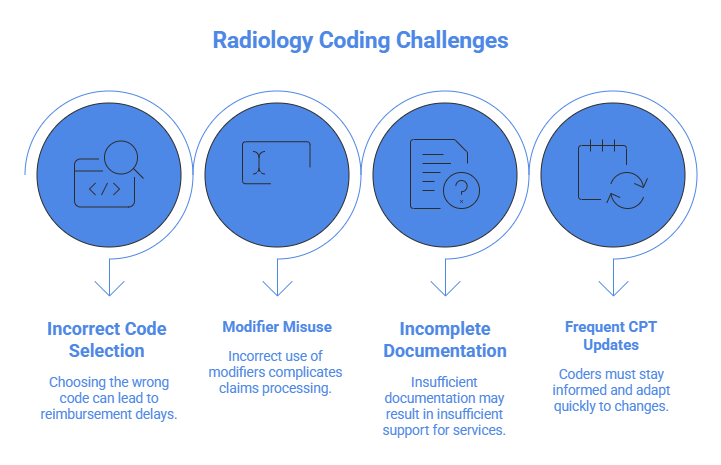
Challenges in Radiology Coding & Billing
Radiology coding may seem straightforward, but it comes with several challenges that can impact reimbursement and compliance.
- Incorrect Code Selection: Choosing the wrong code for a procedure
- Modifier Misuse: Improper use of modifiers like 26 or TC
- Incomplete Documentation: Missing details about contrast, views, or technique
- Frequent CPT Updates: Annual changes that require continuous learning
Even minor mistakes can result in denied claims, delayed payments, or audits. If your practice is frequently flagged for “modifier misuse” or “incomplete documentation,” it is a signal that your revenue cycle is at risk. Professional medical coding audit services can perform a deep dive into your high-volume CPT codes (like 71045 or 74177) to identify systemic errors before they trigger a formal payer investigation or recoupment request.
Tips for Accurate Radiology CPT Coding
Improving accuracy in radiology CPT coding doesn’t require guesswork; it requires consistency, knowledge, and the right tools.
Best Practices
- Stay updated with annual CPT code revisions
- Always verify medical necessity
- Use correct modifiers (26, TC) when applicable
- Cross-check codes with clinical documentation
- Leverage coding software and tools
- Implement robust denial management services. Coding errors are inevitable, but they don’t have to be permanent. A dedicated denial management team can analyze why a specific CPT code was rejected—whether due to a missing modifier or a lack of medical necessity—and appeal the claim with the clinical evidence needed to secure your reimbursement.
Following these best practices helps reduce errors, improve compliance, and maximize reimbursement.
Conclusion
Radiology CPT codes play a vital role in modern healthcare, ensuring that imaging procedures are accurately documented, billed, and reimbursed. From understanding the full code range (70010–79999) to mastering common and advanced procedures, having a solid grasp of these codes is essential for medical coders, billers, and healthcare providers alike.
By using proper lookup methods, staying updated with coding changes, and following best practices, you can significantly reduce errors, improve claim approval rates, and optimize revenue cycles.
Whether you’re just starting out or looking to refine your expertise, mastering radiology CPT codes is a valuable step toward success in medical billing and coding.