
Why are medical claims still refused, even when healthcare services are properly given and documented? In 2026, healthcare systems reported an average initial claim denial rate of 10% to 15%, depending on specialty, payer requirements, and billing tasks. Despite developments in electronic health records and billing systems, denials remain a common problem in hospitals and medical offices due to unnecessary administrative and coding gaps.
For healthcare providers, billing teams, and revenue cycle specialists, the financial effect is enormous. Recent standard practices for 2026 state that the cost of reworking a single denied claim ranges between $25 and $181, depending on claim complexity and payer criteria. Large healthcare organizations continue to lose revenue each year due to some avoidable issues, such as eligibility problems, prior authorization gaps, and coding mismatches, rather than actual coverage constraints.
This blog covers the most common denial challenges and ways to avoid them in practical healthcare billing contexts. It also explains where errors occur in the revenue cycle and how structured controls can reduce denial rates.
What are the Reasons Medical Claims Get Denied, and what are the preventions
Medical claim denials continue to disrupt revenue cycle performance across healthcare systems. This section explains why denial patterns are increasing and how they affect billing accuracy, reimbursement flow, and administrative workload. It also connects denial causes with real operational gaps in healthcare billing workflows.
Why claim denials are increasing in 2026
Why are medical claims facing higher rejection rates even with improved electronic billing systems in place? In 2026, denial rates remain between 10% and 15%, driven by stricter payer rules and higher documentation requirements. Automated claim edits and real-time payer checks are also increasing rejection points at submission.
Insurance payers now use advanced rule-based systems to detect coding mismatches and eligibility gaps. Small errors in CPT, ICD, or HCPCS coding are flagged instantly. This increases front-end rejections before claims even reach full adjudication.
Healthcare teams are also dealing with frequent policy updates across Medicare, Medicaid, and commercial insurers. Prior authorization rules and medical necessity checks are stricter. These changes reduce tolerance for incomplete or inconsistent claim data.
Financial and operational impact of denials
What happens to healthcare operations when claim denials increase across departments? In 2026, the cost to rework a single denied claim ranges from $25 to $181, depending on complexity and payer requirements. This creates direct pressure on revenue cycle performance.
Denials also increase accounts receivable days and delay cash inflow. Billing teams spend more time correcting errors instead of processing new claims. This reduces overall operational efficiency in healthcare organizations.
High denial rates also increase workload for coding and billing staff. Rework cycles grow longer, and appeals require additional documentation. Over time, this leads to revenue leakage and reduced financial predictability for healthcare providers.
Understanding Claim Denials vs Rejections in Medical Billing
Medical claim processing errors are often misclassified, which leads to incorrect correction steps and delayed reimbursement. This section explains the difference between claim rejections and denials and how each affects the revenue cycle. It also connects both terms to the Top 10 Reasons Medical Claims Get Denied and How to Prevent Them, so billing teams can apply the correct correction workflow.
Claim rejection vs claim denial
What is the difference between a claim rejection and a claim denial in medical billing workflows? A claim rejection occurs before payer adjudication when basic errors are detected, such as missing patient data, invalid insurance details, or formatting issues. These claims never enter the payer’s payment system and are returned to the provider for correction.
A claim denial occurs after the payer reviews and processes the claim but decides not to pay it. Common reasons include medical necessity issues, coding mismatches, or policy limitations. These claims require formal correction, documentation updates, or appeal processes.
Rejections are usually faster to fix and involve front-end corrections. Denials require more time and often involve clinical or coding justification. Understanding this difference improves claim follow-up accuracy and reduces revenue delays.
Preventable vs non-preventable denials
Which claim denials can be prevented in healthcare billing operations? Preventable denials occur due to errors in eligibility verification, coding accuracy, prior authorization, or documentation gaps. These issues can be reduced through structured billing workflows and proper data checks before submission.
Non-preventable denials occur due to payer policy limitations, benefit exclusions, or coverage restrictions. These are not caused by billing errors but by plan design or contractual rules between providers and insurers.
Most revenue cycle losses are linked to preventable denials. Focusing on eligibility checks, coding validation, and documentation accuracy helps reduce avoidable claim rework. This improves clean claim rates and supports faster reimbursement cycles.
Top 10 Reasons Medical Claims Get Denied
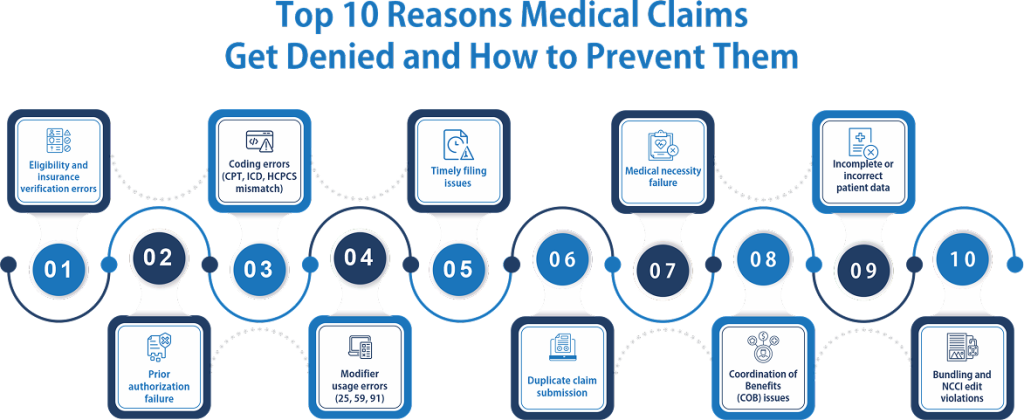
Medical claim denials occur due to repeated breakdowns in eligibility, coding, documentation, and payer rule compliance. This section explains the Top 10 Reasons Medical Claims Get Denied and How to Prevent Them, with clear operational fixes used in healthcare billing workflows.
Each denial reason is directly linked to real-world revenue cycle errors. The focus is on identifying the cause and applying structured preventive steps before claim submission.
1. Eligibility and insurance verification errors
Claims are denied when insurance coverage is inactive, incorrect, or not verified before service delivery. Proper medical billing services ensure eligibility checks are completed before claim submission, reducing avoidable front-end denials. These errors occur at the registration stage and directly impact claim acceptance.
1. Inactive or expired insurance coverage
2. Missing coordination of benefits (COB)
3. Incorrect payer information at intake
2. Prior authorization failure
Many procedures require payer approval before services are performed. In many cases, missing or outdated medical credentialing services records can also prevent prior authorization approval from being successfully processed. Missing authorization leads to automatic denial after claim submission.
1. No prior authorization obtained
2. Incorrect authorization number entered
3. Service not matching approved procedure
3. Coding errors (CPT, ICD, HCPCS mismatch)
Incorrect or mismatched coding between diagnosis and procedure results in claim rejection. Regular medical billing and coding audit services help detect these mismatches before claims are submitted. This is one of the most common preventable rejection causes.
1. CPT code not aligned with the ICD diagnosis
2. Missing specificity in ICD coding
3. Incorrect HCPCS selection
4. Modifier usage errors (25, 59, 91)
Improper modifier use leads to many conflicts and claim rejection concerns. When these errors occur, denial management services help resolve and recover affected claims efficiently. These errors are common during coding review.
1. Missing required modifier
2. Incorrect modifier selection
3. Wrong use of 25, 59, or 91
5. Timely filing issues
Claims submitted after payer deadlines are denied automatically, regardless of clinical accuracy. Each payer has strict filing limits.
1. Late claim submission
2. Missing filing deadline tracking
3. Delayed billing workflow
6. Duplicate claim submission
Submitting the same claim more than once creates system conflicts and automatic denials. This usually happens due to a lack of claim tracking.
1. Re-submission of already processed claims
2. System posting errors
3. Manual billing duplication
7. Medical necessity failure
Claims are denied when documentation does not support the clinical need for services. Payers require clear justification.
1. Incomplete clinical documentation
2. Missing treatment justification
3. Lack of supporting diagnosis details
8. Coordination of Benefits (COB) issues
Incorrect payer sequencing causes claim rejection when multiple insurance plans exist. COB errors delay reimbursement.
1. Wrong primary payer selection
2. Missing secondary insurance details
3. Outdated insurance coordination data
Verify COB information during patient intake and update the payer order correctly.
9. Incomplete or incorrect patient data
Errors in demographic or insurance details lead to claim rejection before processing. These are front-end administrative errors.
1. Incorrect patient name or DOB
2. Wrong insurance ID entry
3. Missing contact or address details
10. Bundling and NCCI edit violations
Claims are denied when procedures are incorrectly bundled or violate coding edit rules. These errors occur during coding review.
1. Unbundled procedure coding
2. NCCI edit conflicts
3. Incorrect service combination
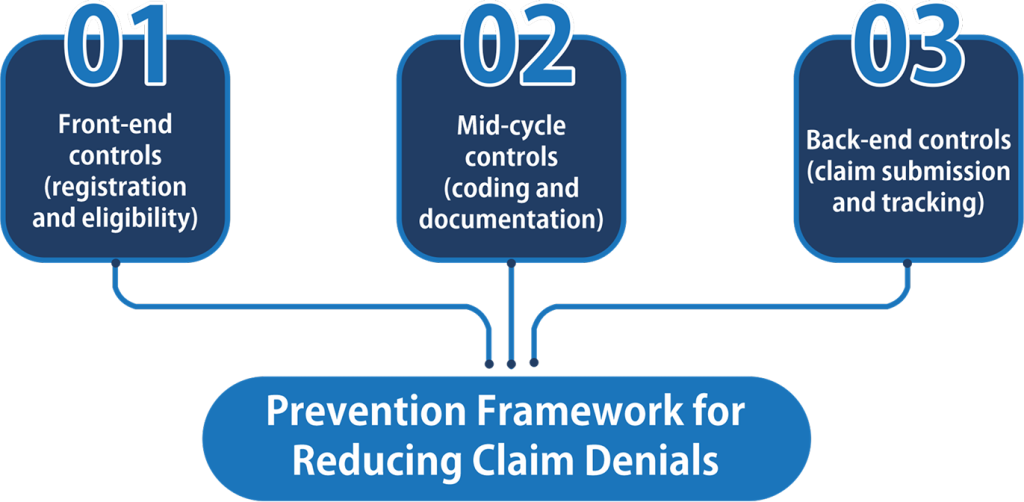
Prevention Framework for Reducing Claim Denials
Medical claim denials can be reduced through structured controls applied at each stage of the revenue cycle. This section explains a practical prevention framework used by healthcare providers, billing specialists, and compliance teams. It focuses on reducing errors before claim submission rather than correcting them after denial.
A strong prevention system improves clean claim rates and reduces administrative rework. It also helps healthcare organizations maintain a consistent reimbursement flow. The framework below corresponds to common failure areas identified in eligibility, coding, documentation, and payer rule validation.
Front-end controls (registration and eligibility)
Front-end controls focus on verifying patient and insurance details before services are delivered. Most preventable denials begin at this stage due to incomplete or incorrect intake data.
- Real-time eligibility verification before appointment confirmation
- Accurate patient demographic and insurance entry
- Coordination of benefits (COB) confirmation at registration
Mid-cycle controls (coding and documentation)
Mid-cycle controls focus on clinical documentation and coding accuracy before claim generation. Errors at this stage often lead to payer denials related to medical necessity and coding mismatches.
- CPT, ICD, and HCPCS code validation against clinical notes
- Documentation review for medical necessity support
- Correct modifier application based on payer guidelines
Back-end controls (claim submission and tracking)
Back-end controls focus on claim submission accuracy and post-submission monitoring. This stage ensures claims are transmitted correctly and tracked for payer response.
- Claim scrubbing before submission to detect errors
- Electronic claim tracking for acceptance and rejection status
- Denial monitoring and correction workflow setup
Conclusion
Medical claim denials continue to impact revenue cycle performance due to avoidable errors in eligibility, coding, documentation, and payer rule compliance. Most of these issues can be reduced with structured workflows and consistent verification at each stage of the billing process.
A strong prevention approach improves clean claim rates, reduces accounts receivable delays, and supports faster reimbursement. A solid preventative strategy increases clean claim rates, reduces accounts receivable delays, and promotes speedier reimbursement. Healthcare providers, billing teams, and coders can limit revenue loss by using correct coding, timely eligibility checks, and daily routine monitoring.
FAQs
What are the most common reasons medical claims get denied?
The most common reasons include eligibility errors, prior authorization failure, coding mistakes, modifier issues, and missing or incomplete documentation. These errors often occur during registration, coding, or claim submission stages.
What is the difference between a claim denial and a rejection?
A claim rejection occurs before payer processing due to basic errors, such as missing or incorrect data. A claim denial occurs after processing when the payer refuses payment due to coverage, coding, or medical necessity issues.
How can healthcare providers reduce claim denials?
Providers can reduce denials by verifying insurance eligibility, securing prior authorizations, ensuring accurate CPT and ICD coding, and improving documentation quality. Regular claim scrubbing and denial tracking also improve results.
Why do prior authorization issues lead to claim denials?
Prior authorization is required for many procedures. If approval is missing, incorrect, or not matched with the service provided, the payer automatically denies the claim regardless of medical necessity.
What impact do medical claim denials have on healthcare revenue?
Claim denials increase accounts receivable days, delay reimbursements, and raise administrative workload. Effective medical A/R services help manage outstanding claims and reduce revenue delays caused by denials. Reworking denied claims also increases operational costs and reduces overall revenue cycle efficiency.