Medical billing becomes significantly more complex when injury-related claims are involved. Two of the most common yet frequently misunderstood billing types are workers’ compensation billing and PIP medical billing. While both focus on reimbursing healthcare providers for treating injured patients, they operate under different insurance systems, documentation standards, reimbursement rules, and regulatory requirements.
The difference between workers’ compensation and PIP medical billing is essential to understand for reducing claim denials, accelerating reimbursements, and maintaining compliance. Whether you’re a medical practice, billing company, chiropractor, physical therapist, or healthcare provider, knowing how each billing process works can help you maximize revenue and avoid costly mistakes with the help of professional medical billing services.
In this article, we’ll break down the key distinctions, billing requirements, and challenges associated with both claim types so you can make informed billing decisions.
What Is Workers’ Compensation Medical Billing?
Workers’ compensation medical billing is a specialized billing process used when a patient receives treatment for a work-related injury or occupational illness. Unlike traditional health insurance claims, these bills are submitted to an employer’s workers’ compensation insurance carrier rather than the patient’s private health insurer.
The primary goal of workers’ compensation billing is to ensure healthcare providers are reimbursed for services rendered while complying with state-specific regulations and fee schedules. Because workers’ compensation claims often involve strict documentation requirements, authorization protocols, and claim reviews, providers must follow precise billing procedures to avoid delays and denials.
How Workers’ Compensation Medical Billing Works
The process typically begins when an employee suffers an injury or develops a medical condition as a direct result of their job duties. After the incident is reported to the employer, a workers’ compensation claim is opened with the insurance carrier. Once the claim is accepted, healthcare providers can submit bills related to the patient’s treatment.
Workers’ compensation billing often requires:
- Employer and insurance carrier information
- Claim number verification
- Prior authorization for certain treatments
- Detailed medical documentation
- Compliance with state fee schedules
- Ongoing treatment progress reports
Because every state has its own workers’ compensation laws, billing requirements may vary significantly depending on the jurisdiction.
Services Commonly Covered Under Workers’ Compensation
Workers’ compensation insurance generally covers medically necessary treatment related to workplace injuries and illnesses, including:
- Emergency medical care
- Physician consultations
- Physical therapy
- Diagnostic imaging
- Surgical procedures
- Occupational therapy
- Prescription medications
- Rehabilitation services
The scope of coverage depends on the nature of the injury and applicable state regulations.
What Is PIP Medical Billing?
PIP medical billing refers to the process of submitting claims under Personal Injury Protection (PIP) insurance coverage. PIP is a component of auto insurance that helps pay medical expenses for individuals injured in a motor vehicle accident, regardless of who caused the crash.
Unlike workers’ compensation, which applies exclusively to workplace injuries, PIP billing focuses on accident-related medical treatment. Healthcare providers must submit claims directly to the patient’s automobile insurance carrier according to state-specific no-fault insurance regulations.
Because PIP policies often have coverage limits and filing deadlines, accurate billing and timely claim submission are essential for securing reimbursement.
How PIP Medical Billing Works?
After a motor vehicle accident occurs, the injured individual files a claim with their auto insurance company. Providers treating the patient then verify coverage, obtain the necessary claim details, and submit bills for accident-related medical services.
The PIP billing process typically includes:
- Insurance eligibility verification
- Accident claim number confirmation
- Collection of accident-related documentation
- Medical necessity review
- Claim submission to the auto insurer
- Follow-up on unpaid or denied claims
Many states impose strict timelines for treatment initiation and claim filing, making prompt documentation critical.
Services Commonly Covered Under PIP
Depending on state regulations and policy limits, PIP coverage may include:
- Emergency room treatment
- Hospital services
- Diagnostic testing
- Chiropractic care
- Physical therapy
- Follow-up physician visits
- Rehabilitation services
- Prescription medications
Coverage limits vary by state and insurance policy, which can directly affect reimbursement amounts.
Workers’ Compensation vs PIP Medical Billing: Key Differences
Although both billing types involve injury-related healthcare services, the claims process, reimbursement structure, and regulatory requirements differ significantly.
| Billing Factor | Workers’ Compensation Billing | PIP Medical Billing |
| Injury Source | Workplace injuries and illnesses | Motor vehicle accidents |
| Insurance Provider | Employer’s workers’ compensation carrier | Auto insurance company |
| Coverage Purpose | Work-related medical treatment | Accident-related medical treatment |
| Claim Trigger | Workplace incident report | Auto accident claim |
| Authorization Requirements | Frequently required | Depends on state regulations |
| Fee Schedules | State workers’ compensation fee schedules | State PIP reimbursement rules |
| Documentation Focus | Employment and injury records | Accident and treatment records |
| Regulatory Oversight | Workers’ compensation laws | No-fault insurance laws |
| Coverage Limits | Determined by workers’ compensation laws | Based on policy limits |
| Denial Triggers | Authorization and causation disputes | Policy limits and documentation issues |
For healthcare providers, understanding these distinctions is critical because billing errors often occur when workers’ compensation and PIP requirements are treated the same. Each payer has unique expectations regarding documentation, coding, reimbursement, and compliance.
Eligibility Requirements for Workers’ Compensation Billing
Before submitting a workers’ compensation claim, providers must verify that the patient’s injury or illness qualifies for coverage under applicable workers’ compensation laws. Eligibility plays a major role in determining whether claims are approved or denied.
Generally, workers’ compensation benefits are available to employees who sustain injuries or develop medical conditions while performing job-related duties. However, not every workplace injury automatically qualifies for reimbursement.
Who Qualifies for Workers’ Compensation Coverage?
Workers’ compensation eligibility typically applies to:
- Employees injured while performing work duties
- Individuals suffering from occupational illnesses
- Workers involved in workplace accidents
- Employees are exposed to hazardous work environments
- Individuals requiring treatment for repetitive stress injuries
Coverage rules may differ by state, employer type, and employment classification.
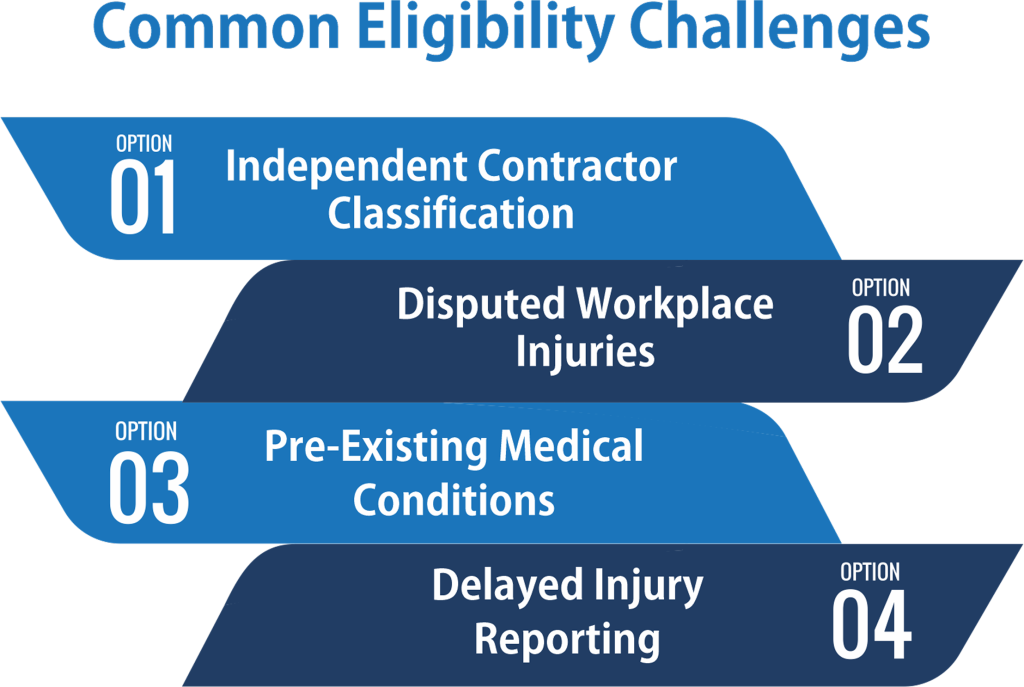
Common Eligibility Challenges
Several factors can complicate workers’ compensation billing and reimbursement, including:
Independent Contractor Classification: Many workers classified as independent contractors may not qualify for traditional workers’ compensation benefits, depending on state laws and employment agreements.
Disputed Workplace Injuries: Insurance carriers may challenge whether an injury is genuinely work-related, leading to payment delays and claim investigations.
Pre-Existing Medical Conditions: Claims involving pre-existing conditions often require additional documentation to demonstrate that the workplace incident directly contributed to the patient’s current medical needs.
Delayed Injury Reporting: Late reporting can create complications during claim review and increase the likelihood of denials.
Because eligibility disputes are one of the leading causes of workers’ compensation claim denials, providers should carefully verify claim details before submitting bills and ensure all supporting documentation clearly establishes the connection between the injury and the patient’s work activities.
Eligibility Requirements for PIP Billing
Just as workers’ compensation claims require eligibility verification, PIP medical billing begins with confirming that the patient qualifies for Personal Injury Protection benefits. Since PIP operates under no-fault insurance laws, eligibility requirements differ from those used in workers’ compensation cases.
Healthcare providers must verify coverage before treatment whenever possible to minimize billing issues and improve reimbursement outcomes.
Who Qualifies for PIP Benefits?
PIP coverage generally extends to individuals injured in a motor vehicle accident, regardless of who caused the collision. Depending on state regulations and policy terms, eligible individuals may include:
- Drivers involved in automobile accidents
- Vehicle passengers
- Family members covered under the policy
- Pedestrians struck by a vehicle
- Cyclists injured in traffic accidents
Coverage eligibility varies significantly from state to state, making insurance verification a crucial first step in the billing process.
State-Specific PIP Requirements
PIP regulations are not uniform across the United States. Some states require PIP coverage, while others offer it as an optional insurance benefit.
Important factors affecting eligibility include:
No-Fault Insurance States
In no-fault states, injured individuals typically seek reimbursement from their own insurance carrier regardless of fault. This structure simplifies initial claim processing but introduces unique billing requirements.
Coverage Limits
Every PIP policy includes a maximum coverage amount. Once benefits are exhausted, providers may need to seek reimbursement through other insurance sources or patient responsibility.
Treatment Deadlines
Many states require injured individuals to seek medical treatment within a specific timeframe after an accident. Missing these deadlines can jeopardize claim eligibility.
Filing Requirements
Insurance carriers often impose strict claim submission deadlines. Failure to submit bills on time may result in claim denial regardless of medical necessity.
Proper eligibility verification at the start of treatment helps providers avoid unnecessary denials and payment delays.
Documentation Requirements for Workers’ Compensation Medical Billing
Documentation is one of the most important aspects of successful workers’ compensation billing. Insurance carriers closely review medical records to determine whether treatment is directly related to a workplace injury and whether services meet reimbursement requirements.
Incomplete or inaccurate documentation remains one of the leading causes of workers’ compensation claim denials.
Essential Documentation Checklist
To support reimbursement, providers should maintain comprehensive records throughout the patient’s treatment journey.
Key documentation often includes:
- First Report of Injury (FROI)
- Employer incident reports
- Workers’ compensation claim number
- Initial evaluation notes
- Progress notes
- Diagnostic imaging reports
- Treatment plans
- Work status reports
- Return-to-work recommendations
- Prior authorization records
- Operative reports when applicable
Each document should clearly establish the relationship between the injury and the patient’s employment activities.
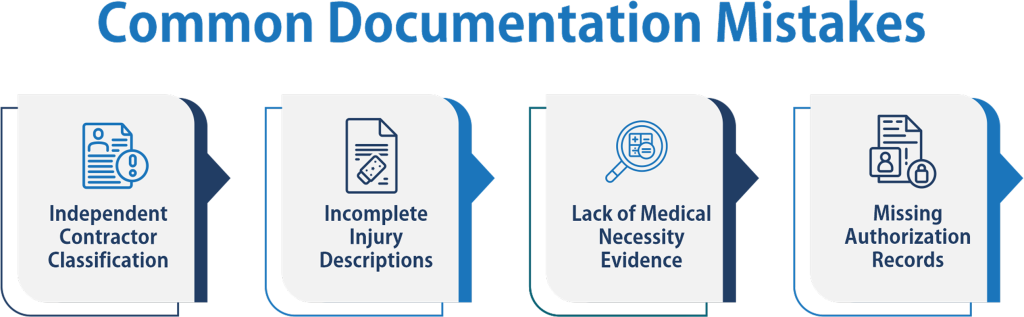
Common Documentation Mistakes
Even minor errors can delay reimbursement or trigger denials.
Missing Employer Information
Claims lacking employer details or claim numbers may be rejected before processing begins.
Incomplete Injury Descriptions
Vague documentation makes it difficult for carriers to determine whether treatment is work-related.
Lack of Medical Necessity Evidence
Providers must clearly explain why each service is necessary for treating the workplace injury.
Missing Authorization Records
Many workers’ compensation insurers require authorization for specific procedures, therapies, and diagnostic tests.
Maintaining accurate and detailed documentation not only supports reimbursement but also strengthens a provider’s position during claim reviews and audits.
Documentation Requirements for PIP Medical Billing
PIP claims also require extensive documentation, although the focus differs from workers’ compensation billing. Instead of proving a workplace connection, providers must demonstrate that treatment is medically necessary and directly related to injuries sustained in an automobile accident.
Strong documentation helps providers justify services, accelerate payments, and reduce denial rates.
Required Documents for PIP Claims
Healthcare providers should gather and maintain the following records:
- Automobile accident reports
- Insurance policy information
- PIP claim number
- Initial patient evaluation
- Diagnostic reports
- Physician notes
- Treatment plans
- Progress reports
- Referral documentation
- Medical necessity statements
- Itemized billing records
The documentation should establish a clear connection between the accident and the services provided.
Common Documentation Errors That Lead to Denials
PIP carriers frequently deny claims when supporting records are incomplete or inconsistent.
Missing Accident Details
Insufficient information regarding the accident can raise questions about claim validity.
Delayed Medical Records
Late documentation often results in payment delays and additional carrier reviews.
Inconsistent Treatment Notes
Discrepancies between diagnoses, treatment plans, and billed services may trigger audits or denials.
Poor Medical Necessity Documentation
Providers must clearly demonstrate how each treatment contributes to the patient’s recovery from accident-related injuries.
Thorough documentation remains one of the most effective ways to improve PIP reimbursement success rates.
Billing Codes and Claim Submission Guidelines
Accurate coding and claim submission are essential for both workers’ compensation and PIP medical billing. While both systems rely on standard medical coding sets, each payer may impose additional requirements that influence reimbursement.
Failure to follow coding guidelines can lead to denied claims, reduced payments, and compliance risks.
Workers’ Compensation Billing Codes
Workers’ compensation claims generally require:
- CPT procedure codes for procedures and services
- ICD-10 diagnosis codes
- HCPCS codes when applicable
- State-specific billing modifiers
- Workers’ compensation claim identifiers
Many states also maintain their own fee schedules that determine allowable reimbursement amounts for specific services.
PIP Billing Codes
PIP claims also utilize standard coding systems but may include additional insurer-specific requirements.
Common coding elements include:
- CPT procedure codes
- ICD-10 diagnosis codes
- HCPCS codes
- Accident-related modifiers
- State-mandated billing forms
Providers should verify coding requirements with the insurance carrier before claim submission to avoid processing delays.
Best Practices for Accurate Claim Submission
To improve first-pass claim acceptance rates, providers should:
- Verify insurance eligibility before treatment
- Confirm claim numbers and policy details
- Ensure diagnoses support billed procedures
- Submit claims within the required deadlines
- Attach all necessary documentation
- Review claims for coding accuracy before submission
- Monitor claim status regularly
An effective coding and claim submission strategy helps healthcare organizations reduce denials, accelerate reimbursements, and maintain a healthy revenue cycle.
Reimbursement Process: Workers’ Compensation vs PIP Billing
Although both billing types are designed to compensate healthcare providers for injury-related treatment, the reimbursement process differs significantly. Understanding how payments are reviewed, approved, and issued can help practices improve cash flow and reduce administrative challenges.
Workers’ Compensation Reimbursement Process
Workers’ compensation reimbursement is typically governed by state regulations and workers’ compensation fee schedules. Before payment is issued, insurance carriers often review treatment records, authorizations, and medical necessity documentation.
The reimbursement process generally includes:
- Verification of the workers’ compensation claim.
- Review of treatment authorization requirements.
- Evaluation of submitted medical documentation.
- Application of state fee schedules.
- Payment determination and claim adjudication.
Since workers’ compensation carriers frequently conduct utilization reviews, reimbursement timelines can vary depending on claim complexity and state regulations.
PIP Reimbursement Process
PIP reimbursement follows a different workflow because claims are submitted to automobile insurance carriers rather than workers’ compensation insurers.
The process usually includes:
- Verification of PIP coverage.
- Review of accident-related documentation.
- Medical necessity assessment.
- Evaluation of policy limits.
- Payment processing and claim settlement.
Many states require insurers to process PIP claims within specific timeframes, making timely claim submission especially important.
Average Payment Timeframes
Payment speed often depends on documentation quality, insurer responsiveness, and state regulations.
Workers’ Compensation
- Frequently requires extensive claim review.
- May involve authorization verification.
- Payment timelines vary by state and carrier.
- Complex claims often experience delays.
PIP Billing
- Usually follows statutory payment deadlines.
- Faster processing when documentation is complete.
- Delays may occur if policy limits are questioned.
- Additional reviews may be triggered by high treatment costs.
Healthcare providers who understand these reimbursement differences can develop more effective follow-up strategies and improve collections.
Common Denials in Workers’ Compensation Billing
Workers’ compensation claims often face scrutiny because insurers must determine whether treatment is directly related to a workplace injury. As a result, denial rates can be higher when documentation or authorization requirements are not met.
Understanding the most common denial reasons allows providers to proactively reduce revenue loss.
Top Reasons Workers’ Compensation Claims Are Denied
Lack of Authorization: Many treatments, diagnostic tests, and procedures require prior approval from the workers’ compensation carrier. Failure to obtain authorization often leads to claim rejection.
Injury Causation Disputes: Insurance carriers may question whether the injury actually occurred in the workplace or resulted from work-related activities.
Incomplete Documentation: Missing reports, treatment notes, or claim details can prevent insurers from validating the claim.
Coding Errors: Incorrect CPT, ICD-10, or HCPCS coding can result in reimbursement delays or denials.
Untimely Filing: Workers’ compensation carriers typically enforce strict billing deadlines. Late submissions may be automatically rejected.
How to Prevent Workers’ Compensation Denials
Healthcare providers can reduce denials by implementing strong billing workflows.
Best practices include:
- Verifying claim information before treatment.
- Securing required authorizations.
- Maintaining detailed medical records.
- Monitoring state filing deadlines.
- Conducting routine coding audits.
- Tracking claim status throughout the reimbursement cycle.
Proactive denial prevention strategies help improve payment rates and reduce administrative workload.
Common Denials in PIP Medical Billing
PIP claims are also vulnerable to denials, especially when insurers question medical necessity or policy eligibility. Because PIP coverage is often limited by policy maximums, providers must pay close attention to claim details throughout treatment.
Common Reasons PIP Claims Are Denied
Exhausted Policy Benefits
PIP policies contain coverage limits. Once those limits are reached, insurers may deny additional claims.
Missing Accident Documentation
Claims lacking police reports, accident details, or supporting evidence often face delays or rejection.
Medical Necessity Challenges
Insurance carriers may dispute whether certain treatments are necessary for the patient’s recovery.
Late Claim Submission
Most states enforce strict billing and treatment deadlines under PIP regulations.
Inconsistent Records
Differences between medical records, diagnoses, and billed services can trigger claim reviews and denials.
How to Reduce PIP Denials
Healthcare organizations can improve reimbursement outcomes by:
- Verifying policy benefits before treatment.
- Monitoring remaining coverage limits.
- Documenting medical necessity thoroughly.
- Maintaining complete accident-related records.
- Submitting claims promptly.
- Following up on outstanding balances regularly.
Effective denial management strategies not only increase collections but also strengthen long-term revenue cycle performance.
Compliance Challenges in Workers’ Compensation and PIP Billing
Compliance remains one of the most overlooked aspects of specialized medical billing. Many providers focus primarily on claim submission while underestimating the regulatory requirements that govern workers’ compensation and PIP reimbursement.
Failure to maintain compliance can result in denied claims, audits, payment recoupments, and legal penalties.
Workers’ Compensation Compliance Requirements
Workers’ compensation billing is heavily regulated at the state level. Providers must remain compliant with various legal and administrative requirements.
Key compliance considerations include:
- State-specific fee schedules.
- Treatment authorization rules.
- Utilization review requirements.
- Medical reporting obligations.
- Filing deadline regulations.
- Documentation retention policies.
Because regulations differ by jurisdiction, providers operating in multiple states often face additional compliance challenges.
PIP Compliance Requirements
PIP billing compliance focuses primarily on no-fault insurance laws and insurer-specific requirements.
Important compliance areas include:
- State PIP regulations.
- Timely treatment requirements.
- Claim submission deadlines.
- Documentation standards.
- Medical necessity guidelines.
- Coverage verification procedures.
Failure to comply with these requirements can significantly impact reimbursement outcomes.
Why Compliance Matters
A strong compliance framework offers several benefits for healthcare providers:
- Reduced denial rates.
- Faster claim processing.
- Lower audit risk.
- Improved reimbursement accuracy.
- Enhanced operational efficiency.
- Better financial performance.
Organizations that prioritize compliance often experience fewer billing disputes and more predictable revenue streams.
Technology and Automation in Specialized Medical Billing
As workers’ compensation and PIP billing become increasingly complex, healthcare providers are turning to technology and automation to improve efficiency, reduce errors, and accelerate reimbursements.
Modern billing solutions help practices manage high claim volumes while maintaining compliance and accuracy.
How Technology Supports Workers’ Compensation Billing?
Advanced billing platforms can help providers:
- Track authorizations automatically.
- Manage claim documentation.
- Monitor reimbursement status.
- Identify denial trends.
- Ensure coding accuracy.
- Improve reporting and analytics.
Automation reduces manual work and allows billing teams to focus on revenue-generating activities.
How Technology Improves PIP Billing?
PIP billing software helps streamline:
- Insurance verification.
- Policy limit tracking.
- Claim submission workflows.
- Documentation management.
- Follow-up processes.
- Denial resolution efforts.
These tools improve visibility into claim performance and help reduce payment delays.
Specialized Billing Solutions for Injury-Related Claims
Successfully managing workers’ compensation and PIP claims requires more than standard medical billing knowledge. Each claim type involves unique documentation requirements, reimbursement rules, payer regulations, and denial management processes.
Healthcare providers that partner with specialized Workers’ Compensation Billing Services often experience fewer claim rejections, improved cash flow, and more predictable reimbursement outcomes
Conclusion
Although workers’ compensation and PIP medical billing both involve injury-related healthcare claims, they differ significantly in terms of coverage, eligibility requirements, documentation standards, reimbursement processes, compliance obligations, and denial management strategies. Workers’ compensation billing focuses on workplace injuries and is governed by state labor and insurance regulations, while PIP medical billing centers on automobile accident injuries and no-fault insurance laws.
For healthcare providers, understanding these distinctions is essential for maintaining compliance, reducing claim denials, and maximizing reimbursements. By implementing accurate billing practices, maintaining thorough documentation, and leveraging specialized billing expertise when necessary, medical organizations can improve revenue cycle performance and ensure a smoother reimbursement process for both workers’ compensation and PIP claims.