Why do many healthcare providers have to wait weeks, even months, to bill insurance companies after submitting their credentials? Many providers face delays because their CAQH profiles are incomplete, outdated, or still awaiting payer evaluation. These delays might keep providers from joining insurance networks, submitting claims, or receiving payment on schedule. In 2026, more than 2.5 million clinicians will actively maintain and verify professional data via CAQH systems used by health insurance across the United States.
CAQH credentialing delays cause operational challenges for medical billing teams, credentialing professionals, and healthcare management. Many providers reduce these delays by using structured medical credentialing services to manage enrollment and documentation accuracy. Delayed provider enrollment can disrupt revenue cycles, raise claim wait times, and hinder provider onboarding. Based on industry data, CAQH profiles must be re-attested every 120 days, and inactive profiles can cause credentialing reviews and delay or prevent payers from accessing provider records.
This blog discusses how long CAQH credentialing takes, what factors influence CAQH processing time, and why insurance credentialing delays occur.
What Is CAQH Credentialing and Why Does It Affect Provider Enrollment?
How Long Does CAQH Credentialing take? It is often misunderstood because CAQH itself does not approve providers for insurance panels. It only collects and validates provider data for payers to review. This section explains how CAQH connects with provider enrollment and why it affects credentialing timelines in 2026.
What Is CAQH ProView?
CAQH ProView is a centralized provider data system used by insurance companies to access and verify provider information. Healthcare providers enter personal, professional, and practice details into one system instead of submitting separate applications to each payer.
Key functions include:
1. Provider demographic data collection
2. License and certification storage
3. Work history documentation
4. Insurance payer access for credentialing
Difference Between CAQH and Full Credentialing
CAQH is a data platform. Full credentialing is an approval process completed by insurance companies. These are separate stages in provider enrollment workflows.
Key differences:
1. CAQH collects and stores provider data
2. Credentialing validates provider eligibility for insurance participation
3. CAQH does not approve network participation
4. Payers perform final review and decision-making
Why CAQH Matters for Healthcare Providers
CAQH impacts how quickly providers can join insurance networks and start billing payers. Incomplete or outdated CAQH profiles often lead to credentialing delays and longer approval cycles.
Key impacts include:
1. Delayed insurance enrollment
2. Slower reimbursement cycles
3. Claim submission restrictions for new providers
4. Increased credentialing processing time
Once enrollment is active, providers rely on medical billing services to begin consistent claim submission and revenue flow.
How Long Does CAQH Credentialing Take for Most Healthcare Providers?
Healthcare providers often expect CAQH credentialing to be a quick step in the enrollment process. In practice, the timeline depends on data accuracy, payer review cycles, and verification speed. Delays in CAQH updates often extend insurance credentialing time and affect provider onboarding.
Average CAQH Processing Time
CAQH processing time usually refers to the time required to complete and validate a provider’s profile in CAQH ProView. In most cases, this stage is faster than payer credentialing.
Typical time range:
- Profile setup: 1–3 days
- Document upload and review: 2–7 days
- Initial validation: up to 2 weeks, depending on accuracy
Delays increase when:
- Licenses are expired or missing
- Work history is incomplete
- Supporting documents are not updated
- Attestation is not completed on time
Average Provider Credentialing Timeline
The credentialing timeline includes CAQH submission plus insurance company review and approval. This stage sets when providers can begin billing payers.
Standard timeline ranges:
- Commercial insurance: 60–120 days
- Medicare enrollment: 60–90 days
- Medicaid enrollment: 90–180 days, depending on state rules
Key stages include:
- Application submission
- Primary source verification
- Credentialing committee review
- Final approval and contract assignment
CAQH Approval Time vs Insurance Credentialing Time
CAQH approval time and insurance credentialing time are often confused, but they represent different stages in the provider enrollment process.
| Factor | CAQH Approval Time | Insurance Credentialing Time |
| Purpose | Validate and store provider data in the CAQH system | Evaluate provider eligibility for insurance network participation |
| Process Owner | CAQH system and data verification teams | Insurance payers and credentialing committees |
| Typical Timeline | 3–14 days (if profile is complete) | 60–180 days, depending on the payer and state rules |
| Key Activities | Profile submission, document upload, attestation review | Primary source verification, committee review, and contract approval |
| Outcome | Data becomes accessible to payers | Provider is approved for insurance billing |
| Common Delays | Missing documents, expired license, incomplete attestation | Payer backlog, verification delays, and committee scheduling |
| Impact on Billing | No direct billing approval | Directly affects the ability to bill insurance companies |
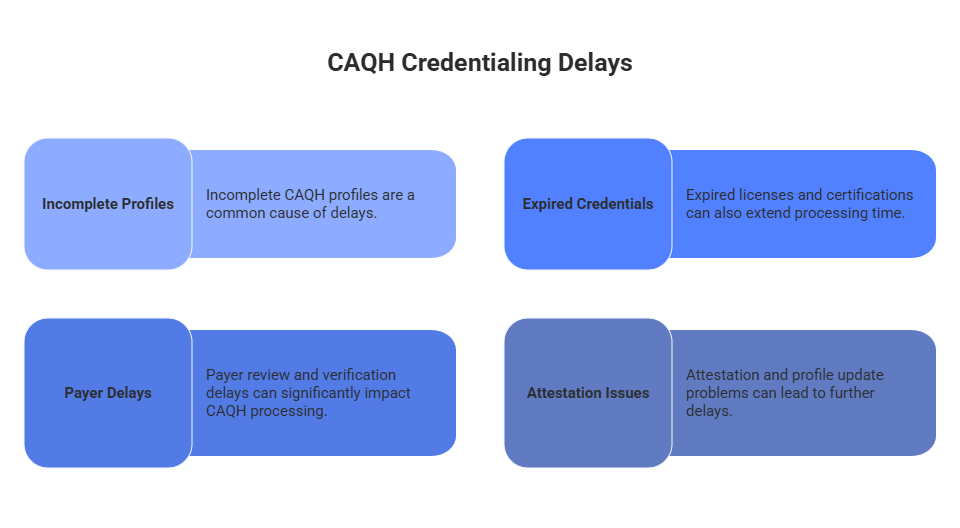
Common Credentialing Delays That Extend CAQH Processing Time
Credentialing delays are one of the main reasons providers experience longer onboarding and slower insurance participation. In many cases, the issue is not the CAQH system itself but errors in provider data, verification delays, or payer-side review cycles.
Incomplete CAQH Profiles
Incomplete CAQH profiles are one of the most common causes of credentialing delays. Missing fields in work history, education, or practice details can pause payer review until corrections are made.
This leads to extended CAQH processing time and slows down insurance credentialing time. Even small gaps in provider data can stop verification workflows.
Common issues include:
- Missing employment history details
- Incomplete license or certification entries
- Unuploaded supporting documents
These errors force payers to request updates before moving forward with credentialing review. Incomplete profiles also affect data consistency across payer systems. When information does not match across records, verification cycles restart and extend approval timelines.
Expired Licenses and Certifications
Expired licenses or certifications can immediately stop credentialing review until updated documents are submitted. Insurance payers require active and verified credentials before approving provider participation.
This directly affects CAQH approval time and extends overall insurance credentialing time. Providers often face delays when renewal dates are missed or not updated in CAQH.
Key issues include:
1. Expired state medical licenses
2. Outdated board certifications
3. Lapsed DEA registration (if applicable)
Payer Review and Verification Delays
Payer review delays occur when insurance companies take longer to verify provider information after receiving CAQH data. This stage is outside the provider’s control but significantly affects overall credentialing timelines.
These delays extend insurance credentialing time even when CAQH profiles are complete. Payers may queue applications based on internal workload and committee schedules.
Common causes include:
1. High application backlog
2. Primary source verification delays
3. Scheduled credentialing committee reviews
Attestation and Profile Update Problems
CAQH requires periodic attestation to confirm that provider information is current and accurate. Missing or delayed attestation can make profiles inactive and pause payer access.
This increases CAQH processing time and delays insurance credentialing workflows. Providers who miss update cycles often restart verification steps.
Common issues include:
1. Missed the 120-day attestation requirement
2. Outdated practice or contact details
3. Unupdated credential changes
Provider Credentialing Timeline by Insurance Type
Provider credentialing timelines vary based on insurance type, internal review structure, and verification depth. Each payer follows a separate approval workflow, which directly impacts how long providers must wait before billing insurance networks.
Medicare Credentialing Timeline
Medicare credentialing follows federal enrollment rules through the PECOS system, which requires strict identity verification and eligibility checks. The process is standardized but still depends heavily on documentation accuracy and CMS review capacity.
The typical Medicare timeline is 60–90 days for standard enrollment. Delays extend this period when applications require corrections, revalidation, or additional identity verification steps.
Processing delays often occur when NPI details, taxonomy codes, or supporting documents do not match CMS records. These mismatches can restart parts of the verification workflow and extend approval time.
Medicaid Credentialing Timeline
Medicaid credentialing varies by state, which creates significant differences in processing times across programs. Each state applies its own verification rules, review cycles, and managed care requirements.
The typical Medicaid timeline ranges from 90 to 180 days, depending on the state. High-volume Medicaid programs often experience longer delays due to application backlogs.
Delays commonly occur during background checks, exclusion list verification, and managed care organization approvals. These additional checks extend the overall credentialing review period.
Commercial Insurance Credentialing Time
Commercial insurance credentialing involves private payers such as BCBS, Aetna, UnitedHealthcare, and Cigna. Each payer operates its own credentialing committee and verification system.
The typical timeline ranges from 60–120 days, depending on application completeness and payer workload. Clean and accurate applications are usually processed faster.
Delays occur when payers request additional verification or when credentialing committees meet on fixed schedules. Providers with multiple payer enrollments often experience staggered approval timelines across networks.
How Credentialing Delays Affect Billing and Revenue Cycle Operations
This section explains how credentialing issues affect billing operations, practice management, and revenue cycle performance in healthcare organizations.
Impact on Medical Billing Specialists and Coders
Medical billing specialists and coders are directly affected when credentialing is not completed on time. Claims cannot be processed correctly if provider enrollment with payers is still pending, which creates billing holds.
This delay leads to unpaid claims and repeated claim resubmissions. It also increases the workload for billing teams managing backlogged accounts.
Coders must also track payer-specific rules during this period. Any mismatch in provider status can result in claim rejections or temporary holds.
Impact on Practice Managers and Administrators
Practice managers and administrators face operational disruption when providers are not credentialed on time. New providers cannot fully participate in scheduled patient services under insurance contracts.
This creates gaps in scheduling and reduces clinic efficiency. It also affects staffing decisions and patient flow management.
Administrative teams must coordinate between payers, credentialing vendors, and internal departments. These coordination delays increase operational pressure and slow down onboarding.
Impact on Healthcare Providers
Healthcare providers experience direct financial and operational impact from credentialing delays. Without completed enrollment, they may be forced to delay in-network billing.
This leads to reduced reimbursement and slower revenue generation. Providers may also need to bill patients out-of-network during the waiting period.
These delays affect patient access and service continuity. Providers often face uncertainty in managing new patient intake during credentialing gaps.
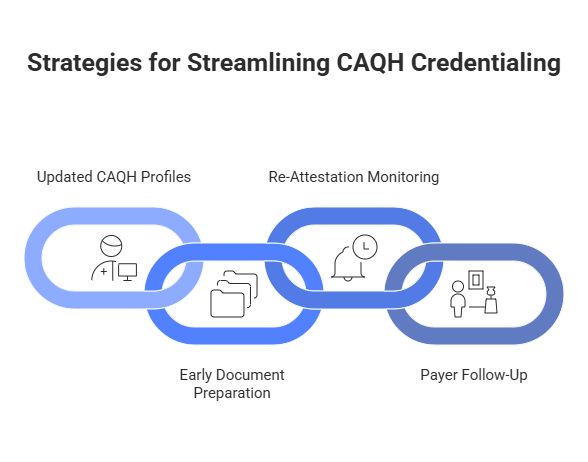
How to Reduce CAQH Credentialing Delays
This section explains practical steps that reduce credentialing delays and improve provider enrollment timelines across insurance networks.
Keep CAQH Profiles Updated
CAQH profiles must remain current to avoid delays during payer review. Outdated information often triggers re-verification requests and slows down credentialing workflows.
Updating provider details regularly reduces interruptions in approval cycles. It also helps maintain consistency between CAQH records and payer systems.
Providers should review key data fields on a scheduled basis. This includes practice locations, contact details, and employment history.
Prepare Credentialing Documents Early
Early preparation of credentialing documents helps reduce delays during the submission and review stages. Missing documents are a common reason for extended credentialing timelines.
When documents are ready in advance, payer verification moves faster. It also reduces back-and-forth communication during the review process.
Key documents should always be checked for accuracy before submission. This prevents rejection or repeated requests for corrections.
Monitor Re-Attestation Deadlines
CAQH requires periodic re-attestation to confirm provider data accuracy. Missing this step can make profiles inactive and delay payer access.
Timely attestation keeps the provider profile active in payer systems. It also reduces interruptions in credentialing workflows.
Providers should track re-attestation cycles carefully. Regular monitoring helps prevent unnecessary delays in approval timelines.
Follow Up With Insurance Payers
Regular follow-up with insurance payers helps identify delays early in the credentialing process. Many applications slow down due to backlog or missing verification responses.
Consistent communication helps move applications through review stages. It also reduces uncertainty in approval timelines.
Credentialing teams should track application status frequently. This ensures faster resolution of pending requests and reduces overall delays.
Conclusion
CAQH credentialing is a data validation step, not the final approval for insurance participation. Most delays occur during payer review, verification checks, and the missing or outdated provider information.
Understanding how CAQH processing time connects with the overall provider credentialing timeline helps healthcare providers, billing teams, and administrators reduce credentialing delays and improve insurance enrollment efficiency.
FAQs
How long does CAQH credentialing usually take in 2026?
CAQH profile completion typically takes 3–14 days if all information and documents are accurate. However, insurance credentialing can take 60–180 days, depending on the payer and verification process.
What causes delays in CAQH credentialing?
Delays usually occur due to incomplete profiles, expired licenses, missing documents, or delayed attestation updates. Payer review backlogs can also extend overall processing time.
Is CAQH approval the same as insurance credentialing approval?
No. CAQH only stores and verifies provider data for payers. Insurance credentialing is a separate process where payers approve providers for network participation and billing.
Can providers bill insurance after CAQH is completed?
No. Completing CAQH does not allow billing. Providers must still complete payer credentialing and receive insurance approval before submitting claims as in-network providers.
How can healthcare providers reduce credentialing delays?
Providers can reduce delays by keeping CAQH profiles updated, submitting accurate documents early, completing attestation on time, and following up regularly with insurance payers.