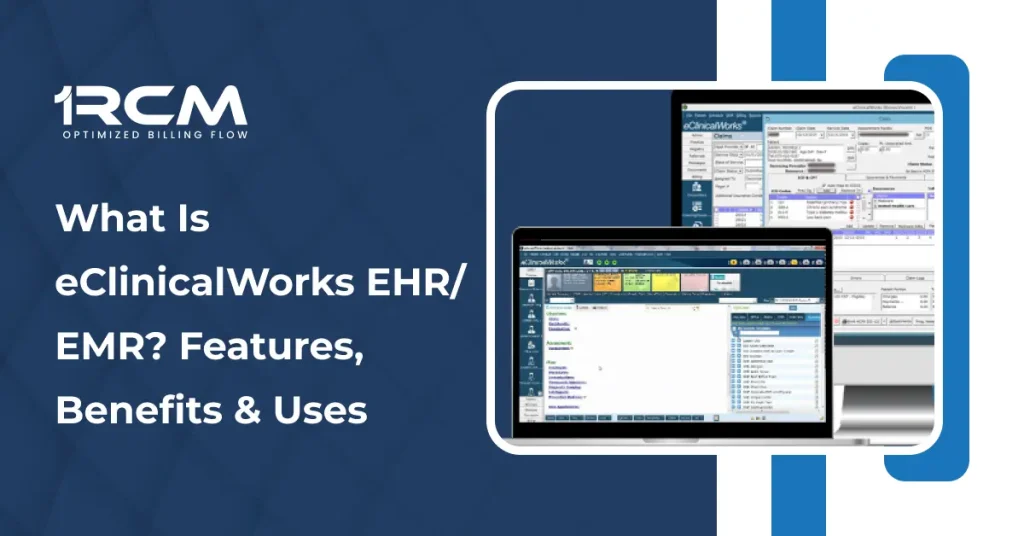
Managing patient records, appointments, billing, prescriptions, and care coordination through disconnected systems can slow down clinical workflows and impact patient outcomes. eClinicalWorks EHR/EMR is a comprehensive healthcare technology platform designed to help medical practices streamline operations, improve documentation accuracy, enhance patient engagement, and deliver more efficient care.
From electronic health records and practice management to telehealth, EHR/EMR billing services, and AI-powered clinical documentation, eClinicalWorks provides healthcare organizations with the tools needed to manage the entire patient journey from a single integrated system.
Whether you’re a small private practice, multi-specialty clinic, urgent care center, or community health organization, understanding how eClinicalWorks works can help you determine whether it’s the right solution for improving productivity, compliance, and patient satisfaction.
What is eClinicalWorks EHR/EMR?
eClinicalWorks is a cloud-based Electronic Health Record (EHR) and Electronic Medical Record (EMR) platform that helps healthcare providers manage patient information, streamline clinical workflows, and improve practice operations. It combines clinical documentation, patient engagement, scheduling, billing, telehealth, and revenue cycle management into a single integrated system.
While EMR primarily focuses on digital patient records within a single practice, EHR enables secure information sharing across multiple healthcare organizations. eClinicalWorks functions as both an EHR and EMR solution, allowing providers to document patient encounters, access medical histories, coordinate care, and exchange health information seamlessly.
Today, eClinicalWorks is used by independent physicians, specialty clinics, urgent care centers, community health organizations, and multi-location healthcare practices seeking a scalable and comprehensive healthcare management solution.
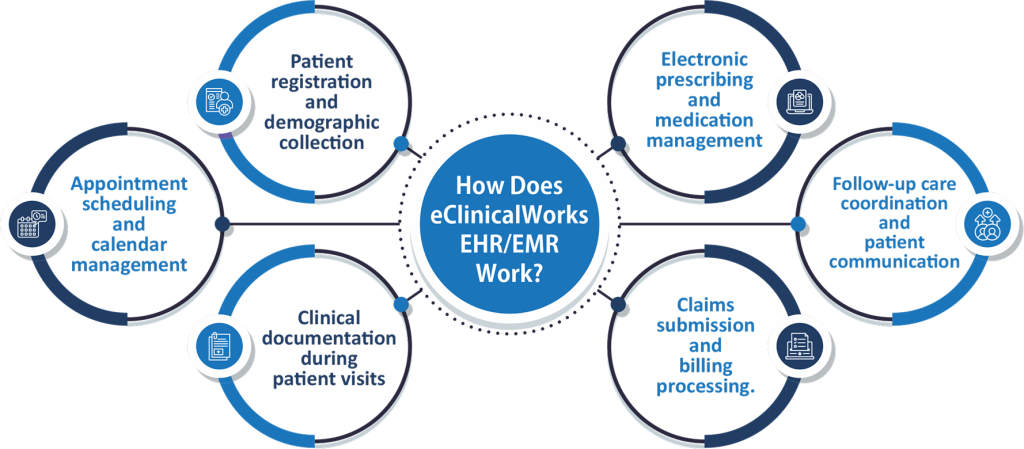
How Does eClinicalWorks EHR/EMR Work?
eClinicalWorks centralizes patient data and clinical workflows through a secure cloud-based platform. Healthcare providers can access patient records, schedule appointments, document encounters, prescribe medications, and manage medical billing services from a unified dashboard.
A typical workflow within eClinicalWorks includes:
- Patient registration and demographic collection.
- Appointment scheduling and calendar management.
- Clinical documentation during patient visits.
- Electronic prescribing and medication management.
- Claims submission and billing processing.
- Follow-up care coordination and patient communication.
Because all information is stored within a connected ecosystem, providers can reduce administrative tasks, improve documentation accuracy, and deliver more efficient patient care.
Key Features of eClinicalWorks EHR/EMR
eClinicalWorks offers a broad range of features designed to support both clinical and administrative operations.
Electronic Health Records Management: Providers can maintain comprehensive digital patient records, including medical histories, diagnoses, medications, allergies, immunizations, lab results, and treatment plans.
Clinical Documentation: The platform supports customizable templates, structured charting, voice recognition, and automated documentation workflows that help reduce charting time.
Practice Management: Healthcare organizations can manage appointments, provider schedules, patient check-ins, and resource allocation through integrated scheduling tools.
Revenue Cycle Management: eClinicalWorks includes billing and coding capabilities that help practices streamline claims submission, reduce denials, and accelerate reimbursement with effective denial management services.
e-Prescribing: Providers can electronically prescribe medications, review drug interactions, manage refills, and support controlled substance prescribing where applicable.
Telehealth and Virtual Care: Built-in telehealth tools allow providers to conduct virtual visits while maintaining documentation and patient communication within the same platform.
Patient Engagement Tools: Through the healow patient portal and mobile applications, patients can schedule appointments, view health records, access lab results, and communicate securely with providers.
AI-Powered Documentation: eClinicalWorks has expanded its capabilities with AI-driven tools such as Sunoh, an ambient medical scribe that helps automate clinical note creation and reduce physician burnout.
Top Benefits of Using eClinicalWorks
Healthcare providers choose eClinicalWorks because it helps improve efficiency, patient satisfaction, and financial performance.
Key benefits include:
- Faster clinical documentation and reduced paperwork.
- Improved patient engagement through self-service tools.
- Better care coordination across providers and facilities.
- Enhanced revenue cycle performance and billing accuracy.
- Increased operational efficiency through workflow automation.
- Simplified regulatory reporting and compliance management.
- Access to real-time analytics and performance insights.
By combining clinical, administrative, and patient engagement tools in one platform, eClinicalWorks helps practices focus more on patient care and less on manual processes.
eClinicalWorks EHR vs EMR: What’s the Difference?
Although the terms EHR and EMR are often used interchangeably, they serve different purposes.
An EMR is a digital version of patient charts used primarily within a single healthcare organization. It helps providers document and manage patient information internally.
An EHR goes beyond recordkeeping by enabling secure data sharing between providers, specialists, hospitals, pharmacies, and other healthcare organizations.
eClinicalWorks supports both functions. It allows providers to maintain detailed patient records while also facilitating interoperability and care coordination across the broader healthcare ecosystem.
For practices looking to improve collaboration, referral management, and patient outcomes, the EHR capabilities of eClinicalWorks offer significant advantages over traditional EMR systems.
Who Should Use eClinicalWorks?
eClinicalWorks is designed to support a wide range of healthcare organizations, making it a flexible solution for practices of different sizes and specialties.
Small Medical Practices:
Independent physicians and small clinics can use eClinicalWorks to simplify scheduling, documentation, billing, and patient communication without managing multiple software systems.
Medium-Sized Healthcare Organizations:
Growing practices benefit from advanced reporting, revenue cycle management, and workflow automation that help improve operational efficiency.
Multi-Location Practices:
Organizations with multiple locations can centralize patient records, standardize workflows, and improve collaboration across facilities.
Specialty Clinics:
Specialty providers can customize templates, workflows, and reporting tools to meet their unique clinical requirements.
Urgent Care Centers:
eClinicalWorks supports fast-paced care environments with streamlined documentation, scheduling, and patient management capabilities.
Community Health Centers:
Federally Qualified Health Centers (FQHCs) and community clinics can leverage population health tools and compliance reporting features to support value-based care initiatives.
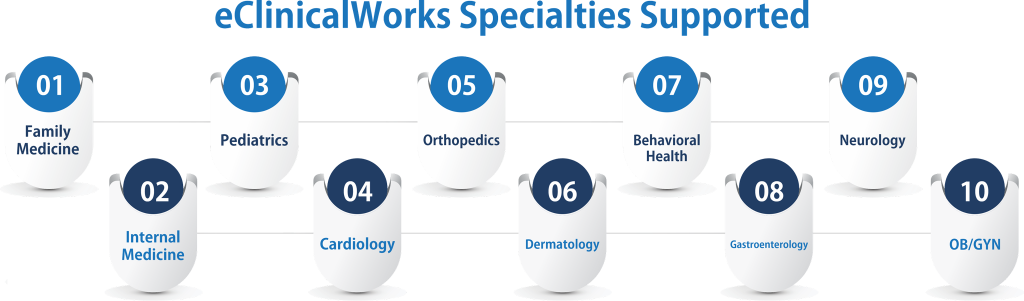
eClinicalWorks Specialties Supported
One of the biggest advantages of eClinicalWorks is its ability to adapt to specialty-specific workflows.
The platform supports a wide range of specialties, including:
- Family Medicine
- Internal Medicine
- Pediatrics
- Cardiology
- Orthopedics
- Dermatology
- Behavioral Health
- Gastroenterology
- Neurology
- OB/GYN
- Pulmonology
- Rheumatology
- Urgent Care
Providers can customize clinical templates, encounter forms, documentation workflows, and specialty-specific reports to align with their unique care delivery processes. This flexibility helps improve efficiency while reducing documentation burden.
eClinicalWorks Interoperability and Integration Capabilities
Modern healthcare depends on seamless data exchange, and interoperability is one of eClinicalWorks’ strongest capabilities.
The platform enables healthcare providers to share patient information securely across different healthcare systems, helping improve care coordination and clinical decision-making.
Key integration capabilities include:
- HL7 data exchange
- FHIR-based interoperability
- Laboratory integrations
- Pharmacy integrations
- Imaging and radiology systems
- Hospital information systems
- Third-party healthcare applications
eClinicalWorks also participates in major interoperability networks, including Carequality and CommonWell, helping providers access patient information across a broader healthcare ecosystem.
These integrations reduce information silos and allow clinicians to access more complete patient histories during care delivery.
eClinicalWorks Patient Portal: Features and Benefits
Patient engagement has become a critical component of modern healthcare, and eClinicalWorks addresses this need through the Healow patient portal.
The portal gives patients convenient access to their healthcare information while reducing administrative workloads for staff.
Key features include:
- Online appointment scheduling
- Secure patient-provider messaging
- Prescription refill requests
- Access to medical records
- Lab and test results viewing
- Online bill payment options
- Health reminders and notifications
By empowering patients to manage their healthcare online, practices can improve satisfaction, strengthen communication, and encourage better health outcomes.
eClinicalWorks Telehealth Solutions
Telehealth has become an essential service for many healthcare organizations, and eClinicalWorks offers integrated virtual care capabilities.
Providers can conduct remote consultations directly within the platform while maintaining access to patient records, documentation tools, and communication features.
Key telehealth capabilities include:
- Secure video visits
- Virtual follow-up appointments
- Mobile telehealth access
- Integrated clinical documentation
- Appointment scheduling for virtual care
- Patient messaging and communication tools
Because telehealth workflows are embedded within the EHR system, providers can maintain continuity of care without switching between multiple applications. This creates a more efficient experience for both healthcare professionals and patients.
eClinicalWorks Implementation Process
Successful EHR implementation requires careful planning, staff training, and workflow optimization. eClinicalWorks follows a structured implementation process to help healthcare organizations transition smoothly.
1. Planning and Assessment:
The implementation team evaluates current workflows, identifies goals, and develops a project roadmap tailored to the practice.
2. System Configuration
Templates, workflows, user roles, reporting requirements, and specialty-specific settings are configured based on organizational needs.
3. Data Migration
Patient records, scheduling information, billing data, and historical documents are transferred from legacy systems into eClinicalWorks.
4. Staff Training
Providers, administrators, and support staff receive role-based training to ensure effective system adoption.
5. Go-Live Deployment
The system is launched in a live clinical environment with support teams available to address issues and optimize workflows.
6. Ongoing Support and Optimization
After deployment, organizations continue refining workflows, generating reports, and implementing new features to maximize system value.
Implementation timelines vary based on practice size and complexity, but most organizations complete deployment within a few weeks to several months.
eClinicalWorks Training and Support
User adoption plays a critical role in EHR success. To help healthcare organizations maximize system utilization, eClinicalWorks offers multiple training and support resources.
Available support options include:
- Instructor-led training sessions
- Virtual learning programs
- Self-paced educational resources
- Product documentation and knowledge bases
- Customer support services
- User communities and forums
- Continuing education opportunities
Comprehensive training helps providers reduce learning curves, improve efficiency, and take full advantage of the platform’s capabilities.
Pros and Cons of eClinicalWorks
Like any healthcare technology solution, eClinicalWorks has strengths and limitations that organizations should evaluate before making a decision.
Pros
- Comprehensive EHR and practice management platform
- Strong interoperability capabilities
- Integrated telehealth functionality
- Robust patient engagement tools
- AI-powered documentation features
- Scalable for practices of different sizes
- Extensive specialty support
Cons
- Initial learning curve for new users
- Implementation can be time-intensive
- Advanced customization may require additional training
- Pricing may vary significantly based on organizational needs
- Some reporting features may require configuration expertise
Understanding both the advantages and limitations helps healthcare organizations make a more informed purchasing decision.
Common Challenges With eClinicalWorks and How to Overcome Them
While eClinicalWorks can deliver significant operational benefits, some organizations encounter challenges during implementation and adoption.
User Adoption Challenges
Staff members may resist transitioning from legacy systems or paper-based workflows.
Solution: Invest in comprehensive training and identify internal champions who can support adoption efforts.
Data Migration Issues
Transferring large volumes of historical patient data can create accuracy and consistency concerns.
Solution: Conduct data validation testing and establish a clear migration strategy before deployment.
Documentation Workflow Adjustments
Providers may initially experience slower documentation speeds while adapting to new processes.
Solution: Customize templates and leverage automation tools such as voice recognition and AI-powered documentation.
Reporting Complexity
Organizations may struggle to build customized reports and dashboards.
Solution: Work with implementation specialists to develop reports aligned with operational and clinical goals.
Workflow Optimization
Out-of-the-box workflows may not fully match every specialty’s requirements.
Solution: Regularly review workflows and customize settings to improve efficiency and user experience.
By proactively addressing these challenges, healthcare organizations can achieve higher adoption rates and maximize the long-term value of their EHR investment.
eClinicalWorks vs Other EHR Systems
Choosing the right EHR platform requires comparing available options based on features, usability, interoperability, scalability, and overall value.
| Feature | eClinicalWorks | Epic | athenahealth | NextGen |
| Cloud-Based Deployment | Yes | Yes | Yes | Yes |
| Practice Management | Yes | Yes | Yes | Yes |
| Telehealth | Yes | Yes | Yes | Yes |
| Patient Portal | Yes | Yes | Yes | Yes |
| AI Documentation Tools | Yes | Expanding | Limited | Limited |
| Interoperability | Strong | Strong | Strong | Moderate |
| Best For | Small to Large Practices | Large Health Systems | Ambulatory Care | Specialty Practices |
eClinicalWorks is often preferred by independent practices and multi-specialty clinics looking for an all-in-one solution that balances functionality, scalability, and affordability. Large hospital systems may gravitate toward Epic, while practices seeking extensive network services may consider athenahealth.
The ideal choice ultimately depends on organizational goals, specialty requirements, budget, and long-term growth plans.
Security, Compliance, and Data Protection
Protecting patient information is a top priority for healthcare organizations, and eClinicalWorks includes multiple security measures designed to support regulatory compliance and data privacy.
Key security capabilities include:
- HIPAA-compliant infrastructure
- Data encryption during storage and transmission
- Role-based access controls
- Multi-factor authentication options
- Audit trails and activity monitoring
- Secure patient-provider communication
- Regular security updates and system monitoring
These protections help healthcare organizations safeguard sensitive patient information while meeting industry compliance requirements.
Additionally, eClinicalWorks supports disaster recovery and backup strategies that help maintain business continuity and reduce the risk of data loss.
Latest Innovations in eClinicalWorks
Healthcare technology continues to evolve, and eClinicalWorks has invested heavily in innovation to help providers improve efficiency and patient outcomes.
Recent advancements include:
AI-Powered Clinical Documentation: Tools like Sunoh use ambient listening technology and artificial intelligence to generate clinical notes automatically, reducing documentation time and physician burnout.
Enhanced Patient Engagement: Expanded patient communication capabilities, mobile health applications, and self-service tools help strengthen patient-provider relationships.
Population Health Management: Advanced analytics help organizations identify care gaps, monitor chronic conditions, and support value-based care initiatives.
Remote Patient Monitoring: Providers can collect and monitor patient health data remotely, enabling more proactive care management and improved outcomes.
Advanced Analytics and Reporting: Real-time dashboards and performance reporting help healthcare organizations make data-driven decisions and improve operational performance.
These innovations position eClinicalWorks as more than just an EHR platform. It serves as a comprehensive healthcare technology ecosystem designed to support modern care delivery.
Is eClinicalWorks Worth It?
For many healthcare organizations, eClinicalWorks offers a strong combination of clinical, administrative, and patient engagement capabilities within a single platform.
It may be a good fit for:
- Independent physician practices
- Multi-specialty clinics
- Urgent care centers
- Community health organizations
- Growing healthcare groups
- Organizations pursuing value-based care initiatives
Practices that need robust interoperability, integrated telehealth, AI-powered documentation, and comprehensive revenue cycle management services often find significant value in the platform.
Summary
eClinicalWorks is a comprehensive EHR and EMR platform that helps healthcare providers streamline clinical workflows, improve patient engagement, simplify billing processes, and enhance care coordination. Its combination of electronic health records, practice management, telehealth, interoperability, revenue cycle management, and AI-powered documentation makes it a compelling option for practices seeking an all-in-one healthcare technology solution.
Whether you’re a small medical practice looking to improve efficiency or a growing healthcare organization focused on scalability and value-based care, eClinicalWorks offers the tools needed to support both operational excellence and better patient outcomes.