
Every denied claim starts with a missed detail, and in most cases, it traces back to poor or incomplete Verification of Benefits (VOB). Healthcare providers lose thousands in revenue not because services weren’t delivered, but because insurance details weren’t properly verified upfront.
If you’re relying on guesswork instead of an accurate VOB, you’re essentially billing blind. And that leads to delayed reimbursements, unexpected patient balances, and a broken revenue cycle.
In this guide, you’ll discover exactly what VOB in medical billing is, how it works step by step, and, more importantly, how to use it strategically to reduce denials, improve cash flow, and stay ahead of costly billing errors.
What is VOB in Medical Billing?
VOB (Verification of Benefits) in medical billing is the process of confirming a patient’s insurance coverage, benefits, and financial responsibilities before healthcare services are provided.
It involves contacting the insurance payer, either through online portals, clearinghouses, or direct calls, to gather detailed information about what services are covered, how much the insurer will pay, and what portion the patient is responsible for.
In simple terms, VOB answers three critical questions:
- Is the patient’s insurance active?
- What services are covered?
- Who pays what and how much?
Unlike a basic eligibility check, VOB goes deeper into the financial and coverage details, ensuring there are no surprises for either the provider or the patient. It is typically handled by front desk staff, billing specialists, or outsourced revenue cycle management (RCM) teams and is performed prior to scheduling or confirming an appointment.
When done correctly, VOB acts as the foundation of a clean claim, reducing errors, preventing rework, and ensuring smoother reimbursement.
Why is VOB Important in Healthcare?
VOB isn’t just a routine administrative task, it’s a revenue protection mechanism. Skipping or rushing this step can directly impact a healthcare provider’s financial stability and patient satisfaction.
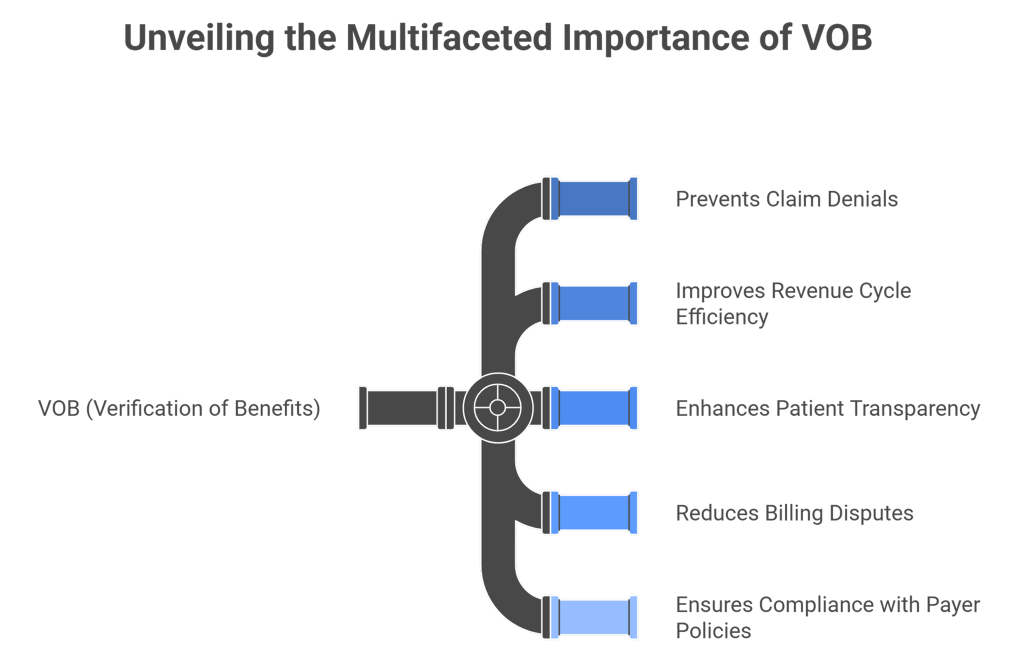
Prevents Claim Denials: One of the biggest causes of claim denials is incorrect or incomplete insurance information. VOB ensures all details are verified upfront, significantly reducing rejection rates.
Improves Revenue Cycle Efficiency: Accurate VOB minimizes back-and-forth with insurance companies, reduces rework, and speeds up the entire billing process, from claim submission to payment.
Enhances Patient Transparency: Patients today expect clarity. VOB allows providers to inform patients about their copays, deductibles, and out-of-pocket costs in advance, avoiding billing surprises later.
Reduces Billing Disputes: When financial responsibilities are clearly communicated beforehand, disputes and confusion over medical bills drop significantly.
Ensures Compliance with Payer Policies: Insurance companies have specific rules regarding coverage, referrals, and authorizations. VOB helps ensure that all payer requirements are met before services are delivered.
VOB vs Eligibility Verification
One of the most common misunderstandings in medical billing is assuming that VOB and eligibility verification are the same thing, they’re not. While they’re related, they serve very different purposes in the billing process.
Here’s a clear breakdown:
| Feature | VOB (Verification of Benefits) | Eligibility Verification |
| Scope | Detailed insurance breakdown | Basic coverage check |
| Purpose | Financial clarity before service | Confirm active insurance |
| Includes | Copay, deductible, coinsurance, limits, authorization | Active/inactive status only |
| Depth | Comprehensive | Surface-level |
| When Used | Before treatment planning & billing | During initial patient check |
Why This Difference Matters
Relying only on eligibility verification is a costly mistake. Just because a patient’s insurance is active doesn’t mean:
- The procedure is covered
- The deductible has been met
- Prior authorization isn’t required
VOB fills these gaps by giving a complete financial picture, allowing providers to plan services confidently and avoid unexpected denials.
Eligibility tells you if the patient has insurance. VOB tells you how that insurance actually works.
What Information is Verified During VOB?
A thorough VOB process goes far beyond checking if insurance is active; it dives deep into the patient’s financial and coverage details. Missing even one of these elements can lead to claim denials or revenue leakage.
Here’s a complete VOB checklist:
Patient Information
- Full name (as per insurance record)
- Date of birth
- Insurance ID and group number
Coverage Details
- Policy status (active/inactive)
- Effective and termination dates
- Type of plan (HMO, PPO, EPO, etc.)
Financial Responsibilities
- Copay amount
- Deductible (total and remaining)
- Coinsurance percentage
- Out-of-pocket maximum (remaining balance)
Service-Specific Details
- Coverage for specific procedures (e.g., MRI, therapy, surgery)
- Frequency limits (e.g., number of visits allowed)
- Exclusions or non-covered services
Authorization & Referral Requirements
- Is prior authorization required?
- Does the patient need a referral from a PCP?
Network Information
- Is the provider in-network or out-of-network?
- Differences in coverage based on network status
- If a provider is not contracted with a plan, utilizing specialized out-of-network billing services becomes essential to ensure maximum allowable reimbursement is captured despite the lack of a formal contract.
Step-by-Step VOB Process in Medical Billing
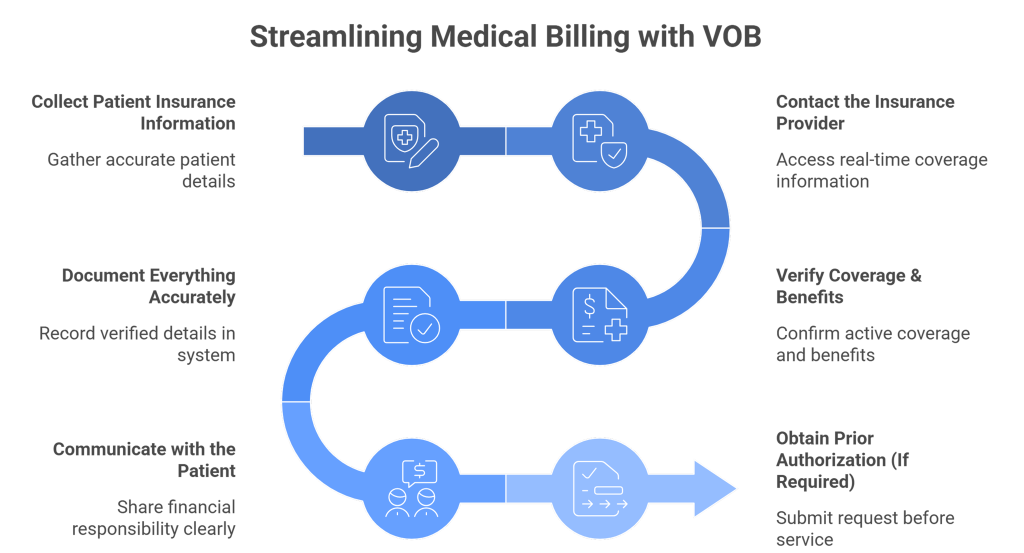
A structured VOB process is what separates high-performing billing teams from those constantly dealing with denials and delays. Here’s how an effective Verification of Benefits workflow typically works:
Step 1: Collect Patient Insurance Information
Start by gathering accurate patient details:
- Insurance card (front & back)
- Policy number and group number
- Patient demographics
Even a small typo here can lead to incorrect verification.
Step 2: Contact the Insurance Provider
Use one of the following methods:
- Insurance portals
- Clearinghouses
- Direct phone calls
The goal is to access real-time, up-to-date coverage information.
Step 3: Verify Coverage & Benefits
This is the core of VOB. Confirm:
- Active coverage status
- Copay, deductible, coinsurance
- Service-specific coverage
- Authorization requirements
Go beyond basics; this is where most errors happen.
Step 4: Document Everything Accurately
Record all verified details in your system (EHR/RCM software), including:
- Reference numbers
- Representative name (if called)
- Date and time of verification
Proper documentation protects you during audits and disputes.
Step 5: Communicate with the Patient
Share financial responsibility clearly:
- Estimated out-of-pocket costs
- Any upfront payments required
Transparency builds trust and reduces billing conflicts later.
Step 6: Obtain Prior Authorization (If Required)
If the payer requires authorization:
- Submit request before service
- Attach necessary clinical documentation
Skipping this step = almost guaranteed denial.
Example of VOB in Action
Let’s break this down with a practical scenario (this is where things really click 👇):
Scenario:
A patient schedules an MRI scan.
During VOB:
- Insurance is active
- Deductible: $1,000 (not yet met)
- Coinsurance: 80/20
- MRI requires prior authorization
Outcome:
- MRI cost: $1,500
- Patient pays full deductible: $1,000
- Remaining $500 → insurance pays 80% ($400), patient pays 20% ($100)
Total patient responsibility: $1,100
What If VOB Was Skipped?
- No prior authorization → claim denied
- Patient unaware of cost → billing dispute
- Provider delays payment → revenue loss
With Proper VOB:
- Authorization obtained in advance
- Patient informed upfront
- Claim processed smoothly
- Payment received faster
Common Mistakes in VOB (And How to Avoid Them)
Even experienced billing teams make VOB mistakes, and unfortunately, even small errors can lead to claim denials, delayed payments, and patient dissatisfaction. Here are the most common pitfalls and how to avoid them:
1. Skipping Prior Authorization Checks
Many providers verify coverage but forget authorization requirements.
Fix: Always confirm whether the procedure requires pre-authorization—and obtain it before service.
2. Incomplete Insurance Verification
Checking only active status without reviewing benefits in detail.
Fix: Use a standardized checklist that includes deductibles, copays, coinsurance, and limitations.
3. Incorrect Patient Information
Typos in policy numbers or names can invalidate the entire verification.
Fix: Double-check insurance cards and confirm details with the patient.
4. Ignoring Coverage Limitations
Some services have restrictions (e.g., limited visits or exclusions).
Fix: Always verify service-specific coverage and frequency limits.
5. Not Updating VOB Before Appointments
Insurance details can change frequently.
Fix: Re-verify benefits 48–72 hours before the appointment.
6. Poor Documentation
Failing to record verification details can create issues during audits or disputes.
Fix: Document everything, date, time, reference number, and payer representative.
Tools & Methods for Performing VOB
With the increasing complexity of insurance plans, relying on manual processes alone is no longer enough. Using the right tools can dramatically improve accuracy, speed, and efficiency.
Insurance Portals
Most insurance providers offer online portals where you can:
- Check eligibility
- Verify benefits
- Review claims history
Fast and reliable for real-time verification.
Clearinghouses
Clearinghouses act as intermediaries between providers and payers.
- Automate eligibility and benefits checks
- Reduce manual effort
- Integrate with billing systems
EHR/RCM Software
Modern healthcare systems often include built-in VOB features:
- Automated verification workflows
- Patient cost estimation tools
- Documentation tracking
Ideal for scaling operations.
Manual Phone Verification
Still necessary in complex cases:
- When portal data is unclear
- For detailed benefit breakdowns
- For unusual or high-cost procedures
Outsourcing VOB Services
Many practices outsource VOB to specialized billing companies to reduce the administrative burden on front-desk staff. Integrating these tasks into comprehensive medical billing services ensures that verification is handled by experts who understand the nuances of payer policies, leading to higher accuracy and faster turnaround times.
Benefits:
- Reduced administrative burden
- Higher accuracy
- Faster turnaround time
Who is Responsible for VOB in Medical Billing?
Verification of Benefits is a shared responsibility within the healthcare workflow, but its execution typically falls on specific roles depending on the size and structure of the organization.
Front Desk Staff
- Often the first point of contact
- Collect insurance details
- Perform basic verification before scheduling
Medical Billing Specialists
- Handle detailed VOB
- Confirm financial responsibilities
- Ensure claims are clean before submission
Revenue Cycle Management (RCM) Teams
- Oversee end-to-end billing processes
- Standardize VOB workflows
- Reduce denials and improve collections
Outsourced Billing Companies
- Perform high-volume VOB tasks
- Use specialized tools and trained staff
- Ideal for practices looking to scale
Regardless of who performs it, accountability must be clear. A poorly defined process leads to missed verifications and lost revenue.
Benefits of Accurate VOB for Healthcare Providers
When done correctly, VOB doesn’t just prevent problems, it actively improves your financial performance and patient experience.
Faster Reimbursements: Clean claims mean fewer delays, leading to quicker payments from insurance companies.
Reduced Accounts Receivable (AR Days): Accurate upfront verification minimizes rework and speeds up the revenue cycle.
Improved Patient Satisfaction: Patients appreciate knowing their financial responsibility in advance, no surprises, no frustration.
Lower Denial Rates: Most denials stem from incorrect or incomplete information. VOB eliminates these risks early.
Better Financial Forecasting: With clear payment expectations, providers can plan revenue more accurately.
Compliance & Legal Considerations
VOB isn’t just about revenue, it’s also about staying compliant with healthcare regulations and payer requirements.
HIPAA Compliance
- Protect patient data during verification
- Ensure secure communication with payers
Proper Documentation
- Maintain records of verification
- Include reference numbers and timestamps
Audit Readiness
- Accurate VOB protects against payer audits
- Helps justify claims and billing decisions
Adherence to Payer Policies
- Follow rules for authorizations and referrals
- Ensure services meet coverage criteria
Ignoring compliance can lead to penalties, denied claims, or even legal complications.
How to Improve Your VOB Process?
If your current VOB workflow is causing delays or denials, it’s time to optimize it.
- Use Automation Tools: Leverage software to streamline eligibility and benefits verification.
- Standardize Checklists: Create a consistent VOB checklist to ensure nothing is missed.
- Train Staff Regularly: Keep your team updated on payer policies and verification best practices.
- Verify in Advance: Always perform VOB 48–72 hours before appointments to allow time for corrections.
- Implement Double-Checks: For high-cost procedures, add a second layer of verification.
Conclusion
Verification of Benefits (VOB) is not just a preliminary step in medical billing; it’s the foundation of a healthy revenue cycle. From preventing claim denials to improving patient transparency, VOB plays a critical role in ensuring both financial stability and operational efficiency.
By implementing a structured VOB process, leveraging the right tools, and training your team effectively, you can eliminate costly errors, accelerate reimbursements, and create a seamless experience for your patients.
Want to reduce denials and optimize your billing process? Start by strengthening your VOB workflow today.