A CAQH profile marked as incomplete is a common issue in provider credentialing workflows. In 2026, CAQH systems are used by over 2.5 million providers and nearly 1,000 health plans, making it a central database for credentialing and enrollment decisions across the U.S. When a profile is incomplete, payer systems stop or reject enrollment until the missing or inconsistent data is updated.
The primary concern with a CAQH Profile Incomplete status is a lack of or outdated provider information, such as licenses, work history, malpractice coverage, or attestation gaps. Based on industry data, credentialing delays for private payers run from 60 to 120 days, with errors in data adding 15-30 days per correction cycle. This causes direct delays in reimbursement and affects provider onboarding across healthcare companies.
This article explains the core reasons behind CAQH profile issues, including application errors, missing data, attestation problems, and ProView system validation failures, along with structured fixes to reduce credentialing delays and maintain continuous payer readiness.
What Does “CAQH Profile Incomplete” Mean in Credentialing
This section explains what the status means in credentialing, how system rules validate provider data, and how it connects to onboarding delays across healthcare organizations.
Core definition in provider enrollment
In provider enrollment, a CAQH Profile Incomplete status means required fields are missing or not verified. These fields include licenses, work history, malpractice coverage, taxonomy codes, and practice locations.
Key points:
- Profile lacks required payer-ready data
- Information is not fully attested or updated
- Supporting documents may be missing or expired
- System blocks submission for payer review
System validation rules
CAQH ProView uses structured validation checks before marking a profile as complete. These checks compare provider entries against required payer formats and stored records.
Common validation rules include:
- License numbers must match state board records
- NPI and taxonomy codes must align with CMS data
- Employment history must show continuous coverage
- Attestation must be current and signed
Relation to provider onboarding
A CAQH Profile Incomplete status directly affects provider onboarding timelines. Payers will not proceed with contracting until the profile is fully verified.
Impact on onboarding:
- Enrollment packets remain on hold
- Credentialing teams must recheck submissions
- Provider start dates are delayed
- Revenue cycle activation is postponed
Common CAQH Missing Information and Application Errors
Missing or incorrect data is one of the main reasons a CAQH profile becomes incomplete. In 2026, credentialing teams report that data entry issues and documentation gaps remain a leading cause of provider enrollment delays. These issues trigger CAQH application errors, slow payer review, and increase rework for billing and credentialing staff.
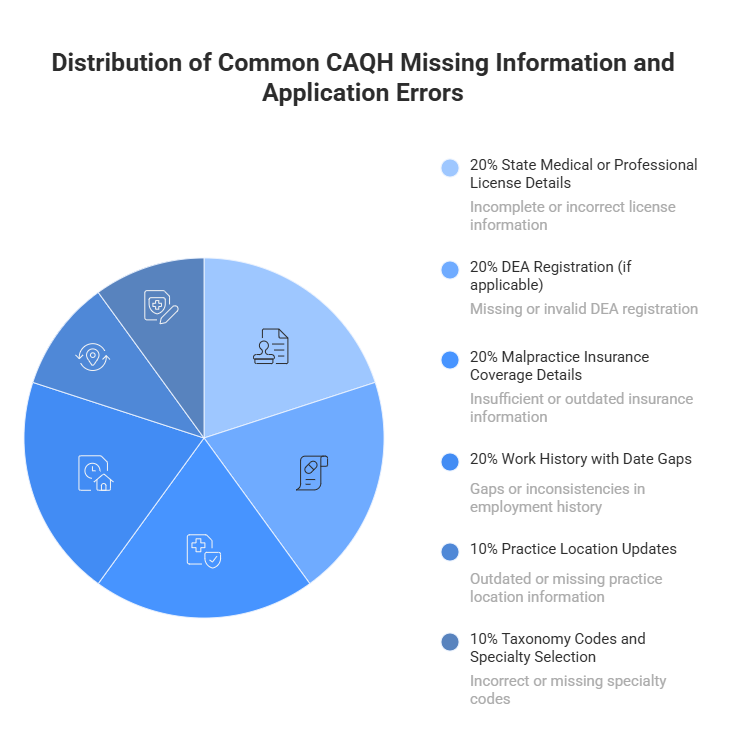
CAQH missing information types
CAQH missing information usually relates to required provider data fields not fully completed or updated in CAQH ProView.
Common missing data includes:
- State medical or professional license details
- DEA registration (if applicable)
- Malpractice insurance coverage details
- Work history with date gaps
- Practice location updates
- Taxonomy codes and specialty selection
CAQH application errors
CAQH application errors occur during data entry or submission in CAQH ProView. These errors affect how payers interpret provider records.
Common application errors include:
- Incorrect NPI entry or mismatch
- Wrong taxonomy code selection
- Duplicate provider records in the system
- Incomplete attestation submission
- Upload failures for supporting documents
Data mismatch issues
Data mismatch issues occur when CAQH records do not align with payer databases or external verification systems. These mismatches are a frequent cause of CAQH profile rejection.
Common mismatch sources:
- Differences between CAQH and NPI registry data
- Outdated address or practice location records
- License expiration is not updated in real time
- Inconsistent employment history entries
- Variation in provider name formatting across systems
CAQH Attestation Issues and Profile Rejection Triggers
CAQH attestation is a required step for validating provider data before payer review. In 2026, credentialing teams continue to report that incomplete or expired attestation is a frequent reason for blocked enrollment workflows.
This section explains how attestation problems occur, what leads to profile rejection, and how these issues affect credentialing timelines across healthcare organizations.
CAQH attestation issues
CAQH attestation issues occur when provider confirmation is missing, outdated, or not properly submitted in CAQH ProView.
Common attestation problems:
- Expired attestation not renewed within the required cycle
- Provider signature not completed in the system
- Changes made to the profile without re-attestation
- Delay in updating practice or license data
- System not reflecting submitted attestation
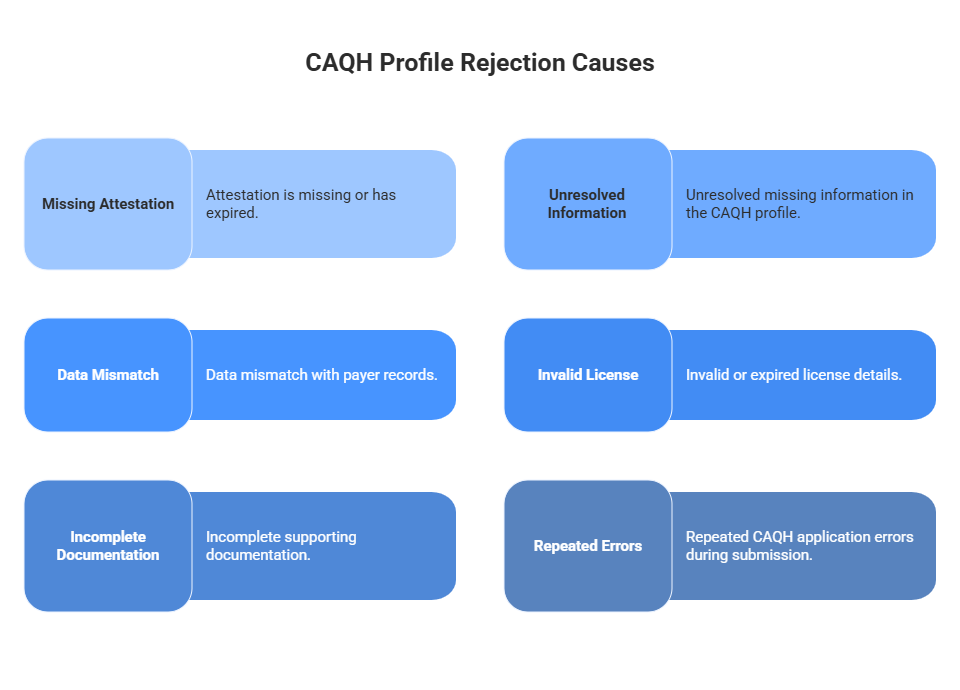
CAQH profile rejection causes
CAQH profile rejection occurs when payers cannot validate provider data during review. This happens after repeated errors or unresolved profile gaps.
Common rejection causes:
- Missing or expired attestation
- Unresolved CAQH missing information
- Data mismatch with payer records
- Invalid or expired license details
- Incomplete supporting documentation
- Repeated CAQH application errors during submission
Credentialing workflow impact
CAQH attestation issues and rejection triggers directly affect credentialing workflows. These problems slow down payer onboarding and delay provider activation.
Workflow impact includes:
- Extended provider enrollment timelines
- Increased follow-up between payers and credentialing staff
- Additional documentation requests from insurers
- Delays in contract finalization
- Postponed billing activation for providers
CAQH ProView Errors and System Validation Problems
CAQH ProView errors occur during data entry, document upload, or profile submission inside the CAQH system. These issues often occur during profile completion and cause delays in payer evaluation. A CAQH Profile Incomplete status is commonly linked to unresolved system-level issues in ProView.
System validation issues occur when provider data does not access CAQH internal checks or payer-required formatting rules. These issues affect how records move through credentialing workflows and often require correction before submission.
CAQH ProView errors
CAQH ProView errors appear during profile creation or updates in the system. These errors usually indicate incorrect input or missing required fields. They block progress until corrected by the provider or billing team.
Common examples include upload failures, session timeouts, and invalid field entries. These issues often occur during high-volume data entry or incomplete session saves. Credentialing teams must recheck each section before resubmission.
System validation failures
System validation failures occur when CAQH data does not meet the required rules. The system compares provider entries with payer and regulatory records. Any mismatch causes validation rejection and profile hold status.
These failures often relate to license format, NPI mismatch, or taxonomy errors. Even minor formatting errors can cause validation blocks. Staff in medical billing and credentialing must correct the data before they attempt to retry.
Submission blocking issues
Submission blocking issues stop the final transmission of CAQH profiles to payers. These blocks occur when required sections remain incomplete or unverified. As a result, the profile cannot move forward in the credentialing pipeline.
Common causes include missing attestation, incomplete uploads, or unresolved errors. The system prevents submission until all validation rules are satisfied. This directly contributes to provider enrollment delays and slowed billing activation.
Fixing and Preventing CAQH Profile Incomplete Issues
Fixing CAQH issues requires the structured correction of data, documents, and system errors in CAQH ProView. Many CAQH Profile Incomplete cases are caused by common input errors or missed updates during provider maintenance cycles. In 2026, credentialing teams focus more on proactive data control to reduce payer delays.
Prevention depends on continuous monitoring of provider records and timely updates in CAQH. Errors in application data, missing fields, or delayed attestation updates often lead to CAQH application errors and longer credentialing cycles if not addressed early.
Fixing CAQH application errors
CAQH application errors must be corrected directly inside CAQH ProView before resubmission.
Each error should be reviewed against payer requirements and system validation rules.
Unresolved errors stop profile processing and keep enrollment on hold.
Common fixes include correcting NPI details, updating taxonomy codes, and re-uploading documents.
Credentialing teams also verify work history gaps and license data for accuracy.
After corrections, the profile must be resubmitted for validation checks.
Preventing CAQH missing information
Preventing CAQH missing information requires regular data review and structured record updates. Provider details must stay aligned with licensing boards and payer databases. Incomplete updates often trigger CAQH profile rejection during review cycles.
Best practices include scheduled audits of provider records and checklist-based entry review. Teams should verify licenses, practice locations, and insurance details before submission. Consistent updates reduce repeated corrections and reduce credentialing delays.
Maintaining attestation compliance
Attestation compliance ensures CAQH profiles remain active and valid for payer review. Failure to complete attestation on time is a major cause of profile inactivity. This often results in blocked enrollment and slowed reimbursement processing.
Providers must complete re-attestation whenever profile changes occur or at required intervals. Credentialing staff should track expiration dates and system alerts closely. Regular compliance checks help avoid unnecessary submission delays and payer holds.
Conclusion
A CAQH Profile Incomplete status can delay provider enrollment, slow reimbursement cycles, and increase administrative rework across healthcare organizations. Missing information, attestation gaps, CAQH application errors, and ProView validation failures remain common causes of credentialing delays in 2026.
Healthcare providers, credentialing experts, and medical billing teams must keep accurate provider records, complete attestations on schedule, and check CAQH data regularly to reduce the risk of profile rejection. Consistent error monitoring and early fixes contribute to quicker payer approvals, smoother onboarding, and uninterrupted revenue cycle processes.