
If you’re involved in healthcare billing, one form can make or break your reimbursement process the UB-04 form. Known as the CMS-1450, this standardized hospital claim form is essential for submitting inpatient, outpatient, and facility-based claims to Medicare, Medicaid, and private insurers.
Imagine completing a claim perfectly, only to have payment delayed because a single field was wrong. That’s why mastering the UB-04 is not just a technical necessity; it’s a business-critical skill that ensures faster payments, fewer denials, and smoother revenue cycles.
Whether you’re a billing professional, hospital administrator, or healthcare provider, understanding how to complete, submit, and optimize UB-04 claims is the fastest path to getting paid accurately and on time.
What is a UB-04 Form?
The UB-04 form, also known as CMS-1450, is the standardized medical billing form used by hospitals and institutional healthcare providers to submit claims for reimbursement. Unlike forms used by individual physicians, the UB-04 is designed for facilities that provide complex, multi-department care. Specialized medical billing services are often required to manage these high-volume institutional claims to ensure every revenue code is captured accurately.
Originally, each state had its own billing form, which made claims processing slow and error-prone. The National Uniform Billing Committee (NUBC) standardized this process in the 1980s, evolving from the UB-82 to UB-92, and finally to the UB-04 form in 2007.
One of the key updates was the inclusion of the National Provider Identifier (NPI) and more fields for diagnosis and revenue codes—making it the backbone of modern hospital billing.
Today, most UB-04 claims are submitted electronically through the 837I transaction, which mirrors the UB-04 field structure but ensures compliance with HIPAA and automated payer systems.
Why it matters: Submitting accurate UB-04 claims is crucial because even a small error can delay payments by weeks, trigger denials, or create audit risks.
What is a UB-04 Form Used For?
The UB-04 form is used to bill for nearly all institutional claims, including inpatient and outpatient hospital services. Its primary purpose is to provide a comprehensive record of all reimbursable care, which payers use to determine how much to reimburse the facility.
Key uses include:
- Submitting claims to Medicare, Medicaid, and commercial insurance.
- Recording all patient services: room and board, lab tests, surgeries, therapies, medications, and more.
- Documenting admission type, discharge status, diagnosis codes, and revenue codes.
- Supporting national reimbursement systems, like DRG (Diagnosis-Related Group) and APC (Ambulatory Payment Classification).
For example:
- A patient admitted for surgery: UB-04 captures room charges, operating room fees, anesthesia, and post-op care.
- An outpatient visit: UB-04 records diagnostics, labs, and minor procedures.
Why it’s critical: Accurate completion of the UB-04 ensures faster reimbursements, fewer denials, and compliance with federal and payer rules.
Who Uses the UB-04 Form?
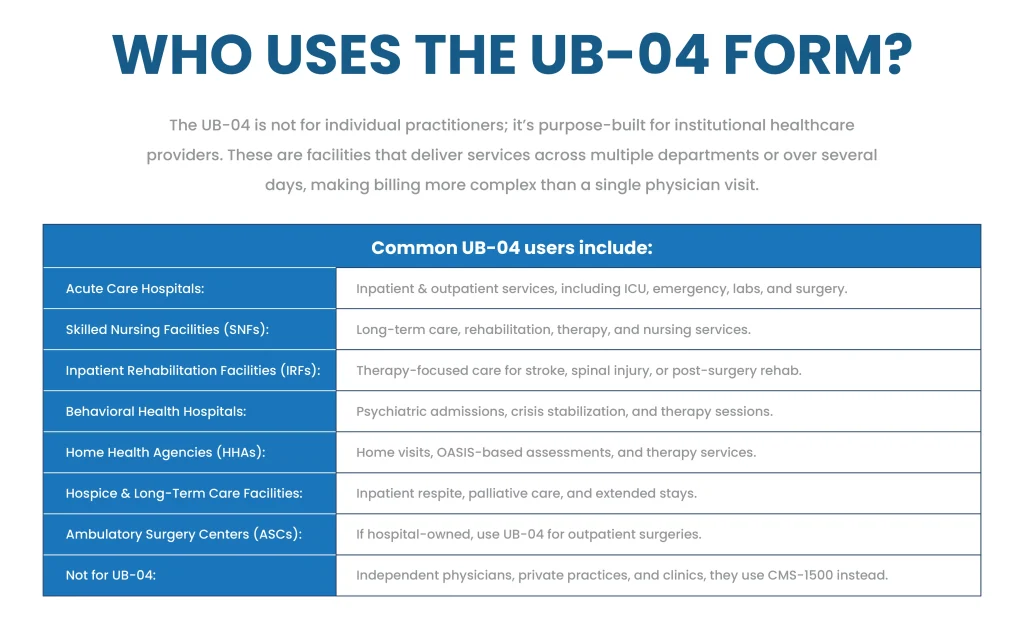
The UB-04 is not for individual practitioners; it’s purpose-built for institutional healthcare providers. These are facilities that deliver services across multiple departments or over several days, making billing more complex than a single physician visit.
Common UB-04 users include:
Acute Care Hospitals: inpatient & outpatient services, including ICU, emergency, labs, and surgery.
Skilled Nursing Facilities (SNFs): long-term care, rehabilitation, therapy, and nursing services.
Inpatient Rehabilitation Facilities (IRFs): therapy-focused care for stroke, spinal injury, or post-surgery rehab.
Behavioral Health Hospitals: psychiatric admissions, crisis stabilization, and therapy sessions.
Home Health Agencies (HHAs): home visits, OASIS-based assessments, and therapy services.
Hospice & Long-Term Care Facilities: inpatient respite, palliative care, and extended stays.
Ambulatory Surgery Centers (ASCs): if hospital-owned, use UB-04 for outpatient surgeries.
Not for UB-04: Independent physicians, private practices, and clinics, they use CMS-1500 instead.
How Many Boxes Are in a UB-04 Form?
The UB-04 is structured into 81 fields, called Form Locators (FLs). Each box captures specific information required for claim adjudication, from patient demographics to revenue codes. Not all fields are used for every claim, but understanding the layout is essential for accurate billing.
Major categories include:
- Provider & Facility Information (FL 1–8): Name, address, statement period, type of bill.
- Patient & Subscriber Information (FL 9–17): Demographics, admission/discharge dates, source, and status.
- Revenue & Procedure Coding (FL 42–49): Revenue codes, HCPCS/CPT, service dates, units, and charges.
- Diagnosis & Procedure Codes (FL 67–74): Principal and secondary diagnosis codes, procedures, DRG/APC codes.
- Attending/Referring Providers (FL 76–79): NPIs of attending, operating, and referring physicians.
- Special Codes & Miscellaneous (FL 18–41, 80–81): Condition codes, occurrence dates, value codes, remarks, and taxonomy codes.
Some fields, like Type of Bill (FL 4) and Revenue Codes (FL 42), are critical for ensuring your claim is routed and reimbursed correctly.
UB-04 Form Field Highlights
To give you a practical sense of the form:
| Category | Key Fields | Purpose |
| Provider Info | FL 1–8 | Facility details, statement period, type of bill |
| Patient Info | FL 9–17 | Admission/discharge, demographics, patient ID |
| Revenue & Procedure | FL 42–49 | Revenue codes, HCPCS/CPT, units, total charges |
| Diagnosis & PPS | FL 67–74 | ICD-10 diagnosis codes, procedures, DRG/APC codes |
| Providers | FL 76–79 | Attending, operating, referring physicians NPI |
| Special Codes | FL 18–41, 80–81 | Condition, occurrence, value codes, remarks |
Each of these sections ensures accurate, compliant, and timely reimbursement. Errors in any field can lead to denials or delayed payments, so understanding these boxes is non-negotiable for billing professionals.
How to Get a UB-04 Form?
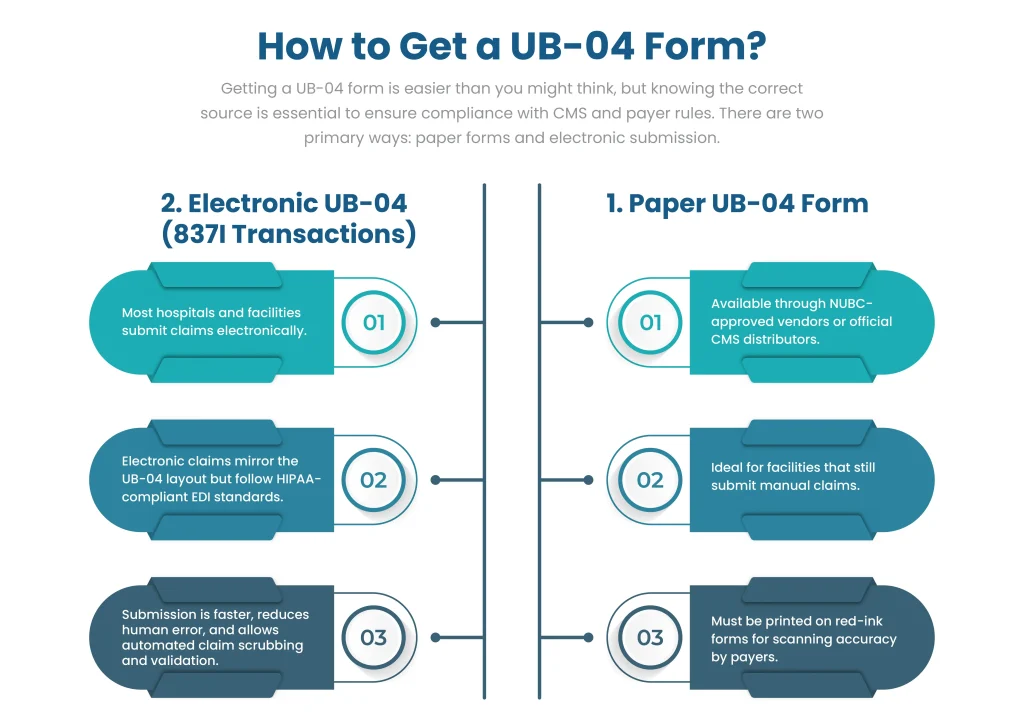
Getting a UB-04 form is easier than you might think, but knowing the correct source is essential to ensure compliance with CMS and payer rules. There are two primary ways: paper forms and electronic submission.
1. Paper UB-04 Form
- Available through NUBC-approved vendors or official CMS distributors.
- Ideal for facilities that still submit manual claims.
- Must be printed on red-ink forms for scanning accuracy by payers.
2. Electronic UB-04 (837I Transactions)
- Most hospitals and facilities submit claims electronically.
- Electronic claims mirror the UB-04 layout but follow HIPAA-compliant EDI standards.
- Submission is faster, reduces human error, and allows automated claim scrubbing and validation.
Common UB-04 Errors and How to Avoid Them
Even experienced billers make mistakes on the UB-04. Since institutional claims go through rigorous edits, errors can lead to payment delays or denials. Here are the most frequent mistakes and how to prevent them:
- Incorrect Type of Bill (FL 4)
- ❌ Using “outpatient” instead of “inpatient”
- ✅ Verify the 3-digit code against payer guidelines
- Mismatched Revenue Codes and HCPCS/CPT (FL 42 & 44)
- ❌ Revenue codes not aligned with procedures
- ✅ Use payer crosswalks for proper code mapping
- Missing or Invalid Diagnosis Codes (FL 67)
- ❌ Wrong ICD-10 codes or truncated entries
- ✅ Always check updated ICD-10 coding manuals
- Discharge Status Errors (FL 17)
- ❌ “Discharged home” reported when patient transferred
- ✅ Match discharge codes with medical records
- Omitted Condition, Occurrence, or Value Codes (FL 18–41)
- ❌ Fields left blank despite eligibility events
- ✅ Review documentation and payer instructions
- Incorrect Provider NPI or Taxonomy (FL 56, 81)
- ❌ Using facility NPI instead of attending physician
- ✅ Cross-check NPI with NPPES registry
- Statement Period vs Service Dates (FL 6 & 45)
- ❌ Dates inconsistent with revenue line items
- ✅ Ensure statement period covers all services billed
Errors in diagnosis codes or discharge status can trigger audits or permanent denials. A periodic medical billing and coding audit is the most effective way to verify that your Form Locators are compliant with the latest payer edits before you submit.
UB-04 vs CMS-1500: Key Differences
Many billing professionals confuse the UB-04 with CMS-1500, but they serve distinct purposes.
| Feature | UB-04 (CMS-1450) | CMS-1500 |
| Used By | Hospitals, SNFs, Institutional facilities | Physicians, therapists, labs, non-facility providers |
| Claim Type | Institutional | Professional |
| Billing For | Room & board, facility fees, labs, surgeries | Physician services, consultations, therapy sessions |
| Coding Systems | ICD-10-CM, HCPCS, Revenue Codes | ICD-10-CM, HCPCS, CPT |
| Submission Format | Paper or 837I Electronic | Paper or 837P Electronic |
| Reimbursement Model | DRG, APC, per diem | Fee-for-service (FFS) |
When to Use Each Form:
- CMS-1500: For individual medical professionals billing directly for services.
- UB-04: For facility-based billing, inpatient/outpatient hospital claims, and multi-department services.
Summary
The UB-04 form is the backbone of institutional medical billing. From capturing all reimbursable care to ensuring compliance with CMS rules, mastering the UB-04 is essential for faster payments, fewer denials, and smooth revenue cycles. Whether you’re submitting claims on paper or electronically, understanding each field, avoiding common errors, and knowing when to use UB-04 versus CMS-1500 can make the difference between delayed reimbursement and timely payment.
By integrating these best practices, your facility can optimize claim submissions, maximize revenue, and maintain compliance, making UB-04 not just a form, but a strategic tool in your healthcare revenue cycle.
Mastering the UB-04 is a strategic tool in your healthcare revenue cycle. To identify if hidden errors in your facility billing are causing payment delays, request a Free RCM Audit and protect your institution’s bottom line today.
FAQs
Q1. How many boxes are in a UB-04 form?
Ans: The UB-04 contains 81 fields or Form Locators, each capturing specific billing or patient information. Not all fields are required for every claim.
Q2. Can UB-04 be submitted electronically?
Ans: Yes. Most claims are submitted as 837I electronic transactions, which mirror the UB-04 layout and comply with HIPAA.
Q3. Which facilities use the UB-04 form?
Ans: Hospitals, skilled nursing facilities, inpatient rehab centers, behavioral health institutions, hospice, home health agencies, and hospital-owned ambulatory surgery centers.
Q4. How do I get a UB-04 form?
Ans: You can order paper UB-04 forms from NUBC-approved vendors or use electronic claim software for 837I submissions.
Q5. Is UB-04 used for outpatient claims?
Ans: Yes. UB-04 is used for both inpatient and outpatient hospital claims.