
When providers, billers, or credentialing teams search for what a taxonomy code is, it usually starts after a problem appears in the revenue cycle. Claims may be denied, enrollment may stall, or NPI records may not match payer requirements. These issues often trace back to incorrect or missing taxonomy data in provider records.
Taxonomy codes will need data elements in NPI enrollment and claim validation systems beyond 2026. The CMS NPI framework validates that taxonomy codes describe a provider’s classification and specialization and are used in the NPI registration and Medicare enrollment operations. Mistakes have a big financial impact. According to industry billing statistics for 2026, total claim denial rates in US healthcare systems are approximately 10-15%, with administrative and missing data challenges (including taxonomy errors) being the most common causes of rejection.
Understanding taxonomy codes helps reduce these disruptions and supports smoother medical credentialing services, provider identification, and claim workflows. It supports accurate provider identification, correct claim submission, and smoother credentialing workflows. The blog explains how taxonomy codes function, where they are used, and how healthcare teams can manage them correctly in daily operations.
What is a Taxonomy Code in Healthcare?
A taxonomy code is a standardized identifier used to classify healthcare providers by specialty and provider type. This code is required in NPI enrollment, insurance credentialing, and claims processing systems.
The focus keyword “what is a taxonomy code” refers to a classification system that ensures payer systems correctly identify who is providing care and under which specialty.
Definition of Taxonomy Code
A taxonomy code is a 10-character alphanumeric code maintained by the National Uniform Claim Committee (NUCC). It defines:
- Provider type (individual or organization)
- Medical specialty or subspecialty
- Classification for billing systems
Where Taxonomy Codes Are Used
Taxonomy codes are used across multiple healthcare systems where provider identification is required:
1. NPI registration through NPPES
3. Commercial insurance credentialing
4. Medical claim submission (CMS-1500 and UB-04)
5. Electronic claim formats (837P and 837I)
6. Provider directory management
What is a taxonomy code, and why does it matter in medical billing?
In medical billing systems, taxonomy codes support provider identification at the specialty level. Payers use this data to verify who provided the service and whether the billed specialty matches enrollment records. When taxonomy data is incorrect, claims may fail edits before reaching adjudication, leading to delays and rework in revenue cycle operations.
Role in Medical Billing
A taxonomy code directly impacts how providers are identified during billing. It is tied to claim submission, provider enrollment, and payer matching.
Key functions in billing:
1. Identifies the provider specialty on claims
2. Links the billing provider to the enrolled taxonomy in the payer systems
3. Supports correct CPT/HCPCS claim mapping
4. Helps determine reimbursement rules for services
5. Used in both professional (CMS-1500) and institutional (UB-04) billing
Impact on Claims Processing
Taxonomy codes directly affect how claims move through payer systems. They are used in front-end claim validation and backend adjudication checks.
Common impacts include:
- Claims may be rejected if the taxonomy code is missing or invalid
- A mismatch between the taxonomy and NPI enrollment can stop claim acceptance
- Incorrect taxonomy can delay claim routing to the correct payer department
- Payer systems may deny claims if the specialty does not match the service billed
- Reimbursement delays occur when records require manual correction, often requiring denial management services to resolve payment issues.
What is a taxonomy code in NPI enrollment?
In NPI enrollment, taxonomy codes define the provider’s classification in the national registry. CMS and NPPES use this information to link providers with their specialty, services, and billing eligibility. Each NPI record must include at least one taxonomy code, with one marked as primary for official billing and enrollment use.
Taxonomy Codes in the NPPES System
The NPPES system uses taxonomy codes to structure provider data for billing and compliance purposes. During NPI registration, providers must select codes that match their training, licensure, and scope of practice.
Key points:
- Taxonomy codes are selected during the initial NPI application
- Providers can assign multiple taxonomy codes if applicable
- One taxonomy must be set as the primary code
- Updates can be made anytime through the NPPES login
- Changes reflect in payer enrollment records after system updates
Primary vs Secondary Taxonomy Code
Primary and secondary taxonomy codes define how a provider is represented in billing and enrollment systems. The primary taxonomy carries the highest weight in payer validation.
| Feature | Primary Taxonomy Code | Secondary Taxonomy Code |
| Purpose | Represents the main specialty used for billing and enrollment | Represents additional specialties or practice areas |
| Usage in Claims | Used first for payer validation and claim processing | Used for supporting provider classification |
| Quantity Allowed | Only one primary taxonomy per NPI record | Multiple secondary taxonomy codes allowed |
| Importance of Enrollment | High importance in Medicare, Medicaid, and commercial payer setup | Supporting role in provider profiling |
| Impact on Billing | Directly affects claim acceptance and reimbursement accuracy | Limited direct impact on claim adjudication |
| Selection Rule | Must reflect the primary clinical role of the provider | Based on additional certifications or services offered |
| System Role | Acts as the default identifier in payer systems | Acts as supplemental provider information |
| Risk of Error | Incorrect selection can lead to claim rejection or enrollment mismatch | Lower risk, but may still affect provider classification accuracy |
How to Change or Update the Taxonomy Code for NPI
The focus keyword what is a taxonomy code is important here because taxonomy updates directly affect how providers are classified in NPI enrollment and how payers validate billing information during claims processing.
Incorrect or outdated taxonomy data can affect credentialing status, claim acceptance, and reimbursement timelines. Updating the NPI record ensures consistency across billing systems, insurance databases, and provider directories.
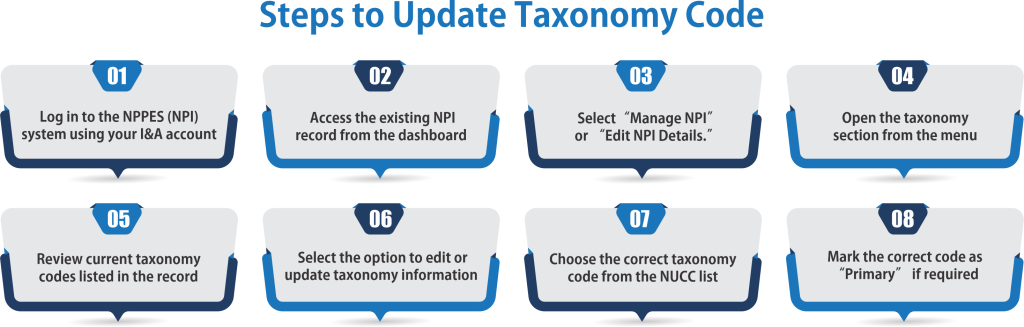
Steps to Update Taxonomy Code
Updating a taxonomy code in the NPI system is done through the NPPES portal. The process is structured and requires accurate provider login credentials.
Steps:
1. Log in to the NPPES (NPI) system using your I&A account
2. Access the existing NPI record from the dashboard
3. Select “Manage NPI” or “Edit NPI Details.”
4. Open the taxonomy section from the menu
5. Review current taxonomy codes listed in the record
6. Select the option to edit or update taxonomy information
7. Choose the correct taxonomy code from the NUCC list
8. Mark the correct code as “Primary” if required
9. Save and submit the updated record
10. Wait for system confirmation of changes
When to Update Taxonomy Code
Taxonomy updates are required whenever a provider’s professional or administrative details change.
Common situations include:
1. Change in medical specialty or subspecialty
2. Addition of new certifications or credentials
3. Correction of the incorrect taxonomy selected during enrollment
4. Expansion of services or practice scope
5. Transition from training status to independent practice
6. Requirement from the payer or credentialing body
Nurse practitioner taxonomy code examples
Nurse practitioners often seek the taxonomy code when setting up NPI records, enrolling with payers, or completing NP credentialing services requirements. In many cases, claim setup errors or credentialing delays occur because the selected taxonomy code does not match the NP’s clinical specialty. Each nurse practitioner role has a specific taxonomy code that reflects training, certification, and scope of practice.
Common NP Taxonomy Codes
Nurse practitioner taxonomy codes vary based on specialty and clinical focus. Below are commonly used examples:
| Nurse Practitioner Specialty | Taxonomy Code |
| Family Nurse Practitioner (FNP) | 363LF0000X |
| Adult-Gerontology Primary Care NP | 363LG0000X |
| Pediatric Nurse Practitioner | 363LP0200X |
| Psychiatric-Mental Health NP | 363LP0808X |
| Women’s Health Nurse Practitioner | 363LW0102X |
| Acute Care Nurse Practitioner | 363LA2100X |
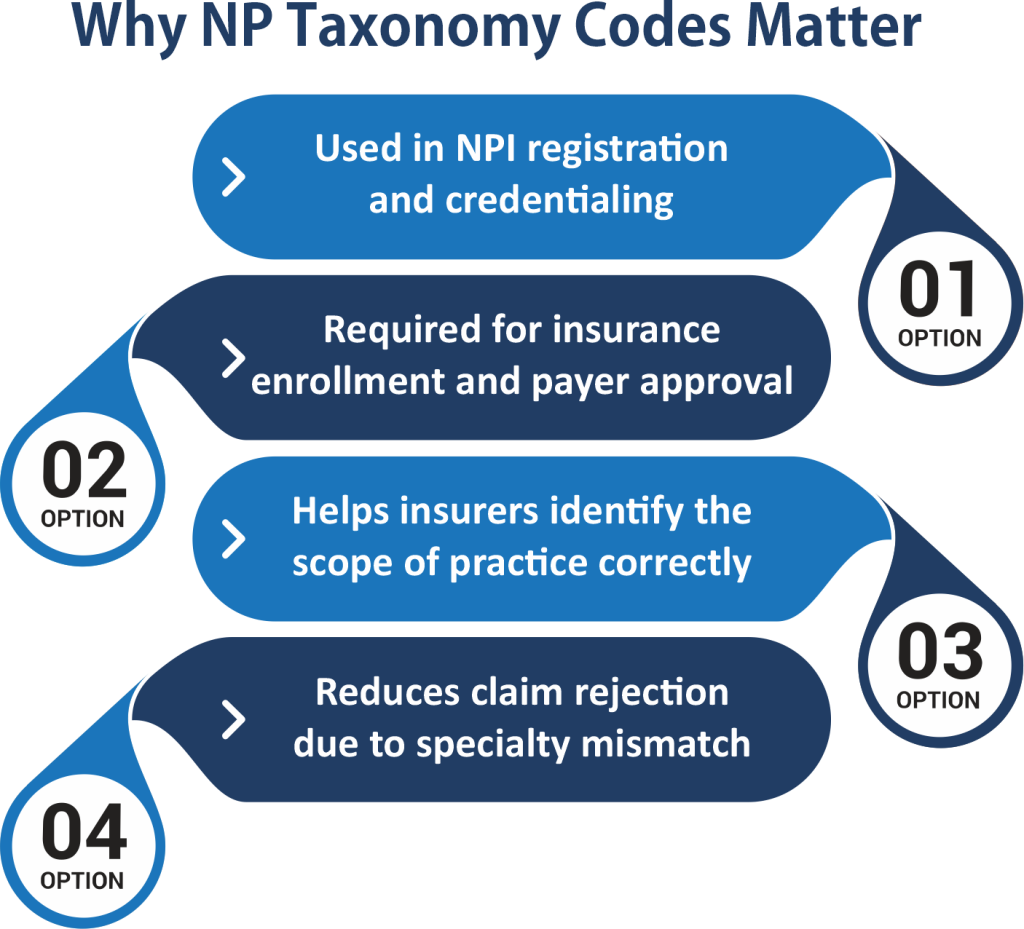
Why NP Taxonomy Codes Matter
Nurse practitioner taxonomy codes directly affect administrative and financial workflows in healthcare systems.
Key reasons:
- Used in NPI registration and credentialing
- Required for insurance enrollment and payer approval
- Impacts claim acceptance and specialty validation
- Helps insurers identify the scope of practice correctly
- Reduces claim rejection due to specialty mismatch
How to find your taxonomy code
Finding the correct taxonomy code ensures alignment between provider specialty, payer enrollment records, and billing systems, reducing the risk of claim rejection or credentialing delays.
Where to Search
Taxonomy codes must be taken from official healthcare classification sources. These systems are maintained for provider enrollment and billing accuracy.
Common sources include:
- NUCC Taxonomy Code Set (official directory of all taxonomy codes)
- NPPES (National Plan and Provider Enumeration System)
- CMS enrollment and provider resources
- Payer-specific enrollment portals (for validation)
These sources ensure that the selected taxonomy code matches current CMS-approved provider classifications.
Selection Guidelines
Selecting the correct taxonomy code requires matching provider qualifications with official classification rules.
Key guidelines:
- Match the taxonomy code with the medical license and specialty
- Confirm code aligns with board certification or training
- Verify payer requirements before final selection
- Use the most specific code available for the specialty
- Avoid generic codes unless required by the provider role
- Ensure consistency across NPI, CAQH, and payer enrollment records
Incorrect selection can lead to claim denials, credentialing delays, or mismatched provider data in insurance systems.
Conclusion
Taxonomy codes are a core part of healthcare provider identification in NPI enrollment, credentialing, and medical billing. Accurate selection and timely updates help maintain consistency across payer systems and reduce administrative errors that affect reimbursement.
Understanding how taxonomy codes work supports cleaner claims, smoother enrollment processes, and fewer claim rejections. Correct usage ensures provider data aligns across all healthcare and insurance systems, improving overall revenue cycle performance.
FAQs
What is a taxonomy code in healthcare?
A taxonomy code is a 10-character alphanumeric code that identifies a healthcare provider’s specialty and classification. It is used in NPI enrollment, credentialing, and medical billing systems.
Why is a taxonomy code important in medical billing?
A taxonomy code ensures providers are correctly identified by specialty during claim submission. Incorrect codes can lead to claim rejections, payment delays, or mismatches in payer systems.
Can a provider have more than one taxonomy code?
Yes. A provider can have multiple taxonomy codes in their NPI record. However, only one code is selected as the primary taxonomy for billing and enrollment purposes.
How do I find my taxonomy code?
Taxonomy codes can be found using the NUCC Taxonomy Code Set or through the NPPES system during NPI registration or updates. The selected code must match your specialty and credentials.
Can changing a taxonomy code affect claims?
Yes. Updating a taxonomy code can impact claim processing, payer enrollment, and credentialing records. It is important to ensure all payer systems are updated after any change to avoid claim issues.