Is your healthcare practice struggling with delayed reimbursements, claim denials, or inconsistent cash flow? Revenue Cycle Management (RCM) is the financial framework that helps healthcare providers manage every stage of the payment process—from patient scheduling and insurance verification to claim reimbursement and final collections. An effective RCM process improves billing accuracy, reduces revenue leakage, and strengthens the financial health of a practice.
Revenue cycle management covers every financial interaction associated with a patient encounter. By streamlining administrative workflows, reducing billing errors, and improving claim accuracy, healthcare organizations can accelerate reimbursements, minimize denials, and maintain a healthier cash flow.
What Is Revenue Cycle Management (RCM) in Healthcare?
This guide explains how revenue cycle management works, outlines each stage of the RCM process, and highlights best practices that help healthcare organizations reduce denials, improve reimbursement accuracy, and strengthen long-term financial performance.
What Is Revenue Cycle Management (RCM)?
Revenue cycle management is the structured financial process that tracks a patient’s journey from initial appointment scheduling down to the final zero-balance ledger entry.
RCM Definition and Purpose
Revenue Cycle Management (RCM) manages every financial activity associated with a patient’s care, beginning when an appointment is scheduled and continuing until the provider receives full reimbursement. The process includes patient registration, insurance verification, medical coding, claim submission, payment posting, patient collections, and accounts receivable follow-up.
Key Components of RCM
The core components of revenue cycle management include patient registration, insurance eligibility verification, medical coding, charge capture, claim submission, payment posting, denial management, patient collections, and accounts receivable follow-up. Together, these functions ensure that healthcare providers receive timely and accurate reimbursement while maintaining financial accuracy throughout the revenue cycle.
Why RCM Matters
Revenue cycle management directly impacts a practice’s financial performance by reducing billing errors, minimizing claim denials, accelerating reimbursements, and improving cash flow. It also helps healthcare organizations identify revenue leakage, monitor financial performance, and maintain long-term operational stability.
The Revenue Cycle Management Process
The revenue cycle management process consists of interconnected stages that work together to ensure accurate reimbursement and financial stability. Optimizing each step helps healthcare organizations reduce delays, minimize claim denials, and improve overall revenue cycle performance.
Pre-Service Activities
The revenue cycle begins before the patient receives care. During the pre-service phase, staff schedule appointments, collect demographic and insurance information, verify eligibility, obtain prior authorizations when required, confirm patient financial responsibility, and register patients accurately within the practice management system. Completing these steps correctly helps prevent claim rejections and reimbursement delays later in the revenue cycle.
Service Delivery and Documentation
During the patient encounter, providers must accurately document diagnoses, procedures, treatments, and the medical necessity for every service rendered. Complete and compliant documentation supports proper coding, minimizes billing errors, and provides the evidence required for successful claim reimbursement.
Post-Service Activities
After services are provided, certified coders assign the appropriate diagnosis and procedure codes, while billing staff prepare and submit clean claims to insurance payers. The practice then monitors claim status, posts payments, manages denied claims, and bills patients for any remaining balances until the account is fully resolved.
How Medical Billing Supports Revenue Cycle Management
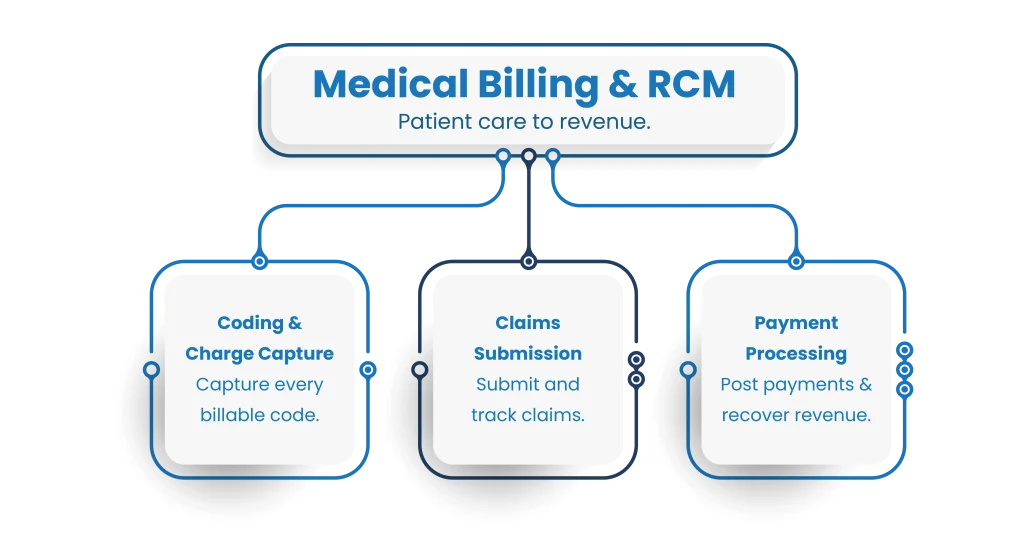
Medical billing plays a central role in revenue cycle management by converting documented healthcare services into reimbursable insurance claims. Accurate billing helps providers receive timely payments, reduce denials, and maintain consistent cash flow.
Coding and Charge Capture
Accurate coding and complete charge capture are essential to revenue cycle success. Medical coders assign the appropriate CPT and ICD-10 codes based on clinical documentation, ensuring every billable service is captured correctly. Regular charge audits help identify missed services and reduce revenue leakage.
Claims Submission Process
Most healthcare claims are submitted electronically through clearinghouses, which validate claim data before forwarding it to insurance payers. Automated claim edits identify missing information, coding errors, and formatting issues before submission, increasing first-pass acceptance rates and reducing reimbursement delays. Practices should monitor claim status regularly and promptly correct or resubmit rejected claims whenever necessary.
Payment Processing
After claims are processed, insurance companies issue payments accompanied by an Explanation of Benefits (EOB). Practices post payments accurately, reconcile reimbursement amounts, identify underpayments, appeal incorrect reimbursements when necessary, and apply patient payments to outstanding balances.
Common RCM Challenges
Healthcare organizations face a variety of operational and financial challenges that can disrupt the revenue cycle. Identifying these issues early helps reduce payment delays, improve collections, and strengthen overall financial performance.
Claim Denials and Rejections
Claim denials remain one of the largest obstacles to an efficient revenue cycle. Common causes include coding errors, incomplete documentation, eligibility verification failures, missing prior authorizations, and timely filing issues. An effective denial management process identifies recurring trends, corrects errors quickly, and improves future claim acceptance rates.
Patient Collections Issues
Rising deductibles and out-of-pocket expenses have increased patient financial responsibility, making collections more challenging for healthcare practices. Many patients struggle to pay large balances, resulting in delayed payments and higher outstanding accounts receivable. Clear billing statements, flexible payment plans, and proactive patient communication can improve collection rates and reduce unpaid balances.
Technology and Integration Problems
Outdated billing systems, disconnected software platforms, and manual data entry increase administrative workload and the risk of billing errors. Integrating practice management, EHR, and billing systems improves efficiency, reduces duplicate work, and supports a smoother revenue cycle.
Best Practices for RCM Success
Implementing proven revenue cycle management best practices helps healthcare organizations improve reimbursement accuracy, reduce claim denials, and strengthen long-term financial performance.
Staff Training and Education
Ongoing staff education is essential for maintaining an efficient revenue cycle. Regular training on coding updates, payer policy changes, documentation requirements, and internal workflows helps reduce billing errors, improve compliance, and increase first-pass claim acceptance rates.
Technology Solutions
Modern billing software, automated eligibility verification, electronic claim submission, real-time claim tracking, and patient payment portals help improve operational efficiency. Regular medical billing and coding audits further ensure billing accuracy, identify revenue leakage, and support continuous process improvement.
Regular Performance Monitoring
Healthcare organizations should continuously monitor key performance indicators such as days in accounts receivable (A/R), first-pass claim acceptance rate, denial rate, collection rate, and net collection percentage. Tracking these metrics helps identify operational bottlenecks and supports informed decision-making.
Improving Your RCM Process
Improving revenue cycle performance requires continuous monitoring, process optimization, and staff accountability. Identifying operational inefficiencies early helps healthcare organizations prioritize improvements that deliver the greatest financial impact.
Identify Problem Areas
Reviewing denial trends, aging accounts receivable, claim turnaround times, and low-performing service lines helps identify inefficiencies within the revenue cycle. Staff feedback and workflow analysis also provide valuable insight into operational bottlenecks that require improvement.
Implement Process Changes
After identifying problem areas, healthcare organizations should prioritize high-impact improvements, automate repetitive administrative tasks, standardize workflows, develop process checklists, and test operational changes before implementing them across the organization.
Measure and Adjust
Revenue cycle improvement is an ongoing process. Practices should establish measurable performance goals, monitor progress regularly, compare results against industry benchmarks, and adjust workflows based on performance data to ensure continuous financial improvement.
Conclusion
Revenue Cycle Management is more than a billing function—it is the foundation of a financially healthy healthcare practice. By optimizing every stage of the revenue cycle, from patient registration through final payment, providers can improve reimbursement accuracy, reduce denials, strengthen cash flow, and deliver a better financial experience for both staff and patients.
FAQs
What does RCM stand for in healthcare?
RCM stands for Revenue Cycle Management. It refers to the process of managing every financial stage of a patient encounter, from appointment scheduling and insurance verification to claim reimbursement, patient collections, and final payment.
How long does the revenue cycle take?
The average revenue cycle takes 30-90 days, usually. Time varies by payer and claim complexity. Clean claims are processed much faster than claims requiring corrections or resubmission. Some claims take longer due to denials.
What are the main stages of revenue cycle management?
The main stages include patient registration, insurance verification, service delivery, medical coding, billing, claims submission, payment posting, denial management, patient collections, and account follow-up.
Why do healthcare practices need RCM?
RCM helps healthcare providers improve reimbursement accuracy, reduce claim denials, strengthen cash flow, and maintain financial stability by managing every stage of the revenue cycle efficiently.
What causes most RCM problems?
The most common RCM challenges include coding errors, incomplete documentation, insurance eligibility verification failures, missing prior authorizations, claim denials, patient collection difficulties, and inefficient administrative workflows.