In a healthcare environment, even small billing errors can lead to massive revenue losses. That’s where healthcare charge capture becomes critical. It’s the process that ensures every service provided, from consultations to procedures, is accurately recorded and billed. Yet, many healthcare providers still struggle with missed charges, delayed entries, and compliance risks.
If you’ve ever wondered why revenue leaks happen or how hospitals improve their financial performance, the answer often lies in an optimized charge capture process. When done right, charge capture medical billing not only boosts revenue but also reduces claim denials and improves operational efficiency.
In this guide, you’ll discover exactly what charge capture is, how it works, the common challenges providers face, and the best charge capture solutions to streamline your workflow and maximize reimbursements.
What is Healthcare Charge Capture?
Healthcare charge capture is the process of accurately recording all billable services provided to a patient so healthcare organizations can receive proper reimbursement. In simple terms, it acts as the bridge between patient care and payment.
Every time a provider delivers a service, whether it’s a consultation, diagnostic test, procedure, or medication, it must be documented and translated into billable charges. This is where charge capture medical billing begins. If even a single service is missed or incorrectly recorded, it can lead to lost revenue or compliance issues.
A well-structured charge capture process ensures that:
- Every service is documented in real time
- Charges are accurately coded using standardized systems
- Billing teams receive complete and error-free data
Ultimately, charge capture is not just about billing; it’s about ensuring healthcare providers are fairly compensated for the care they deliver while maintaining transparency and compliance.
Why is Charge Capture Important in Healthcare?
The importance of healthcare charge capture cannot be overstated. It directly impacts a healthcare organization’s financial health, operational efficiency, and regulatory compliance.
Here’s why it matters:
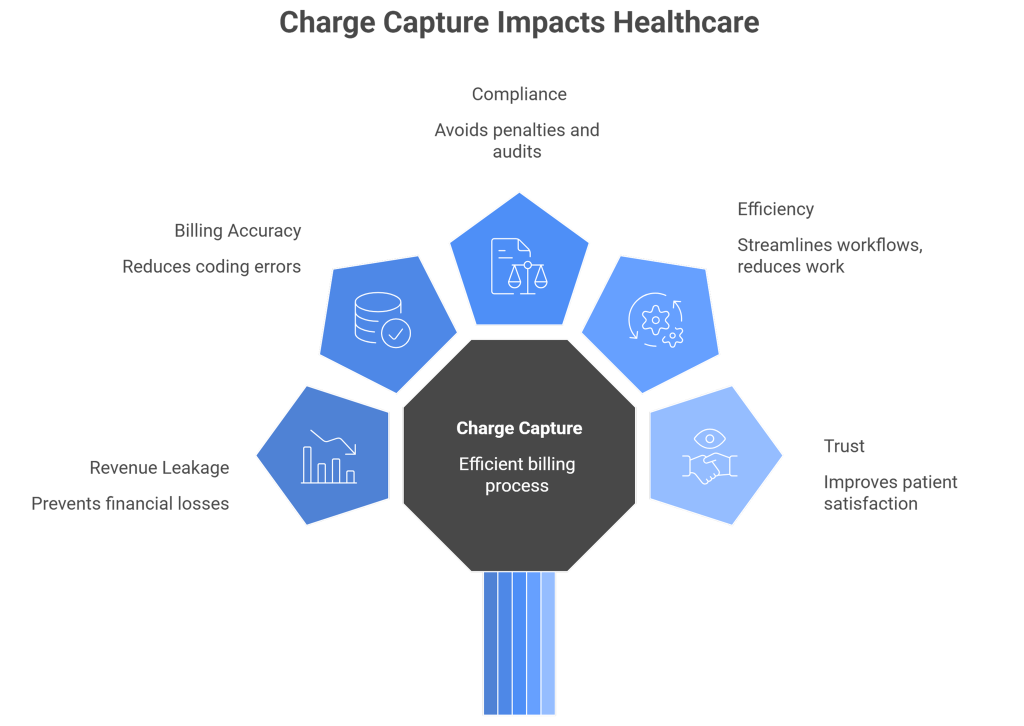
Prevents Revenue Leakage: Missed or delayed charges can result in significant financial losses. An efficient charge capture process ensures that no service goes unbilled.
Improves Billing Accuracy: Accurate charge capture and medical billing reduce errors in coding and claim submissions, leading to fewer denials and faster reimbursements.
Ensures Compliance: Healthcare billing must comply with strict regulations. Proper charge capture helps avoid undercoding, overcoding, and potential audits or penalties.
Enhances Operational Efficiency: Automated charge capture solutions streamline workflows, reduce manual work, and allow staff to focus on patient care instead of administrative tasks.
Builds Patient Trust: Transparent and accurate billing improves patient satisfaction and reduces disputes over charges.
In short, optimizing charge capture is one of the most effective ways to increase revenue while maintaining compliance and efficiency.
How the Charge Capture Process Works (Step-by-Step)
Understanding the charge capture process is essential for improving billing accuracy and reducing revenue loss. Here’s how it typically works:
🔹 Step 1: Patient Encounter
The process begins when a patient receives care. This could include consultations, procedures, lab tests, or treatments.
🔹 Step 2: Documentation
Healthcare providers document all services performed during the visit. Accurate and detailed documentation is critical for successful charge capture medical billing.
🔹 Step 3: Medical Coding
The documented services are translated into standardized medical codes (such as ICD-10 and CPT codes). This step ensures that services can be billed correctly.Ensuring these codes are applied accurately through professional medical coding audit services is vital to preventing lost revenue.
🔹 Step 4: Charge Entry
All coded services are entered into the billing system or Electronic Health Record (EHR). This is where charge capture officially converts into billable data.
🔹 Step 5: Claim Submission
The billing team submits claims to insurance providers or payers for reimbursement.
🔹 Step 6: Reconciliation
Finally, payments are matched against submitted charges to ensure accuracy and identify any discrepancies or missing revenue.
Types of Charge Capture in Healthcare
Understanding the different types of charge capture methods helps healthcare organizations choose the right approach for accuracy and efficiency. While many competitors briefly mention this, a deeper breakdown gives you a clear advantage.
1. Manual Charge Capture
This traditional method involves paper-based documentation or manual data entry.
- Prone to human error
- Higher chances of missed charges
- Time-consuming and inefficient
2. Electronic Charge Capture
This method uses Electronic Health Records (EHRs) and digital systems to record services.
- Reduces errors
- Improves accuracy in charge capture medical billing
- Enables faster claim submission
3. Mobile Charge Capture
With mobile apps and cloud-based tools, providers can capture charges in real time.
- Ideal for physicians on the go
- Minimizes charge lag
- Enhances the overall charge capture process
Modern charge capture solutions often combine electronic and mobile capabilities to ensure real-time, accurate billing.
Common Challenges in Charge Capture
Even with advanced systems, many healthcare providers struggle with inefficiencies in healthcare charge capture. Identifying these challenges is the first step toward improvement.
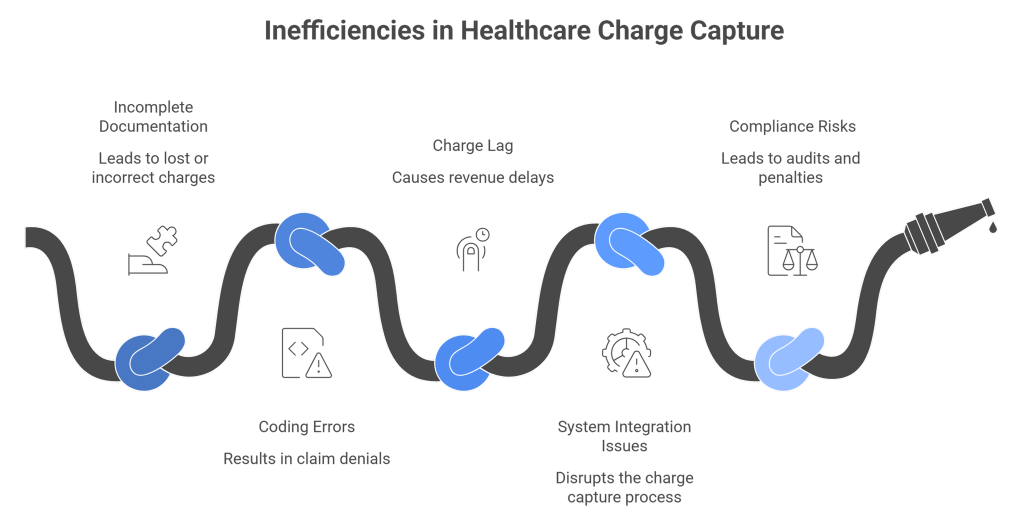
- Incomplete Documentation: Missing or unclear documentation leads to lost charges or incorrect billing.
- Coding Errors: Incorrect coding is a primary driver of revenue loss. When these errors bypass initial checks, they inevitably result in rejected claims, requiring specialized denial management services to investigate the root cause, file appeals, and recover the unpaid revenue.
- Charge Lag: Delays between service delivery and charge entry can cause revenue delays and missed billing opportunities.
- System Integration Issues: Disconnected systems between EHR, billing, and coding tools can disrupt the charge capture process.
- Compliance Risks: Improper charge capture can lead to audits, penalties, or legal issues due to inaccurate billing.
These challenges are often overlooked by competitors, but addressing them directly helps build authority and trust with readers.
Benefits of an Effective Charge Capture System
Implementing efficient charge capture solutions can transform both financial and operational performance in healthcare organizations.
- Increased Revenue Accuracy
- Faster Reimbursements
- Reduced Claim Denials
- Improved Compliance
- Enhanced Workflow Efficiency
- Better Financial Visibility
Role of Charge Capture in Medical Billing
Charge capture medical billing is the foundation of the entire revenue cycle. Without accurate charge capture, even the most efficient billing systems can fail to generate proper reimbursement.
Here’s how charge capture fits into medical billing:
🔹 Starting Point of the Revenue Cycle
Every billing process begins with capturing charges. If this step is flawed, everything that follows, coding, claims, and reimbursement, will be affected.
🔹 Ensures Clean Claim Submission
Accurate healthcare charge capture ensures that claims are complete and error-free before submission, reducing the chances of rejection.
🔹 Prevents Undercoding and Overcoding
A strong charge capture process ensures that services are billed correctly, avoiding lost revenue from undercoding and compliance risks from overcoding.
🔹 Improves Financial Performance
When charge capture medical billing is optimized, organizations experience fewer denials, faster payments, and better cash flow.
Many competitors mention this briefly, but in reality, charge capture is the single most critical step that determines the success of the entire billing cycle.
Top Charge Capture Solutions in Healthcare
With increasing complexity in billing, healthcare providers are turning to advanced charge capture solutions to improve accuracy and efficiency.
Electronic Health Record (EHR) Integration: Modern systems integrate charge capture directly into EHR platforms, ensuring seamless documentation and billing.
Mobile Charge Capture Apps: Mobile-enabled charge capture solutions allow providers to record services in real time, reducing delays and missed charges.
AI-Powered Coding Tools: Artificial intelligence helps automate coding, improving accuracy in charge capture, medical billing, and reducing manual errors.
Revenue Cycle Management (RCM) Software: Comprehensive platforms combine billing, coding, and analytics to optimize the entire charge capture process.
Features to Look for in Charge Capture Solutions:
- Real-time data entry
- Automated coding assistance
- EHR integration
- Compliance tracking
- Analytics and reporting
Best Practices to Improve Charge Capture
Improving healthcare charge capture requires a combination of technology, training, and process optimization. Here are proven best practices that leading organizations follow:
Train Staff Regularly: Ensure providers and billing teams understand the importance of accurate documentation and the charge capture process.
Implement Real-Time Documentation: Encourage capturing charges immediately after patient encounters to reduce charge lag.
Use Automated Charge Capture Solutions: Adopting modern charge capture solutions minimizes errors and improves efficiency.
Conduct Regular Audits: Routine audits help identify gaps in charge capture, medical billing, and ensure compliance.
Integrate Systems: Seamless integration between EHR, billing, and coding systems enhances workflow and reduces data silos.
Monitor Key Performance Indicators (KPIs): Track metrics like charge lag, denial rates, and revenue leakage to continuously improve performance.
Future Trends in Charge Capture (2026 & Beyond)
As healthcare continues to evolve, charge capture solutions are becoming smarter, faster, and more automated. Staying ahead of these trends can give healthcare organizations a strong competitive advantage.
Artificial intelligence is transforming charge capture and medical billing by automating coding, detecting missed charges, and reducing human errors. Modern systems enable instant documentation and billing, eliminating delays in the charge capture process and improving cash flow.
With the rise of virtual care, healthcare charge capture is adapting to include telehealth services, ensuring accurate billing for remote consultations.
As healthcare shifts toward value-based care, charge capture is evolving to align with quality outcomes rather than just service volume. New charge capture solutions provide actionable insights, helping organizations identify revenue gaps and optimize performance.
Conclusion
In the healthcare landscape, healthcare charge capture is no longer optional; it’s essential for financial stability and operational success. From ensuring accurate documentation to enabling efficient charge capture and medical billing, every step in the charge capture process directly impacts revenue and compliance.
By implementing modern charge capture solutions, training staff, and optimizing workflows, healthcare organizations can significantly reduce errors, prevent revenue leakage, and improve overall performance.