Podiatry billing can feel overwhelming, especially when coding errors lead to denied claims, delayed payments, or compliance risks. Whether you’re a podiatrist, medical biller, or part of an RCM team, understanding the right CPT codes for podiatry care is critical to keeping your practice financially healthy and audit-ready. The good news?
With the right knowledge and structure, coding doesn’t have to be complicated. In this article, we break down the most important podiatry CPT codes, from evaluation and treatment to common procedures, so you can code with confidence, reduce denials, and ensure you’re getting paid for the care you deliver.
What Are CPT Codes in Podiatry?
CPT codes, or Current Procedural Terminology codes, are standardized codes developed by the American Medical Association (AMA) to describe medical, surgical, and diagnostic services. In podiatry, these codes play a critical role in ensuring that every service provided, from routine nail care to complex surgical procedures, is accurately documented and billed.
For podiatry practices, CPT coding is more than just an administrative task. It directly impacts reimbursement, compliance, and overall revenue cycle performance. Using the correct podiatry CPT codes helps providers communicate clearly with payers, justify medical necessity, and reduce the risk of claim denials.
Categories of Podiatry CPT Codes
To simplify coding and improve accuracy, podiatry CPT codes are generally grouped into key categories based on the type of service provided. Understanding these categories helps providers and billing teams quickly identify the right codes for each patient encounter.
Evaluation and Management (E/M) Codes
Evaluation and Management codes are used when a podiatrist assesses a patient’s condition and determines a treatment plan. These are some of the most commonly used CPT codes for podiatry care.
- New Patients: 99202 to 99205
- Established Patients: 99211 to 99215
These codes are selected based on the level of medical decision-making or the total time spent with the patient. Proper documentation is essential, including patient history, examination findings, and treatment planning.
These codes directly address common searches such as the CPT code for podiatry evaluation and treatment, making them essential for both clinical and billing accuracy.
Surgical and Procedure Codes
This category includes codes for procedures performed by podiatrists, ranging from minor treatments to more complex surgical interventions.
Common examples include:
- Nail debridement and removal
- Treatment of ingrown toenails
- Excision of skin lesions
- Foot and ankle surgical procedures
Accurate use of podiatry procedure codes ensures that each service is billed correctly and reimbursed appropriately. It also helps avoid undercoding or overcoding, both of which can create compliance issues.
Routine Foot Care Codes
Routine foot care is a significant part of podiatry services, especially for patients with chronic conditions such as diabetes.
These codes cover:
- Trimming of nails
- Removal of corns and calluses
However, it is important to note that routine foot care is often not covered by Medicare unless specific medical conditions are documented. Proper use of diagnosis codes and supporting documentation is key to receiving reimbursement.
Diagnostic Services
Diagnostic CPT codes in podiatry are used when evaluating underlying conditions affecting the foot and ankle.
These may include:
- X-rays and imaging services
- Biomechanical assessments
- Vascular or neurological testing
Using the correct diagnostic codes helps support medical necessity and strengthens the overall claim, reducing the likelihood of denials.
Common Podiatry CPT Codes You Should Know
When it comes to podiatry billing, certain CPT codes are used more frequently than others. Knowing these common podiatry CPT codes can significantly improve coding efficiency, reduce errors, and help ensure consistent reimbursement.
Below is a quick reference of widely used codes in podiatry care:
| CPT Code | Description | Typical Use Case |
| 11720 | Debridement of nail(s), 1 to 5 | Fungal or thickened nails |
| 11721 | Debridement of nail(s), 6 or more | Advanced nail conditions |
| 11055 | Paring or cutting of 1 corn or callus | Minor lesions |
| 11056 | Paring of 2 to 4 corns or calluses | Moderate cases |
| 11057 | Paring of more than 4 corns or calluses | Extensive lesions |
| 11730 | Avulsion of nail plate | Ingrown toenail treatment |
| 11750 | Excision of nail and nail matrix | Permanent nail removal |
| 99213 | Office visit for established patient | Routine evaluation |
| 99214 | Office visit with moderate complexity | Chronic or complex conditions |
These codes form the foundation of most podiatry practices. Using them correctly not only supports accurate billing but also aligns your documentation with payer expectations.
Podiatry Procedure Codes Explained
Understanding podiatry procedure codes in detail helps providers choose the most appropriate code for each clinical scenario. This reduces the risk of denials and ensures that services are properly reimbursed.
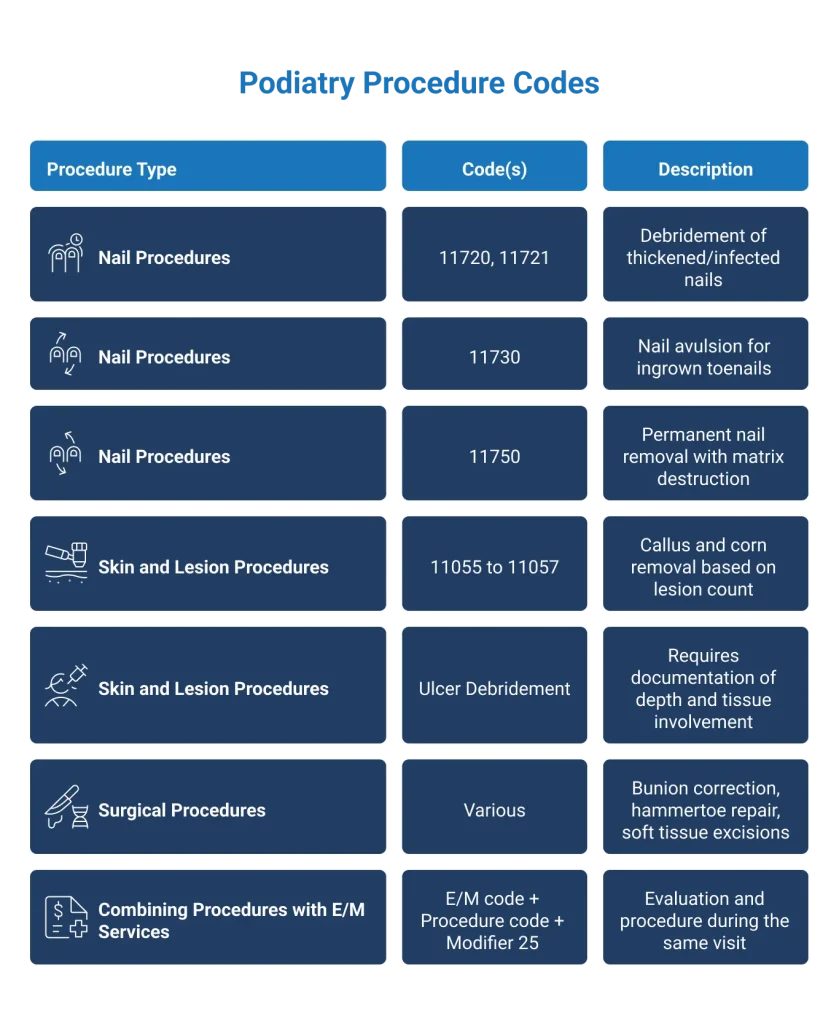
1. Nail Procedures
Nail-related treatments are among the most common services in podiatry.
- Debridement (11720, 11721): Used when thickened or infected nails are reduced in length and thickness
- Nail Avulsion (11730): Removal of part or all of the nail, typically for ingrown toenails
- Permanent Nail Removal (11750): Includes destruction of the nail matrix to prevent regrowth
Choosing between these codes depends on the severity of the condition and whether the procedure is temporary or permanent.
2. Skin and Lesion Procedures
Podiatrists frequently treat skin conditions such as corns, calluses, and ulcers.
- Callus and Corn Removal (11055 to 11057): Based on the number of lesions treated
- Ulcer Debridement: Requires careful documentation of depth and tissue involvement
Accurate coding in this category depends heavily on documenting the number of lesions and the complexity of treatment.
3. Surgical Procedures
For more advanced conditions, podiatrists may perform surgical interventions.
Examples include:
- Bunion correction procedures
- Hammertoe repair
- Soft tissue excisions
These procedures often require more detailed coding and may involve multiple CPT codes, modifiers, and supporting documentation.
4. Combining Procedures with E/M Services
In many cases, a podiatrist may perform both an evaluation and a procedure during the same visit.
For example:
- A patient presents with foot pain
- The provider performs an evaluation and removes an ingrown toenail
In such cases, an E/M code like 99213 can be billed alongside a procedure code like 11730, provided that the evaluation is significant and separately identifiable. Modifier 25 is typically required in this scenario.
CPT Code for Podiatry Evaluation and Treatment
Selecting the correct CPT code for podiatry evaluation and treatment is essential for accurate billing and proper reimbursement. Many claim denials happen because providers either undercode, overcode, or fail to document the level of service correctly.
🔸 Understanding E/M Code Selection
Evaluation and Management codes are divided into two main categories:
- New Patients: 99202 to 99205
- Established Patients: 99211 to 99215
These codes are chosen based on one of the following:
- Medical Decision Making (MDM)
- Total Time Spent on the Encounter
Most podiatry practices rely on medical decision-making, which considers:
- The complexity of the patient’s condition
- The amount of data reviewed
- The risk of complications or treatment
🔸 Example of Proper Coding
Let’s break this down with a real-world scenario:
A patient with diabetes visits for foot pain and shows signs of a developing ulcer. The podiatrist performs a detailed evaluation, reviews the patient’s history, and initiates treatment.
- E/M Code: 99214 (moderate complexity)
- Procedure Code: 11055 or debridement code depending on treatment
If both services are provided and documented properly, they can be billed together using modifier 25 with the E/M code.
🔸 Documentation Tips for Accurate Coding
To support the correct CPT code selection, your documentation should include:
- Patient history and presenting complaint
- Examination findings
- Diagnosis and clinical reasoning
- Treatment plan and follow-up
Clear and detailed documentation not only supports higher-level codes when appropriate but also protects your practice during audits.
Common Billing Mistakes in Podiatry Coding
Even experienced providers and billing teams can make coding mistakes that lead to claim denials or revenue loss. Identifying and avoiding these errors can significantly improve your reimbursement rates.

Incorrect Code Selection
Using the wrong CPT code for a procedure or evaluation is one of the most common issues. This can happen when:
- Codes are selected based on habit instead of documentation
- The complexity of the visit is underestimated or overstated
Missing or Incorrect Modifiers
Modifiers are essential in podiatry billing, especially when multiple services are performed during the same visit.
Common issues include:
- Not using modifier 25 when billing E/M with a procedure
- Incorrect use of modifier 59 for distinct services
Without proper modifiers, claims may be denied or bundled incorrectly.
Billing Non-Covered Routine Foot Care
Routine foot care services, such as nail trimming or callus removal, are often not covered by Medicare unless specific medical conditions are documented.
Failing to:
- Link the correct diagnosis code
- Document medical necessity
can result in automatic denials.
Unbundling Services
Some procedures are meant to be billed together under a single code. Billing them separately can trigger compliance issues and audits.
Always verify:
- National Correct Coding Initiative guidelines
- Payer-specific bundling rules
Incomplete Documentation
No matter how accurate your coding is, poor documentation can invalidate the claim.
Missing details such as:
- Procedure notes
- Number of lesions treated
- Severity of condition
can lead to reduced payments or denials.
Avoiding these common mistakes not only protects your revenue but also strengthens compliance and reduces administrative burden over time.
Modifiers Used in Podiatry Billing
Modifiers play a crucial role in podiatry coding by providing additional context to the services performed. When used correctly, they help prevent claim denials and ensure accurate reimbursement.
Common Modifiers in Podiatry
- Modifier 25
Used when a significant and separately identifiable E/M service is performed on the same day as a procedure.
Example: Office visit plus nail avulsion - Modifier 59
Indicates a distinct procedural service that should not be bundled with another procedure - Toe Modifiers (T1 to T9, TA to T9)
Specify the exact toe where the procedure was performed. These are essential for surgical accuracy and payer clarity - Modifier Q7, Q8, Q9
Used for routine foot care when qualifying systemic conditions are present, especially for Medicare claims
Correct use of modifiers ensures that services are not incorrectly bundled or denied, making them a key part of podiatry billing success.
Medicare Guidelines for Podiatry CPT Codes
Medicare has strict rules when it comes to podiatry services, especially routine foot care. Understanding these guidelines is critical for avoiding denials and maintaining compliance.
Routine Foot Care Coverage: Medicare generally does not cover routine foot care such as:
- Nail trimming
- Corn and callus removal
However, exceptions are made when the patient has a qualifying medical condition, such as:
- Diabetes
- Peripheral vascular disease
- Neuropathy
In these cases, proper documentation and the use of modifiers like Q7, Q8, or Q9 are required.
Documentation Requirements: To meet Medicare standards, providers must clearly document:
- The underlying systemic condition
- The severity of the foot condition
- The medical necessity of the service
Incomplete or vague documentation can lead to immediate claim rejection.
Frequency Limitations: Medicare may limit how often certain podiatry services can be billed. Providers should:
- Verify payer specific frequency rules
- Maintain accurate patient visit records
Staying compliant with these guidelines helps reduce audits and ensures consistent reimbursement.
Best Practices for Accurate Podiatry Coding
Improving coding accuracy is not just about knowing the right codes. It requires a consistent and proactive approach.
Keep Coding Resources Updated: Always refer to the latest CPT code set and payer policies to avoid outdated coding practices.
Focus on Detailed Documentation: Strong documentation supports higher-level codes when justified and protects against audits.
Perform Regular Audits: Internal audits help identify coding errors, missed revenue opportunities, and compliance risks.
Train Staff Continuously: Billing teams and providers should stay informed about coding updates, modifier usage, and payer changes.
Leverage Technology or RCM Support: Using advanced billing software or outsourcing to experienced RCM teams can improve accuracy and efficiency.
Closing Note
Accurate use of CPT codes for podiatry care is essential for maintaining a healthy revenue cycle and ensuring compliance with payer requirements. From evaluation and treatment codes to procedure-specific billing and modifier usage, every detail matters when it comes to reducing denials and maximizing reimbursement.
By understanding common podiatry CPT codes, following Medicare guidelines, and maintaining strong documentation practices, providers can streamline their billing process and focus more on delivering quality patient care.
If you want to improve your coding accuracy and reduce administrative stress, investing in proper training or expert billing support can make a significant difference in your practice’s long-term success.