Radiology billing compliance isn’t just about submitting claims; it’s about submitting the right claims with the right documentation. Incomplete or inaccurate patient records are one of the leading causes of claim denials, delayed reimbursements, and even costly audits.
Whether you’re a radiology practice, medical biller, or healthcare administrator, understanding exactly what needs to be documented is critical to protecting your revenue and staying compliant with strict regulatory standards.
In this article, we’ll break down every essential component that must be included in a patient record for radiology billing compliance. From physician orders to coding accuracy and medical necessity, you’ll gain a clear, actionable roadmap to ensure your documentation meets payer expectations.
Radiology Billing Compliance
Radiology billing compliance refers to adhering to the rules, regulations, and documentation standards required by payers to ensure accurate reimbursement for imaging services. It goes beyond just coding and submitting claims; it involves maintaining complete, verifiable patient records that justify every procedure performed.
In today’s highly regulated healthcare environment, even minor documentation errors can lead to denied claims or trigger audits. That’s why compliance is not optional; it’s essential for financial stability and operational efficiency.
What is Radiology Billing?
Radiology billing is a specialized area of medical billing that focuses on imaging services such as X-rays, CT scans, MRIs, and ultrasounds. It involves translating medical procedures into standardized codes (like CPT and ICD-10) and submitting them to insurance companies for reimbursement.
What makes radiology billing unique is its dual component:
- Professional billing (radiologist’s interpretation)
- Technical billing (use of equipment and facility)
Both components must be properly documented in the patient record to ensure full and accurate reimbursement.
Why Compliance is Critical?
Failing to meet radiology billing requirements can have serious consequences. Here’s why compliance should be a top priority:
- Prevents Claim Denials: Missing or incomplete documentation is a leading cause of rejected claims
- Ensures Legal Protection: Proper records protect against fraud and abuse allegations
- Improves Revenue Cycle: Clean claims lead to faster reimbursements
- Reduces Audit Risks: Complete documentation minimizes exposure during payer audits
Ultimately, compliance is about creating a defensible, transparent patient record that supports every billed service. If you are unsure if your current records would survive a payer review, regular medical coding audit services are your best defense. An external audit can pinpoint documentation gaps in your physician orders or radiology reports before they are flagged by CMS or private insurers during a formal investigation.
Key Components Required in a Patient Record for Radiology Billing Compliance
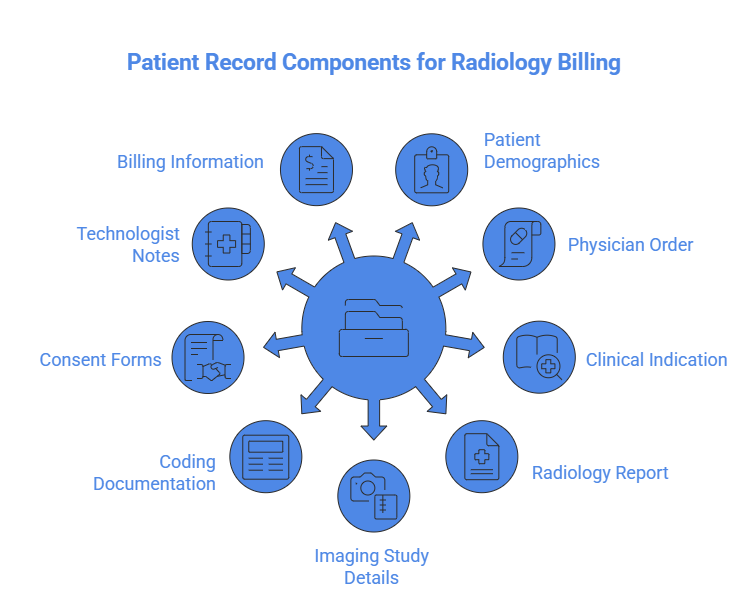
To be compliant with radiology billing requirements, every patient record must include specific components that validate the service provided. Missing even one element can result in claim rejection or payment delays.
Let’s break down each required component:
1. Patient Demographics
Accurate patient identification is the foundation of any medical record. This includes:
- Full name
- Date of birth
- Gender
- Insurance information
- Contact details
Errors in demographics can lead to claim rejections before the billing process even begins.
2. Physician Order / Referral
A valid physician order is mandatory for most radiology procedures. It must include:
- Referring physician’s name and credentials
- Specific imaging test requested
- Clinical indication or reason for the test
Without a proper order, the service may not be considered medically necessary, resulting in non-payment.
3. Clinical Indication (Medical Necessity)
Medical necessity is one of the most scrutinized aspects of radiology billing. The patient record must clearly explain why the imaging study was needed.
This includes:
- Symptoms or presenting condition
- Relevant diagnosis codes (ICD-10)
- Supporting clinical notes
Payers will not reimburse services that are not medically justified, making this a critical compliance component.
4. Radiology Report
The radiology report is the official interpretation of the imaging study and must be:
- Completed by a qualified radiologist
- Detailed with findings and impressions
- Signed and dated
Unsigned or incomplete reports are a common reason for denied claims.
5. Imaging Study Details
Every imaging procedure must be fully documented, including:
- Type of imaging performed (e.g., MRI, CT scan)
- Date and time of service
- Technical details of the procedure
This ensures transparency and supports both the technical and professional billing components.
6. CPT and ICD-10 Coding Documentation
Accurate coding is essential for compliance and reimbursement. The patient record must support:
- CPT codes (procedure performed)
- ICD-10 codes (diagnosis or reason for procedure)
Any mismatch between documentation and coding can result in claim denials or compliance issues.
7. Consent Forms (If Applicable)
Certain imaging procedures, especially those involving contrast or higher risks, require documented patient consent.
This should include:
- Signed consent forms
- Explanation of risks and benefits
Failure to obtain proper consent can lead to legal complications and billing issues.
8. Technologist Notes
Technologist documentation adds another layer of detail to the patient record. These notes may include:
- How the procedure was performed
- Use of contrast agents
- Any complications or patient reactions
These notes support the accuracy of the procedure and can be critical during audits.
9. Billing and Charge Capture Information
Finally, the patient record must align with the billing data submitted. This includes:
- Itemized services provided
- Modifiers (if applicable)
- Accurate charge entries
Consistency between clinical documentation and billing is key to avoiding discrepancies and denials.
Regulatory Guidelines for Radiology Billing Compliance
Radiology billing is governed by strict regulations designed to ensure accuracy, transparency, and patient protection. Understanding these guidelines is essential for maintaining compliance and avoiding penalties.
HIPAA Requirements
The Health Insurance Portability and Accountability Act (HIPAA) mandates the protection of patient information.
Key compliance points include:
- Secure storage of patient records
- Controlled access to sensitive data
- Proper handling of electronic health records (EHRs)
Violations can result in severe fines and reputational damage.
CMS (Centers for Medicare & Medicaid Services) Guidelines
CMS sets the standard for documentation and reimbursement in radiology billing.
Important requirements include:
- Proof of medical necessity
- Proper use of CPT and ICD-10 codes
- Complete and accurate documentation
CMS guidelines often influence private payer policies, making them essential to follow.
Local Coverage Determinations (LCDs)
LCDs are region-specific policies that define which services are covered and under what conditions.
They help determine:
- Whether a procedure is medically necessary
- Which diagnosis codes justify certain imaging studies
Failure to comply with LCDs can lead to denied claims, even if all other documentation is correct. Staying on top of these region-specific rules requires constant monitoring, which is why many imaging centers partner with dedicated radiology billing services. These specialists manage the local coverage nuances for you, ensuring that your documentation consistently meets the specific medical necessity criteria of your regional payers.
Common Mistakes That Lead to Claim Denials
Even well-established radiology practices can face claim denials due to avoidable documentation errors. If you are already seeing a high volume of rejections due to “missing physician orders” or “unsigned reports,” integrating denial management services into your workflow is critical. These specialists don’t just resubmit claims; they analyze your denial patterns to help you fix the clinical documentation bottlenecks that are hurting your cash flow.
Understanding these common pitfalls can help you proactively protect your revenue cycle.
Missing Physician Orders: One of the most frequent reasons for denial is the absence of a valid physician order. Without it, the procedure may not qualify as medically necessary.
Incomplete Documentation: Partial or vague patient records fail to justify the service provided. Missing details, like imaging specifics or clinical indications, can trigger rejections.
Incorrect Coding: Using inaccurate or outdated CPT and ICD-10 codes creates a mismatch between the service performed and the claim submitted.
Lack of Medical Necessity: If the documentation does not clearly explain why the imaging was needed, payers are likely to deny reimbursement.
Unsigned Radiology Reports: A missing signature from the radiologist can invalidate the entire report, making the claim non-compliant.
Best Practices for Maintaining Compliance
Maintaining radiology billing compliance requires a proactive and systematic approach. Implementing these best practices can significantly reduce errors and improve reimbursement rates.
Accurate and Real-Time Documentation
Ensure that all patient information is recorded promptly and accurately. Delayed or incomplete entries increase the risk of errors and omissions.
Regular Internal Audits
Conduct periodic audits to identify documentation gaps, coding errors, and compliance risks before they escalate into costly issues.
Ongoing Staff Training
Keep your billing and clinical teams updated on:
- Coding changes
- Regulatory updates
- Documentation standards
Well-trained staff is your first line of defense against compliance failures.
Use of Advanced Radiology Billing Software
Modern billing solutions can:
- Automate coding suggestions
- Flag missing documentation
- Reduce manual errors
This not only improves efficiency but also enhances compliance accuracy.
Radiology Billing Compliance Checklist
Use this quick checklist to ensure every patient record meets radiology billing requirements:
- ✔ Complete patient demographics
- ✔ Valid physician order or referral
- ✔ Clear documentation of medical necessity
- ✔ Signed and finalized radiology report
- ✔ Accurate CPT and ICD-10 codes
- ✔ Consent forms (if required)
- ✔ Detailed technologist notes
- ✔ Correct billing and charge capture information
This checklist can serve as a daily operational tool to minimize denials and streamline workflows.
The Bottom Line
Radiology billing compliance starts and ends with a complete, accurate patient record. Every detail, from physician orders to coding and final reports, plays a critical role in ensuring that claims are approved and reimbursed without delays.
By understanding the required components, avoiding common mistakes, and implementing proven best practices, radiology providers can significantly reduce denials, improve cash flow, and maintain full compliance with regulatory standards.
In an industry where even small documentation gaps can lead to major financial setbacks, getting your patient records right isn’t just important; it’s essential.
FAQs
Q: What documentation is required for radiology billing compliance?
Ans: Radiology billing compliance requires a complete patient record that includes demographics, physician orders, medical necessity, radiology reports, imaging details, coding, consent forms (if applicable), and billing information.
Q: Why is medical necessity important in radiology billing?
Ans: Medical necessity ensures that the imaging service is justified based on the patient’s condition. Without it, insurance providers are unlikely to reimburse the claim.
Q: What happens if documentation is incomplete?
Ans: Incomplete documentation can lead to claim denials, delayed payments, increased audit risk, and potential legal or financial penalties.
Q: How can radiology practices improve billing accuracy?
Ans: Practices can improve accuracy by implementing regular audits, training staff, using advanced billing software, and ensuring thorough, real-time documentation.