
Urinary tract infections (UTIs) are among the most commonly reported conditions in healthcare, yet they remain one of the most frequently miscoded diagnoses in medical billing. Selecting the correct ICD-10 code, whether it’s N39.0 for unspecified UTI or a more specific code for cystitis or pyelonephritis, can directly impact reimbursement, compliance, and claim approval rates.
Many providers unintentionally rely on generalized codes, leading to avoidable denials and revenue loss. By understanding how to accurately identify and apply ICD-10 codes for UTI, healthcare professionals can strengthen documentation, minimize coding errors, and ensure smoother billing processes with the support of professional medical coding services.
What is the ICD-10 code for UTI?
The most commonly used ICD-10 code for urinary tract infection is N39.0 – Urinary tract infection, site not specified. This code is applied when a provider diagnoses a UTI but does not document the exact location of the infection within the urinary tract. While N39.0 is widely used in clinical settings, relying on it without reviewing documentation can lead to missed opportunities for more accurate and specific coding, something expert medical billing services can help optimize.
When Should You Use N39.0?
N39.0 should only be used when the infection site, such as the bladder, kidneys, or urethra, is not clearly documented. Coders and billers should always verify whether more detailed clinical information is available before assigning this code.
- Used for unspecified urinary tract infections
- Appropriate when documentation lacks site-specific details
- Should be avoided if cystitis or pyelonephritis is documented
- Requires supporting clinical notes for compliance
Complete List of ICD 10 Codes for UTI
UTIs can affect multiple parts of the urinary system, and ICD-10 provides a range of codes to capture these variations. Choosing the correct code depends on factors such as infection site, severity, and associated symptoms. Below is a categorized breakdown of the most relevant ICD-10 codes for UTI.
1. Unspecified UTI Code
When no specific site is mentioned, coders default to the unspecified category. However, overuse of this code is one of the most common coding mistakes.
Code:
- N39.0: Urinary tract infection, site not specified
Long Bullet Insights:
- Commonly used in outpatient and primary care settings
- Should be replaced with specific codes whenever possible
- May trigger payer scrutiny if overused
2. Cystitis (Bladder Infection) Codes
Cystitis is one of the most frequently diagnosed forms of UTI and involves inflammation or infection of the bladder. Accurate coding depends on whether hematuria (blood in urine) is present.
Codes:
- N30.00: Acute cystitis without hematuria
- N30.01: Acute cystitis with hematuria
- N30.90: Cystitis, unspecified without hematuria
- N30.91: Cystitis, unspecified with hematuria
Long Bullet Insights:
- Always verify the presence or absence of hematuria before coding
- Differentiate between acute and unspecified cystitis
- Using the correct code improves clinical accuracy and reimbursement
3. Pyelonephritis (Kidney Infection) Code
Pyelonephritis represents a more severe upper urinary tract infection that affects the kidneys. It typically requires prompt diagnosis and treatment, often in more acute care settings.
Code:
N10: Acute pyelonephritis
- Indicates a serious infection requiring immediate attention
- Often associated with systemic symptoms like fever and chills
- Must be supported by clear clinical documentation
4. Urethritis Codes
Urethritis involves inflammation of the urethra and may be caused by infections or other irritants. These cases are coded separately from bladder or kidney infections.
Codes:
N34.1: Nonspecific urethritis
N34.2: Other urethritis
- Used when infection is limited to the urethra
- Should not be confused with general UTI coding
- Requires accurate diagnosis from provider documentation
5. Additional Codes for Organisms and History
In some cases, additional ICD-10 codes are necessary to identify the underlying cause of the infection or the patient’s medical history. These codes are used alongside the primary diagnosis and are often managed efficiently by a reliable Medical Billing Company like ORCM.
Codes:
- B96.2: Escherichia coli (E. coli) as the cause of diseases
- B96.1: Klebsiella pneumoniae as the cause of diseases
- Z87.440: Personal history of urinary tract infections
ICD 10 Code for Recurrent UTI
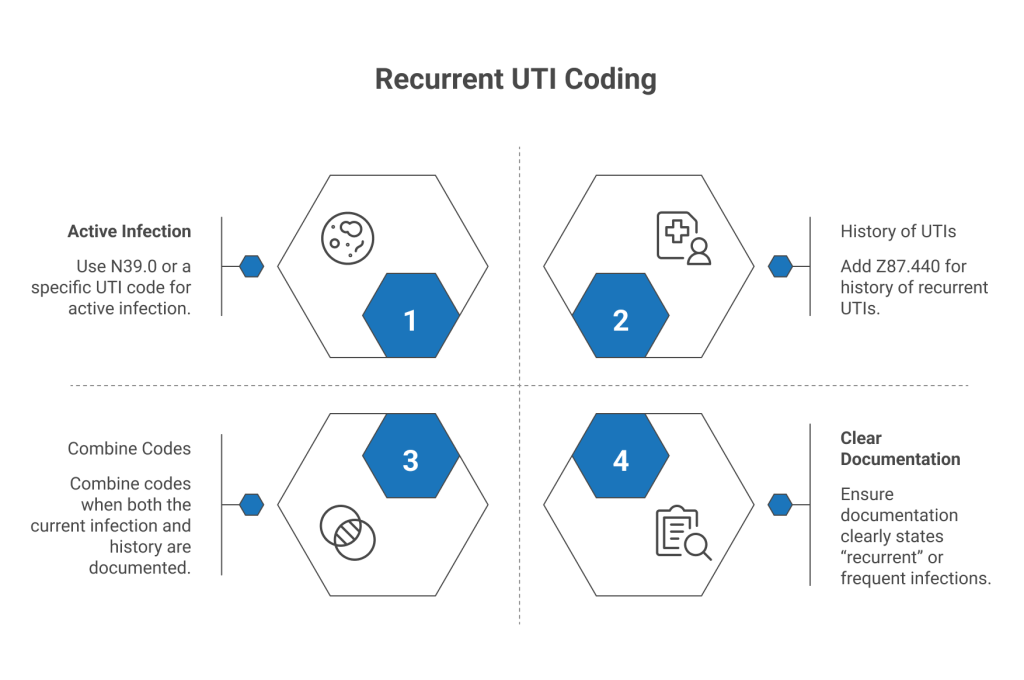
Recurrent UTIs are common, especially in certain patient populations, but ICD-10 does not provide a single dedicated code for this condition. Instead, coding depends on whether the patient currently has an active infection or a documented history of repeated infections.
How to Code Recurrent UTIs Correctly?
To ensure accurate reporting, coders must evaluate the patient’s current condition and medical history before selecting the appropriate combination of codes.
- Use N39.0 or a specific UTI code for active infection
- Add Z87.440 for history of recurrent UTIs
- Combine codes when both the current infection and history are documented
- Ensure documentation clearly states “recurrent” or frequent infections
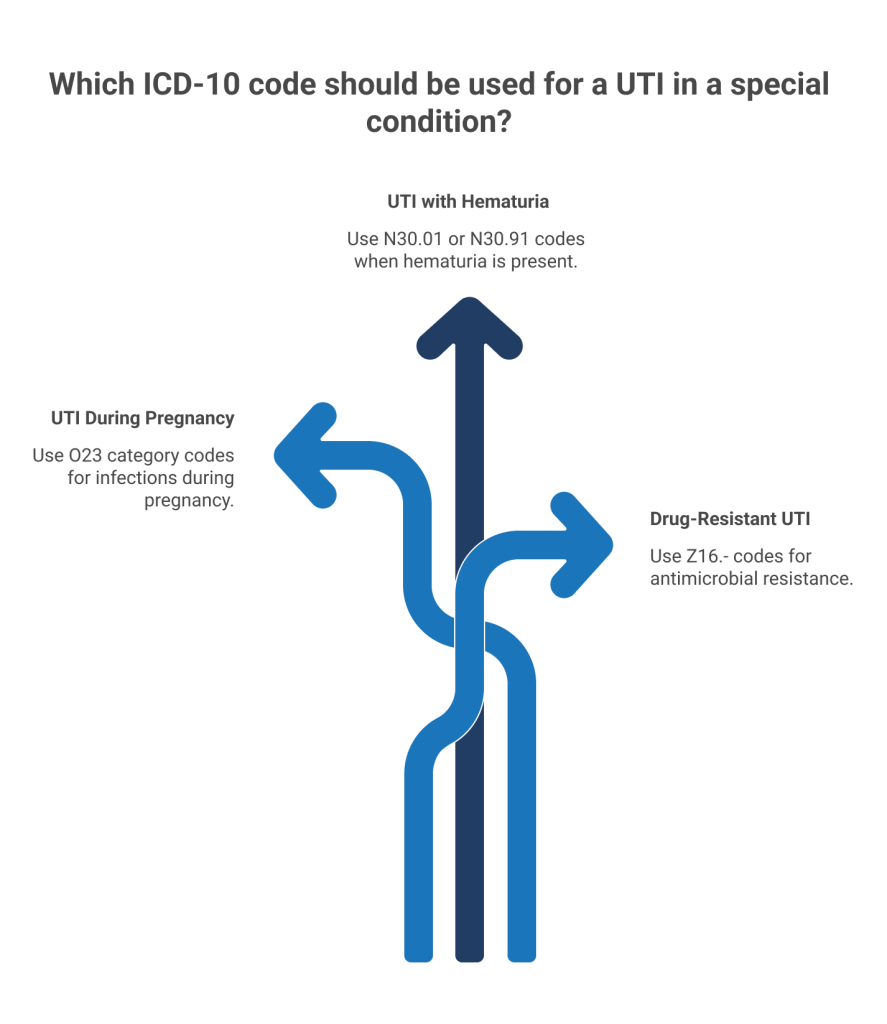
ICD 10 Codes for UTI in Special Conditions
Certain patient conditions require more specific ICD-10 coding considerations. These scenarios often involve additional codes to capture the full clinical picture.
UTI During Pregnancy
UTIs in pregnant patients fall under obstetric coding and require codes from the O23 category, which accounts for infections during pregnancy.
- Use pregnancy-specific codes instead of N39.0
- Important for risk adjustment and maternal care tracking
UTI with Hematuria
When a UTI is accompanied by hematuria, coders must select a code that specifically reflects this condition, particularly in cases of cystitis.
- Use N30.01 or N30.91 when hematuria is present
- Do not code hematuria separately if included in the diagnosis
Drug-Resistant UTI
Infections caused by antibiotic-resistant organisms require additional coding to reflect treatment complexity.
- Use Z16.- codes for antimicrobial resistance
- Supports accurate clinical reporting and treatment planning
ICD 10 Coding Guidelines for UTI
Accurate ICD-10 coding for urinary tract infections is not just about selecting a code, it’s about aligning clinical documentation with coding standards to ensure compliance and maximize reimbursement. Coders must follow official ICD-10-CM guidelines while carefully reviewing provider notes to capture the highest level of specificity.
Key Coding Guidelines to Follow
- Always code to the highest level of specificity, avoiding unspecified codes when detailed documentation is available
- Do not default to N39.0 if the provider has documented a specific condition such as cystitis or pyelonephritis
- Use additional codes (B95–B97) to identify the causative organism when confirmed through lab results
- Follow Excludes1 and Excludes2 notes to prevent incorrect code combinations
- Ensure that all codes are fully supported by physician documentation to avoid audits and denials
- Review patient history and current condition to determine if combination coding is required
Common ICD 10 Coding Mistakes to Avoid
Even experienced coders can make errors when handling UTI diagnoses. These mistakes can lead to claim denials, delayed payments, or compliance issues. Understanding common pitfalls can help improve accuracy and efficiency.
- Overusing N39.0 (unspecified UTI) without checking for more specific diagnoses
- Failing to include organism codes when lab results clearly identify the cause
- Ignoring documentation of hematuria, leading to incorrect cystitis coding
- Not distinguishing between upper and lower UTIs
- Missing history codes for patients with recurrent infections
- Incorrectly combining codes that are mutually exclusive
The Bottom Line
ICD-10 coding for urinary tract infections requires more than just familiarity with N39.0. Accurate coding depends on understanding the type, location, and cause of the infection, along with proper clinical documentation. By selecting the most specific codes, applying additional organism or history codes when needed, and avoiding common mistakes, healthcare providers and coders can significantly improve billing accuracy and reduce claim denials. Consistent attention to detail in UTI coding not only enhances reimbursement outcomes but also supports better patient care and data integrity.