Among the Evaluation and Management (E/M) codes, CPT Code 99212 is commonly used for established patient office visits involving straightforward medical decision-making or a total provider time of 10–19 minutes on the date of the encounter. However, many healthcare providers and medical billers still have questions about when to report this code, what documentation it requires, how it differs from other office visit CPT codes, and how reimbursement is determined.
This comprehensive guide answers everything you need to know about CPT Code 99212, including its official description, documentation requirements, time guidelines, billing rules, reimbursement factors, and comparisons with similar established patient office visit codes.
What Is CPT Code 99212?
CPT Code 99212 is an Evaluation and Management (E/M) code used to report an office or outpatient visit for an established patient. It is appropriate when the visit involves straightforward medical decision-making (MDM) or when the physician or other qualified healthcare professional spends 10–19 minutes providing services on the date of the encounter.
This code is designed for follow-up visits where the patient’s condition is relatively stable and does not require complex evaluation or treatment. Instead of focusing on extensive documentation, CPT Code 99212 emphasizes the medical necessity of the visit and the level of decision-making involved.
Since the 2021 revisions to office and outpatient E/M coding, providers can select 99212 based on either:
- Straightforward Medical Decision Making (MDM), or
- Total provider time of 10–19 minutes spent on the date of the encounter.
Common scenarios where CPT Code 99212 may be appropriate include:
- Routine follow-up appointments
- Medication management for stable conditions
- Evaluation of minor illnesses
- Healing wound checks
- Monitoring chronic conditions that are well controlled
Because it applies only to established patients, the patient must have previously received professional services from the same physician or another physician of the same specialty within the same practice during the past three years.
99212 CPT Code Description
The official 99212 CPT code description refers to an office or other outpatient visit for the evaluation and management of an established patient that requires a medically appropriate history and/or physical examination and straightforward medical decision-making, or meets the required total time on the date of the encounter.
Unlike previous E/M coding guidelines, providers are no longer required to document a specific number of history or examination elements to support this code.
Instead, the history and physical examination should be medically appropriate for the patient’s condition, while the code selection is primarily based on either medical decision-making or total provider time.
Key Features of CPT Code 99212
| Feature | Description |
| Patient Type | Established patient |
| Visit Setting | Office or outpatient |
| Medical Decision Making | Straightforward |
| Time Requirement | 10–19 minutes (if selected by time) |
| History & Examination | Medically appropriate |
| Common Use | Routine follow-up visits and stable conditions |
Healthcare providers commonly report 99212 for patients who require ongoing monitoring but do not present with significant diagnostic or treatment complexity. The code reflects services where the clinical work is meaningful but relatively straightforward.
Is CPT Code 99212 an Established Patient CPT Code?
Yes. CPT Code 99212 is specifically classified as an established patient CPT code. It should only be reported when the patient has an existing professional relationship with the provider under the CPT definition of an established patient.
An established patient is someone who has received professional services from the same physician or another physician of the same specialty and within the same group practice during the previous three years.
If the patient has not been seen within that timeframe, or is being treated by a provider of a different specialty within the same group, they may instead qualify as a new patient, making a different series of E/M codes applicable.
Examples of Established Patients
A patient qualifies as established when:
- They return for a follow-up appointment with their primary care physician.
- They revisit the same cardiologist for ongoing management of hypertension.
- They see another physician in the same specialty and medical group within three years.
A patient generally does not qualify as established when:
- It is their first visit with the practice.
- More than three years have passed since their last professional service with the same specialty.
- They are seeing a physician from a different specialty, even within the same organization, if no prior professional services were provided by that specialty.
Correctly identifying patient status is critical because using an established patient code for a new patient can lead to claim denials, reimbursement issues, and compliance concerns.
Is 99212 an Office Visit CPT Code?
Yes. 99212 is an office visit CPT code included in the Office and Other Outpatient Evaluation and Management (E/M) code set. It is intended for services provided in outpatient settings rather than inpatient hospitals or emergency departments.
Healthcare professionals across many specialties use this code when treating established patients during routine office visits that involve straightforward evaluation and management.
Common practice settings include:
- Family medicine
- Internal medicine
- Pediatrics
- Geriatric medicine
- Endocrinology
- Dermatology
- Cardiology
- Orthopedics
- Neurology
- Other outpatient specialty clinics
Depending on payer policies and applicable regulations, 99212 may also be reported for eligible telehealth services when all documentation, coding, and billing requirements are met.
Because it represents a lower-level established patient office visit, this code is frequently used for scheduled follow-up appointments, medication monitoring, and reassessments of stable medical conditions.
When Should You Use CPT Code 99212?
CPT Code 99212 should be used when an established patient requires an office or outpatient visit involving straightforward medical decision-making or when the total provider time spent on the date of the encounter is 10–19 minutes. The visit should be medically necessary and supported by documentation that accurately reflects the services performed.
Typically, 99212 is appropriate when the patient’s condition is stable, presents minimal complexity, and requires limited evaluation or management.
Common Situations Where 99212 May Be Appropriate
Providers may report 99212 for encounters such as:
- Follow-up visits for well-controlled hypertension
- Stable diabetes medication checks
- Routine medication refill appointments with clinical assessment
- Follow-up for seasonal allergies
- Evaluation of a healing wound
- Monitoring a minor skin condition
- Follow-up after treatment for a minor infection
- Review of laboratory results requiring straightforward management
- Assessment of stable chronic conditions with no significant complications
Situations Where 99212 May Not Be Appropriate
A higher-level E/M code may be more appropriate when:
- The patient’s condition has significantly worsened.
- Multiple complex medical problems are evaluated.
- Extensive diagnostic data must be reviewed.
- Treatment decisions involve moderate or high risk.
- The provider spends more time than the range associated with CPT Code 99212.
Before assigning 99212, providers should always confirm that the encounter meets the requirements for medical necessity, documentation, and either straightforward medical decision-making or the applicable time threshold. Proper code selection helps ensure accurate reimbursement while reducing the risk of audits, denials, and coding errors.
CPT Code 99212 Documentation Requirements
Accurate documentation is the foundation of proper coding and reimbursement. While CPT Code 99212 no longer requires providers to document a specific number of history or examination elements, the medical record must clearly support the level of service billed.
The documentation should demonstrate medical necessity and show that the encounter meets the requirements for either straightforward medical decision-making (MDM) or 10–19 minutes of total provider time on the date of the encounter.
The documentation should tell a complete clinical story that justifies why the patient was seen, what was evaluated, and how the provider managed the patient’s condition.
Medical Decision Making (MDM)
For CPT Code 99212, the encounter must involve straightforward medical decision-making when the code is selected based on MDM.
Straightforward MDM generally includes:
- A minimal number or low complexity of problems addressed
- Minimal or no review of external data
- Minimal risk of complications, treatment, or management decisions
Examples include:
- Follow-up for a stable chronic condition
- Evaluation of a minor acute illness
- Medication refill with routine clinical assessment
- Review of uncomplicated laboratory results
History
The patient’s history should be medically appropriate for the presenting problem.
Depending on the clinical situation, documentation may include:
- Chief complaint
- History of present illness (HPI)
- Relevant past medical history
- Current medications
- Allergies
- Review of symptoms when clinically necessary
The history should support the reason for the visit without including unnecessary information simply to increase documentation volume.
Physical Examination
A medically appropriate physical examination should also be documented.
The examination should focus on the patient’s presenting condition and may include:
- Vital signs (when appropriate)
- Targeted system examination
- Assessment of affected body areas
- Relevant clinical findings
Only clinically necessary examination elements need to be documented.
Assessment
The assessment should clearly identify:
- The patient’s diagnosis or diagnoses
- Current clinical status
- Whether the condition is stable, improving, or worsening
Examples include:
- Essential hypertension: stable
- Allergic rhinitis: improved with medication
- Healing postoperative wound: no signs of infection
Treatment Plan
The treatment plan should explain how the provider intends to manage the patient’s condition.
This may include:
- Continue current medications
- Medication refill
- Lifestyle recommendations
- Patient education
- Ordering appropriate tests, if necessary
- Scheduling follow-up appointments
- Referral to another specialist when indicated
Documentation Checklist
Before billing CPT Code 99212, ensure the medical record includes:
✔ Established patient status
✔ Chief complaint or reason for the visit
✔ Medically appropriate history
✔ Medically appropriate physical examination
✔ Straightforward medical decision-making (if billing by MDM)
✔ Assessment and diagnosis
✔ Treatment or management plan
✔ Documentation supporting medical necessity
✔ Total provider time (if billing based on time)
Well-organized documentation not only supports accurate reimbursement but also helps reduce the likelihood of coding errors, payer denials, and audit findings.
99212 Time Requirements
One of the most common questions healthcare providers ask is, “What is the time requirement for CPT Code 99212?”
When selecting the code based on total provider time, CPT Code 99212 applies when the physician or qualified healthcare professional spends 10 to 19 minutes on the date of the patient encounter.
The total time is calculated only for work personally performed by the billing provider on the encounter date.
99212 Time Requirement
| CPT Code | Total Provider Time |
| 99211 | No specific time requirement |
| 99212 | 10–19 minutes |
| 99213 | 20–29 minutes |
| 99214 | 30–39 minutes |
| 99215 | 40–54 minutes |
What Counts Toward the Total Time?
When billing based on time, providers may include activities such as:
- Reviewing the patient’s medical records before the visit
- Obtaining or reviewing separately obtained history
- Performing the patient evaluation
- Counseling the patient or caregiver
- Educating the patient about treatment options
- Ordering medications, laboratory tests, or diagnostic studies
- Communicating with other healthcare professionals regarding the patient’s care
- Documenting the encounter in the medical record
- Coordinating care related to the patient’s treatment
All of these activities must occur on the same calendar date as the encounter.
What Does Not Count Toward Time?
Certain activities should not be included in the total provider time, such as:
- Time spent by clinical staff without provider involvement
- Travel time
- Services performed on a different date
- Time spent on separately billable procedures
- Administrative work unrelated to the patient’s care
If the total provider time falls within the 10–19 minute range and the documentation supports medical necessity, 99212 may be selected using time rather than medical decision-making.
Medical Decision Making (MDM) for CPT Code 99212
Medical Decision Making (MDM) is one of the primary methods used to select CPT Code 99212. The required level for this code is Straightforward Medical Decision Making, which represents the lowest physician MDM level for established patient office visits above CPT 99211.
MDM is determined by evaluating three key elements:
- The number and complexity of problems addressed
- The amount and complexity of data reviewed and analyzed
- The risk of complications or morbidity associated with patient management
For 99212, the encounter typically reflects minimal clinical complexity across these elements.
1. Problems Addressed
The visit usually involves:
- One self-limited or minor problem, or
- One stable chronic illness requiring routine monitoring, or
- A minor acute uncomplicated illness
Examples include:
- Controlled hypertension
- Stable hypothyroidism
- Seasonal allergies
- Mild dermatitis
- Routine medication follow-up
2. Data Reviewed
Data review for 99212 is generally minimal or may not be required.
Examples include:
- Reviewing a previously completed laboratory result
- Reviewing a medication list
- Assessing prior visit notes when clinically necessary
Complex interpretation of imaging studies or extensive external record review is generally associated with higher-level E/M codes.
3. Risk of Patient Management
The level of risk is minimal.
Examples include:
- Continuing current medications
- Providing reassurance
- Recommending conservative treatment
- Scheduling routine follow-up
- Advising over-the-counter medications
The provider is not making high-risk treatment decisions or managing conditions requiring intensive monitoring.
Example of Straightforward MDM
Patient: Returns for a follow-up visit regarding controlled hypertension.
Provider Actions:
- Reviews blood pressure readings.
- Confirms medication compliance.
- Performs a focused physical examination.
- Continues current medication regimen.
- Advises maintaining a low-sodium diet.
- Schedules a six-month follow-up.
This encounter represents straightforward medical decision-making because the patient’s condition is stable, minimal data are reviewed, and the treatment plan involves low-risk management.
CPT Code 99212 Reimbursement
One of the most frequently searched topics is 99212 CPT code reimbursement. While reimbursement varies by payer and location, CPT Code 99212 is generally reimbursed at a lower rate than higher-level established patient office visit codes because it represents a straightforward Evaluation and Management (E/M) service.
The exact payment amount depends on several factors, including:
- Medicare payment policies
- Medicaid reimbursement schedules
- Commercial insurance contracts
- Geographic practice location
- Facility versus non-facility setting
- Annual updates to the Medicare Physician Fee Schedule
Because reimbursement rates are updated regularly, providers should always verify the current allowable amount with the applicable payer before submitting claims.
Factors That Affect Reimbursement
Several variables can influence the amount paid for 99212, including:
- The payer’s contracted fee schedule
- Locality-specific payment adjustments
- Whether the service was provided in a physician office or facility setting
- Correct modifier usage, when applicable
- Accurate diagnosis coding supporting medical necessity
- Proper documentation that justifies the reported level of service
Tips to Maximize Accurate Reimbursement
To reduce claim denials and improve payment accuracy:
- Confirm the patient qualifies as an established patient.
- Ensure documentation supports straightforward MDM or 10–19 minutes of total provider time.
- Link the service to appropriate ICD-10-CM diagnosis codes.
- Avoid upcoding or downcoding the encounter.
- Review payer-specific billing requirements before claim submission.
- Maintain complete and accurate clinical documentation for audit purposes.
Proper coding and documentation not only support timely reimbursement but also help healthcare organizations remain compliant with payer guidelines and reduce the risk of audits or payment recoupments.
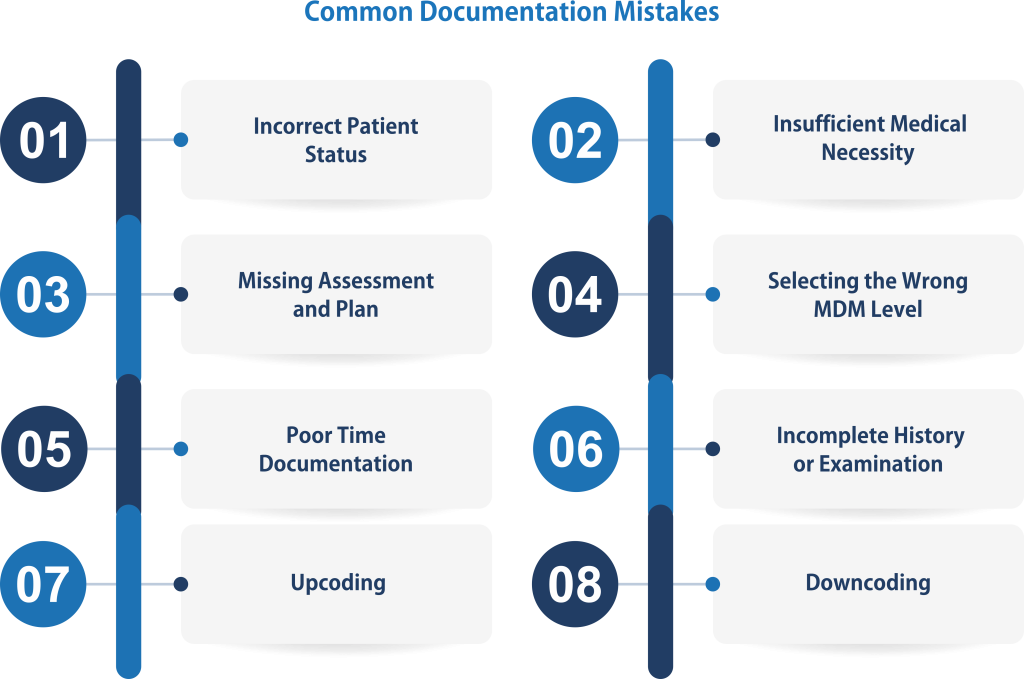
Common Documentation Mistakes
Although CPT Code 99212 represents a relatively straightforward office visit, documentation errors can still result in claim denials, downcoding, or compliance concerns. Understanding these common mistakes can help providers submit cleaner claims and improve coding accuracy.
1. Incorrect Patient Status
One of the most common mistakes is reporting 99212 for a patient who should be classified as a new patient.
Always verify whether the patient has received professional services from the same physician or another physician of the same specialty within the same practice during the previous three years.
2. Insufficient Medical Necessity
The documentation must clearly explain why the visit was clinically necessary.
Simply documenting a routine follow-up without describing the patient’s condition or management may not adequately support the billed service.
3. Missing Assessment and Plan
Some records describe the patient’s symptoms but fail to include:
- Final assessment
- Diagnosis
- Clinical impression
- Treatment plan
- Follow-up recommendations
Without these elements, the documentation may not support the reported E/M level.
4. Selecting the Wrong MDM Level
Providers occasionally report 99212 when the medical decision-making actually supports:
- 99211 (minimal service), or
- 99213 (low MDM)
Choosing the wrong code can result in underpayment or overpayment and increase audit risk.
5. Poor Time Documentation
When selecting 99212 based on total time, providers should clearly document the total time spent on the encounter date.
A simple statement such as:
“Total provider time spent on today’s encounter: 15 minutes.”
helps support time-based code selection.
6. Incomplete History or Examination
Although detailed history and physical examination are no longer required for code selection, the documentation should still include information that is medically appropriate for the patient’s condition.
Sparse or incomplete notes may fail to support medical necessity.
7. Upcoding
Reporting 99213 or higher when the encounter only supports 99212 may lead to:
- Claim denials
- Payment recoupment
- Compliance investigations
- Audit findings
Providers should always code to the level supported by the documentation.
8. Downcoding
Billing 99211 instead of 99212 when the documentation supports straightforward MDM or 10–19 minutes of provider time can result in lost revenue and underreport the complexity of the services provided.
CPT Code 99212 vs. 99211
Because both codes apply to established patients, they are often confused. However, they represent different levels of Evaluation and Management services.
| Feature | 99211 | 99212 |
| Patient Type | Established | Established |
| Provider Involvement | May not require physician or qualified healthcare professional presence, depending on payer rules | Requires physician or qualified healthcare professional involvement |
| Medical Decision Making | Minimal or not required | Straightforward MDM |
| Total Time | No specific time requirement | 10–19 minutes (when selected by time) |
| Complexity | Minimal | Straightforward |
| Typical Visit | Blood pressure check, dressing change, simple nurse visit | Routine physician follow-up for stable condition |
When to Use 99211
Use 99211 when the service involves a minimal level of evaluation and management, often performed under appropriate supervision and requiring limited clinical decision-making.
When to Use 99212
Choose 99212 when the physician or qualified healthcare professional personally evaluates the patient and the encounter involves straightforward medical decision-making or 10–19 minutes of total provider time.
In general, 99212 represents a higher level of service than 99211 because it reflects greater provider involvement and clinical decision-making.
CPT Code 99212 vs. 99213
99212 and 99213 are among the most frequently billed established patient office visit codes. While they appear similar, the required level of medical decision-making and total provider time differ significantly.
| Feature | 99212 | 99213 |
| Patient Type | Established | Established |
| Medical Decision Making | Straightforward | Low |
| Total Provider Time | 10–19 minutes | 20–29 minutes |
| Visit Complexity | Low | Moderate compared with 99212 |
| Documentation | Supports straightforward MDM or qualifying time | Supports low MDM or qualifying time |
| Typical Patient | Stable condition requiring routine follow-up | Stable or mildly worsening condition requiring additional evaluation |
CPT Code 99212 vs. Other Established Patient Office Visit Codes
Healthcare providers often compare CPT Code 99212 with other established patient Evaluation and Management (E/M) codes to determine the correct level of service. The primary differences between these codes lie in the complexity of medical decision-making (MDM) and the total provider time spent on the date of the encounter.
The following table provides a quick comparison of the five established patient office visit CPT codes.
| CPT Code | Patient Type | Medical Decision Making | Total Provider Time | Typical Visit Complexity |
| 99211 | Established | Minimal or N/A | No specific time requirement | Minimal service |
| 99212 | Established | Straightforward | 10–19 minutes | Low-complexity follow-up |
| 99213 | Established | Low | 20–29 minutes | Mildly complex follow-up |
| 99214 | Established | Moderate | 30–39 minutes | Multiple or worsening conditions |
| 99215 | Established | High | 40–54 minutes | Highly complex patient management |
Conclusion
CPT Code 99212 plays an important role in reporting low-complexity office and outpatient visits for established patients. It is most appropriate when the encounter involves straightforward medical decision-making or 10–19 minutes of total provider time on the date of the visit. Although it represents one of the lower-level Evaluation and Management (E/M) services, accurate code selection still requires careful attention to medical necessity, patient status, and complete documentation.
By understanding the official 99212 CPT code description, documentation requirements, billing guidelines, time threshold, and reimbursement considerations, healthcare providers and medical coders can improve coding accuracy, reduce claim denials, and support compliance with payer requirements. When in doubt, always rely on the clinical documentation to determine the correct level of service, ensuring that every reported code accurately reflects the care delivered.