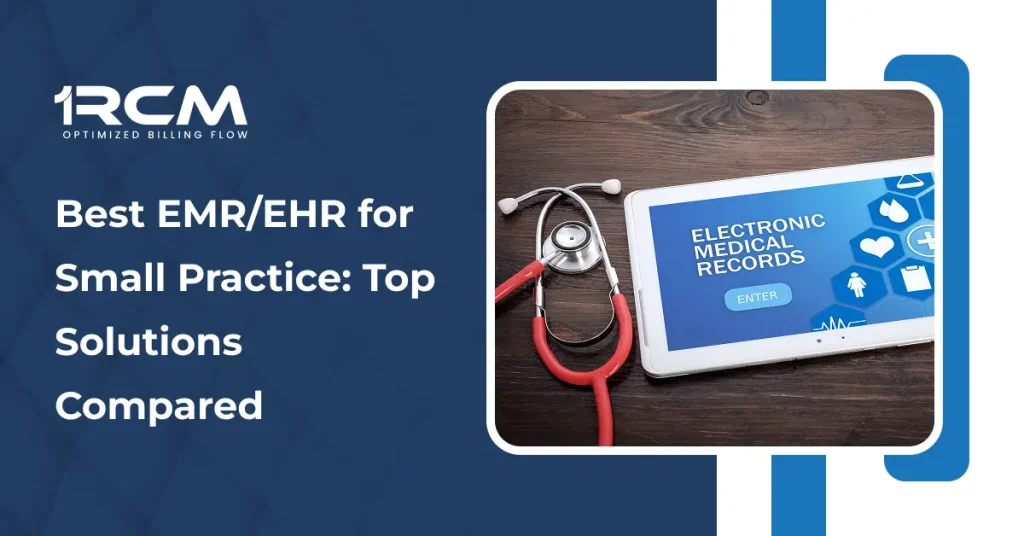
Running a small medical practice means balancing exceptional patient care with countless administrative responsibilities. From managing patient records and scheduling appointments to handling billing and ensuring regulatory compliance, every task demands efficiency. That’s where choosing the best EMR/EHR for a small practice becomes a game-changer.
The right electronic medical records (EMR) or electronic health records (EHR) system can automate routine workflows, reduce documentation time, improve patient communication, and support long-term practice growth, all without overwhelming your budget.
However, with dozens of EMR/EHR platforms promising similar features, selecting the right solution can feel overwhelming. Each system offers different pricing models, specialties, integrations, and usability, making it essential to evaluate your options carefully.
Quick Comparison of the Best EMR for Small Practice
Choosing the right EHR for small practices becomes much easier when you compare the essential features side by side. The table below highlights some of the most popular EMR/EHR solutions based on pricing, deployment, ideal practice size, and standout capabilities.
| EMR/EHR Software | Best For | Deployment | Starting Price* | Free Demo | Standout Feature |
| AdvancedMD | Overall Best | Cloud-Based | Custom Quote | ✔ | Comprehensive practice management |
| DrChrono | Apple-Based Practices | Cloud-Based | Custom Quote | ✔ | Native iPad and iPhone support |
| Kareo (Tebra) | Independent Practices | Cloud-Based | Custom Quote | ✔ | Easy billing and practice management |
| Athenahealth | Growing Clinics | Cloud-Based | Custom Quote | ✔ | Revenue cycle management |
| eClinicalWorks | Cost-Conscious Practices | Cloud-Based | Custom Quote | ✔ | AI-powered documentation |
| NextGen Healthcare | Multi-Specialty Clinics | Cloud-Based | Custom Quote | ✔ | Specialty-specific templates |
| Practice Fusion | Budget-Friendly Practices | Cloud-Based | Custom Quote | ✔ | Simple interface and affordability |
| CharmHealth | Small & Solo Practices | Cloud-Based | Affordable Plans | ✔ | Flexible and customizable workflows |
| CureMD | Billing-Focused Practices | Cloud-Based | Custom Quote | ✔ | Integrated billing and EHR |
| RXNT | All-in-One Solution | Cloud-Based | Subscription-Based | ✔ | ePrescribing and patient engagement |
Note: Pricing may vary depending on the number of providers, selected modules, implementation requirements, and contract terms. Contact vendors directly for the latest pricing.
What Is an EMR/EHR?
Electronic Medical Record (EMR) and Electronic Health Record (EHR) systems have become essential tools for modern healthcare practices. They replace traditional paper charts with digital records, allowing healthcare providers to document patient information, prescribe medications electronically, schedule appointments, manage billing, and securely access clinical data from virtually anywhere.
For small clinics and independent physicians, adopting an EHR for small practices not only improves operational efficiency but also enhances patient care by reducing paperwork, minimizing errors, and streamlining everyday administrative tasks. While many people use the terms EMR and EHR interchangeably, there are important differences between the two.
EMR vs. EHR: What’s the Difference?
Although both systems store patient health information electronically, they serve different purposes.
An Electronic Medical Record (EMR) is essentially a digital version of a patient’s chart within a single healthcare organization. It contains medical history, diagnoses, medications, treatment plans, immunization records, allergies, and physician notes. EMRs are primarily designed for internal use within one practice.
An Electronic Health Record (EHR) goes a step further by enabling secure data sharing across different healthcare providers, hospitals, laboratories, pharmacies, and specialists. This interoperability ensures that authorized healthcare professionals have access to a patient’s complete medical history, improving care coordination and reducing duplicate tests or procedures.
In short:
- EMR = Digital records used within one practice.
- EHR = Comprehensive patient records that can be securely shared across multiple healthcare organizations.
For most modern clinics, especially those looking for scalability and better care coordination, an EHR offers greater long-term value.
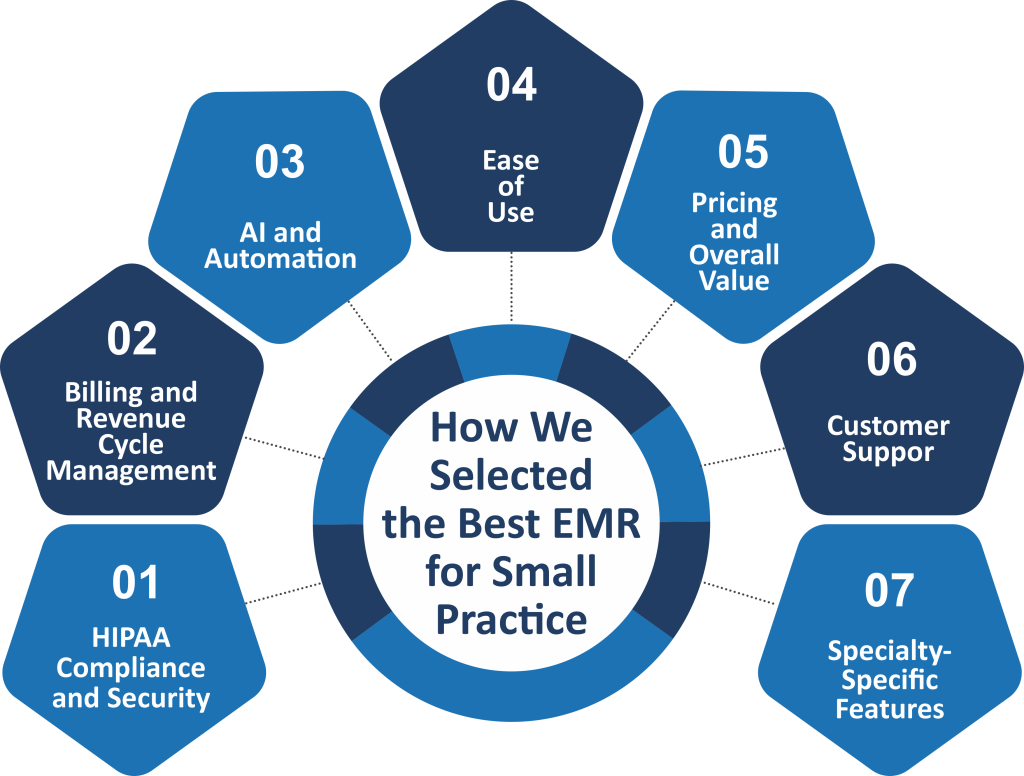
How We Selected the Best EMR for Small Practice?
Not every EMR solution is designed with small healthcare practices in mind. To ensure our recommendations are practical and reliable, we evaluated each platform using criteria that matter most to solo providers, private clinics, and growing medical practices.
Our assessment focused on usability, affordability, scalability, customer satisfaction, security, and overall value. Here’s what we considered when selecting the top EHR/EMR for private and small practices.
Ease of Use: A user-friendly interface reduces training time and improves staff productivity. We prioritized platforms with intuitive dashboards, customizable workflows, and straightforward navigation.
Pricing and Overall Value: Cost is often a deciding factor for smaller clinics. We evaluated subscription models, implementation costs, hidden fees, and the overall value each solution provides relative to its features.
Customer Support: Reliable customer support is essential during implementation and daily operations. We favored vendors that offer responsive technical assistance, onboarding resources, training programs, and ongoing customer support.
Specialty-Specific Features: Different specialties require different workflows. We looked for software that provides specialty-specific templates, customizable documentation, and tailored clinical workflows for practices such as family medicine, dermatology, behavioral health, pediatrics, and cardiology.
AI and Automation: Modern healthcare increasingly relies on automation. We considered platforms offering AI-powered documentation, automated charting, appointment reminders, voice recognition, and intelligent clinical workflows.
Billing and Revenue Cycle Management: Integrated billing capabilities help reduce claim denials and improve cash flow. We assessed each platform’s medical billing features, coding assistance, insurance claim management, and revenue cycle tools.
HIPAA Compliance and Security: Patient data security remains a top priority. Every recommended solution supports HIPAA compliance and includes features such as encryption, role-based access controls, secure cloud hosting, audit logs, and regular security updates.
Scalability: As practices grow, their software should grow with them. We favored systems that support multiple providers, additional locations, advanced reporting, telehealth integration, and third-party application compatibility without requiring a complete system change.
By evaluating these critical factors, we’ve created a list of the best EMR for small practice solutions that balance functionality, affordability, and long-term scalability for today’s healthcare providers.
Best EMR for Small Practice: In-Depth Reviews
Finding the best EMR for small practice isn’t about choosing the platform with the longest feature list; it’s about selecting software that aligns with your workflow, budget, specialty, and future growth plans. While some solutions excel at practice management and billing, others focus on clinical documentation, telehealth, or specialty-specific workflows.
To help you make an informed decision, we’ve reviewed the leading EHR for small practices based on usability, pricing, key features, customer support, integrations, and overall value.
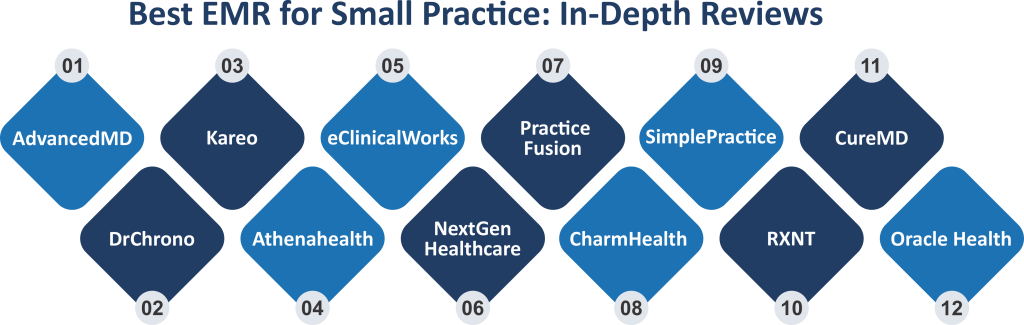
1. AdvancedMD: Best Overall EMR for Small Practices
AdvancedMD is widely recognized as one of the most comprehensive cloud-based healthcare platforms available today. It combines electronic health records, practice management, medical billing, patient engagement, and telehealth into one unified solution, making it an excellent choice for independent physicians and growing medical practices.
Its customizable workflows allow providers across multiple specialties to tailor documentation templates, automate repetitive tasks, and improve operational efficiency without sacrificing flexibility.
Key Features
- Cloud-based EMR and practice management
- Integrated medical billing and revenue cycle management
- Telemedicine platform
- Electronic prescribing (eRx)
- Customizable clinical templates
- Patient portal and online scheduling
- Mobile application
- Reporting and analytics dashboard
Pros
- Comprehensive all-in-one solution
- Highly customizable workflows
- Excellent billing capabilities
- Strong customer support
- Suitable for multiple specialties
Cons
- Custom pricing only
- Initial implementation may require training
- Some advanced features have a learning curve
Best For
Growing small practices looking for an all-in-one platform with advanced billing and practice management capabilities.
2. DrChrono: Best for Apple-Based Medical Practices
DrChrono has become a favorite among physicians who prefer Apple’s ecosystem. Built with iPhone, iPad, and Mac users in mind, it offers one of the most intuitive user experiences in the healthcare software industry.
Its flexibility allows providers to customize forms, templates, and workflows without requiring technical expertise. The platform also integrates telehealth, scheduling, billing, and patient communication into a single interface.
Key Features
- Native iPad and iPhone support
- Medical billing integration
- Telehealth appointments
- ePrescribing (including EPCS)
- Custom medical forms
- Patient portal
- Appointment scheduling
- Medical dictation
Pros
- Extremely user-friendly interface
- Excellent mobile experience
- Highly customizable templates
- Strong patient communication tools
Cons
- Works best within Apple’s ecosystem
- Some advanced integrations require higher-tier plans
Best For
Solo physicians and private clinics using Apple devices who want a modern, mobile-first EHR.
3. Kareo (Tebra): Best for Independent Practices
Tebra, formerly known as Kareo, has long been one of the most trusted names among independent healthcare providers. Designed specifically for small and mid-sized practices, it simplifies everything from patient scheduling to insurance claims.
One of its biggest strengths is its intuitive billing system, making it an excellent option for practices seeking to improve revenue collection while reducing administrative workload.
Key Features
- Electronic health records
- Medical billing software
- Practice management tools
- Telehealth
- Patient portal
- Online appointment booking
- Insurance eligibility verification
- Claims management
Pros
- Easy implementation
- Excellent billing workflow
- Designed specifically for independent practices
- User-friendly interface
Cons
- Limited customization compared to enterprise solutions
- Pricing requires consultation
Best For
Independent physicians, family medicine clinics, and small healthcare practices seeking an affordable all-in-one solution.
4. Athenahealth: Best Cloud-Based EHR for Growing Clinics
Athenahealth is one of the most recognized cloud-based healthcare platforms, serving practices of all sizes. Its standout feature is its powerful revenue cycle management system, which leverages automation to improve claim acceptance rates and reduce administrative burdens.
The platform continuously updates regulatory requirements and clinical workflows, helping providers stay compliant without manual intervention.
Key Features
- Cloud-native EHR
- Revenue cycle management
- Telehealth integration
- AI-assisted documentation
- Patient engagement tools
- Clinical decision support
- Appointment scheduling
- Reporting and analytics
Pros
- Excellent revenue cycle performance
- Regular software updates
- Strong interoperability
- Scalable for growing practices
Cons
- Premium pricing
- May include features unnecessary for very small clinics
Best For
Growing practices that prioritize automation, billing efficiency, and long-term scalability.
5. eClinicalWorks: Best Value for Small Medical Practices
eClinicalWorks delivers a robust combination of clinical documentation, practice management, population health, and telehealth features at a competitive price point. It has become a popular choice among practices seeking enterprise-level functionality without enterprise-level costs.
Its AI-powered documentation tools and virtual assistant help reduce physician burnout by minimizing manual charting.
Key Features
- AI-powered documentation
- Telehealth platform
- Patient portal
- Electronic prescribing
- Population health management
- Revenue cycle management
- Clinical analytics
- Mobile access
Pros
- Strong feature-to-price ratio
- AI tools improve efficiency
- Comprehensive patient engagement features
- Suitable for multiple specialties
Cons
- Interface can feel overwhelming for new users
- Some features require additional training
Best For
Small and mid-sized practices looking for advanced features at a competitive price.
6. NextGen Healthcare: Best for Growing Multi-Specialty Practices
NextGen Healthcare is a powerful, cloud-based EHR platform designed to support practices as they grow. It offers specialty-specific workflows, advanced reporting, revenue cycle management, and patient engagement tools, making it an excellent choice for clinics that plan to expand over time.
Unlike many generic EHR systems, NextGen provides customizable templates for numerous medical specialties, helping providers improve documentation accuracy while reducing administrative work.
Key Features
- Specialty-specific clinical templates
- Practice management software
- Revenue cycle management
- Telehealth integration
- Patient portal
- Electronic prescribing
- Population health analytics
- Mobile access
Pros
- Excellent scalability
- Strong specialty customization
- Comprehensive reporting tools
- Reliable customer support
Cons
- Higher learning curve
- Premium pricing for advanced modules
Best For
Growing multi-provider and multi-specialty practices that require customizable workflows and enterprise-level capabilities.
7. Practice Fusion: Best Budget-Friendly EHR for Small Practices
Practice Fusion has earned a reputation as one of the most affordable cloud-based EHR solutions available. Designed with independent physicians and small clinics in mind, it provides essential clinical and administrative features without unnecessary complexity.
Its intuitive interface allows providers to get started quickly while maintaining access to core functionalities like ePrescribing, charting, appointment scheduling, and patient communication.
Key Features
- Cloud-based EHR
- ePrescribing
- Appointment scheduling
- Patient charting
- Lab integration
- Patient portal
- Electronic faxing
- Reporting tools
Pros
- Affordable pricing
- Easy to learn
- Quick implementation
- Reliable for smaller practices
Cons
- Limited customization
- Fewer advanced features than premium competitors
Best For
Solo practitioners and budget-conscious clinics looking for a dependable and easy-to-use EHR solution.
8. CharmHealth: Best Affordable EMR for Solo Providers
CharmHealth is designed specifically for independent physicians, small clinics, and healthcare startups seeking an affordable yet feature-rich EHR. Its flexible pricing model makes it attractive for practices that want enterprise-grade functionality without committing to expensive long-term contracts.
The platform supports multiple specialties and offers integrated telemedicine, making it ideal for providers delivering both in-person and virtual care.
Key Features
- Electronic health records
- Telemedicine platform
- Patient portal
- Medical billing
- Appointment scheduling
- Secure messaging
- Clinical documentation
- Mobile accessibility
Pros
- Affordable subscription plans
- User-friendly interface
- Excellent telehealth integration
- Flexible customization options
Cons
- Limited advanced analytics
- Some integrations require additional setup
Best For
Solo practitioners and small healthcare providers looking for an affordable, cloud-based EMR with modern telehealth capabilities.
9. SimplePractice: Best EHR for Mental Health and Therapy Practices
SimplePractice is purpose-built for behavioral health professionals, therapists, counselors, psychologists, and social workers. Rather than trying to serve every medical specialty, it focuses on the unique needs of mental health providers.
Its intuitive platform simplifies scheduling, documentation, telehealth, billing, and secure client communication, allowing practitioners to spend more time with clients and less time on administrative work.
Key Features
- Behavioral health EHR
- HIPAA-compliant telehealth
- Online appointment scheduling
- Secure client portal
- Insurance claim submission
- Progress note templates
- Automated reminders
- Integrated payments
Pros
- Built specifically for therapists
- Clean and intuitive interface
- Excellent telehealth experience
- Strong client communication tools
Cons
- Not suitable for most medical specialties
- Limited advanced clinical workflows
Best For
Behavioral health providers, psychologists, counselors, and therapy practices.
10. CureMD: Best EHR with Integrated Billing
CureMD combines electronic health records, practice management, and medical billing into a single platform that helps providers optimize both clinical and financial performance.
Its intelligent billing tools, coding assistance, and revenue cycle management capabilities make it particularly attractive for practices looking to reduce claim denials and improve cash flow.
Key Features
- Cloud-based EHR
- Integrated medical billing
- Revenue cycle management
- Patient portal
- Telehealth
- ePrescribing
- Clinical decision support
- Practice analytics
Pros
- Excellent billing integration
- Comprehensive reporting
- Strong interoperability
- Suitable for multiple specialties
Cons
- Interface may require onboarding
- Custom pricing only
Best For
Practices seeking a fully integrated EHR and medical billing solution. To further maximize the financial return on integrated billing tools, clinics often pair their software setup with expert medical billing services.
11. RXNT: Best All-in-One Healthcare Platform
RXNT offers a complete suite of healthcare software that includes electronic health records, ePrescribing, scheduling, medical billing, and practice management. Its modular approach allows practices to purchase only the features they need, making it a cost-effective option for small and growing clinics.
The platform is known for its quick implementation process and straightforward user interface.
Key Features
- Electronic health records
- Practice management
- Medical billing
- ePrescribing
- Patient portal
- Appointment scheduling
- Mobile app
- Integrated reporting
Pros
- Modular pricing options
- Fast implementation
- User-friendly interface
- Strong ePrescribing capabilities
Cons
- Limited specialty customization
- Reporting features could be more advanced
Best For
Small practices seeking an affordable all-in-one healthcare management platform.
12. Oracle Health (Cerner): Best Enterprise-Level Solution
Oracle Health (formerly Cerner) is one of the most recognized names in healthcare technology. While it’s often associated with large hospitals and healthcare systems, it also supports larger private practices and multi-location clinics requiring enterprise-grade interoperability and scalability.
Its advanced analytics, population health tools, and robust data-sharing capabilities make it an excellent long-term investment for organizations expecting significant growth.
Key Features
- Enterprise EHR platform
- Advanced interoperability
- Population health management
- Clinical decision support
- AI-driven analytics
- Revenue cycle management
- Patient engagement tools
- Secure cloud infrastructure
Pros
- Highly scalable
- Industry-leading interoperability
- Advanced analytics
- Comprehensive clinical capabilities
Cons
- Expensive for smaller clinics
- Longer implementation process
- More features than many small practices require
Best For
Large private practices, multi-location healthcare organizations, and rapidly growing medical groups.
Best EHR Software for Small Practice by Specialty
Every medical specialty has unique documentation requirements, workflows, and patient management needs. While many EHR platforms offer general-purpose features, the best EHR software for small practice should also support specialty-specific templates, billing codes, clinical workflows, and reporting capabilities.
Below are our top recommendations based on different practice types.
Family Medicine
Recommended Software: AdvancedMD, Athenahealth, eClinicalWorks
Family medicine providers require an EHR capable of managing diverse patient populations, preventive care, chronic disease management, immunizations, and long-term health records.
Key features to prioritize include:
- Preventive care reminders
- Chronic disease management
- ePrescribing
- Patient portal
- Lab integrations
- Population health reporting
Best Choice: AdvancedMD offers an excellent balance of usability, customization, and integrated billing for family medicine practices.
Internal Medicine
Recommended Software: NextGen Healthcare, Athenahealth, CureMD
Internal medicine practices often manage complex cases involving multiple chronic conditions. They benefit from robust documentation tools, advanced reporting, and integrated clinical decision support.
Important features include:
- Chronic care management
- Clinical decision support
- Medication management
- Comprehensive charting
- Referral management
Best Choice: NextGen Healthcare provides highly customizable workflows tailored to internal medicine providers.
Pediatrics
Recommended Software: eClinicalWorks, AdvancedMD, Kareo (Tebra)
Pediatric practices require specialized tools such as immunization tracking, growth charts, developmental milestone monitoring, and pediatric-specific documentation templates.
Look for features like:
- Growth charts
- Vaccine management
- Pediatric templates
- Parent portals
- Appointment reminders
Best Choice: eClinicalWorks offers comprehensive pediatric workflows and excellent patient engagement tools.
Cardiology
Recommended Software: NextGen Healthcare, Athenahealth, Oracle Health
Cardiology clinics require detailed documentation, imaging integration, diagnostic reporting, and comprehensive patient history management.
Essential features include:
- Cardiology-specific templates
- ECG and imaging integration
- Medication management
- Clinical analytics
- Referral coordination
Best Choice: NextGen Healthcare offers extensive specialty-specific customization for cardiology practices.
Dermatology
Recommended Software: AdvancedMD, DrChrono, NextGen Healthcare
Dermatologists often need visual documentation, procedure tracking, customizable templates, and image management capabilities.
Important features include:
- Image documentation
- Procedure templates
- Custom clinical forms
- Mobile charting
- Patient photo management
Best Choice: DrChrono’s customizable forms and mobile-first experience make it an excellent option for dermatology practices.
Behavioral Health
Recommended Software: SimplePractice, CharmHealth, AdvancedMD
Behavioral health providers require secure telehealth, psychotherapy notes, treatment planning, and confidential documentation.
Key features include:
- HIPAA-compliant telehealth
- Secure messaging
- Progress notes
- Treatment plans
- Client portals
Best Choice: SimplePractice is purpose-built for behavioral health professionals and therapists.
Chiropractic
Recommended Software: CharmHealth, Kareo (Tebra), DrChrono
Chiropractic clinics benefit from customizable SOAP notes, appointment scheduling, billing automation, and patient communication tools.
Look for:
- SOAP note templates
- Appointment management
- Medical billing
- Mobile access
- Patient communication
Best Choice: CharmHealth provides affordability and flexibility for chiropractic clinics.
Physical Therapy
Recommended Software: NextGen Healthcare, AdvancedMD, eClinicalWorks
Physical therapy clinics require treatment tracking, progress documentation, scheduling, and outcome reporting.
Essential capabilities include:
- Therapy documentation
- Progress tracking
- Goal management
- Patient scheduling
- Outcome reporting
Best Choice: NextGen Healthcare delivers strong workflow customization for rehabilitation practices.
Mental Health
Recommended Software: SimplePractice, CharmHealth
Mental health providers prioritize secure documentation, online scheduling, teletherapy, electronic payments, and client communication.
Key features:
- Teletherapy
- Progress notes
- Client portal
- Insurance billing
- Secure messaging
Best Choice: SimplePractice remains one of the most complete platforms for mental health professionals.
Multi-Specialty Clinics
Recommended Software: Athenahealth, AdvancedMD, Oracle Health
Multi-specialty practices require software capable of supporting multiple providers, specialties, billing workflows, and reporting needs from a single platform.
Features to prioritize include:
- Specialty-specific templates
- Multi-location support
- Advanced analytics
- Revenue cycle management
- Interoperability
- Role-based access
Best Choice: Athenahealth offers exceptional scalability for expanding multi-specialty organizations.
Additionally, to ensure all practitioners operating across these specialty workflows are properly verified and approved by insurance networks, practices frequently utilize professional medical credentialing solutions alongside their EHR implementation.
Cloud-Based vs. On-Premise EMR: Which Is Better?
One of the first decisions healthcare providers face is whether to choose a cloud-based or on-premise EMR system. While both options offer digital patient record management, they differ in terms of cost, accessibility, maintenance, and scalability.
For most small clinics, cloud-based solutions have become the preferred choice due to their flexibility and lower upfront investment.
| Feature | Cloud-Based EMR | On-Premise EMR |
| Initial Cost | Lower | Higher |
| Monthly Subscription | Yes | Usually No |
| Hardware Requirements | Minimal | Significant |
| Software Updates | Automatic | Manual |
| Data Storage | Secure Cloud Servers | Local Servers |
| Remote Access | Available Anywhere | Limited |
| IT Maintenance | Vendor Managed | Practice Managed |
| Scalability | Excellent | Limited |
| Disaster Recovery | Built-In | Practice Responsibility |
How Much Does an EHR Cost for a Small Practice?
One of the biggest concerns for healthcare providers is understanding the true cost of implementing an EHR. While pricing varies by vendor, practice size, specialty, and feature requirements, most cloud-based platforms follow a subscription-based pricing model.
Below is a general breakdown of what small practices can expect.
| Cost Category | Typical Price Range |
| Basic Cloud EHR | $100–$300 per provider/month |
| Mid-Tier Solutions | $300–$700 per provider/month |
| Enterprise Platforms | Custom Pricing |
| Implementation Fees | $1,000–$10,000+ |
| Data Migration | $500–$5,000 |
| Staff Training | Often Included or Additional |
| Telehealth Modules | May Cost Extra |
| Revenue Cycle Management | Percentage of Collections or Separate Fee |
Final Verdict
Choosing the best EMR for small practice ultimately depends on your specialty, budget, practice size, and long-term goals. While every platform featured in this guide offers unique strengths, the right solution is one that streamlines daily operations, enhances patient care, and supports the future growth of your practice.
If you’re looking for an all-around solution, AdvancedMD stands out for its comprehensive practice management, billing, and clinical capabilities. DrChrono is an excellent choice for Apple-based practices that prioritize mobility and ease of use, while Athenahealth excels in revenue cycle management and scalability for growing clinics.
Budget-conscious providers may find Practice Fusion or CharmHealth to be practical and affordable options, whereas behavioral health professionals will benefit most from SimplePractice’s specialty-focused features.