Choosing the correct Evaluation and Management (E/M) code isn’t just about getting reimbursed; it’s about ensuring accurate documentation, maintaining coding compliance, and reducing the risk of audits or claim denials. CPT Code 99203 is one of the most frequently used codes for new patient office visits, yet it’s also one of the most misunderstood. Questions about its time requirements, documentation standards, billing rules, and differences from other new patient CPT codes often leave providers and medical coders uncertain about when this code should be reported.
If you’re looking for a clear explanation of CPT Code 99203, you’re in the right place. In this article, we’ll break down the official code description, explain the medical decision-making (MDM) and time requirements, discuss billing and documentation guidelines, compare it with other new patient office visit codes, and answer the most common questions healthcare professionals have.
What Is CPT Code 99203?
CPT Code 99203 is an Evaluation and Management (E/M) code used to report an office or other outpatient visit for a new patient. It applies when a physician or qualified healthcare professional provides an evaluation that involves low-level medical decision-making (MDM) or spends 30–44 minutes on the date of the encounter if the service is selected based on time.
This code is part of the new patient office visit CPT code series (99202–99205), with each code representing a different level of complexity. Compared to CPT Code 99202, which is intended for straightforward cases, 99203 is used when the patient’s condition requires a more comprehensive assessment and a greater level of clinical judgment, but does not rise to the moderate complexity required for 99204.
Healthcare providers commonly report Billing Code 99203 for patients presenting with stable chronic conditions, uncomplicated acute illnesses, or minor injuries that require evaluation, diagnosis, treatment planning, and appropriate follow-up. The code can be used across a variety of outpatient specialties where precise medical coding services are essential to capture the correct level of clinical complexity.
In short, 99203 CPT Code represents a low-complexity new patient office visit where the provider performs a medically appropriate evaluation and documents the encounter according to current E/M coding guidelines.
CPT Code 99203 Description
The official CPT Code 99203 description is:
Office or other outpatient visit for the evaluation and management of a new patient, which requires a medically appropriate history and/or examination and low level of medical decision-making. When using total time for code selection, 30–44 minutes must be spent on the date of the encounter.
While the official description is concise, each component has an important meaning.
Office or Other Outpatient Visit
This code is intended for services performed in an outpatient setting, such as a physician’s office, clinic, or similar healthcare facility. It does not apply to inpatient hospital care, emergency department visits, or observation services.
New Patient
The patient must qualify as a new patient under CPT guidelines. This means the patient has not received any professional services from the physician or another physician or qualified healthcare professional of the same specialty and subspecialty within the same group practice during the previous three years.
Medically Appropriate History and Examination
Unlike older E/M guidelines, providers are no longer required to document a specific number of history or examination elements. Instead, the history and physical examination should be medically appropriate for the patient’s presenting problem and support clinical decision-making.
Low Medical Decision-Making (MDM)
To report CPT Code 99203, the encounter must involve low-complexity MDM if the provider is selecting the code based on decision-making rather than time. This generally includes managing uncomplicated conditions, reviewing a limited amount of clinical data, and making treatment decisions that involve a low level of patient risk.
Time-Based Reporting
Providers may also report 99203 based on 30–44 minutes of total physician or qualified healthcare professional time spent on the date of the encounter, provided all CPT time-reporting requirements are met.
Who Qualifies as a New Patient?
One of the most common reasons for coding errors is misunderstanding the definition of a new patient. Simply visiting a provider for the first time does not automatically make someone a new patient for billing purposes.
According to CPT guidelines, a new patient is an individual who has not received any professional services from the physician or another physician or qualified healthcare professional of the exact same specialty and subspecialty within the same group practice during the past three years.
The Three-Year Rule
The “three-year rule” is the primary factor used to determine patient status. If more than three years have passed since the patient’s last professional service with the same specialty provider in the same practice, the patient is generally considered new.
For example:
- A patient who has never visited your practice is considered a new patient.
- A patient last seen by your family medicine practice more than three years ago is typically considered a new patient.
- A patient seen six months ago by another physician in the same specialty within your group practice is considered an established patient, not a new patient.
Same Group Practice and Specialty Matter
If the patient previously received services from a provider in the same specialty and subspecialty within your medical group, the visit is generally billed as an established patient encounter, even if they are seeing a different physician.
However, if the patient is evaluated by a provider from a different specialty, they may still qualify as a new patient under CPT rules.
CPT Code 99203 Time Requirements
Many healthcare providers choose CPT Code 99203 based on the total amount of time spent caring for the patient rather than relying solely on medical decision-making. When time is used to select the code, the provider must spend 30–44 minutes on the date of the encounter.
This total time includes both face-to-face and certain non-face-to-face activities performed by the physician or qualified healthcare professional on the same day, such as:
- Reviewing the patient’s medical records and test results before the visit
- Performing the patient evaluation
- Counseling the patient or family members
- Ordering medications, laboratory tests, or diagnostic procedures
- Communicating with other healthcare professionals when appropriate
- Documenting the encounter in the medical record
- Coordinating care related to the patient’s condition
It’s important to note that only the physician’s or qualified healthcare professional’s time counts toward the total. Time spent solely by clinical staff is generally not included unless specifically permitted by CPT guidance. If total time falls below 30 minutes, a lower-level code may apply; encounters exceeding 44 minutes may require professional medical billing services optimization or higher-level E/M coding depending on documentation.
Medical Decision-Making (MDM) Requirements for CPT Code 99203
When CPT Code 99203 is selected based on medical decision-making (MDM), the encounter must meet the requirements for low-complexity MDM.
Medical decision-making is evaluated using three key elements:
| MDM Element | Requirement for CPT Code 99203 |
| Number and complexity of problems addressed | Low complexity |
| Amount and complexity of data reviewed and analyzed | Limited |
| Risk of complications and/or morbidity of patient management | Low risk |
To qualify for low MDM, at least two of these three elements must meet the required level.
Problems Addressed
Examples of conditions commonly associated with low-complexity MDM include:
- Acute uncomplicated illnesses
- Stable chronic conditions
- Minor injuries
- Allergic rhinitis
- Uncomplicated urinary tract infections
- Mild skin infections
- Controlled hypertension requiring routine management
Data Reviewed
The provider may review or order a limited amount of clinical data, such as:
- Laboratory tests
- Imaging studies
- Previous medical records
- External physician notes
- Diagnostic test results
Risk of Patient Management
The overall risk should remain low, meaning treatment decisions typically involve conservative management, prescription drug management when appropriate, routine follow-up, or ordering standard diagnostic tests without significant risk to the patient.
Accurately documenting the complexity of medical decision-making is essential because it directly supports the selection of Billing Code 99203 when the encounter is not reported based on total time.
Billing Code 99203: Documentation Requirements
Proper documentation is the foundation of accurate medical billing. Even if a provider spends the required amount of time or performs low-complexity medical decision-making (MDM), Billing Code 99203 should only be reported when the medical record clearly supports the level of service provided.
Current E/M guidelines focus on documenting the clinical necessity of the visit rather than meeting rigid documentation checklists. Every encounter should accurately reflect the patient’s condition, the provider’s evaluation, and the medical decisions made during the visit.
Documentation Checklist for CPT Code 99203
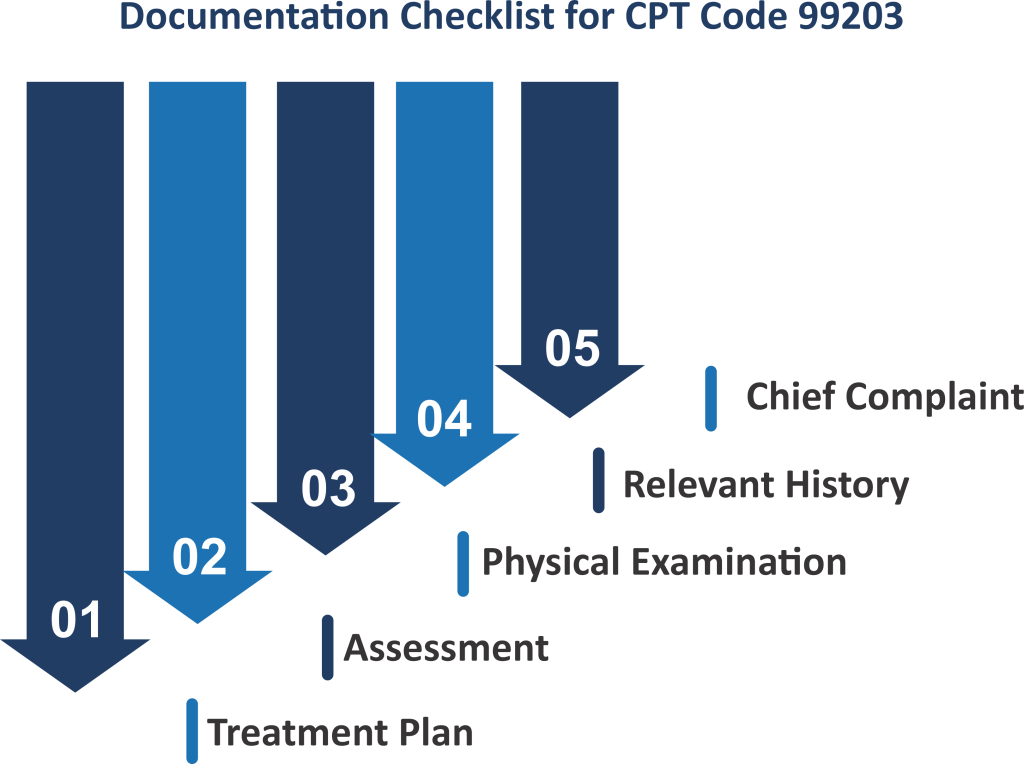
To support CPT Code 99203, the medical record should typically include:
- Chief Complaint (CC): The primary reason for the patient’s visit.
- Relevant History: A medically appropriate history related to the presenting problem.
- Physical Examination: A medically appropriate examination based on the patient’s condition.
- Assessment: The provider’s diagnosis or clinical impression.
- Treatment Plan: Recommended medications, tests, referrals, follow-up care, or patient education.
- Medical Decision-Making (MDM): Documentation demonstrating low-complexity decision-making when selecting the code based on MDM.
- Total Time (If Applicable): If the service is billed based on time, document the total physician or qualified healthcare professional time spent on the date of the encounter.
Always document enough clinical detail to explain why the selected E/M level is appropriate rather than simply documenting more information than medically necessary.
Common Documentation Mistakes
Incorrect documentation is one of the leading causes of claim denials and audit findings. Some of the most common errors include:
- Billing a new patient visit when the patient meets the definition of an established patient.
- Failing to document sufficient evidence of low-complexity MDM.
- Omitting total encounter time when billing based on time.
- Using cloned or copied documentation that does not accurately reflect the current visit.
- Missing the assessment, treatment plan, or follow-up recommendations.
- Selecting a higher E/M level than the documentation supports (upcoding).
Maintaining complete, accurate, and patient-specific documentation helps support compliant coding while minimizing reimbursement issues.
CPT Code 99203 vs. Other New Patient Office Visit Codes
Choosing the correct new patient E/M code requires understanding how 99203 compares with the other office visit codes in the 99202–99205 series. The primary differences involve medical decision-making (MDM) and total provider time.
| CPT Code | Patient Type | MDM Level | Total Time |
| 99202 | New Patient | Straightforward | 15–29 minutes |
| 99203 | New Patient | Low | 30–44 minutes |
| 99204 | New Patient | Moderate | 45–59 minutes |
| 99205 | New Patient | High | 60–74 minutes |
CPT Code 99202 vs. 99203
Although these two codes are often confused, they represent different levels of clinical complexity.
Choose 99202 when:
- The patient’s condition is relatively simple.
- Medical decision-making is straightforward.
- Total provider time is between 15–29 minutes.
Choose 99203 when:
- The patient’s condition requires low-complexity MDM.
- Additional diagnostic evaluation or treatment planning is necessary.
- Total provider time falls between 30–44 minutes.
CPT Code 99203 vs. 99204
The distinction between these two codes primarily depends on the complexity of decision-making and the amount of time spent managing the patient’s care.
99203 is appropriate when:
- Problems addressed are generally uncomplicated or stable.
- Clinical data reviewed is limited.
- Overall management risk is low.
99204 is more appropriate when:
- Multiple chronic conditions require active management.
- More extensive data review or interpretation is performed.
- Patient management involves moderate risk.
- Total encounter time reaches 45–59 minutes.
Selecting the correct code helps ensure accurate reimbursement while reducing the likelihood of coding errors or payer scrutiny.
When Should You Use CPT Code 99203?
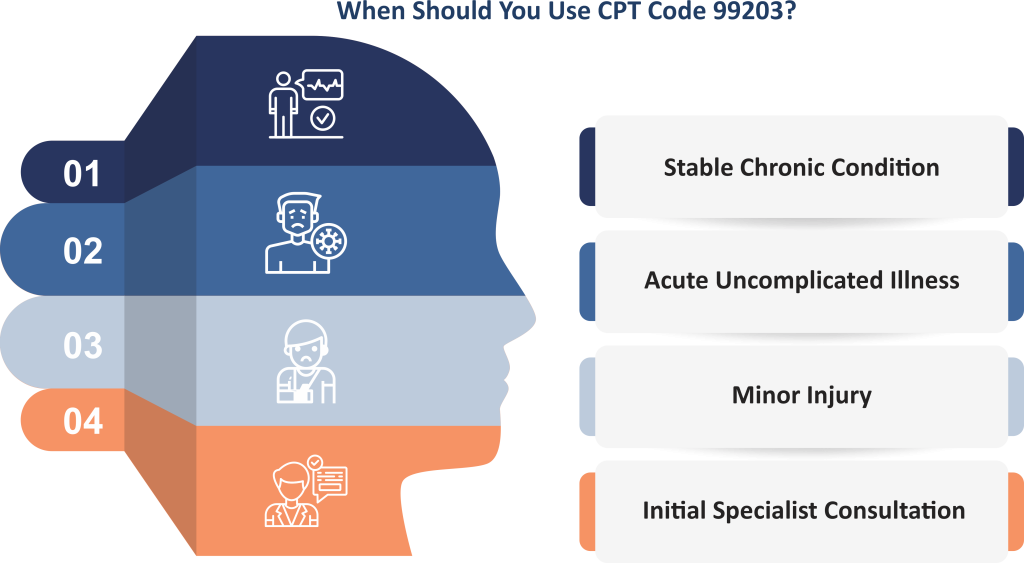
CPT Code 99203 should be reported when a new patient receives an office or outpatient Evaluation and Management (E/M) service that meets the requirements for low medical decision-making (MDM) or 30–44 minutes of total provider time on the date of the encounter.
Rather than focusing solely on the patient’s diagnosis, providers should evaluate the overall complexity of the encounter, the clinical work performed, and whether the documentation supports the selected code.
Example 1: Stable Chronic Condition
A patient visits a family physician for the first time to establish care for well-controlled hypertension. The physician reviews previous medical records, evaluates the patient’s current condition, adjusts lifestyle recommendations, and develops an ongoing treatment plan.
Why 99203 may apply: The encounter involves a new patient with a stable chronic illness requiring low-complexity MDM.
Example 2: Acute Uncomplicated Illness
A new patient presents with symptoms of acute sinusitis. The physician performs an evaluation, confirms the diagnosis, prescribes medication, provides home-care instructions, and schedules follow-up if symptoms persist.
Why 99203 may apply: The visit involves an uncomplicated acute illness with low-risk treatment decisions.
Example 3: Minor Injury
A patient who has never visited the practice is evaluated for a mild ankle sprain after a fall. The provider performs an examination, orders an X-ray to rule out a fracture, recommends conservative treatment, and discusses recovery expectations.
Why 99203 may apply: The encounter includes evaluation of a minor injury with low-complexity clinical management.
Example 4: Initial Specialist Consultation
A primary care physician refers a patient to a dermatologist for evaluation of a persistent skin lesion. The dermatologist performs an initial assessment, reviews available records, develops a treatment plan, and documents low-complexity MDM.
Why 99203 may apply: If the patient qualifies as a new patient and the visit meets the documentation requirements, 99203 may be the appropriate E/M code regardless of the referral.
These examples illustrate that code selection depends on the complexity of the encounter and supporting documentation, not simply on the diagnosis or specialty.
CPT Code for Office Visit New Patient
When billing office or outpatient Evaluation and Management services for new patients, providers typically choose from four CPT codes:
| CPT Code | Typical Complexity | Total Time |
| 99202 | Straightforward | 15–29 minutes |
| 99203 | Low | 30–44 minutes |
| 99204 | Moderate | 45–59 minutes |
| 99205 | High | 60–74 minutes |
Each code represents a progressively higher level of physician work, decision-making complexity, and time spent managing the patient’s care.
Among these codes, CPT Code 99203 is one of the most frequently reported because it reflects many routine new patient encounters involving uncomplicated acute illnesses, stable chronic conditions, and conservative treatment plans.
When selecting the appropriate CPT code for an office visit for a new patient, providers should consider:
- Whether the patient qualifies as a new patient under CPT guidelines.
- The level of medical decision-making (MDM) performed.
- The total physician or qualified healthcare professional time spent on the date of the encounter, if selecting the code based on time.
- Whether the documentation fully supports the reported level of service.
Accurate code selection not only ensures appropriate reimbursement but also promotes compliance with payer policies and current E/M coding standards.
Can CPT Code 99203 Be Used for Specialist Referrals?
Yes, CPT Code 99203 can be reported for a specialist visit, but being referred to a specialist does not automatically determine which CPT code should be billed.
A common misconception is that there is a separate Evaluation and Management (E/M) code specifically for specialist referrals. In reality, the referral itself has no impact on CPT code selection. Instead, the provider must choose the appropriate E/M code based on the patient’s status (new or established) and the complexity of the encounter.
For example, if a primary care physician refers a patient to a cardiologist for the evaluation of newly diagnosed hypertension, the cardiologist may report 99203 if:
- The patient qualifies as a new patient under CPT guidelines.
- The encounter involves low-complexity medical decision-making (MDM) or 30–44 minutes of total physician or qualified healthcare professional time.
- The documentation supports the selected level of service.
However, if the patient’s condition requires moderate or high-complexity decision-making, a higher-level E/M code such as 99204 or 99205 may be more appropriate.
When Specialists Should Not Use 99203
A specialist should not report 99203 if:
- The patient is considered an established patient under CPT guidelines.
- The visit does not meet the documentation requirements for low-complexity MDM.
- The total provider time is less than 30 minutes when coding by time.
- The encounter supports a different E/M level based on either MDM or total time.
Ultimately, referrals simply explain why the patient is seeing the specialist—they do not determine how the visit is coded.
CPT Code for Referral to Specialist
One of the most frequently searched questions is, “What is the CPT code for a referral to a specialist?” The answer is straightforward:
There is no specific CPT code used solely for referring a patient to a specialist.
A referral is a clinical decision made by the treating provider to obtain additional evaluation or treatment from another healthcare professional. It is considered part of the patient’s overall management and is generally documented within the office visit rather than billed as a separate referral service.
Here’s how the billing process typically works:
Primary Care Provider
The referring physician bills the appropriate Evaluation and Management (E/M) code for the office visit during which the referral was made. For example, if the encounter meets the requirements for CPT Code 99203, that code may be reported.
Specialist
The specialist independently bills the E/M code that best reflects the services provided during the patient’s visit. If the patient qualifies as a new patient and the encounter meets the requirements for 99203, the specialist may also report 99203. Otherwise, another new or established patient E/M code may be more appropriate.
Referral Documentation Should Include
Although the referral itself is not assigned a separate CPT code, providers should clearly document:
- The medical reason for the referral.
- The patient’s signs, symptoms, or diagnosis.
- Relevant medical history.
- Previous treatments or diagnostic testing.
- The specialist or specialty receiving the referral.
- The expected purpose of the consultation or treatment.
Proper referral documentation improves continuity of care, supports medical necessity, and helps specialists understand the patient’s clinical background.
Key Takeaways
CPT Code 99203 is an important Evaluation and Management (E/M) code for reporting low-complexity office or outpatient visits for new patients. Correctly identifying patient status, selecting the appropriate code based on medical decision-making (MDM) or 30–44 minutes of total provider time, and maintaining thorough documentation are all essential for accurate billing and compliance.
By understanding when and how to use 99203, healthcare providers and medical billing professionals can improve coding accuracy, reduce claim denials, and ensure appropriate reimbursement for the services they provide.