Managing provider credentials is one of the most critical yet time-consuming responsibilities for healthcare organizations. From verifying licenses and certifications to handling provider enrollment and maintaining compliance, even minor delays or errors can impact patient care, reimbursement, and regulatory readiness. As healthcare networks grow and compliance requirements become more complex, relying on spreadsheets and manual processes is no longer sustainable.
Medical credentialing management software helps healthcare organizations automate credential verification, streamline provider enrollment, monitor license expirations, and centralize provider data within a secure platform.
Whether you manage a private practice, multi-specialty clinic, hospital, or enterprise health system, the right healthcare credentialing management software can significantly reduce administrative workload while improving accuracy and operational efficiency.
Why Healthcare Organizations Need Credentialing Management Software
Provider credentialing is much more than verifying medical licenses. It directly impacts patient safety, regulatory compliance, insurance reimbursement, and provider onboarding timelines. Without an efficient credentialing process, organizations risk delayed revenue, compliance violations, and operational inefficiencies.
Medical credentialing management software addresses these challenges by automating complex workflows and reducing manual intervention.
Faster Provider Onboarding: Automated credential collection, verification, and approval workflows help organizations onboard physicians and other healthcare professionals more quickly, reducing delays in patient care and revenue generation.
Improved Regulatory Compliance: Healthcare regulations require organizations to maintain accurate provider records and complete regular credential renewals. Credentialing management solutions help ensure ongoing compliance by monitoring licenses, certifications, and required documentation.
Reduced Administrative Workload: Administrative teams often spend countless hours managing paperwork, emails, and spreadsheets. Automation reduces repetitive tasks, allowing staff to focus on higher-value responsibilities.
Fewer Credentialing Errors: Manual processes increase the likelihood of missing documents, expired licenses, and inaccurate provider information. Automated validation and centralized record management significantly reduce these risks.
Better Provider Experience: Healthcare providers benefit from simplified document submission, digital forms, automated notifications, and transparent credentialing progress, creating a smoother onboarding experience.
Improved Financial Performance: Delayed credentialing often postpones payer enrollment and reimbursement. By accelerating provider credentialing and enrollment, organizations can begin billing sooner and improve cash flow.
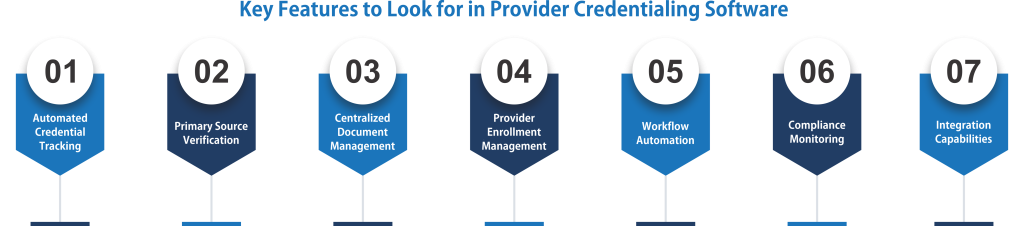
Key Features to Look for in Provider Credentialing Software
Not all credentialing platforms offer the same capabilities. Choosing the right solution depends on your organization’s size, workflows, compliance requirements, and integration needs. The best provider credentialing software typically includes the following features.
Automated Credential Tracking:
Monitor licenses, certifications, registrations, malpractice insurance, and other credentials from one dashboard with automatic renewal reminders to prevent compliance issues.
Primary Source Verification:
Verify provider qualifications directly with licensing boards, educational institutions, and certification organizations to improve accuracy and reduce manual work.
Centralized Document Management:
Store, organize, and securely access all provider documents from a single cloud based repository while maintaining version control and audit history.
Provider Enrollment Management:
Manage payer enrollment applications, monitor submission status, and streamline communication with insurance providers to accelerate reimbursement. To further optimize this step, pairing software with specialized payer contract management services ensures your practice maximizes reimbursement potential.
Workflow Automation:
Automate repetitive tasks such as document requests, approval routing, reminders, notifications, and credential renewals to improve operational efficiency.
Compliance Monitoring:
Track regulatory requirements, identify expired credentials, generate compliance reports, and maintain complete audit readiness for accreditation and inspections.
Integration Capabilities:
The best healthcare provider credentialing software integrates seamlessly with:
- Electronic Health Record (EHR) systems
- Practice Management Software
- Revenue Cycle Management platforms
- Human Resource Information Systems (HRIS)
- Identity and access management solutions
Reporting and Analytics:
Gain valuable insights through customizable dashboards that measure credentialing timelines, provider status, compliance performance, enrollment progress, and operational efficiency.
Role-Based Access Control:
Protect sensitive provider information with configurable user permissions, ensuring only authorized personnel can access or modify credentialing records.
Scalable Cloud Infrastructure:
Cloud-based credentialing management solutions provide secure access from anywhere while supporting growing healthcare organizations without requiring significant IT infrastructure investments.
Different Medical Credentialing Management Software
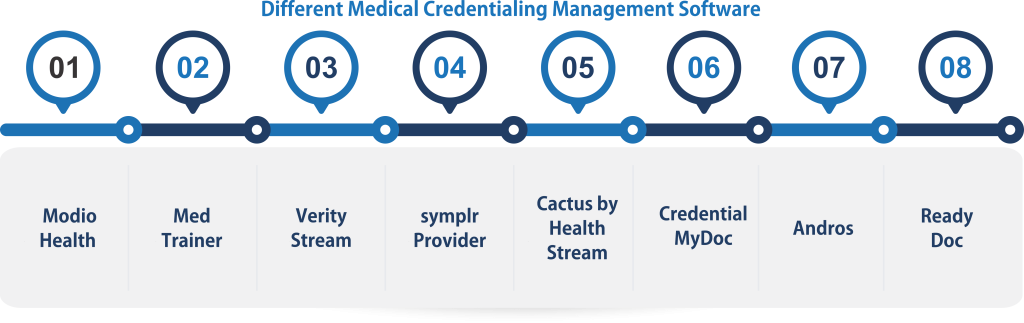
The healthcare credentialing software market offers solutions designed for organizations of every size, from independent physician practices to enterprise health systems. While all platforms aim to simplify provider credentialing, they differ in their focus, automation capabilities, integrations, and scalability.
Below is a comparison of some of the most widely used medical credentialing management software solutions.
1. Modio Health
Best For: Physician groups, multi-specialty practices, and healthcare organizations seeking provider lifecycle management.
Modio Health is a cloud-based provider credentialing software that helps organizations manage credentialing, provider enrollment, license tracking, and provider data from a centralized platform. Its intuitive interface and automation tools reduce manual paperwork while improving credential accuracy.
Key Features
- Automated license monitoring
- Provider enrollment management
- Digital document storage
- Compliance tracking
- Custom reporting
Pros
- Easy-to-use interface
- Strong automation capabilities
- Cloud-based accessibility
Considerations
- Some enterprise features may require higher-tier plans.
2. MedTrainer
Best For: Healthcare organizations that want credentialing, compliance, and workforce training in a single platform.
MedTrainer combines healthcare credentialing management software with compliance management, policy administration, learning management, and document control. It is particularly useful for organizations that need to manage workforce compliance alongside provider credentialing.
Key Features
- Provider credentialing
- Compliance management
- Automated reminders
- Employee training
- Policy management
Pros
- All-in-one compliance platform
- Strong regulatory support
- User-friendly dashboards
Considerations
- Organizations seeking only credentialing functionality may find additional modules unnecessary.
3. VerityStream
Best For: Hospitals and enterprise healthcare systems.
VerityStream is an enterprise credentialing management solution designed for complex healthcare organizations. It supports credentialing, privileging, provider enrollment, peer review, and provider lifecycle management.
Key Features
- Enterprise credentialing workflows
- Privileging management
- Automated primary source verification
- Advanced analytics
- Extensive healthcare integrations
Pros
- Highly scalable
- Comprehensive enterprise features
- Excellent compliance capabilities
Considerations
- Better suited for larger healthcare organizations than small practices.
4. symplr Provider
Best For: Large hospitals, integrated delivery networks, and enterprise provider organizations.
symplr Provider helps healthcare organizations automate credentialing, provider data management, enrollment, and compliance. The platform is widely adopted across hospitals because of its extensive integration capabilities and enterprise-level workflow automation.
Key Features
- Provider credentialing
- Provider data management
- Enrollment tracking
- Compliance monitoring
- Workflow automation
Pros
- Enterprise ready
- Strong reporting capabilities
- Excellent scalability
Considerations
- Implementation may require dedicated onboarding resources.
5. Cactus by HealthStream
Best For: Medical staff offices and hospitals.
Cactus focuses on credentialing, privileging, provider onboarding, and medical staff management. It helps healthcare organizations maintain regulatory compliance while simplifying provider administration.
Key Features
- Credentialing workflows
- Privileging management
- Provider onboarding
- Compliance reporting
- Audit support
Pros
- Long-established reputation
- Strong hospital workflow support
- Comprehensive credential management
Considerations
- More suitable for hospitals than small physician practices.
6. CredentialMyDoc
Best For: Independent practices and smaller healthcare organizations.
CredentialMyDoc offers affordable credentialing and provider enrollment software designed to simplify credential management without enterprise-level complexity.
Key Features
- Provider enrollment
- Credential tracking
- License monitoring
- Document management
- Renewal alerts
Pros
- Easy implementation
- Affordable pricing
- Simple interface
Considerations
- Limited advanced enterprise functionality.
7. Andros
Best For: Organizations focused on provider enrollment and revenue cycle optimization.
Andros specializes in provider enrollment automation while integrating credentialing workflows with revenue cycle management processes.
Key Features
- Enrollment automation
- Credential management
- Workflow tracking
- Reporting
- Payer management
Pros
- Excellent enrollment capabilities
- Helps reduce reimbursement delays
- Workflow transparency
Considerations
- Organizations looking for broader workforce management may require additional software.
8. Ready Doc
Best For: Small to mid-sized healthcare organizations.
Ready Doc provides cloud-based credentialing management solutions with an emphasis on usability and operational efficiency.
Key Features
- Provider profiles
- Credential verification
- License tracking
- Compliance alerts
- Reporting
Pros
- Quick deployment
- Easy navigation
- Cloud accessibility
Considerations
- Advanced customization options may be limited compared to enterprise platforms.
Credentialing and Provider Enrollment Software
Although the terms credentialing and provider enrollment are often used interchangeably, they represent two distinct but closely connected processes. Modern credentialing and provider enrollment software combines both functions into a unified platform, helping healthcare organizations accelerate provider onboarding while minimizing administrative complexity.
Credentialing verifies that a healthcare provider is qualified to practice, while provider enrollment registers that provider with insurance payers so they can bill and receive reimbursement. Delays in either process can postpone patient care and negatively impact revenue.
Medical Credentialing vs. Provider Enrollment
| Medical Credentialing | Provider Enrollment |
| Verifies provider qualifications | Registers providers with insurance payers |
| Confirms licenses and certifications | Establishes billing eligibility |
| Ensures regulatory compliance | Enables reimbursement for services |
| Uses primary source verification | Requires payer-specific documentation |
| Focuses on provider qualifications | Focuses on insurance participation |
While these processes have different objectives, they depend on one another. A provider typically cannot complete payer enrollment until credentialing requirements have been satisfied. For practices looking for end-to-end support with these workflows, utilizing professional medical credentialing services can eliminate administrative bottlenecks entirely.
Why Organizations Need Both?
Healthcare organizations benefit from platforms that manage credentialing and provider enrollment together because they can:
- Eliminate duplicate data entry
- Improve collaboration across departments
- Reduce onboarding timelines
- Track enrollment progress in real time
- Minimize reimbursement delays
- Maintain complete provider records in one location
Organizations using integrated credentialing management solutions often experience smoother onboarding and improved financial performance because providers can begin billing sooner.
Conclusion
Managing provider credentials is a critical responsibility for every healthcare organization, but it doesn’t have to be a slow, manual, or error-prone process. The right medical credentialing management software can automate repetitive tasks, streamline provider onboarding, simplify compliance, and keep provider records accurate and up to date.
Whether you’re a private practice managing a handful of providers or a large health system overseeing thousands of clinicians, investing in a reliable healthcare credentialing management software solution can improve operational efficiency, accelerate provider enrollment, and reduce administrative costs.
Features such as automated license tracking, primary source verification, centralized document management, and seamless integrations help organizations stay compliant while enabling providers to begin delivering care more quickly.