Submitting all the required documents can feel like the final step toward insurance panel approval. Yet, many healthcare providers are surprised to receive a rejection even after fulfilling every documentation requirement. The reality is that insurance companies evaluate much more than paperwork. Factors such as credential verification, professional history, network capacity, compliance standards, and internal approval criteria can significantly influence the outcome.
Exploring these often-overlooked reasons can help providers identify potential roadblocks, strengthen future applications, and improve their chances of joining an insurance panel successfully.
What Does Insurance Panel Denial Mean?
Insurance panel denial occurs when a healthcare provider’s application to join an insurance network is rejected. This decision can happen even when all required documents have been submitted correctly and on time. While documentation is an important part of the process, insurers also evaluate qualifications, professional history, compliance records, and network requirements before approving a provider.
Understanding why panel denials occur is the first step toward identifying potential issues and improving future applications.
Insurance Panel Approval Process Explained
Before approving a provider, insurance companies follow a detailed review process to ensure they meet network standards. This process typically includes:
- Application submission
- Document review
- provider credential verification
- Professional background assessment
- Network needs evaluation
- Final approval decision
Each stage plays a critical role in determining whether a provider will be accepted into the network. A problem at any stage can lead to denial, even when the documentation appears complete.
Difference Between Panel Denial and Claim Denial
Many healthcare providers mistakenly use these terms interchangeably, but they refer to two different situations.
Panel denial occurs when a provider’s request to join an insurance network is rejected.
Claim denial occurs when an insurance company refuses payment for a specific medical service provided to a patient.
Understanding the difference helps providers address the right issue and take the appropriate next steps.
Top Reasons Insurance Panels Reject Applications Despite Complete Documents
Many providers assume that submitting every required document guarantees approval. However, insurance companies evaluate much more than paperwork. Several factors can influence the final decision, even when the application package is complete.
1. Incomplete Credential Verification
Submitting credentials and successfully verifying them are two different things. Insurance companies conduct primary source verification to confirm education, licenses, certifications, and work history.
If verification agencies encounter delays, missing records, or conflicting information, the application may be denied despite having all required documents.
2. Inconsistent Information Across Documents
Even minor inconsistencies can raise concerns during the medical credentialing process.
Common examples include:
- Different addresses across documents
- Variations in provider names
- Incorrect license numbers
- Mismatched tax identification information
- Conflicting employment histories
Insurance companies prioritize accuracy, and inconsistencies may trigger additional reviews or rejection.
3. Expired or Soon-to-Expire Certifications
Providers are expected to maintain active credentials throughout the review process. If any required certification expires during evaluation, approval may be delayed or denied.
Insurers commonly review:
- Medical licenses
- Board certifications
- DEA registrations
- Malpractice insurance coverage
Keeping credentials current can prevent avoidable setbacks during paneling.
4. Malpractice History or Legal Issues
Insurance companies carefully evaluate professional risk before approving providers.
Factors that may affect approval include:
- Previous malpractice claims
- Disciplinary actions
- License restrictions
- Regulatory investigations
- Ongoing legal disputes
While these issues do not always result in rejection, they can significantly influence the insurer’s decision.
5. Poor Professional Standing
A provider’s reputation and professional track record can also impact panel approval.
Insurance companies may review:
- Previous insurance network terminations
- Compliance violations
- Patient complaints
- Quality assurance concerns
- Professional conduct records
Strong professional standing often strengthens a provider’s eligibility for network participation.
Hidden Reasons Insurance Companies Rarely Mention
Not every insurance panel denial is linked to missing documents or credentialing issues. In many cases, insurance companies reject applications for internal business reasons that are rarely disclosed to providers. These factors can influence approval decisions even when an application meets all stated requirements.
Network Saturation
One of the most common yet least discussed reasons for panel denial is network saturation. Insurance companies aim to maintain a balanced provider network within each specialty and geographic area.
If a network already has enough providers offering similar services, additional applications may be rejected regardless of the applicant’s qualifications. This decision is often based on market demand rather than provider performance.
Geographic Coverage Strategy
Insurance companies continuously evaluate where they need providers and where coverage is already sufficient.
A provider practicing in an area with adequate network representation may face rejection, while another provider with similar credentials in an underserved region may be approved. Geographic planning often plays a larger role in paneling decisions than many providers realize.
Internal Quality Metrics
Many insurers assess providers using internal quality benchmarks before making enrollment decisions.
These evaluations may include:
- Clinical performance records
- Patient satisfaction trends
- Compliance history
- Quality improvement participation
- Risk management indicators
Providers who do not align with an insurer’s quality expectations may experience difficulty securing approval.
Cost Management Considerations
Insurance companies carefully manage financial risk across their networks. As a result, reimbursement strategies and cost control initiatives can influence enrollment decisions.
Insurers may limit the addition of new providers within certain specialties if they believe existing network capacity adequately meets patient demand while maintaining budget objectives.
Internal Business Decisions
Sometimes a denial has little to do with a provider’s qualifications. Insurance companies regularly restructure networks, update participation requirements, and revise long-term business strategies.
These decisions may lead to temporary enrollment freezes or selective provider recruitment, resulting in denials that are unrelated to the quality of an application.
Common Documentation Mistakes That Cause Rejection
Although some denials occur for strategic reasons, documentation errors remain a major cause of application rejection. Even small mistakes can create delays, trigger additional reviews, or lead to outright denial.
Missing Supporting Documents
Submitting the primary application without all required supporting materials can immediately affect the review process.
Commonly overlooked documents include:
- Malpractice insurance certificates
- Board certifications
- DEA registrations
- Work history verification records
- Continuing education documentation
Missing documents often prevent credentialing teams from completing their assessment.
Incorrect Credentialing Forms
Credentialing forms require precise and accurate information. Errors in provider details, employment history, specialty information, or contact information can raise concerns during verification.
Even minor inaccuracies may result in requests for clarification or application rejection.
Outdated Professional Records
Insurance companies expect providers to submit the most current versions of their professional documents.
Outdated records may include:
- Expired licenses
- Old malpractice insurance policies
- Previous practice addresses
- Inactive certifications
Regularly updating records before submission can help avoid unnecessary complications.
Missing Malpractice Insurance Details
Malpractice coverage is a critical component of provider credentialing. Incomplete insurance information, insufficient coverage limits, or missing policy documentation can lead to rejection.
Insurance companies want assurance that providers meet all liability requirements before joining the network.
Failure to Respond to Follow-Up Requests
Many providers assume their role ends after submitting an application. However, insurers frequently request additional information during the review process.
Failing to respond promptly to requests for clarification, updated documents, or verification details can cause applications to be closed or denied, even when the original submission was complete.
How Insurance Companies Verify Your Documents
Submitting documents is only the beginning of the credentialing process. Insurance companies perform extensive verification checks to ensure every detail provided by a healthcare provider is accurate and meets their standards. Any discrepancy discovered during verification can delay approval or result in denial.
Primary Source Verification: Insurance companies do not rely solely on submitted documents. Instead, they verify information directly with the original issuing organizations.
License Verification: Insurers verify whether a provider’s license is active, unrestricted, and in good standing with the relevant licensing board.
Education Verification: Healthcare providers must demonstrate that their educational background meets industry standards.
Work History Review: A provider’s employment history offers valuable insight into their professional experience and stability.
Sanction and Exclusion Screening: Insurance companies screen providers against federal and state databases to identify sanctions or exclusions.
Background Checks: Many insurers conduct background investigations as part of their risk assessment process.
Warning Signs Your Insurance Panel Application May Be Rejected
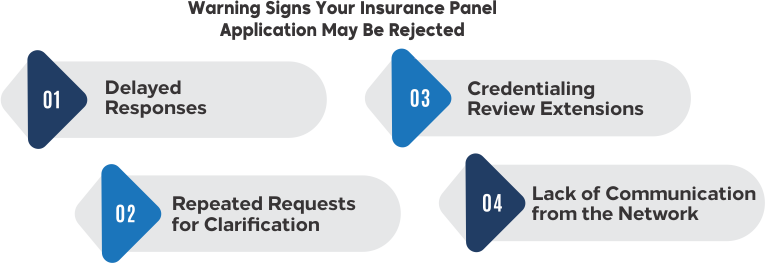
While insurers rarely indicate a final decision before completing their review, certain warning signs may suggest that an application is facing challenges. Recognizing these indicators early can give providers an opportunity to address issues before a final determination is made.
Delayed Responses:
Credentialing timelines vary, but prolonged silence can sometimes indicate additional review requirements.
Repeated Requests for Clarification:
Insurance companies occasionally request additional information during the review process. However, multiple requests regarding the same issue may indicate concerns about the application.
Credentialing Review Extensions:
Many insurers provide estimated credentialing timelines. If the review period is extended multiple times, it may indicate that the application requires additional investigation.
Lack of Communication from the Network:
A complete absence of updates after document submission can be frustrating for providers.
What to Do If Your Insurance Panel Application Is Denied
Receiving a denial does not necessarily mean the end of the enrollment process. In many cases, providers can identify the reason for rejection, address the underlying issue, and pursue approval through an appeal or future application. Taking the right steps immediately after a denial can significantly improve the likelihood of success.
Request the Exact Reason for Denial
The first step is to determine why the application was rejected. Some insurers provide a detailed explanation, while others offer only limited information.
Requesting clarification can help you understand whether the denial was related to:
- Credentialing concerns
- Verification issues
- Network capacity limitations
- Compliance requirements
- Administrative errors
Having a clear explanation allows you to focus on the appropriate solution.
Review the Denial Letter Carefully
Many providers overlook important details contained within denial notices.
Review the letter for:
- Specific reasons for rejection
- Missing requirements
- Appeal instructions
- Reapplication timelines
- Additional documentation requests
A careful review may reveal issues that can be corrected quickly.
Correct Identified Issues
If the denial resulted from inaccurate information, expired credentials, or missing records, address these problems as soon as possible.
Examples include:
- Updating professional licenses
- Correcting application errors
- Resolving verification discrepancies
- Submitting additional supporting documents
The sooner issues are resolved, the stronger your position will be for future consideration.
Submit Additional Documentation
Some insurers allow providers to provide supplemental information before making a final determination.
Additional documentation may include:
- Updated certifications
- Professional references
- Corrected credentialing records
- Clarification letters
- Proof of compliance requirements
Providing complete and accurate information can sometimes reverse an unfavorable decision.
File an Appeal
If you believe the denial was incorrect or based on incomplete information, filing an appeal may be appropriate.
A well-prepared appeal should:
- Address the insurer’s concerns directly
- Include supporting evidence
- Explain corrective actions taken
- Demonstrate eligibility for network participation
Strong documentation often improves the effectiveness of an appeal.
Consider Reapplication
If an appeal is unsuccessful, reapplying at a later date may still be an option.
Many insurance companies allow providers to reapply after:
- Credentialing deficiencies are corrected
- Network needs change
- Enrollment restrictions are lifted
- Professional qualifications are strengthened
Understanding the insurer’s reapplication policy can help determine the best path forward.
Can You Appeal an Insurance Panel Rejection?
Yes, many insurance companies offer an appeal process for providers whose applications have been denied. However, success often depends on the reason for rejection and the quality of the information submitted during the appeal.
When an Appeal Is Worth Filing
An appeal may be worthwhile if:
- Incorrect information influenced the decision
- Verification errors occurred
- Required documents were overlooked
- Credentialing concerns have been resolved
- Additional supporting evidence is available
Appeals are generally less effective when denial is solely due to network saturation or business strategy decisions.
Documents Required for Appeal
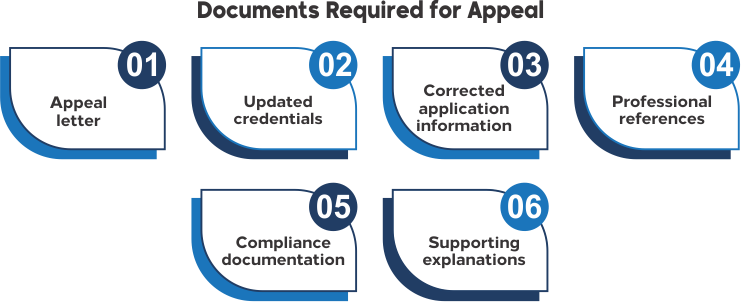
The required documentation varies by insurer, but commonly includes:
- Appeal letter
- Updated credentials
- Corrected application information
- Professional references
- Compliance documentation
- Supporting explanations
Submitting organized and comprehensive evidence can strengthen the appeal considerably.
Common Appeal Mistakes
Many appeals fail because providers make avoidable errors.
Common mistakes include:
- Submitting incomplete information
- Ignoring the stated reason for denial
- Missing appeal deadlines
- Providing insufficient evidence
- Using generic appeal letters
A focused, evidence-based appeal is typically far more effective than a broad request for reconsideration.
How to Improve Your Chances of Insurance Panel Approval?
Although not every denial can be prevented, providers can take several proactive steps to improve their approval prospects. A strong application combined with accurate credentialing practices can reduce delays and increase the likelihood of acceptance.
Maintain Accurate Credentials
Credentialing information should always be current and consistent across all records.
Regularly review:
- Professional licenses
- Certifications
- Employment history
- Contact information
- Practice details
Accurate records help prevent verification issues during the review process.
Keep Licenses Updated
Expired licenses remain one of the most preventable causes of application delays and denials.
Providers should monitor renewal deadlines and ensure that updated documentation is readily available before beginning the paneling process.
Respond Quickly to Verification Requests
Timely communication demonstrates professionalism and helps keep the application moving forward.
Whenever an insurer requests clarification or additional documentation, responding promptly can prevent unnecessary delays and reduce the risk of rejection.
Strengthen Professional Reputation
Insurance companies often evaluate more than credentials alone.
Maintaining a strong professional reputation may involve:
- Following compliance requirements
- Delivering quality patient care
- Avoiding disciplinary actions
- Participating in professional development
A positive professional record can support long-term credentialing success.
Work with Credentialing Experts
Credentialing specialists understand the complexities of insurance panel enrollment and can help identify issues before they become obstacles.
Professional assistance may improve:
- Application accuracy
- Documentation quality
- Compliance management
- Appeal preparation
For many providers, expert guidance can streamline the entire enrollment process, including payer enrollment support for commercial and government insurance plans.
Monitor Your CAQH Profile Regularly
Many insurance companies rely on CAQH data during credentialing reviews.
An outdated CAQH profile can create inconsistencies that delay verification or trigger concerns.
Regular updates help ensure that insurers receive accurate information throughout the application process.
Final Thoughts
Being denied from an insurance panel despite submitting complete documents can be frustrating and confusing. However, documentation is only one component of a much larger evaluation process. Insurance companies assess credential accuracy, professional standing, network capacity, geographic demand, compliance history, and business objectives before making enrollment decisions.
By maintaining accurate records, responding promptly to insurer requests, monitoring credentialing profiles, and addressing potential weaknesses proactively, providers can significantly increase their chances of securing insurance panel approval and expanding their access to patients. Providers seeking expert assistance can benefit from medical credentialing services to improve application accuracy and reduce avoidable delays.