In a healthcare environment, selecting the right technology can directly impact patient outcomes, operational efficiency, compliance, and revenue. Yet many healthcare providers find themselves asking the same question: What is the difference between EHR and EMR software, and which one does my practice actually need? While these terms are often used interchangeably, they serve different purposes and offer distinct advantages depending on the size, structure, and goals of your organization.
Whether you’re running a small private practice, managing a growing multi-specialty clinic, or overseeing a large healthcare network, understanding the differences between Electronic Medical Records (EMRs) and Electronic Health Records (EHRs) is essential for making a smart long-term investment.
The right system can streamline clinical workflows, improve care coordination, reduce administrative burdens, enhance billing accuracy, and position your practice for future growth. When integrated with medical billing services, both EHR and EMR platforms can help practices reduce administrative errors, accelerate reimbursements, and improve overall financial performance.
What Is an EMR (Electronic Medical Record)?
An Electronic Medical Record (EMR) is a digital version of a patient’s paper chart maintained within a single healthcare practice or organization. It stores important clinical information such as medical history, diagnoses, medications, treatment plans, immunization records, allergies, and laboratory results in one centralized system.
EMR software was developed to replace traditional paper-based documentation, making patient information easier to access, update, and manage. Healthcare providers can quickly review a patient’s history, document encounters, prescribe medications electronically, and monitor treatment progress without searching through physical records.
Unlike broader healthcare record systems, EMRs are primarily designed for use within one practice. While they improve efficiency and documentation accuracy, they typically do not support seamless information sharing with external providers, hospitals, or healthcare networks.
How EMR Software Works?
EMR systems collect, organize, and store patient information digitally throughout the care process. Every time a patient visits a healthcare provider, new clinical notes, prescriptions, test results, and treatment updates are recorded directly into the system.
Healthcare professionals can access these records instantly, helping them make informed decisions based on complete patient histories. Automated documentation tools, e-prescribing capabilities, and appointment management features further streamline daily operations.
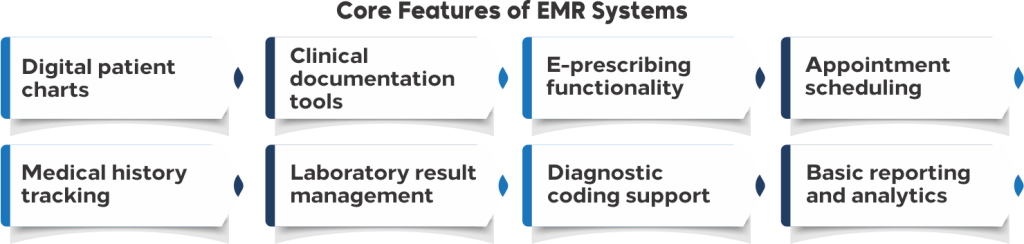
Core Features of EMR Systems
Most EMR platforms include:
- Digital patient charts
- Clinical documentation tools
- E-prescribing functionality
- Appointment scheduling
- Medical history tracking
- Laboratory result management
- Diagnostic coding support
- Basic reporting and analytics
- Secure patient information storage
Benefits of Using EMR Software
Healthcare practices continue to adopt EMR software because it offers several operational and clinical advantages.
Reduced Administrative Burden: Digital documentation eliminates much of the paperwork associated with traditional record-keeping, saving time for physicians and administrative staff.
Improved Documentation Accuracy: Electronic records reduce errors caused by illegible handwriting and incomplete patient files.
Faster Access to Patient Information: Providers can retrieve patient records within seconds, improving efficiency during consultations and treatment planning.
Better Workflow Management: Integrated scheduling, documentation, and prescription tools help streamline daily operations and reduce repetitive tasks.
Limitations of EMR Systems: Although EMRs offer significant benefits, they also have limitations that healthcare organizations should consider.
- Limited interoperability with external providers
- Difficulty sharing patient records across healthcare networks
- Restricted care coordination capabilities
- Scalability challenges for rapidly growing organizations
For practices operating within a single location and requiring basic digital record management, an EMR may be sufficient. However, organizations seeking greater connectivity and coordinated patient care often require a more comprehensive solution.
What Is an EHR (Electronic Health Record)?
An Electronic Health Record (EHR) is a comprehensive digital record that contains a patient’s complete health information and can be securely shared across multiple healthcare providers, facilities, and care settings.
While an EMR focuses on records within a single practice, an EHR creates a broader view of the patient’s healthcare journey. It allows physicians, specialists, laboratories, pharmacies, hospitals, and other authorized providers to access and update patient information in real time.
This enhanced connectivity supports coordinated care, improves communication among providers, and helps healthcare organizations deliver more informed treatment decisions.
How EHR Software Works?
EHR systems collect data from multiple healthcare sources and maintain a continuously updated patient record. Authorized providers can access the same information regardless of where the patient receives treatment.
For example, if a patient visits a primary care physician, specialist, and hospital, each provider can view relevant medical information, reducing duplicate tests, improving diagnosis accuracy, and ensuring continuity of care.
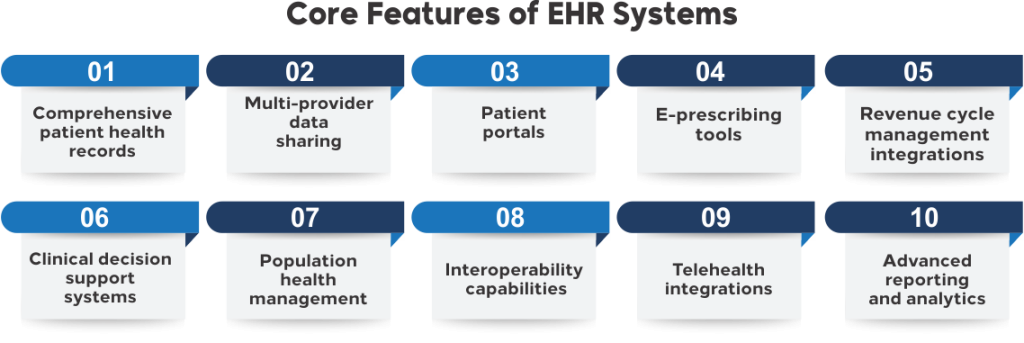
Core Features of EHR Systems
Modern EHR software typically includes:
- Comprehensive patient health records
- Multi-provider data sharing
- Patient portals
- E-prescribing tools
- Clinical decision support systems
- Population health management
- Interoperability capabilities
- Telehealth integrations
- Revenue cycle management integrations
- Advanced reporting and analytics
Benefits of EHR Software
EHR systems offer substantial advantages for organizations focused on delivering connected, patient-centered care.
Enhanced Care Coordination: Providers across different facilities can collaborate using shared patient information, leading to more consistent treatment plans.
Improved Patient Outcomes: Access to complete health histories helps clinicians make better-informed decisions and reduce medical errors.
Greater Patient Engagement: Patient portals enable individuals to access records, communicate with providers, schedule appointments, and manage their healthcare more actively.
Improved Data Accessibility: Authorized healthcare professionals can securely access records whenever needed, improving efficiency and continuity of care.
Scalability for Growing Organizations: EHR systems are designed to support multi-location practices, hospitals, and healthcare networks that require seamless information sharing.
Limitations of EHR Systems: Despite their benefits, EHR platforms may present challenges during implementation.
- Higher upfront investment
- Longer deployment timelines
- Staff training requirements
- More complex system configurations
- Ongoing maintenance and optimization needs
However, for organizations focused on long-term growth, interoperability, and coordinated patient care, these challenges are often outweighed by the operational and clinical benefits.
EHR vs EMR: Key Differences Explained
Although EMR and EHR systems both digitize patient information, they differ significantly in functionality, accessibility, and long-term value. Understanding these distinctions is essential when selecting software for your healthcare organization.
| Feature | EMR | EHR |
| Purpose | Digital patient records within one practice | Comprehensive patient records across providers |
| Data Sharing | Limited | Extensive |
| Interoperability | Minimal | Advanced |
| Patient Access | Rarely included | Commonly available through portals |
| Care Coordination | Limited | Strong |
| Scalability | Best for smaller practices | Ideal for growing organizations |
| Integration Capabilities | Basic | Extensive |
| Cost | Lower initial investment | Higher but more scalable |
| Regulatory Support | Standard compliance | Advanced compliance and reporting |
Scope of Patient Information:
EMRs primarily store information generated within a single healthcare organization. EHRs provide a more complete picture by combining information from multiple providers involved in a patient’s care.
Data Sharing Capabilities:
One of the most important distinctions is interoperability. EHRs are built to share information securely across healthcare systems, while EMRs typically keep data within one organization.
Patient Engagement:
Many EHR systems include patient portals that allow patients to access their records, communicate with providers, and manage appointments. Most traditional EMRs lack these advanced engagement tools.
Long-Term Growth Potential:
Practices planning to expand, add locations, or improve care coordination often find EHR systems more suitable because they support larger operational requirements and future growth.
Similarities Between EHR and EMR
Despite their differences, EHR and EMR systems share many common objectives. Both are designed to improve healthcare delivery, increase operational efficiency, and replace outdated paper-based processes.
Digital Record Management: Both systems store patient information electronically, making records easier to access, update, and maintain.
Clinical Documentation: Healthcare providers can document diagnoses, treatments, prescriptions, and patient encounters within both EMR and EHR platforms.
Improved Efficiency: By reducing paperwork and automating administrative tasks, both systems help healthcare organizations operate more efficiently.
Enhanced Data Security: Modern EMR and EHR solutions include security features such as encryption, user authentication, and audit trails to help protect sensitive patient information.
Support for Regulatory Compliance: Both systems assist healthcare organizations in meeting healthcare documentation and compliance requirements through accurate recordkeeping and reporting capabilities.
While these similarities exist, the primary distinction remains the ability of EHR systems to share and coordinate information across multiple healthcare settings.
EHR vs EMR: Which Is Better for Different Healthcare Organizations?
There is no universal answer to whether an EHR or EMR is better. The right choice depends on your organization’s size, growth plans, patient volume, and care coordination requirements.
1. Solo Physicians and Independent Practices
Many solo practitioners choose EMR systems because they provide efficient patient record management without the added complexity and cost of enterprise-level connectivity.
Best Fit: EMR
2. Small Clinics
Small clinics with limited referral networks may find EMRs sufficient. However, clinics planning future expansion should consider EHR solutions to avoid costly system migrations later.
Best Fit: EMR or Entry-Level EHR
3. Specialty Practices
Specialists who frequently collaborate with referring physicians, hospitals, and diagnostic centers often benefit from EHR systems that support information sharing and coordinated care.
Best Fit: EHR
4. Multi-Location Practices
Organizations operating across multiple locations require centralized access to patient information and standardized workflows.
Best Fit: EHR
5. Hospitals and Healthcare Networks
Hospitals manage large patient populations and coordinate care across numerous departments and providers. EHR systems provide the interoperability, scalability, and reporting capabilities necessary to support these complex environments.
Best Fit: EHR
| Organization Type | Recommended Solution |
| Solo Practice | EMR |
| Small Clinic | EMR or EHR |
| Specialty Practice | EHR |
| Multi-Specialty Group | EHR |
| Multi-Location Organization | EHR |
| Hospital System | EHR |
Ultimately, the decision should be based not only on your current needs but also on where your organization expects to be in the next five to ten years. Choosing software that supports future growth can save significant time, money, and operational disruption down the road.
EHR vs EMR Cost Comparison
Cost is often one of the most important factors healthcare organizations consider when evaluating software solutions. While EMR systems generally require a lower initial investment, EHR platforms provide broader functionality and long-term scalability that may justify the higher cost.
The total cost of ownership extends beyond software licensing. Healthcare organizations must also account for implementation, training, maintenance, customization, and ongoing support.
Initial Implementation Costs
EMR systems are typically faster and less expensive to implement because they are designed for use within a single practice. Their simpler infrastructure often requires fewer resources during deployment.
EHR systems involve more complex configurations, integrations, and data-sharing capabilities, resulting in higher implementation expenses.
Subscription and Licensing Fees
Most modern healthcare software solutions operate on a subscription-based pricing model. Costs vary based on:
- Number of providers
- Practice size
- Required features
- Customization needs
- Storage requirements
- Integration capabilities
Organizations using EHR platforms often pay more due to advanced interoperability and patient engagement tools.
Training and Onboarding Expenses
Even the best software can fail without proper staff adoption. Healthcare organizations should budget for:
- Provider training
- Administrative staff training
- Workflow optimization
- Technical support during rollout
Because EHR systems typically offer more functionality, they often require additional training compared to EMRs.
Ongoing Maintenance Costs
Software updates, cybersecurity improvements, technical support, and compliance enhancements contribute to long-term operational expenses.
Cloud-based systems generally reduce infrastructure costs, while on-premise deployments may require additional IT resources.
Hidden Costs to Consider
Many organizations overlook expenses such as:
- Data migration
- Workflow disruptions during implementation
- Third-party integrations
- Additional user licenses
- System customization
- Compliance upgrades
When evaluating software, decision-makers should focus on overall return on investment rather than upfront pricing alone.
How EHR and EMR Impact Revenue Cycle Management
Many healthcare providers focus on clinical benefits when comparing EHR and EMR systems, but the financial impact can be just as significant. The right software can improve billing accuracy, accelerate reimbursements, and strengthen overall revenue cycle performance.
Improved Documentation Accuracy
Incomplete or inaccurate documentation is one of the leading causes of claim denials.
Both EMR and EHR systems help providers maintain detailed patient records, reducing coding errors and improving claim quality before submission.
Faster Claims Processing
Integrated documentation workflows allow billing teams to access patient information more efficiently, helping claims move through the reimbursement process faster.
This can lead to:
- Reduced claim submission delays
- Faster insurance payments
- Improved cash flow
- Better financial visibility
Reduced Claim Denials
Advanced EHR platforms often include automated validation tools that identify missing information before claims are submitted. These tools help reduce coding errors, eligibility issues, documentation deficiencies, and compliance-related denials. Pairing these capabilities with dedicated claim denial management services can further improve first-pass claim acceptance rates and maximize reimbursement.
These tools help reduce:
- Coding errors
- Eligibility issues
- Documentation deficiencies
- Compliance-related denials
Better Insurance Verification
Many modern systems integrate directly with payer networks, allowing staff to verify insurance coverage before appointments.
This minimizes eligibility-related denials and improves collection rates.
Enhanced Financial Reporting
Healthcare leaders need visibility into key performance metrics such as:
- Accounts receivable
- Collection rates
- Denial trends
- Provider productivity
- Revenue performance
EHR systems generally offer more advanced reporting capabilities that support informed financial decision-making. Combining these insights with expert accounts receivable management enables organizations to monitor outstanding balances, improve collections, and maintain healthier cash flow.
Why Billing Integration Matters
The most successful healthcare organizations view clinical operations and revenue cycle management as connected processes rather than separate functions.
When patient records, coding, claims management, and billing workflows work together, organizations often experience:
- Higher reimbursement rates
- Fewer denied claims
- Faster payment cycles
- Improved operational efficiency
Interoperability: Why It Matters More Than Ever
Interoperability has become one of the most important considerations when selecting healthcare technology. As healthcare delivery becomes increasingly connected, providers need systems that can exchange information efficiently and securely.
This is where the difference between EHR and EMR becomes most apparent.
What Is Healthcare Interoperability?
Interoperability refers to the ability of different healthcare systems, applications, and organizations to exchange and use patient information effectively.
Instead of operating in isolated data silos, connected systems allow authorized providers to access relevant patient information whenever and wherever it is needed.
Why EHR Systems Have an Advantage?
EHR platforms are specifically designed to support interoperability.
They enable healthcare providers to:
- Share patient records securely
- Coordinate care across multiple facilities
- Reduce duplicate testing
- Improve treatment accuracy
- Enhance patient experiences
EMRs, by comparison, are typically limited to information generated within a single organization.
Benefits for Patients
Patients often receive care from multiple providers, including:
- Primary care physicians
- Specialists
- Laboratories
- Pharmacies
- Hospitals
When providers have access to the same patient information, patients experience more coordinated care and fewer communication gaps.
Benefits for Healthcare Organizations
Interoperability can help organizations:
- Improve care quality
- Reduce operational inefficiencies
- Enhance provider collaboration
- Support value-based care initiatives
- Meet regulatory requirements
As healthcare continues moving toward connected care models, interoperability is becoming less of a competitive advantage and more of a necessity.
Compliance, Security, and HIPAA Considerations
Healthcare organizations manage some of the most sensitive information in any industry. As a result, security and regulatory compliance should be major factors when evaluating both EHR and EMR software.
HIPAA Compliance Requirements
Healthcare software must support compliance with HIPAA regulations by protecting patient information and ensuring secure access controls.
Organizations should look for systems that provide:
- Data encryption
- Secure authentication
- Access management
- Audit logs
- Breach monitoring
Data Encryption and Protection
Modern healthcare software uses encryption to protect data both during transmission and while stored.
Encryption helps prevent unauthorized access and reduces cybersecurity risks.
Role-Based Access Controls
Not every employee requires access to every patient record.
Role-based permissions allow organizations to control who can view, edit, or share sensitive information based on job responsibilities.
Audit Trails and Activity Monitoring
Audit logs track system activity and create accountability by recording:
- User access
- Record modifications
- Data exports
- Security events
These logs are critical during compliance reviews and security investigations.
Cybersecurity Best Practices
Healthcare organizations should also implement:
- Multi-factor authentication
- Regular software updates
- Employee cybersecurity training
- Secure backup systems
- Incident response planning
As cyber threats continue to evolve, selecting a secure software platform is essential for protecting both patient trust and organizational reputation.
Signs Your Practice Has Outgrown an EMR
Many healthcare organizations begin with an EMR because it meets their immediate needs and budget requirements. However, as practices expand, limitations can emerge that affect efficiency, patient care, and long-term growth.
Recognizing these warning signs can help determine when it may be time to transition to a more advanced EHR solution.
You Operate Multiple Locations
When providers work across several offices, maintaining separate records can create inefficiencies and inconsistencies.
An EHR provides centralized access to patient information regardless of location.
Referral Coordination Has Become Difficult
If your staff frequently exchanges patient information with specialists, hospitals, or diagnostic centers, limited data-sharing capabilities can slow care delivery.
An EHR simplifies communication and improves coordination among providers.
Patient Records Are Becoming Fragmented
As patient volume increases, disconnected systems can create data silos that make it difficult to maintain complete and accurate records.
EHR platforms help consolidate information into a unified patient record.
Compliance and Reporting Demands Are Increasing
Healthcare regulations continue to evolve. Organizations experiencing more complex reporting requirements often benefit from the advanced compliance features available within EHR systems.
Growth Plans Require Greater Scalability
Practices planning to:
- Add providers
- Open new locations
- Expand service offerings
- Improve patient engagement
Often, we need technology that can support future operational demands.
If these challenges sound familiar, your organization may be reaching the point where an EHR can provide greater value than a traditional EMR system.
How to Transition From EMR to EHR Successfully
For many healthcare organizations, moving from an EMR to an EHR is a natural step as the practice grows and requires greater connectivity, scalability, and care coordination. While the transition can seem overwhelming, proper planning can minimize disruptions and maximize long-term benefits.
Evaluate Current Workflows
Before selecting a new system, assess how your current workflows operate.
Consider questions such as:
- What processes work well today?
- Where are the biggest inefficiencies?
- Which tasks require manual intervention?
- What integrations are currently missing?
Identifying these gaps helps ensure your new EHR addresses both current challenges and future objectives.
Develop a Data Migration Strategy
Patient records are among the most valuable assets within any healthcare organization.
A successful migration plan should include:
- Patient demographics
- Clinical histories
- Medication records
- Insurance information
- Billing data
- Laboratory results
Data accuracy should be verified before migration to prevent errors and duplicate records.
Select the Right EHR Vendor
Not all EHR solutions offer the same functionality.
When evaluating vendors, consider:
- Interoperability capabilities
- User experience
- Scalability
- Security features
- Billing integration
- Customer support
- Implementation assistance
Choosing a platform that aligns with your long-term goals can help avoid future software replacements.
Train Staff Thoroughly
Technology adoption depends heavily on user confidence.
Comprehensive training should be provided for:
- Physicians
- Nurses
- Administrative teams
- Billing specialists
- Practice managers
Organizations that invest in training often experience smoother transitions and faster productivity gains.
Monitor Performance After Go-Live
Implementation is only the beginning.
After deployment, healthcare organizations should track:
- User adoption rates
- Documentation efficiency
- Claim performance
- Patient satisfaction
- Workflow improvements
Continuous optimization helps maximize the value of the new EHR investment.
Need Help Maximizing Your EHR, EMR, and Billing Performance?
Selecting the right healthcare software is only one part of building an efficient and profitable practice. To achieve the best results, your EHR or EMR system should work seamlessly with your billing and revenue cycle processes.
At ORCM, we help healthcare organizations optimize workflows, improve reimbursement rates, reduce claim denials, and streamline practice operations through comprehensive EHR, EMR & Billing Services. Whether you’re implementing a new system, transitioning from an EMR to an EHR, or looking to improve financial performance, our team can help you maximize the value of your healthcare technology investment.
Summary
The debate between EHR vs EMR is not about determining which system is universally better; it’s about identifying which solution aligns best with your organization’s needs, operational goals, and future growth plans.
EMR systems provide an effective solution for practices seeking streamlined digital record management within a single organization. They offer improved documentation, enhanced efficiency, and lower implementation costs, making them an attractive option for smaller healthcare providers.
EHR systems, on the other hand, deliver a broader and more connected approach to healthcare information management. Their ability to support interoperability, care coordination, patient engagement, advanced reporting, and revenue cycle integration makes them the preferred choice for growing practices, multi-location organizations, and healthcare networks.