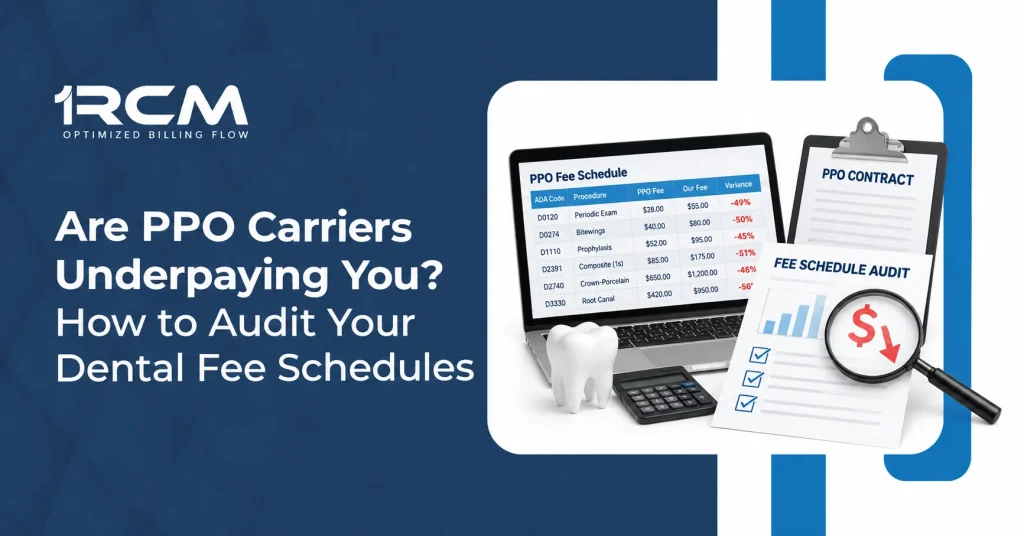
To audit your dental PPO fee schedules, compare three numbers for your most-used CDT codes: the fee in each signed PPO contract, the fee loaded in your practice management software, and the amount the carrier actually allowed and paid. Each difference then falls into one of three buckets: a correct contractual write-off, a carrier underpayment, or a posting error your own team can fix. In short, good dental PPO fee schedule management keeps those three numbers in sync.
Key Takeaways
- Your practice management system (PMS) fee schedule is only a copy of the contract. When a carrier changes its allowances and nobody updates the PMS, write-offs, patient estimates and payment reviews all use the wrong number.
- Separate three amounts on every audited claim line: the correct contractual write-off, any carrier underpayment, and any excess write-off your team posted.
- A lower payment is not automatically an underpayment. For example, deductibles, coinsurance, annual maximums, frequency limits, alternate benefits and coordination of benefits can all explain it.
- Start with your highest-revenue CDT codes and your largest PPO networks, because that is where small per-claim differences add up fastest.
- Contract terms decide what you can collect. In addition, network leasing, noncovered services laws and plan type (fully insured or self-funded) all change the math.
- The American Dental Association recommends reviewing contracted fee schedules annually and checking the next EOBs to confirm that the carrier applied agreed fee changes.
1. Why Outdated PPO Fee Schedules Cost Dental Practices Money
Many dental offices attach a PPO fee schedule to each insurance plan in Dentrix, Eaglesoft or Open Dental. The software then uses those dental insurance contracted rates to estimate the patient’s portion and, in many offices, to post the contractual write-off.
That works only as long as the stored fees match the contract. Carriers can amend fee schedules. However, as ADA News has reported, payers may post these amendments on their websites or bury them in newsletters. If nobody loads the change, three things go wrong at the same time:
- The software calculates write-offs from the old allowance.
- Patient estimates and checkout copays rely on the wrong fee.
- Underpayments become invisible, because staff compare each payment with an outdated expected amount.
Hypothetical example: your office fee for a procedure is $200. The contracted allowance rose from $120 to $145, but your PMS still holds $120. If your team posts write-offs from the PMS schedule, each claim gets an $80 write-off instead of $55. As a result, the practice writes off $25 per claim that it could have collected from the carrier, the patient or both, depending on the plan’s benefits.
Warning signs your PPO reimbursements need an audit
- Contractual write-offs for the same carrier keep growing while production stays flat.
- Allowed amounts on EOBs differ from the fees in your PMS for the same CDT code.
- Patients receive unexpected balances or refunds after the carrier processes their claims.
- Payments for one code vary between claims from the same plan with no benefit explanation.
- EOBs show you as in-network with a plan your practice never signed with.
- Nobody can say when each PPO fee schedule in the software was last checked against the contract.
Keep reporting your full office fee on claims even when you use PPO fee schedules in the software. The ADA’s Council on Dental Benefit Programs says it is always appropriate to report your full fee. In addition, the full fee lets the allowed amount on each EOB show you when a carrier’s fee has changed.
2. Contractual Write-Off, Underpayment or Posting Error?
A dental insurance write-off audit only works if the team agrees on what each number means:
- Contractual write-off: the difference between your office fee and the contracted allowance for a covered service. Under a typical PPO participation agreement, the practice cannot collect it from the patient.
- Carrier underpayment: the carrier paid less than it owes under the contract and the patient’s benefits.
- Posting error (excess write-off): your team wrote off more than the contract requires, usually because the PMS fee schedule is wrong or someone adjusted off the whole unpaid balance.
Worked example: one claim line
| Fee Component | Amount |
|---|---|
| Office fee | $200 |
| Verified contracted allowance | $150 |
| Plan coverage for this service | 80% (deductible already met) |
| Expected insurance payment | $120 (80% of $150) |
| Patient coinsurance | $30 (20% of $150) |
| Correct contractual write-off | $50 ($200 − $150) |
| Insurance payment received | $100 |
| Potential carrier underpayment | $20 ($120 − $100) |
The two formulas behind the audit:
- Expected write-off = office fee − contracted allowance
- Potential underpayment = expected insurance payment − actual insurance payment
The patient’s share in this example stays at $30. In other words, the missing $20 is a question for the carrier, not a balance to move to the patient.
Now suppose the PMS still holds an outdated $125 allowance for the same code. The system then posts a $75 write-off instead of $50. That extra $25 is an internal posting error, separate from anything the carrier did.
Similarly, if the same $20 underpayment repeated on 150 similar claims, the potential gap would reach $3,000. However, treat that total as unverified until you confirm each claim.
Read CO and PR adjustments on the ERA
Electronic remittance advice (the X12 835) explains each adjustment with a group code and a Claim Adjustment Reason Code (CARC). Group code CO (contractual obligation) assigns the amount to the provider. In contrast, PR (patient responsibility) assigns it to the patient. CMS states that all payers must use approved CARCs and remark codes from X12-recognized code set maintainers, not proprietary codes.
In the X12 Claim Adjustment Reason Code list, CARC 45 means the charge exceeds the fee schedule, maximum allowable or contracted fee arrangement. As a result, on a correctly processed in-network claim, the CO-45 amount should equal your expected write-off. However, if CO-45 is larger than your full office fee minus the contracted allowance, the carrier most likely applied a lower allowance than your contract. In that case, the line belongs on your audit list.
For a field-by-field refresher, see our guide on how to read a dental EOB.
3. How to Audit Your Dental PPO Fee Schedules in Six Steps
A repeatable audit is the core of dental PPO fee schedule management. Run these six steps for one carrier first, then repeat them for each network.
| Step | Action | What to Do |
|---|---|---|
| Step 1 | Build a contract inventory | Collect every signed PPO agreement, amendment and current fee schedule with effective dates. |
| Step 2 | Pick high-volume codes | Rank CDT codes by total revenue and audit the top codes first. |
| Step 3 | Compare contract fees with the PMS | Check each stored fee, plan assignment and effective date against the contract. |
| Step 4 | Reconcile EOB and ERA lines | Compare allowed amount, payment, patient share and adjustment codes with expected amounts. |
| Step 5 | Audit posted write-offs | Compare each posted adjustment with office fee minus contracted allowance. |
| Step 6 | Document, dispute and fix | Log variances, request reprocessing where supported, correct the PMS and track outcomes. |
Step 1: Build a contract and fee schedule inventory
For each PPO network, gather:
- The signed participation agreement and every amendment.
- The current fee schedule and the date it took effect.
- Which providers and locations the agreement covers.
- The carrier’s provider manual or office reference manual, which often holds claim and dispute rules.
- Any list of plans or networks allowed to access your fees through leasing.
The ADA’s Contract Negotiation Guide advises that nothing is final until it appears in a signed, written agreement, and it recommends keeping copies of future amendments. If you cannot find a signed fee schedule, request it from the carrier’s provider relations team or provider portal before auditing.
Step 2: Start with your highest-revenue CDT codes
The ADA guide also recommends knowing which procedure codes generate the highest total revenue for your practice. Run a production report by CDT code and carrier, then audit the top codes first. After all, a $5 difference on a code you bill thousands of times a year matters more than a large gap on a rare procedure.
| CDT Code | Procedure (Plain Language) | Why Audit It |
|---|---|---|
| D0120 | Periodic exam for an established patient | Billed at most recall visits |
| D1110 | Adult cleaning (prophylaxis) | High volume; subject to frequency limits |
| D2392 | Two-surface posterior composite filling | Common restoration; alternate benefit rules may apply |
| D2740 | Porcelain or ceramic crown | High fee; small percentage gaps are large in dollars |
The American Dental Association maintains CDT codes and their official descriptors, so check the current CDT version before updating fees. If cleanings are a large share of your volume, our breakdown of D1110 vs. D4910 frequency limits explains why some lower payments are benefit limits rather than fee errors.
Step 3: Compare contracted fees with your PMS fee schedules
For each audited code and network, check:
- The stored fee matches the contracted fee for the current effective period.
- Each insurance plan in the software points to the right network’s fee schedule.
- Provider- or location-specific fee schedules exist where the contract requires them.
- No audited code is missing from the PPO schedule.
Compare older claims with the fee schedule in effect on the date of service, not with today’s rates.
Step 4: Reconcile a sample of EOB and ERA lines
Pull a recent sample for each major carrier, for example the last 30 to 90 days of paid lines for your top codes. This is a practical starting range, not a carrier rule. Compare:
| Claim Detail | What to Compare It With |
|---|---|
| Allowed amount | Contracted fee for that code, network and date of service |
| Insurance payment | Allowed amount minus deductible and coinsurance under the patient’s benefits |
| Patient responsibility | Deductible, coinsurance or noncovered amounts shown on the EOB |
| CO adjustments | Your expected write-off (office fee minus contracted allowance) |
| Reason and remark codes | Frequency limits, alternate benefits, bundling, coordination of benefits or annual maximums |
| Network shown | The network you contracted with, or a leased network |
Step 5: Run a dental insurance write-off audit
Then compare every posted contractual adjustment with the expected write-off. Watch for three patterns:
- The write-off equals the whole unpaid balance, so the team adjusted off an underpayment instead of disputing it.
- The team posted a write-off after the primary EOB and again after the secondary EOB.
- Write-offs match an outdated PMS allowance rather than the current contract.
In fact, accurate payment posting services rely on this same check: each adjustment should trace back to a contract term or an EOB explanation.
Step 6: Document, dispute and fix the root cause
For each confirmed variance, record the patient account, claim number, date of service, CDT code, network and fee schedule version, expected allowance and payment, actual allowance and payment, the variance, and the EOB or ERA reference.
Then contact the carrier to request reprocessing or reconsideration. Reconsideration and appeal deadlines vary by carrier, contract and plan, so check the agreement and provider manual before submitting older claims. Finally, correct the PMS fee schedule or posting rule that caused the problem, and track the amount requested and recovered.
When the same variance repeats across many claims from one carrier, send provider relations a grouped report rather than disputing each claim separately.
4. Check a Claim: PPO Underpayment and Write-Off Calculator
Enter one claim line to separate the correct write-off, the expected insurance payment and any shortfall. The calculator starts with the worked example above.
PPO Underpayment and Write-Off Check
Pre-filled with the worked example. Change any value to test one of your own claim lines; results update automatically when your browser runs JavaScript.
The carrier paid $20.00 less than expected on this line. Check the EOB for deductibles, maximums, frequency limits or alternate benefits before disputing.
Screening tool only. The annual figure counts the larger of the underpayment and the excess write-off on each claim, so money that was underpaid and then written off is not counted twice. It does not model annual maximums, frequency limits, alternate benefits, waiting periods or coordination of benefits. Verify each result against the contract and EOB before disputing a claim or changing a patient balance.
5. Updating Fee Schedules in Dentrix, Eaglesoft and Open Dental
Dental practice fee schedule updating fixes the root cause the audit uncovers. Menus differ between software versions, so follow your vendor’s current help for your version. Before any change, back up or export the existing fees, and test a sample patient estimate afterward.
Dentrix
Dentrix Magazine, published by Henry Schein One, describes editing fee schedules in Dentrix from the Office Manager through Fee Schedule Maintenance. In contrast, an older article names the same task Fee Schedule Setup under Practice Setup. Its guidance includes:
- Export the fee schedule to a file before you edit it, so you can import it back if a change goes wrong.
- Attach the PPO fee schedule to the insurance plan through the plan’s Insurance Data window. Choosing Change Plan for All updates every patient on that plan; Add As New Plan creates a copy instead.
- Avoid assigning an insurance fee schedule directly to a patient in the Family File. When a patient has no fee schedule, Dentrix looks to the insurance plan and then the provider.
- Existing treatment plans and scheduled appointments keep their old fees until you run Update Treatment Plan Fees and Update Scheduled Amounts.
Eaglesoft
Eaglesoft also supports insurance fee schedules. However, menu names and setup steps vary by version, so use Patterson’s current Eaglesoft help or support team for the exact steps.
Whatever the menu, the checks stay the same: confirm each PPO fee schedule matches the current contract, confirm that every plan using that network points to it, and recheck estimates after updating.
Open Dental
The Open Dental fee schedules manual documents these tools:
- Setup > Fee Schedules lists fee schedules by type (Normal, CoPay, Out of Network, FixedBenefit and ManualBlueBook). The manual describes Normal as the in-network contracted fee schedule type, which you select in the insurance plan’s Fee Schedule field.
- Check Insurance Plan Fees (the Go button in the Fee Schedules window) lists insurance plans with their attached fee schedule. As a result, you can spot plans attached to the wrong schedule and reassign them in bulk.
- Fee Tools (Procedure Codes > Fee Tools) can copy, export, import, clear or increase fees by a percentage. Imports use a tab-delimited file and overwrite existing fees, so the manual advises backing up existing fees first.
- Global Updates: Update Proc Fees Only changes fees on treatment-planned procedures but not insurance estimates; Update Estimates Only recalculates estimates and write-offs.
6. Contract Rules That Change What You Can Collect
Fee changes and notice
Whether a carrier can change your fee schedule, and how much notice it must give, depends on your participation agreement, its amendments and, in some cases, state law. There is no single notice period that applies to every dental PPO contract. Instead, read the amendment clause in each agreement and watch payer portals and newsletters. Then, as the ADA advises, check the next EOBs after any agreed change.
Leased networks
Network leasing lets a carrier rent your contracted fees to other plans or networks. The ADA explains that a dentist who signs with one network can end up treated as in-network with a plan that leases it and paid at the discounted fee schedule.
According to the ADA, 30 states have passed laws on leasing of third-party payer contracts. Some let dentists opt out, while others require advance notice, such as 30 days, before a leased arrangement applies. Therefore, ask each carrier for a list of every payer that can access your fee schedule.
Covered services and balance billing
For covered services, an in-network dentist generally agrees to accept the contracted fee, so the practice writes off the difference between the office fee and the allowance instead of billing it to the patient. The patient still owes deductibles and coinsurance under the plan. Check your contracts for exact terms.
Noncovered services laws
According to ADA News (March 2026), 44 states have noncovered services laws that prohibit plans from dictating a provider’s fee for services the plan does not cover. Important qualifications from the same ADA guidance:
- Most of these laws define a covered service by benefit eligibility, not by whether a claim was paid, so a covered service that went unpaid may still fall under the contracted fee.
- The laws typically apply to fully insured plans regulated by the state. ERISA-governed self-funded plans may still require the contracted PPO fee for noncovered services.
- In states without such a law, the PPO contract controls.
Confirm whether a patient’s plan is fully insured or self-funded before charging your full fee for a noncovered service.
7. Dental PPO Fee Schedule Optimization: Using Your Audit Results
Dental PPO fee schedule optimization starts with clean data. Once your stored fees are correct, you can compare networks fairly:
- Write-off percentage by network (total contractual write-offs divided by gross production for that network’s patients).
- Allowances for your top CDT codes, network by network.
- Patient volume and new-patient flow from each network.
- Recurring underpayments, leased-network claims and administrative burden.
Hypothetical example: if one network’s patients generated $100,000 in gross production and the practice wrote off $32,000, the write-off rate is 32%. That figure alone does not tell you whether to stay in the network, but it shows where to look first.
The ADA’s guide also recommends reviewing contracted fee schedules annually and renegotiating periodically, such as when an agreement comes up for renewal. When the numbers show that a contract needs renegotiation, ORCM’s payer contract management services can help prepare the analysis. This is also where PPO reimbursement rates for dentists differ most: allowances vary by carrier, network, region and agreement, so compare your own contracts rather than published averages.
8. Dental PPO Fee Schedule Management: How Often to Review
| Audit Activity | Recommended Frequency |
|---|---|
| Load carrier fee changes into the PMS | As soon as a signed change takes effect |
| Spot-check EOB allowances for top codes | Monthly |
| Dental insurance write-off audit (sample) | Monthly or quarterly |
| Full contract and fee schedule review | At least annually, and at each renewal |
| Network performance review | Annually |
Dental PPO fee schedule management is ongoing work rather than a one-time cleanup. These intervals reflect recommended practice, not carrier requirements. Specifically, the annual review follows ADA guidance, while the other intervals are operational suggestions to adapt to your claim volume.
9. Common Fee Schedule Audit Mistakes
- Trusting PMS fees without checking the signed contract.
- Comparing old claims with current rates instead of the fee schedule in effect on the date of service.
- Calling every low payment an underpayment before checking deductibles, frequency limits, alternate benefits and coordination of benefits.
- Writing off the full unpaid balance instead of only the contractual difference.
- Moving a carrier shortfall to the patient’s balance.
- Ignoring leased-network claims because the practice assumes it is in-network anyway.
- Missing the carrier’s reconsideration or appeal window while the audit drags on.
Get Help Auditing Your Dental PPO Payments
A fee schedule audit takes time your front desk rarely has: collecting contracts, matching EOB lines, correcting write-offs and following up with carriers. ORCM supports dental practices with insurance verification, payment posting, review of contracted fees and adjustments, and follow-up on underpaid claims.
Explore ORCM’s dental billing services to see how a structured posting and follow-up workflow can keep your PPO fee schedules, write-offs and collections aligned.
Frequently Asked Questions
It depends on the participation agreement, its amendment terms and applicable state law; there is no universal notice period. Some carriers announce changes through portals or newsletters rather than letters. Therefore, review each agreement’s amendment clause and compare EOB allowances with your stored fees to catch changes.
Each carrier’s contract, provider manual and plan rules set the reconsideration and appeal windows, and some state laws also apply. Check the deadline before you audit older claims, and dispute the most recent and highest-value variances first.
UCR (usual, customary and reasonable) generally refers to an amount a plan considers typical for a service in an area, often used for out-of-network benefits. A PPO contracted fee is the amount an in-network dentist has agreed to accept for a covered service under a participation agreement.
Both methods can work. Attaching each PPO’s fee schedule to its plans gives more accurate patient estimates, but someone must update the schedules whenever a contract changes. Either way, report your full office fee on claims so EOBs show the carrier’s allowance.
This often happens through network leasing, where a carrier you contracted with rents your fee schedule to another plan or network. Ask the carrier you signed with which payers can access your fees and whether you can opt out of leased arrangements.