
Pain management billing denials often result from coding inaccuracies, insufficient medical necessity documentation, missing prior authorizations, and payer-specific coverage restrictions. These issues can delay reimbursements, increase administrative costs, and disrupt a practice’s revenue cycle. Exploring the common causes of pain management billing denials and implementing preventive billing strategies can help practices reduce claim rejections, maintain compliance, and improve reimbursement efficiency.
Key Takeaways
- Medical necessity documentation: Incomplete clinical records and insufficient treatment justification can lead to pain management claim denials.
- Prior authorization requirements: Missing or incorrect authorizations can delay or prevent reimbursement for pain procedures.
- Coding and modifier accuracy: Incorrect CPT codes, modifier usage, and unbundling errors increase the risk of denied claims.
- Procedure frequency limits: Exceeding payer-specific frequency restrictions can result in noncovered services and payment denials.
- Proactive denial prevention: Regular coding audits, documentation reviews, and payer-policy verification help practices improve clean claim submissions and reimbursement outcomes.
What Are the Most Common Pain Management Billing Denials?
Pain management billing denials occur when insurance payers refuse reimbursement for submitted services due to documentation deficiencies, coding errors, medical necessity concerns, or coverage restrictions. Common issues include missing prior authorizations, incorrect modifiers, exceeded procedure frequency limits, and bundled service billing. These denials can delay payments and increase administrative workload for pain management practices.
Although often used interchangeably, claim denials and claim rejections are different. A rejected claim fails initial processing because of missing or invalid information, while a denied claim has been processed but not approved for payment.
The following table highlights common causes of interventional pain management claim rejections and denials.
| Denial Category | Common Cause |
| Medical necessity | Insufficient clinical evidence supporting the procedure |
| Prior authorization | Missing, expired, or incorrect authorization |
| Frequency limitations | Procedures exceed payer-approved limits |
| Coding and modifiers | Incorrect CPT, ICD-10-CM, or modifier reporting |
| Unbundling | Separately billing services included in another procedure |
| Documentation | Missing treatment history or procedural details |
7 Common Pain Management Billing Denials and How to Prevent Them
Pain management procedures often involve complex coding requirements, clinical documentation standards, and payer-specific coverage policies. Even minor inconsistencies between medical records and submitted claims can trigger reimbursement delays or denials.
Below are seven common causes of denial and practical strategies practices can use to prevent them.

1. Medical Necessity Denials Due to Insufficient Clinical Documentation
Medical necessity denials occur when the submitted documentation fails to establish why a pain management procedure is clinically appropriate. Insurance payers evaluate whether the diagnosis, symptoms, treatment history, and proposed intervention meet applicable coverage criteria.
Under pain management medical necessity guidelines, documentation may need to establish the patient’s pain characteristics, functional limitations, relevant examination findings, diagnostic evidence, and response to previous treatments.
For example, an epidural steroid injection claim may be denied if the medical record does not adequately establish the condition being treated or the clinical rationale for the injection.
How to prevent medical necessity denials:
- Document the patient’s diagnosis, pain severity, symptoms, and functional limitations.
- Include relevant imaging findings and clinical examination results.
- Record previous treatments and the patient’s response to those treatments.
- Ensure ICD-10-CM diagnosis codes accurately reflect the documented condition.
- Review applicable payer coverage policies before performing the procedure.
Complete, consistent clinical documentation helps establish medical necessity and supports reimbursement when the procedure meets the payer’s coverage requirements.
2. Prior Authorization Denials for Pain Injections
Prior authorization denials occur when a practice performs a procedure without obtaining required payer approval or when the authorization does not match the services billed.
Prior authorization requirements for pain injections vary depending on the insurance plan, procedure type, and clinical circumstances. Certain epidural injections, facet interventions, and radiofrequency procedures may require advance approval.
Common authorization errors include incorrect CPT codes, expired approval dates, mismatched treatment locations, or authorization for fewer services than those performed.
How to prevent prior authorization denials:
- Verify authorization requirements before scheduling the procedure.
- Confirm that approved CPT codes match the planned services.
- Check authorization validity dates and approved service quantities.
- Maintain authorization records in the patient’s billing documentation.
- Reverify approval when the treatment plan or procedure changes.
Practices should also remember that prior authorization does not guarantee reimbursement. The submitted claim must still satisfy medical necessity, eligibility, coding, and other applicable coverage requirements.
3. Frequency Limit Denials for Repeated Pain Procedures
Frequency limit denials occur when repeated pain management procedures exceed the number of services covered under a payer’s policy.
Pain procedure frequency caps can apply to epidural steroid injections, facet joint interventions, diagnostic blocks, and other procedures. These restrictions may depend on the anatomical region, treatment interval, procedure type, and documented response to previous interventions.
For example, a practice may submit a claim for a repeat injection without recognizing that the patient has already reached the payer’s covered frequency limit.
How to prevent frequency limit denials:
- Review payer-specific frequency restrictions before scheduling repeat procedures.
- Track previously performed injections and their dates of service.
- Verify whether restrictions apply by spinal region, session, or rolling coverage period.
- Document the patient’s response to previous procedures.
- Review whether any policy exceptions apply and what documentation they require.
A centralized procedure tracking system can help billing teams identify potential frequency conflicts before services are scheduled or claims are submitted.
4. Incorrect Modifier 25 Use With Epidural Injection Visits
Modifier 25 errors occur when a separately billed evaluation and management (E/M) service does not meet the requirements for reporting it alongside a procedure performed on the same day.
In modifier 25 epidural injection coding, the modifier is appended to the appropriate E/M code when the provider performs a significant, separately identifiable E/M service beyond the usual evaluation associated with the procedure.
For example, a patient receiving a scheduled epidural injection may also require a separately identifiable evaluation for a new clinical problem. If that evaluation meets the applicable requirements and is adequately documented, reporting an E/M service with modifier 25 may be appropriate.
However, a routine pre-procedure assessment alone generally does not justify a separately billed E/M service.
How to prevent modifier 25 denials:
- Confirm that the E/M service is significant and separately identifiable.
- Document the additional evaluation and medical decision-making.
- Avoid billing routine procedure-related assessments as separate E/M services.
- Apply modifier 25 to the qualifying E/M code, not the injection procedure code.
- Review payer-specific modifier policies before claim submission.
Accurate modifier reporting reduces coding disputes and helps practices support separately payable services.
5. Fluoroscopic Guidance Coding and Billing Errors
Fluoroscopic guidance billing errors occur when imaging services are reported separately even though the applicable procedure code already includes image guidance.
Fluoroscopic guidance CPT billing rules differ according to the specific pain procedure and code description. Certain interventional pain management codes include imaging guidance, while other services may have different reporting requirements.
For example, separately reporting fluoroscopic guidance with an injection code that already includes the imaging component may result in a bundling-related denial.
How to prevent fluoroscopic guidance denials:
- Review current CPT code descriptions before reporting imaging guidance.
- Determine whether fluoroscopy is included in the primary procedure code.
- Check applicable National Correct Coding Initiative (NCCI) edits.
- Ensure procedure notes support the imaging technique used.
- Avoid billing imaging components separately when prohibited by coding rules.
Practices can consult the CMS National Correct Coding Initiative for Medicare coding edits and guidance on services that should not be reported separately.
6. Unbundling Errors in Interventional Pain Management Claims
Pain management unbundling errors occur when components of a single procedure are billed separately despite being included in a comprehensive procedure code.
These errors frequently involve imaging guidance, procedural components, and services that are considered integral to the primary intervention.
For example, billing a comprehensive pain injection procedure along with a separately reported component already included in its CPT description may trigger an NCCI edit or payer denial.
Unbundling can also create compliance risks when separate reporting is not supported by coding rules.
How to prevent unbundling errors:
- Verify whether the primary CPT code includes related procedural services.
- Review NCCI procedure-to-procedure edits and payer bundling policies.
- Avoid using modifiers solely to bypass valid coding edits.
- Confirm that separately billed services are independently reportable.
- Conduct periodic coding audits for frequently performed pain procedures.
Consistent coding reviews help practices identify incorrect code combinations before claims reach the payer.
7. Missing Conservative Treatment Documentation for Epidurals
Conservative therapy documentation for epidurals is often essential when payers require evidence that appropriate nonsurgical treatment has been attempted before an interventional procedure.
Depending on the applicable coverage policy, conservative treatment may include physical therapy, medication management, activity modification, or other clinically appropriate interventions.
A claim may be denied when the medical record does not adequately document prior treatment, its duration, the patient’s response, or the clinical reason conservative treatment was unsuitable.
How to prevent conservative treatment documentation denials:
- Record previous conservative treatments and their duration.
- Document whether symptoms improved, persisted, or worsened.
- Explain why an epidural injection is clinically appropriate.
- Record contraindications or other reasons conservative treatment could not be completed.
- Compare clinical documentation against applicable payer coverage criteria.
Practices can use the CMS Medicare Coverage Database to locate relevant Medicare Local Coverage Determinations (LCDs) and related billing articles.
Clear treatment histories help demonstrate that the intervention meets the applicable medical necessity requirements.
How Do Facet Joint Block Billing Guidelines Affect Claim Approval?
Facet joint block billing guidelines affect claim approval by establishing requirements for medical necessity, diagnostic procedures, anatomical levels, and treatment frequency. Incorrect CPT coding, missing documentation, or failure to meet payer coverage criteria can lead to denied claims for facet joint injections and medial branch blocks.
Facet interventions may include diagnostic medial branch blocks (MBBs), intra-articular injections, and radiofrequency ablation (RFA). Each procedure has distinct documentation and coverage requirements.
For example, certain Medicare Local Coverage Determinations require documented pain relief following diagnostic medial branch blocks before radiofrequency ablation can qualify for coverage. These policies may also restrict the number of treated levels and procedures within a specified period.
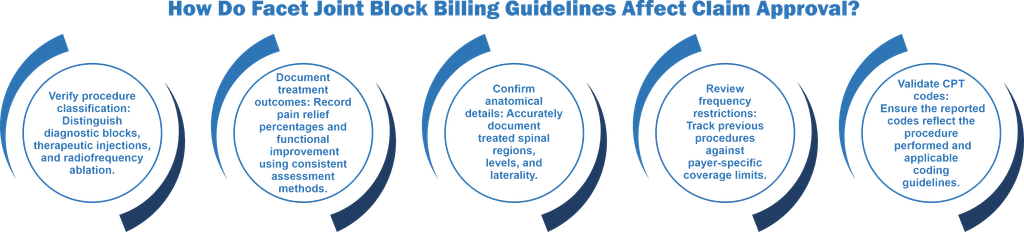
To reduce facet joint billing denials, practices should:
- Verify procedure classification: Distinguish diagnostic blocks, therapeutic injections, and radiofrequency ablation.
- Document treatment outcomes: Record pain relief percentages and functional improvement using consistent assessment methods.
- Confirm anatomical details: Accurately document treated spinal regions, levels, and laterality.
- Review frequency restrictions: Track previous procedures against payer-specific coverage limits.
- Validate CPT codes: Ensure the reported codes reflect the procedure performed and applicable coding guidelines.
Accurate facet joint billing requires coordination between clinical documentation and coding teams. Reviewing coverage requirements before treatment helps reduce avoidable reimbursement disputes.
How Can Pain Management Practices Prevent Billing Denials Before Claim Submission?
Pain management practices can prevent billing denials by establishing a standardized pre-submission workflow that verifies insurance eligibility, medical necessity, prior authorization, clinical documentation, and coding accuracy. Identifying potential claim errors before submission reduces administrative rework and supports more consistent reimbursement.
An effective denial prevention process should include the following steps:
1. Verify patient eligibility and benefits: Confirm active insurance coverage, plan limitations, network status, and applicable patient responsibilities before treatment.
2. Review medical necessity requirements: Compare the documented diagnosis, clinical findings, and proposed procedure against relevant payer policies.
3. Confirm prior authorization: Verify authorization numbers, approved procedures, service dates, and authorized quantities.
4. Validate CPT and ICD-10-CM codes: Ensure procedure and diagnosis codes accurately represent the services performed and support applicable coverage criteria.
5. Check modifiers and bundling rules: Review modifier usage, NCCI edits, and payer-specific coding restrictions before submitting claims.
6. Track procedure frequency: Maintain accurate records of previous injections, diagnostic blocks, and other interventions to identify potential coverage limitations.
7. Perform claim scrubbing: Use billing software or manual quality checks to detect missing information, invalid code combinations, and claim formatting errors.
Recommended Pain Management Billing Workflow
STEP 1: Eligibility Verification
STEP 2: Authorization Review
STEP 3: Clinical Documentation
STEP 4: Coding Validation
STEP 5: Claim Submission
STEP 6: Denial Monitoring
A structured workflow helps billing teams detect inconsistencies early, reduce preventable denials, and improve first-pass claim acceptance.
How Should Practices Manage and Appeal Pain Management Claim Denials?
Pain management practices should manage denied claims by identifying the exact denial reason, reviewing payer policies, correcting eligible billing errors, and submitting supported appeals within required deadlines. A systematic denial management process helps recover appropriate reimbursement while preventing recurring claim issues.
Not every denial requires a formal appeal. Some claims can be corrected and resubmitted, while others require additional medical records or a request for reconsideration.
Practices can improve denial resolution through the following measures:
- Identify denial reasons: Review electronic remittance advice, Claim Adjustment Reason Codes (CARCs), and Remittance Advice Remark Codes (RARCs).
- Review supporting documentation: Compare submitted codes with clinical notes, authorization records, and applicable coverage requirements.
- Determine the appropriate action: Identify whether the claim requires correction, reconsideration, or a formal appeal.
- Submit complete appeals: Include relevant medical records, treatment histories, authorization evidence, and a clear explanation supporting reimbursement.
- Monitor payer deadlines: Track timely filing limits and appeal submission requirements.
- Analyze recurring denials: Categorize denial patterns by payer, procedure, provider, and root cause.
Practices should also monitor denial trends to identify opportunities for improvement. For example, repeated authorization-related denials may indicate a scheduling workflow issue, while frequent modifier denials may suggest a need for additional coding education.
A proactive approach to denial management supports appropriate revenue recovery and strengthens long-term billing performance.
How Can Specialized Pain Management Billing Services Reduce Denials?
Specialized pain management billing services help practices manage complex coding requirements, payer policies, and reimbursement workflows. Experienced billing teams can support accurate CPT coding, prior authorization tracking, medical necessity documentation reviews, claim scrubbing, and timely denial follow-up.
By identifying billing inconsistencies before submission and monitoring recurring denial patterns, specialized billing support can reduce preventable errors and administrative burdens. Practices seeking to improve claim accuracy, streamline revenue cycle operations, and strengthen collections can benefit from professional pain management billing services tailored to interventional procedures and payer-specific requirements.
The Bottom Line
Pain management billing denials commonly result from incomplete documentation, missing authorizations, incorrect coding, frequency restrictions, and payer-specific coverage requirements. These challenges can delay reimbursements, increase administrative workloads, and affect a practice’s financial performance.
Reducing denials requires accurate clinical records, consistent coding reviews, timely authorization verification, and proactive claim monitoring. By strengthening billing workflows and staying informed about payer policies, pain management practices can improve claim accuracy, reduce preventable denials, and maintain a more efficient revenue cycle.
FAQs
Q: What Is the Difference Between a Denied and a Rejected Pain Management Claim?
Ans: A rejected pain management claim fails initial processing because of errors such as missing patient information, invalid codes, or incorrect claim formatting. A denied claim has been processed by the payer but was not approved for payment. Rejections generally require correction and resubmission, while denials may require correction, reconsideration, or appeal.
Q: Can a Pain Management Claim Be Resubmitted After Denial?
Ans: Yes, a pain management claim may be resubmitted after denial when the payer permits a corrected claim. However, some denials require reconsideration or a formal appeal rather than resubmission. Practices should review the denial reason, payer instructions, and filing deadlines before determining the appropriate action.
Q: What Are the Most Common Denial Codes in Pain Management Billing?
Ans: Common denial codes include CO-16 for missing or incorrect claim information, CO-50 for services considered not medically necessary, and CO-197 for missing required precertification or authorization. Practices should review accompanying remark codes and payer explanations to determine the exact reason for each denial.
Q: How Is the Pain Management Billing Denial Rate Calculated?
Ans: The pain management billing denial rate measures the percentage of submitted claims that receive denials during a defined reporting period.
Denial Rate = (Number of Denied Claims ÷ Total Claims Submitted) × 100
For example, if a practice submits 500 claims and 40 are denied, its denial rate is 8%. Practices should use consistent reporting periods and distinguish initial denials from final denials when tracking performance.
Q: What KPIs Should Pain Management Practices Track to Improve Collections?
Ans: Pain management practices should monitor first-pass claim acceptance rate, initial denial rate, denial overturn rate, days in accounts receivable (A/R), and net collection rate. These key performance indicators help identify billing inefficiencies, evaluate denial management effectiveness, and measure revenue cycle performance over time.