
Nephrology billing challenges often arise from incomplete CKD staging documentation, incorrect diagnosis sequencing, complex dialysis billing rules, medical necessity requirements, and Medicare coordination of benefits. Practices can reduce preventable denials by verifying ICD-10-CM codes, documenting the services provided, applying ESRD monthly capitation payment rules correctly, and monitoring claims from submission through final payment.
A reliable nephrology revenue cycle management (RCM) process combines accurate clinical documentation, specialty-specific coding knowledge, payer verification, and consistent denial follow-up.
Key Takeaways
- Document the patient’s CKD stage and relevant clinical conditions accurately.
- Follow ICD-10-CM guidelines for hypertensive CKD and diabetic kidney complications.
- Distinguish physician ESRD monthly capitation payments from dialysis facility reimbursement.
- Verify medical necessity and documentation for additional dialysis treatments.
- Monitor Medicare coordination of benefits, transient visits, claim denials, and underpayments.
What Are the Most Common Nephrology Billing Challenges?
Nephrology practices manage chronic conditions that require ongoing monitoring, recurring treatments, complex medication management, and coordination among multiple healthcare providers. These clinical demands create additional billing and documentation requirements.
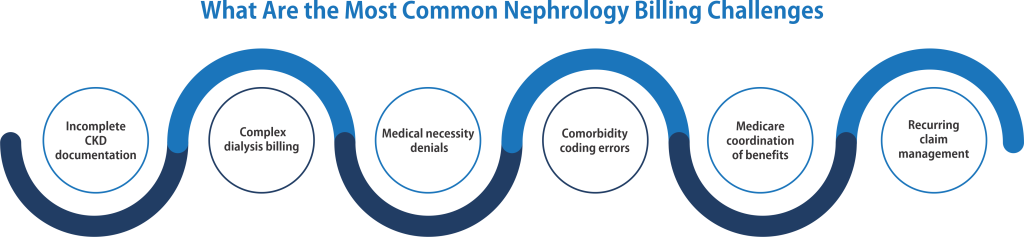
The most common nephrology billing challenges include:
| Billing Challenge | How It Affects Reimbursement |
|---|---|
| Incomplete CKD documentation | Missing or inconsistent CKD stages can lead to inaccurate diagnosis coding and requests for additional information. |
| Complex dialysis billing | Physician management services and facility dialysis treatments follow different billing and reimbursement rules. |
| Medical necessity denials | Insufficient documentation supporting the frequency or type of dialysis treatment can result in denied or reduced payments. |
| Comorbidity coding errors | Hypertension, diabetes, heart disease, and CKD may require specific diagnosis combinations and sequencing. |
| Medicare coordination of benefits | Incorrectly identifying the primary payer can delay reimbursement or result in claim rejections. |
| Recurring claim management | Monthly physician services and recurring dialysis treatments require accurate tracking to prevent duplicate billing and missed charges. |
A structured nephrology billing workflow helps practices address these issues before they affect reimbursement.
1. Improving Chronic Kidney Disease Coding Accuracy
Chronic kidney disease coding accuracy is essential because the documented stage and associated conditions affect diagnosis reporting, medical necessity review, and the overall accuracy of the claim.
ICD-10-CM category N18 identifies chronic kidney disease, with codes corresponding to documented stages and end-stage renal disease.
Why CKD staging documentation matters
A nephrology note should support the diagnosis and stage being reported. Billing teams should review documentation for:
- The provider-documented CKD stage.
- Relevant kidney function findings and clinical assessments.
- Whether the condition is documented as stable, progressing, or otherwise clinically significant.
- Associated conditions such as hypertension or diabetes.
- Dialysis status and other applicable clinical details.
Laboratory findings can support clinical assessment, but billing staff should not independently assign or change a diagnosis solely from laboratory values without an appropriate coding basis and provider documentation.
Common CKD coding errors
Errors can occur when a claim uses an unspecified stage despite available documentation, reports conflicting stages across records, or fails to include additional diagnoses required by coding guidelines.
When documentation is incomplete or inconsistent, the billing team should follow its provider-query process rather than guessing the appropriate code.
For the current code set and reporting requirements, consult the official CMS ICD-10 resources. The applicable fiscal-year guidelines should be used for the date of service.
2. Hypertensive Chronic Kidney Disease Code Sequencing
Hypertensive CKD requires careful diagnosis sequencing under ICD-10-CM guidelines.
When hypertension and CKD are both present, the classification generally presumes a relationship unless the provider documents that the conditions are unrelated. Codes from category I12 identify hypertensive CKD, while an additional code from category N18 identifies the CKD stage.
When hypertension, heart disease, and CKD are all present, category I13 may apply instead. Additional codes may be required to identify the specific heart condition and CKD stage.
| Documented Conditions | ICD-10-CM Category | Additional Code Required |
|---|---|---|
| Hypertension + CKD | I12 (hypertensive CKD) | N18 code to identify the CKD stage |
| Hypertension + heart disease + CKD | I13 (hypertensive heart and CKD) | Codes for the specific heart condition and the N18 CKD stage |
| Hypertension and CKD documented as unrelated | Separate codes per provider documentation | Follow the official guidelines for the date of service |
How to reduce sequencing errors
Before submitting a claim:
- Confirm the documented hypertension and kidney disease diagnoses.
- Determine whether category I12 or I13 applies under the coding guidelines.
- Add the appropriate N18 code to identify the CKD stage.
- Review additional code requirements for associated conditions.
- Confirm the sequencing against the official guidelines for the applicable date of service.
Do not automatically assign separate hypertension, heart disease, and CKD codes without checking the relevant combination-code requirements.
The FY 2027 ICD-10-CM Official Guidelines explain the applicable conventions for hypertensive CKD and hypertensive heart and CKD.
3. Diabetic Nephropathy ICD-10 Coding
Diabetic nephropathy creates another coding challenge because diabetes and kidney disease may need to be represented together under ICD-10-CM conventions.
The applicable diabetes code depends on the documented diabetes type and associated kidney complication. Additional coding may be required to identify the CKD stage.
What should billing teams verify?
- The documented type of diabetes.
- The specific kidney complication identified by the provider.
- The appropriate diabetes-with-kidney-complication code.
- The applicable additional CKD-stage code.
- Any other relevant conditions supported by the record.
Avoid coding a more specific complication than the documentation supports. If the record uses terms such as diabetic kidney disease, diabetic nephropathy, or CKD without sufficient detail, review the applicable coding conventions and query the provider when clarification is necessary.
Accurate diabetic nephropathy ICD-10 coding helps ensure that the claim reflects the documented clinical picture without adding unsupported diagnoses.
4. Dialysis CPT Coding Guidelines and Medical Necessity
Dialysis billing involves separate considerations for physician management services and dialysis facility treatments. Using the correct code family is only one part of the process; the documentation and payment rules must also support the service.
Physician dialysis management versus facility billing
Physicians managing patients with end-stage renal disease may bill for eligible monthly management services under the ESRD monthly capitation payment system.
Dialysis facilities generally bill under Medicare’s ESRD Prospective Payment System (PPS) for covered outpatient maintenance dialysis services. The facility payment includes a defined bundle of renal dialysis services, so certain items and services cannot simply be billed separately by another provider.
CMS explains these requirements in its ESRD PPS consolidated billing guidance.
| Factor | Physician / Practitioner | Dialysis Facility |
|---|---|---|
| Payment system | ESRD monthly capitation payment (MCP) | ESRD Prospective Payment System (PPS) |
| Billing basis | Monthly management of eligible ESRD patients | Per dialysis treatment furnished |
| Key variables | Patient age, qualifying visits per month, home vs. center-based dialysis | Sessions actually furnished, each reported on a separate claim line |
| What is included | Eligible monthly management services | A defined bundle of renal dialysis services (consolidated billing) |
| Common risk | Duplicate MCP claims for the same month | Billing sessions that were not furnished or unbundling bundled services |
Documentation supporting dialysis medical necessity
Billing teams should verify that the medical record supports the service and frequency billed. Relevant records may include:
- The physician’s treatment plan or dialysis prescription.
- Documentation of the dialysis sessions actually furnished.
- Clinical justification for additional treatments when required.
- Relevant physician assessments and treatment records.
- Applicable orders, modifiers, and payer-required information.
For Medicare facility claims, each dialysis session performed must be reported on a separate line under the applicable billing requirements. Sessions listed in the patient’s plan of care but not actually furnished must not be billed.
Additional treatments beyond the usual frequency may require supporting medical documentation to establish that they were reasonable and necessary.
Review the applicable CMS Billing and Coding guidance for Frequency of Hemodialysis and the relevant Medicare Administrative Contractor policies before submitting claims.
5. Understanding ESRD Monthly Capitation Payment Rules
ESRD monthly capitation payment (MCP) is a Medicare payment methodology for eligible physician and practitioner management of patients with end-stage renal disease.
The physician MCP is different from the facility’s per-treatment ESRD PPS payment. Confusing these payment types can create duplicate billing, inaccurate claims, and potential overpayments.
How physician MCP billing works
For eligible patients receiving center-based dialysis, the payment methodology generally varies according to the patient’s age and the number of qualifying visits during the calendar month. Different requirements apply to home dialysis patients.
The applicable CPT code must reflect the patient’s circumstances and the services provided. A practice should not assume that every patient qualifies for the same monthly payment or that the number of visits alone establishes eligibility.
Avoiding duplicate MCP claims
CMS has identified duplicate ESRD MCP claims as an overpayment risk. For the specific codes addressed in its review, CMS states that only one paid claim or claim line is covered for the applicable monthly service, while additional claims can be recovered as overpayments.
To reduce this risk:
- Verify the physician responsible for the patient’s monthly management.
- Confirm the relevant calendar month and patient circumstances.
- Review visit documentation and applicable code requirements.
- Check existing claims before submitting another MCP claim.
- Reconcile remittance records and investigate duplicate payments.
Read the official CMS guidance on ESRD MCP payments for four or more visits per month.
6. Transient Dialysis Visit Billing
Transient dialysis billing can become complicated when patients temporarily receive care away from their usual dialysis location, such as while traveling or staying in another area.
The billing team must establish which services were provided, which provider or facility is responsible for billing them, and whether those services fall under the physician MCP or facility payment rules.
Best practices for transient visits
- Verify the patient’s regular dialysis arrangements and temporary treatment dates.
- Confirm the actual services provided and the responsible billing entity.
- Check whether the visit is covered by an existing payment arrangement.
- Review applicable Medicare rules for temporary changes in treatment location or physician management.
- Prevent duplicate claims for services already included in an applicable payment.
A temporary dialysis visit should not automatically be treated as a separate billable physician service. Review the circumstances and applicable rules before choosing the billing approach.
For more complex situations, consult the applicable Medicare Claims Processing Manual and Medicare Administrative Contractor guidance.
7. Dialysis Coordination of Benefits Under Medicare
Medicare coordination of benefits can affect reimbursement when a patient has additional health insurance, employer coverage, or other coverage that may be primary.
For people with ESRD, Medicare Secondary Payer rules can differ from the rules that apply to other Medicare beneficiaries. The patient’s coverage history and applicable coordination period may affect which payer is responsible for a particular claim.
How to avoid coordination-of-benefits errors
Billing teams should:
- Verify current Medicare entitlement and other insurance coverage.
- Confirm whether Medicare or another insurer is primary for the service.
- Review the applicable ESRD Medicare Secondary Payer rules.
- Submit claims to the correct payer in the required order.
- Retain primary payer EOBs and other supporting records.
- Update insurance information when the patient’s coverage changes.
Do not assume that Medicare is always primary simply because the patient has ESRD. Verify the applicable coverage facts and rules before submitting the claim.
Incorrect payer order can cause rejections, payment delays, and avoidable rework.
8. How to Prevent Nephrology Billing Denials
A reliable billing process should address errors before claims reach the payer and ensure that denied claims receive timely attention.
Use a consistent pre-submission workflow
| Step | Action | What to Check |
|---|---|---|
| Step 1 | Verify patient and payer information | Confirm eligibility, coverage dates, and coordination of benefits. |
| Step 2 | Review clinical documentation | Ensure the CKD stage, associated conditions, dialysis services, and medical necessity are adequately supported. |
| Step 3 | Validate coding | Check ICD-10-CM diagnosis selection and sequencing, applicable CPT codes, and any required modifiers. |
| Step 4 | Review payment methodology | Distinguish physician MCP claims from dialysis facility claims and check for duplicate billing. |
| Step 5 | Submit and track claims | Monitor acceptance reports, rejections, payer responses, and outstanding balances. |
| Step 6 | Investigate denials | Identify whether the issue involves coding, documentation, medical necessity, payer order, or a payment-policy requirement. |
| Step 7 | Monitor recurring problems | Track denial reasons, aging accounts receivable, and underpayments to identify workflow improvements. |
Regular reporting can help practices identify patterns and prioritize issues that affect reimbursement.
9. How Nephrology RCM Services Can Improve Billing Performance
Nephrology practices need billing processes that account for specialty-specific documentation, recurring services, payer requirements, and complex reimbursement arrangements.
Specialized revenue cycle management can support:
- Diagnosis and procedure coding review.
- Claim submission and rejection monitoring.
- Denial investigation and appeal support where permitted.
- Payment posting and underpayment identification.
- Accounts receivable follow-up.
- Payer verification and coordination-of-benefits workflows.
- Reporting on denial trends and outstanding claims.
ORCM provides medical billing, coding audit, denial management, and accounts receivable services to support healthcare practices. Learn more about ORCM’s medical billing services or explore the full range of ORCM revenue cycle management services.
A consistent billing process can help nephrology practices improve claim accuracy, identify avoidable errors, and manage reimbursement more effectively.
Improve Your Nephrology Revenue Cycle With ORCM
Nephrology billing requires more than submitting claims. Accurate CKD staging, appropriate comorbidity coding, dialysis payment compliance, and consistent claim follow-up all contribute to a dependable revenue cycle.
ORCM helps healthcare practices manage billing workflows, coding review, denials, and accounts receivable. Explore ORCM’s medical billing services to learn how a more structured billing process can support your practice.
Frequently Asked Questions
Common nephrology conditions include chronic kidney disease, acute kidney injury, hypertension-related kidney disease, diabetic nephropathy, electrolyte disorders, kidney stones, and end-stage renal disease. Accurate documentation of these conditions supports appropriate coding and billing.
Both codes describe subsequent hospital inpatient or observation care. They represent different levels of medical decision-making or qualifying total time under applicable evaluation and management guidelines. The selected code must match the documented encounter and current CPT requirements.
Nephrology uses different code sets depending on the service, including evaluation and management, dialysis-related physician management, and other medically necessary procedures. The correct code depends on the service furnished, the provider’s role, documentation, and applicable payer rules.
The phrase “rule of 7” is not a universal CMS billing rule for dialysis claims. Billing teams should follow the applicable Medicare manual, current coding requirements, documentation standards, and payer-specific policies rather than relying on an informal rule of thumb.
Practices can monitor clean claim rates, denial rates, days in accounts receivable (A/R), reimbursement per encounter, and collection rates. Reviewing these metrics monthly helps identify recurring billing errors and opportunities to improve revenue cycle performance.