Healthcare providers can improve out-of-network reimbursement by verifying benefits before treatment, documenting medical necessity, submitting clean claims, negotiating underpayments with evidence, and appealing incorrect payment decisions. When the No Surprises Act (NSA) applies, providers must follow federal balance-billing restrictions and may use the Independent Dispute Resolution (IDR) process for eligible payment disputes. A consistent billing workflow helps practices recover appropriate reimbursement while protecting patients and maintaining compliance.
Key Takeaways
- Verify out-of-network benefits, deductibles, coinsurance, and authorization requirements before scheduled services.
- Review every Explanation of Benefits (EOB) and remittance advice for underpayments, denials, and incorrect adjustments.
- Use payer contracts, comparable reimbursement data, documentation, and applicable payment rules to support negotiations.
- Follow the No Surprises Act for eligible emergency, facility-based, and air ambulance services.
- Use the federal IDR process only for eligible disputes and observe the applicable deadlines.
- Provide Good Faith Estimates when required for uninsured and self-pay patients.
1. Why Out-of-Network Reimbursement Is Challenging
Out-of-network providers do not have a contracted reimbursement rate with a patient’s health plan. Payment therefore depends on the patient’s plan benefits, the insurer’s out-of-network payment methodology, applicable laws, and the type of service delivered.
Common challenges include:
| Challenge | What It Means |
|---|---|
| Low reimbursement rates | The insurer may calculate payment using an allowed amount that is lower than the provider’s charge. |
| High patient cost-sharing | Out-of-network deductibles and coinsurance may leave patients responsible for a larger portion of the bill. |
| Unexpected denials | Claims may be rejected for missing authorization, incomplete documentation, coding errors, or filing-limit violations. |
| Payment calculation disputes | The insurer’s allowed amount or benefit calculation may not match the policy terms. |
| Balance-billing restrictions | Federal or state laws may limit what the provider can collect from the patient. |
The first step is to determine which rules apply to each claim. An ordinary out-of-network claim is not automatically eligible for the No Surprises Act’s protections or federal IDR process.
2. Verify Out-of-Network Benefits Before Providing Care
One of the most effective out-of-network reimbursement strategies is to confirm the patient’s coverage before the appointment or procedure.
A current insurance card alone does not establish the patient’s out-of-network benefits. The billing team should verify the details directly with the payer and document the response.
What should the billing team verify?
- Whether the plan includes out-of-network benefits.
- Whether the provider and service are covered.
- The out-of-network deductible and remaining balance.
- Coinsurance and applicable out-of-pocket limits.
- Referral and prior authorization requirements.
- Claim submission deadlines and required documentation.
- How the plan calculates its out-of-network allowed amount.
- Whether the No Surprises Act or a state surprise-billing law may apply.
Record the verification date, representative or reference number, and the information provided by the payer. Eligibility verification is not a guarantee of payment, but it helps practices identify coverage issues before they become costly denials.
3. Apply No Surprises Act Out-of-Network Rules Correctly
The No Surprises Act has been in effect since January 1, 2022. It generally protects people with qualifying private health coverage from certain unexpected out-of-network bills.
Federal protections include eligible emergency services, certain non-emergency services provided by out-of-network professionals at participating in-network facilities, and covered out-of-network air ambulance services. Specific exclusions and exceptions apply.
Under protected circumstances, patient cost-sharing is generally calculated using in-network rules, and providers cannot bill patients for the prohibited balance.
When does the No Surprises Act apply?
Before billing the patient, determine:
- Whether the patient has coverage subject to the federal protections.
- Whether the service and setting fall within the law.
- Whether a statutory exception or permitted notice-and-consent process applies.
- Whether state law provides additional protections.
- Whether the claim qualifies for the federal payment dispute process.
Do not assume that every out-of-network office visit, elective procedure, or scheduled service is covered by the NSA. Conversely, do not assume a patient can waive protections simply by signing a general financial responsibility form.
Review the official CMS No Surprises Act guidance when building your compliance workflow.
4. Improve Out-of-Network Claim Negotiation Methods
For claims outside the NSA’s protected payment process, direct negotiation with the payer may help resolve reimbursement disputes. Negotiations should be based on the specific claim, the patient’s benefits, and evidence supporting the requested payment.
Build an evidence-based negotiation file
Include:
- The original claim and any corrected claim.
- The EOB or electronic remittance advice.
- Relevant medical records and medical necessity documentation.
- The applicable plan language and out-of-network benefit terms.
- The payer’s stated allowed amount and payment calculation.
- Comparable reimbursement information, where available.
- The requested adjustment and a clear explanation of the discrepancy.
Ask the payer to explain how it calculated the allowed amount. If the payment appears inconsistent with the plan terms or applicable requirements, identify the specific issue and request a written reconsideration.
For eligible NSA claims, the federal open negotiation and IDR procedures are separate from routine payer negotiations. Do not substitute an ordinary appeal or informal negotiation for a required NSA process.
5. Handle Out-of-Network Insurance Underpayments
An underpayment occurs when the insurer pays less than the amount the provider believes is due under the applicable plan terms, law, or payment process. A lower payment is not automatically an error: the amount may reflect a deductible, coinsurance, exclusion, or valid benefit limitation.
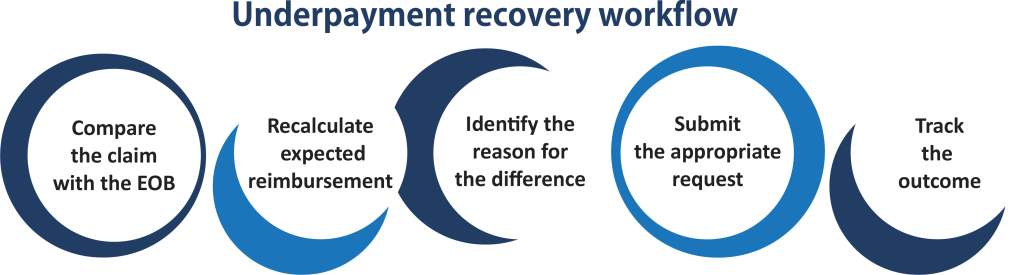
A structured underpayment review can help determine whether further action is warranted.
Underpayment recovery workflow
| Step | Action | What to Do |
|---|---|---|
| Step 1 | Compare the claim with the EOB | Confirm the billed charge, allowed amount, payer payment, patient responsibility, adjustments, and denial or remark codes. |
| Step 2 | Recalculate expected reimbursement | Use the patient’s benefit terms and the payer’s stated methodology. For eligible NSA claims, review the applicable payment information, including the Qualifying Payment Amount (QPA) when relevant. |
| Step 3 | Identify the reason for the difference | Separate contractual or benefit-based reductions from potential processing errors, incorrect coding, missing information, or disputed payment calculations. |
| Step 4 | Submit the appropriate request | Depending on the issue, this may be a corrected claim, reconsideration, appeal, formal negotiation, or an eligible NSA payment dispute. |
| Step 5 | Track the outcome | Record the amount requested, amount recovered, submission date, deadline, payer response, and any remaining patient responsibility. |
Prioritize high-value claims, recurring payer issues, and accounts approaching their appeal or dispute deadlines.
6. Understand the Qualifying Payment Amount (QPA)
The Qualifying Payment Amount is an insurer-calculated median contracted rate used in determining certain cost-sharing amounts and considered in the federal NSA payment dispute framework.
It is important to understand what the QPA does—and does not—mean.
- The QPA is not automatically the final payment owed to an out-of-network provider.
- Its calculation follows specific federal methodology and depends on factors such as the relevant market, specialty, service, and applicable plan rules.
- Other permitted information may be considered in the federal IDR process under the applicable legal framework.
- A provider should not assume that a charge above the QPA is, by itself, sufficient to establish entitlement to a higher payment.
When reviewing a qualifying claim, request the required payment information from the payer and examine it for completeness and consistency. If a dispute proceeds to IDR, submit relevant supporting information in accordance with the applicable requirements.
For methodology details, consult the official CMS Qualifying Payment Amount calculation methodology.
7. Use the Independent Dispute Resolution Process for Eligible Claims
The federal Independent Dispute Resolution process provides a way for eligible providers and health plans to resolve certain out-of-network payment disputes under the No Surprises Act.
It is not a universal appeals process for every unpaid or underpaid out-of-network claim.
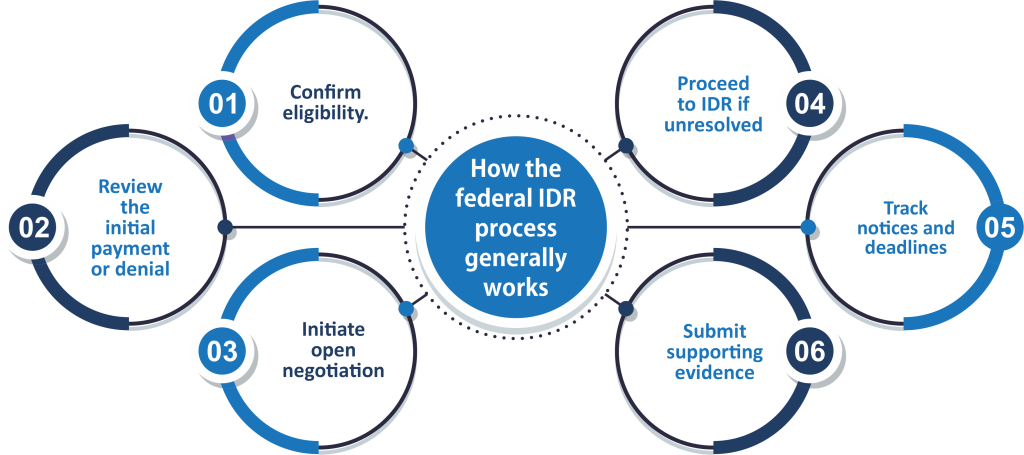
How the federal IDR process generally works
| Stage | What Happens |
|---|---|
| 1. Confirm eligibility | Check whether the service, coverage, and dispute meet the federal IDR requirements. |
| 2. Review the initial payment or denial | Examine the payer’s explanation and the payment information supplied for the claim. |
| 3. Initiate open negotiation | For eligible disputes, the parties generally have a 30-business-day open negotiation period. |
| 4. Proceed to IDR if unresolved | If the parties do not reach an agreement, an eligible party may initiate the federal IDR process within the applicable deadline. |
| 5. Submit supporting evidence | Provide relevant documentation and information required by the process. |
| 6. Track notices and deadlines | Missing procedural requirements can affect whether a dispute proceeds. |
The federal process has specific eligibility rules, submission requirements, and fees. State-specific payment resolution systems may apply instead in some circumstances.
CMS announced a Federal IDR Operations Final Rule on May 28, 2026, addressing communication, open negotiation, and process requirements. Because regulatory implementation details can change, providers should verify the currently applicable requirements before submitting a dispute.
Review the CMS overview of Independent Dispute Resolution before establishing or updating your internal workflow.
8. Follow Good Faith Estimate Rules for Self-Pay Patients
The No Surprises Act also includes protections for uninsured individuals and people who choose not to use their insurance for a service. In applicable circumstances, providers and facilities must provide a Good Faith Estimate (GFE) of expected charges.
Generally, a GFE is required when a patient requests one or schedules care at least three business days in advance. Specific timing and content requirements apply.
A compliant workflow should:
- Identify patients who are uninsured or intend to self-pay.
- Provide the estimate within the required timeframe.
- Include an itemized description of expected charges for the relevant provider or facility.
- Retain a copy of the estimate and delivery record.
- Explain that separately scheduled services or other providers may issue separate estimates.
- Maintain a process for responding to patient questions and billing disputes.
If the final bill is at least $400 more than a provider’s estimate for the applicable items or services, the patient may be eligible to use the federal Patient-Provider Dispute Resolution process. Eligibility and filing deadlines apply.
During a pending patient-provider dispute, providers must follow the applicable restrictions on collections and late fees.
See CMS guidance on Good Faith Estimates for current requirements.
9. Out-of-Network Patient Financial Consent Forms and Balance Billing
Patient financial forms should clearly explain expected charges and the patient’s potential financial responsibility. However, a general financial consent form does not automatically authorize balance billing where federal or state law prohibits it.
For services potentially subject to the NSA:
- Determine whether notice-and-consent requirements apply and whether the service is eligible for that exception.
- Use the required notice and consent documents and follow timing rules.
- Do not treat a signed form as a universal waiver of surprise-billing protections.
- Apply state-specific requirements where they are stricter or otherwise relevant.
- Document the patient’s coverage, disclosures, consent, and applicable billing determination.
The purpose of the workflow is to support informed financial decisions while ensuring that patient collections comply with applicable law.
10. OON Surprise Billing Compliance Checklist
Use this checklist when reviewing out-of-network claims and patient balances.
- Verify insurance coverage and out-of-network benefits.
- Confirm authorization, referral, and claim filing requirements.
- Determine whether federal NSA or state surprise-billing protections apply.
- Check whether the service qualifies for any permitted notice-and-consent exception.
- Provide Good Faith Estimates to eligible uninsured and self-pay patients.
- Review the EOB and remittance advice for payment discrepancies.
- Document underpayment calculations and supporting evidence.
- Track appeal, open negotiation, IDR, and patient dispute deadlines.
- Confirm that patient balances comply with applicable balance-billing restrictions.
- Maintain records of payer communications, notices, consent forms, and claim outcomes.
A checklist works best when integrated into the billing system, with work queues for deadlines, unresolved underpayments, and compliance exceptions.
11. How Out-of-Network Billing Services Can Improve Collections
Managing out-of-network claims requires more than submitting a claim and waiting for payment. Practices need a repeatable process for eligibility verification, claim review, payment reconciliation, underpayment analysis, payer follow-up, and compliant patient billing.
ORCM provides out-of-network billing services to help practices manage out-of-network claims, negotiations, and appeals. A structured revenue cycle workflow can help identify payment discrepancies, reduce preventable errors, and improve visibility into outstanding accounts.
When evaluating an out-of-network billing partner, ask how it:
- Verifies out-of-network benefits and patient responsibility.
- Identifies underpayments and prioritizes high-value accounts.
- Tracks payer appeals and applicable NSA deadlines.
- Handles balance-billing restrictions and patient financial communications.
- Reports collections, outstanding A/R, and recovery outcomes.
The goal is to improve appropriate reimbursement while maintaining clear documentation and compliance at every stage.
Improve Your Out-of-Network Reimbursement Process
A reliable reimbursement strategy combines accurate claims, proactive underpayment review, evidence-based negotiations, timely appeals, and compliance with patient billing protections. The right process helps practices identify recoverable revenue without treating every low payment as an error or every out-of-network claim as eligible for the NSA dispute process.
Explore ORCM’s out-of-network billing services to learn how a structured billing and follow-up workflow can support your practice’s collections.
Frequently Asked Questions
If your health plan includes out-of-network benefits, review the plan’s claim-submission requirements. Depending on the plan, you or the provider may submit the claim with an itemized bill, procedure and diagnosis codes, and supporting documentation. Reimbursement depends on plan terms and applicable laws.
Suppose a provider charges $300 for a service and the insurer determines that $200 is the eligible allowed amount. If the plan pays 60% of that amount after applying the relevant benefit rules, the insurer’s payment would be $120, before any other applicable adjustments. Actual calculations depend on the plan and the patient’s deductible, coinsurance, and other benefits.
Medicare billing depends on the provider’s enrollment and participation status, the service, and applicable Medicare rules. Providers who have opted out of Medicare and use valid private contracts are subject to specific requirements. Do not apply commercial-plan out-of-network billing practices to Medicare without checking the relevant rules.
Professional outpatient services are generally billed on the CMS-1500 paper claim form or its electronic equivalent, the 837P. Institutional outpatient services are generally billed on the UB-04/CMS-1450 or its electronic equivalent, the 837I. The correct form depends on the billing entity and service.
Practices should track reimbursement rates, underpayment recovery, denial rates, outstanding A/R, appeal outcomes, and collection timelines. Segmenting results by payer and service helps identify recurring payment issues and prioritize accounts for follow-up.