If you’ve ever felt confused while calculating therapy billing units, you’re not alone. The 8-minute rule is one of the most commonly misunderstood concepts in medical billing, yet it plays a critical role in ensuring accurate reimbursement and avoiding costly claim denials.
Whether you’re a physical therapist, occupational therapist, speech-language pathologist, or billing professional, understanding how this rule works can directly impact your revenue and compliance.
In this guide, we’ll break down the 8-minute rule in the simplest way possible, complete with examples, charts, and practical tips, so you can bill with confidence and precision.
What Is the 8 Minute Rule?
The 8-minute rule is a Medicare billing guideline that determines how healthcare providers bill for time-based CPT codes. In simple terms, you must provide at least 8 minutes of direct, one-on-one patient care to bill for one unit of a timed service.
This rule was introduced by Medicare in 1999 and fully implemented in 2000 to ensure fair and accurate reimbursement for outpatient therapy services like physical, occupational, and speech therapy.
- You need a minimum of 8 minutes to bill 1 unit
- Billing is done in 15-minute increments
- It applies only to time-based (timed) CPT codes
- Requires direct, face-to-face patient interaction
- Anything less than 8 minutes is not billable
The purpose of the 8-minute rule is to:
- Prevent overbilling
- Standardize therapy billing practices
- Ensure providers are paid fairly for actual time spent
In short, it creates a balance between accurate billing and compliance with Medicare regulations.
How Does the 8 Minute Rule Work?
Understanding the 8-minute rule becomes much easier once you know how to calculate billable units. At its core, the rule converts total treatment time into 15-minute billing units, with a special condition for leftover minutes.
There are two simple methods you can use to calculate units accurately:
Method 1: Long Division Approach
This is the most commonly used method in medical billing.
Steps:
- Add all timed (one-on-one) treatment minutes
- Divide the total by 15
- Look at the remainder:
- If it’s 8 or more → add 1 unit
- If it’s 7 or less → ignore it
Example:
- Total time = 23 minutes
- 23 ÷ 15 = 1 unit + 8 minutes remainder
- Since remainder ≥ 8 → Bill 2 units
Method 2: “Start From 8” Shortcut (Easier Way)
Instead of dividing, you can memorize starting points for each unit.
- 1 unit starts at 8 minutes
- Add 15 minutes for each additional unit
Quick Reference:
- 1 unit = 8 minutes
- 2 units = 23 minutes (8 + 15)
- 3 units = 38 minutes (8 + 30)
- 4 units = 53 minutes (8 + 45)
Example:
If you treated a patient for 38 minutes, you can bill 3 units
8 Minute Rule Chart
If you don’t want to calculate units every time, this 8-minute rule chart is your best friend. It quickly shows how many billing units you can report based on the total time spent on timed services.
8 Minute Rule Cheat Sheet
| Units | Time Range (Minutes) |
| 1 unit | 8 – 22 minutes |
| 2 units | 23 – 37 minutes |
| 3 units | 38 – 52 minutes |
| 4 units | 53 – 67 minutes |
| 5 units | 68 – 82 minutes |
| 6 units | 83 – 97 minutes |
| 7 units | 98 – 112 minutes |
| 8 units | 113 – 127 minutes |
Time-Based vs Service-Based CPT Codes
Before applying the 8-minute rule, it’s critical to understand the difference between time-based (timed) and service-based (untimed) CPT codes. This is where many billing errors begin.
What Are Service-Based (Untimed) CPT Codes?
Service-based codes are billed once per session, regardless of how much time you spend with the patient. Even if a service takes 10 minutes or 60 minutes, you can only bill one unit.
Common Examples:
- Physical Therapy Evaluation (97161, 97162, 97163)
- PT Re-evaluation (97164)
- Hot/Cold Packs (97010)
- Electrical Stimulation – unattended (97014 or G0283)
- Group Therapy (97150)
Key Characteristics:
- Not affected by time
- Fixed reimbursement per session
- Billed once per visit
What Are Time-Based CPT Codes?
Time-based codes are billed in 15-minute increments and are directly impacted by the 8-minute rule.
These services require direct, one-on-one patient interaction and active provider involvement.
Common Examples:
- Therapeutic Exercise (97110)
- Manual Therapy (97140)
- Neuromuscular Re-education (97112)
- Gait Training (97116)
- Ultrasound (97035)
- Electrical Stimulation – manual (97032)
Key Characteristics:
- Based on total treatment time
- Require constant attendance
- Follow the 8-minute rule for billing units
Why This Distinction Matters
- The 8-minute rule ONLY applies to timed codes
- Untimed codes are billed separately and do not count toward timed minutes
- Mixing these incorrectly can lead to underbilling or compliance issues
In multidisciplinary clinics where therapy and counseling overlap, managing these distinctions is even more complex. Many providers utilize dedicated mental health billing services to ensure that time-based behavioral interventions are partitioned correctly from untimed evaluations, preventing “unit leakage” and maintaining audit readiness.
Step-by-Step: How to Calculate Billing Units
Now that you know which codes are timed, let’s break down exactly how to calculate billing units correctly using the 8-minute rule.
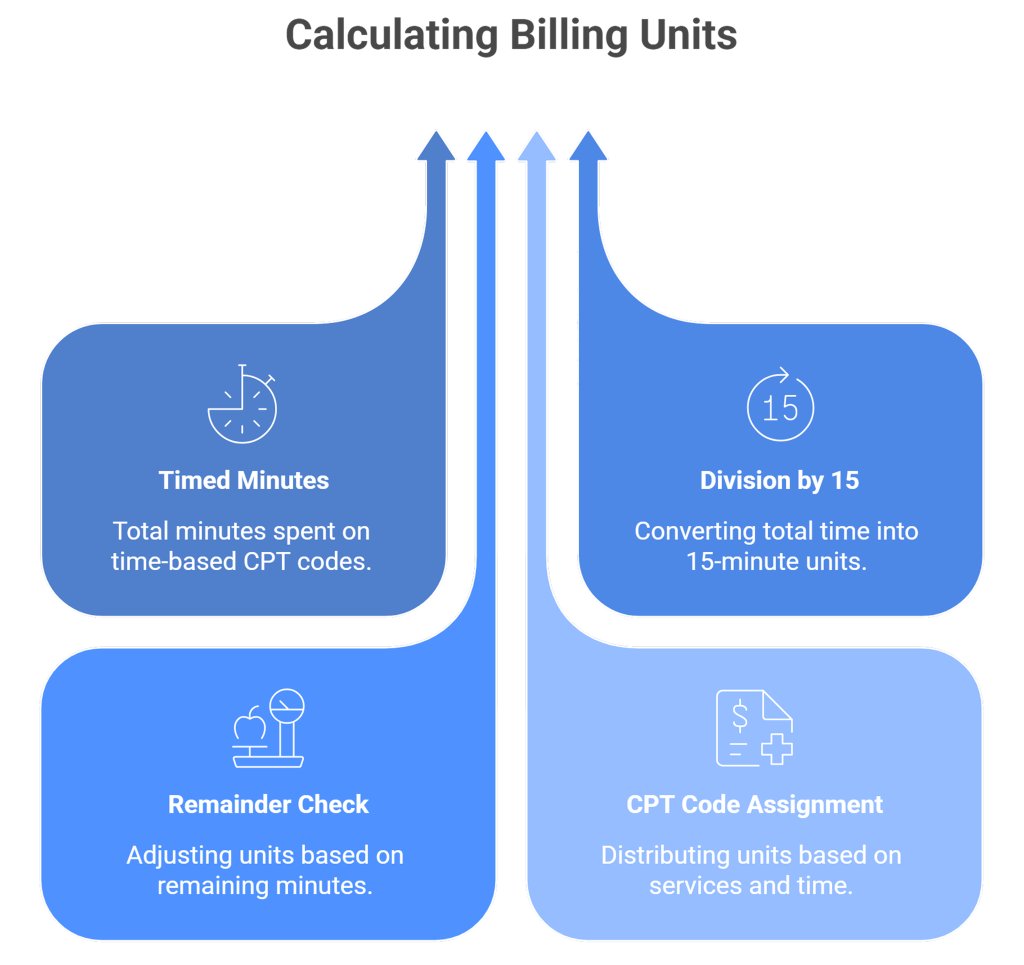
Step 1: Add All Timed Minutes
Combine all minutes spent on time-based CPT codes only.
Example:
- 20 min (97110) + 15 min (97140) + 10 min (97112)
= 45 total timed minutes
Step 2: Divide by 15
Convert total time into 15-minute units.
45 ÷ 15 = 3 units
Step 3: Check the Remainder
If total time doesn’t divide evenly:
- ≥ 8 minutes → add 1 unit
- ≤ 7 minutes → ignore
Example:
50 ÷ 15 = 3 units + 5 remainder → 3 units only
Step 4: Assign Units to CPT Codes
Distribute units based on:
- The services performed
- The time spent per service
Always assign units to the codes with the highest minutes first
Common Mistakes to Avoid
❌ Including untimed services in calculations
❌ Ignoring leftover minutes
❌ Assigning units randomly instead of by time
❌ Not documenting total minutes clearly
Always document exact minutes per CPT code; this makes calculations easier and protects you during audits.
8 Minute Rule Example
Let’s apply everything you’ve learned with a practical example.
Scenario:
A therapist performs the following services in one session:
- 30 minutes of Therapeutic Exercise (97110)
- 15 minutes of Manual Therapy (97140)
- 8 minutes of Ultrasound (97035)
- 15 minutes of Electrical Stimulation – unattended (97014)
Step 1: Add Timed Minutes
Only include timed services:
30 + 15 + 8 = 53 minutes
Step 2: Apply 8-Minute Rule Chart
53 minutes falls within the 53–67 minute range
4 units allowed
Step 3: Add Untimed Codes
- Electrical Stimulation (97014) = 1 unit (untimed)
Final Billing:
- 4 units (timed services)
- 1 unit (untimed service)
Total = 5 units billed
What Are Mixed Remainders?
When working with multiple timed CPT codes in a single session, you’ll often end up with leftover minutes after assigning full 15-minute units. These leftover minutes are known as remainders.
A mixed remainder occurs when these extra minutes come from more than one CPT code.
Why Mixed Remainders Matter
Individually, these leftover minutes may not meet the 8-minute threshold required to bill an additional unit. However, under Medicare’s 8-minute rule, you are allowed to combine these remainders to determine if they collectively qualify for another unit.
This is one of the most misunderstood, but important, concepts in therapy billing.
Example of Mixed Remainders
Let’s say a therapist performs:
- 20 minutes of Therapeutic Exercise (97110)
- 18 minutes of Manual Therapy (97140)
Now break it down:
- 20 minutes → 1 full unit (15 min) + 5 minutes leftover
- 18 minutes → 1 full unit (15 min) + 3 minutes leftover
Total remainder = 5 + 3 = 8 minutes
Since the combined remainder is 8 minutes, you can bill one additional unit.
Which CPT Code Gets the Extra Unit?
You must assign the extra unit to the code with the highest remaining time.
In this case:
- Therapeutic Exercise has 5 leftover minutes
- Manual Therapy has 3 leftover minutes
So, the extra unit goes to 97110 (Therapeutic Exercise)
Common Mistakes with Mixed Remainders
- Ignoring leftover minutes completely
- Not combining remainders across codes
- Assigning extra units to the wrong CPT code
- Confusing CMS rules with AMA rules
8 Minute Rule vs Rule of Eights
Although they sound similar, the 8-minute rule and the Rule of Eights are not the same. Understanding the difference is essential to avoid billing errors, especially when dealing with different payers.
What Is the Rule of Eights?
The Rule of Eights, introduced by the American Medical Association (AMA), follows a stricter approach. It applies the 8-minute threshold to each CPT code individually, rather than combining total session time.
Key Differences
- Calculation Method
- 8-Minute Rule (CMS): Combines total time across all timed services
- Rule of Eights (AMA): Calculates each CPT code separately
- Remainders
- CMS: Allows combining leftover minutes
- AMA: Does NOT allow combining remainders
- Usage
- CMS: Medicare and federal payers
- AMA: Some private insurance providers
Example Comparison
Imagine a session includes:
- 10 minutes of Therapeutic Exercise (97110)
- 10 minutes of Gait Training (97116)
Under CMS (8-Minute Rule):
- Total time = 20 minutes
- → 1 unit only
Under AMA (Rule of Eights):
- Each service exceeds 8 minutes
- → 2 units total (1 per code)
Does Assessment and Management Time Count?
A common question among therapists is whether non-treatment activities, like assessment or patient education, can be included in billable time. The answer is yes, but with conditions.
You can include time spent on activities that are essential to delivering the treatment, as long as they are performed face-to-face with the patient.
These include:
- Assessing the patient before treatment
- Evaluating the patient’s response during or after therapy
- Providing education and home-care instructions
- Answering patient or caregiver questions
- Documenting care while the patient is present
Why Documentation Is Critical
Including assessment and management time is allowed, but only if your documentation is clear and defensible.
Good documentation should:
- Accurately describe the treatment provided
- Explain clinical reasoning
- Be understandable to another provider
- Justify the time spent
Think of billing time as everything required to deliver the intervention, not just hands-on treatment. If it directly contributes to patient care and is properly documented, it likely counts.
Common CPT Codes Used Under the 8-Minute Rule
To apply the 8-minute rule correctly, you need to clearly identify which CPT codes are timed and which are untimed. This ensures accurate billing and prevents compliance issues.
Common Time-Based CPT Codes (Subject to 8-Minute Rule)
These codes are billed in 15-minute increments and require direct one-on-one patient care:
- 97110: Therapeutic Exercise
- 97112: Neuromuscular Re-education: This code is frequently used for activities focused on improving balance, coordination, kinesthetic sense, and posture. It is a staple in high-acuity recovery, such as post-operative care following spinal or cranial procedures. Because these sessions are often lengthy and intensive, specialized neurosurgery billing expertise is required to ensure that the 8-minute rule is applied accurately across multiple units of complex rehabilitation codes.
- 97140: Manual Therapy
- 97116: Gait Training
- 97530: Therapeutic Activities
- 97035: Ultrasound
- 97032: Electrical Stimulation (manual)
- 97535: Self-care/Home Management Training
- 97761: Prosthetic Training
- 97750: Physical Performance Testing
Common Service-Based (Untimed) CPT Codes
These are billed once per session, regardless of time:
- 97161–97163: Physical Therapy Evaluation
- 97164: Re-evaluation
- 97010: Hot/Cold Packs
- 97014 / G0283: Electrical Stimulation (unattended)
- 97150: Group Therapy
Summary
The 8-minute rule is a fundamental part of therapy billing that directly impacts your revenue, compliance, and efficiency. While it may seem complex at first, breaking it down into simple steps, understanding timed vs untimed codes, calculating total minutes, and applying the correct rules, makes it much easier to manage.
By mastering this rule, you can:
- Avoid costly billing errors
- Reduce claim denials
- Maximize reimbursement
- Stay compliant with Medicare guidelines
Start applying these principles in your daily billing workflow, and you’ll not only improve accuracy but also strengthen your overall revenue cycle performance.