Insect bites are one of the most frequently encountered conditions in clinical settings, but coding them correctly in ICD-10 can quickly become confusing without proper guidance. From identifying the correct nonvenomous insect bite code (W57) to selecting precise location-based injury codes for the face, legs, ears, or multiple sites, accuracy is essential for proper documentation and reimbursement.
Whether you’re dealing with an unspecified insect bite, a possible bite, or a reaction like dermatitis or allergy, each scenario requires a slightly different coding approach.
In this article, you’ll find a clear and practical breakdown of insect bite ICD-10 codes, helping you avoid common coding errors, improve claim acceptance rates, and ensure compliance with current medical coding standards.
What Is the ICD-10 Code for Insect Bite?
The most commonly used ICD-10 code for an insect bite is W57.XXXA, which represents a nonvenomous insect bite or sting during the initial encounter. This code is part of the external cause category and is widely used for bites caused by insects such as mosquitoes, fleas, bedbugs, and other nonvenomous organisms.
However, it’s important to understand that W57.XXXA alone is not always sufficient for billing purposes. Since it is classified as an external cause code, it must typically be used alongside a primary diagnosis code that describes the actual injury or condition caused by the bite, such as swelling, redness, or skin damage.
Here’s how the extensions work:
- W57.XXXA – Initial encounter
- W57.XXXD – Subsequent encounter
- W57.XXXS – Sequela (late effects)
In practice, coders must ensure that the correct encounter type is selected and that supporting diagnosis codes are included to reflect the patient’s condition accurately. This combination ensures proper reimbursement and reduces the risk of claim rejection.
Understanding W57: Nonvenomous Insect Bite ICD-10 Code
The W57 category in ICD-10 is specifically used to classify cases involving bites or stings from nonvenomous insects. This includes common everyday exposures such as mosquito bites, flea bites, lice, and bedbug bites. These incidents are generally considered minor but still require accurate documentation and coding for medical records and billing.
One of the key things to remember is that W57 does not describe the injury itself, it only identifies the cause of the injury. This means that healthcare providers and coders must pair it with another ICD-10 code that reflects the affected body part or resulting condition.
Key points to understand about W57:
- It applies only to nonvenomous insect bites or stings
- It is categorized under external causes of morbidity
- It requires a 7th character extension (A, D, S)
- It is often used in combination with injury or skin condition codes
For example, if a patient presents with swelling on the arm due to a mosquito bite, the correct coding approach would involve:
- A site-specific injury code (e.g., arm bite)
- Plus W57.XXXA to indicate the cause
Failing to include both codes is a common mistake that can lead to incomplete documentation or denied claims. Proper use of W57 ensures that the cause of the injury is clearly recorded, which is essential for both clinical accuracy and insurance processing.
Unknown or Unspecified Insect Bite ICD-10 Code
In many clinical scenarios, the exact type of insect responsible for a bite may not be identified. In such cases, coders must rely on unspecified insect bite ICD-10 codes while still maintaining compliance with coding guidelines.
Even when the insect is unknown, W57.XXXA is still used to indicate a nonvenomous insect bite. However, it must be paired with an unspecified injury code that reflects the affected area of the body.
For example:
- S00.96XA: Insect bite (nonvenomous) of unspecified part of head
- Other unspecified site codes may be used, depending on documentation
Using unspecified codes is acceptable when:
- The provider documentation lacks detail
- The exact location or insect type cannot be determined
- The case is being coded in an emergency or initial assessment setting
However, overuse of unspecified codes can create issues. It may:
- Reduce coding accuracy
- Lead to claim denials or delays
- Affect data quality for reporting and analytics
Best practice is to always code to the highest level of specificity available. If documentation improves in follow-up visits, coders should update the codes accordingly to reflect more precise information.
However, overuse of unspecified codes can create issues, such as reduced coding accuracy and increased payer scrutiny. If your facility relies heavily on unspecified codes for environmental encounters, medical coding audit services can help identify gaps in your clinical documentation. An audit ensures your team is capturing the specificity required to justify higher-level encounters and stay compliant with ICD-10 standards.
Possible Insect Bite ICD-10 Code: How to Code Suspected Cases
When a provider documents a possible insect bite, coding becomes slightly more nuanced. According to ICD-10 guidelines, uncertain or “possible” diagnoses should not be coded as confirmed conditions in outpatient settings. Instead, coders should rely on the documented signs and symptoms rather than assuming the cause.
In practical terms, this means that if a patient presents with redness, swelling, or itching and the provider suspects an insect bite but does not confirm it, the coder should avoid directly assigning W57 or a specific insect bite injury code.
Instead, coding should focus on symptoms such as:
- R21: Rash and other nonspecific skin eruptions
- L29.9: Pruritus (itching), unspecified
- R22.9: Localized swelling, mass, and lump
Once the diagnosis is confirmed in a later visit, the coder can then assign the appropriate insect bite ICD-10 codes.
This approach ensures:
- Compliance with ICD-10 outpatient coding rules
- Reduced risk of inaccurate claims
- Better alignment with clinical documentation
In inpatient settings, however, suspected conditions may be coded differently if documented as probable or likely, making it essential to understand the care setting before assigning codes.
ICD-10 Codes for Insect Bites by Body Location
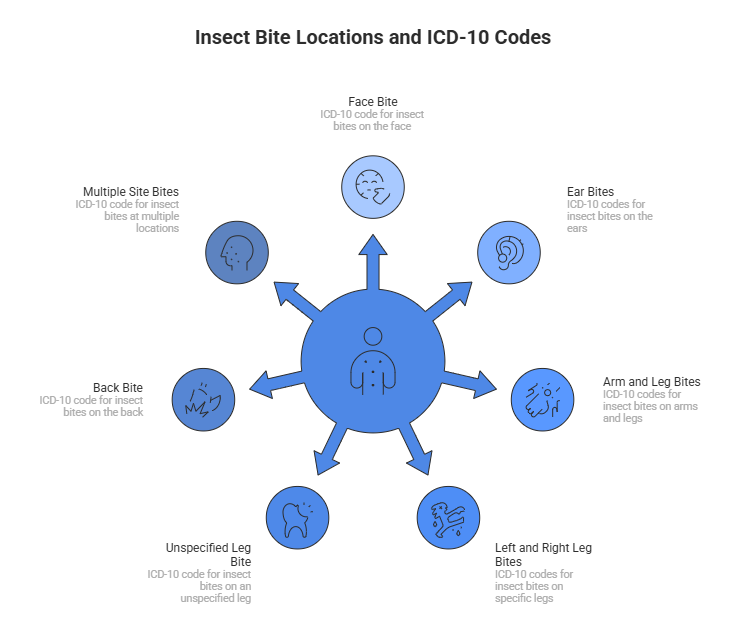
Accurate coding of insect bites often depends on precise documentation of the affected body part. ICD-10 provides detailed codes based on anatomical location, which helps improve claim accuracy and clinical specificity. This section covers the most commonly searched location-based codes.
1. ICD-10 Code for Insect Bite on Face
Insect bites affecting the face fall under the S00 category (superficial injuries of the head). These codes are used when the bite results in visible skin injury, swelling, or irritation.
Commonly used code:
- S00.86XA: Insect bite (nonvenomous) of other part of head, initial encounter
In practice, this code should be used when the bite affects areas such as the cheek, forehead, or chin. Coders must also include W57.XXXA to indicate the external cause.
Proper documentation should specify:
- Exact facial location
- Severity of the reaction
- Encounter type
2. ICD-10 Code for Insect Bite on Left Ear and Right Ear
When an insect bite affects the ear, coding falls under head injury classifications, specifically targeting the external ear region.
While ICD-10 may not always provide highly specific ear-only bite codes, providers often use:
- S00.46XA: Insect bite (nonvenomous) of ear, initial encounter
Laterality (left or right) should be documented whenever possible, even if the code itself does not explicitly differentiate. This improves record accuracy and supports better clinical tracking.
3. ICD-10 Code for Insect Bite on Arms and Legs
For bites on the limbs, ICD-10 uses different code ranges depending on the exact location. This is where specificity becomes especially important for coders.
General coding categories include:
- S40–S49: Shoulder and upper arm
- S50–S59: Forearm
- S60–S69: Wrist and hand
- S70–S79: Hip and thigh
- S80–S89: Lower leg
Each category includes specific insect bite codes that must be selected based on documentation. In all cases, pairing with W57.XXXA remains essential.
4. ICD-10 Code for Insect Bite on Left Leg and Right Leg
Targeting lower limb bites, coders typically use:
- S80.86XA: Insect bite (nonvenomous) of lower leg, initial encounter
If documentation specifies laterality (left or right), coders should select the appropriate variation where available. Laterality improves claim accuracy and reduces ambiguity in patient records.
5. ICD-10 Code for Insect Bite Unspecified Leg
When documentation does not clearly indicate whether the bite is on the left or right leg, coders may use unspecified codes within the same category.
However, relying on unspecified codes should be minimized because:
- It lowers coding precision
- It may trigger payer scrutiny
- It can delay reimbursement
Always prioritize specific documentation over generalized coding whenever possible.
6. ICD-10 Code for Insect Bite on Back
Bites on the back or trunk are classified under S20–S30 categories, depending on the exact anatomical region.
These codes apply when:
- The bite affects the upper or lower back
- There is visible injury or skin reaction
- Documentation supports trunk involvement
As with all cases, coders must include the external cause code (W57) alongside the injury code.
7. ICD-10 Code for Insect Bites at Multiple Sites
When a patient presents with multiple insect bites across different areas, coding requires careful consideration.
There are two main approaches:
- Assign multiple site-specific codes for each affected area
- Use a generalized or unspecified code if documentation lacks detail
Best practice is to code each site individually whenever possible. This provides:
- Greater clinical accuracy
- Improved data tracking
- Stronger justification for treatment and billing
ICD-10 Code for Nonvenomous Insect Bite
The standard ICD-10 code for a nonvenomous insect bite is:
- W57.XXXA: Bitten or stung by a nonvenomous insect, initial encounter
This code applies to bites from:
- Mosquitoes
- Fleas
- Bedbugs
- Other nonvenomous insects
It is important to note that W57 does not describe the injury itself, but rather the cause of the injury. Therefore, it must always be used in combination with a primary diagnosis code that reflects the patient’s condition, such as a skin lesion or localized swelling.
Proper use of this code ensures:
- Accurate documentation of the incident
- Compliance with ICD-10 guidelines
- Improved reimbursement outcomes
ICD-10 Code for Allergic Reaction to Insect Bite
In some cases, an insect bite can trigger an allergic reaction, ranging from mild irritation to severe systemic responses. In such scenarios, coding must reflect the reaction itself rather than just the bite, as the allergic response is often the primary reason for treatment.
Common ICD-10 codes used include:
- T78.40XA: Allergy, unspecified, initial encounter
- T78.2XXA: Anaphylactic shock, unspecified (for severe reactions)
When coding allergic reactions to insect bites, it is important to:
- Prioritize the allergic condition code as the primary diagnosis
- Add W57.XXXA as a secondary code to identify the cause
- Include additional symptom codes if documented (e.g., swelling, rash)
For example, if a patient presents with significant swelling and itching due to a mosquito bite, the correct coding approach would include:
- An allergy or reaction code
- Plus W57 to indicate the insect bite cause
This ensures accurate clinical representation and helps justify the level of care provided.
Dermatitis from Insect Bite ICD-10 Code
Insect bites often lead to dermatitis, especially when the skin becomes inflamed due to scratching or irritation. In these cases, coders must focus on the skin condition rather than the bite alone.
Commonly used ICD-10 code:
- L30.9: Dermatitis, unspecified
Depending on documentation, more specific dermatitis codes may also be applicable. The key is to determine whether the provider has diagnosed a skin condition resulting from the bite, rather than just a superficial injury.
Coding approach typically includes:
- A dermatitis code (primary diagnosis)
- W57.XXXA as a secondary external cause code
This distinction is important because dermatitis may require different treatment approaches, such as topical steroids or antihistamines, which must be supported by accurate coding.
ICD-10 Coding Guidelines for Insect Bites (Important Rules)
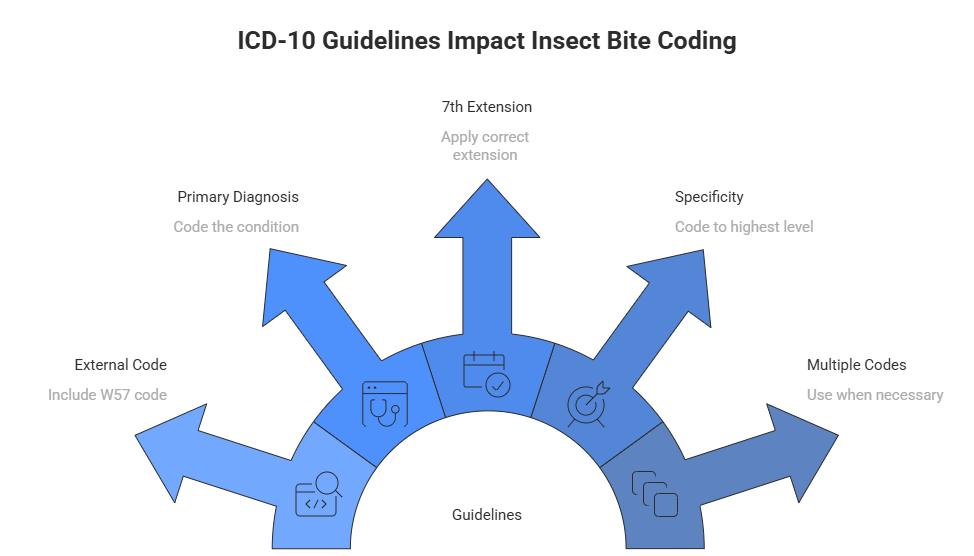
Accurate ICD-10 coding for insect bites depends on following a few essential guidelines. These rules help ensure proper documentation, reduce errors, and improve claim acceptance rates.
Key guidelines to follow:
Always include the external cause code (W57)
This identifies the insect bite as the cause of the injury, but should not be used alone.
Use a primary diagnosis code for the condition
This could be an injury code (S00–S90), dermatitis code, or allergy code, depending on the case.
Apply the correct 7th character extension
- A = Initial encounter
- D = Subsequent encounter
- S = Sequela
Code to the highest level of specificity
Avoid unspecified codes when detailed documentation is available.
Use multiple codes when necessary
For example, a bite causing both swelling and infection may require more than one diagnosis code.
Following these guidelines ensures that the coding reflects the patient’s condition accurately and meets payer requirements.
Common Coding Errors and How to Avoid Them
Even though insect bite coding may seem straightforward, several common mistakes can lead to claim denials or inaccurate records. Understanding these errors can help coders improve accuracy and efficiency.
Some of the most frequent coding errors include:
Using W57 as the only code: Since it is an external cause code, it must be paired with a condition or injury code.
Missing the 7th character extension: Omitting “A,” “D,” or “S” can make the code invalid.
Overusing unspecified codes: This reduces coding quality and may trigger payer audits.
Not coding associated conditions: Failing to include dermatitis, infection, or allergic reactions can result in incomplete claims.
Ignoring laterality or location details: Specificity is critical for accurate billing and documentation.
Avoiding these mistakes not only improves claim success rates but also ensures compliance with ICD-10 standards. If your practice is already seeing rejections due to “invalid 7th characters” or “mismatched diagnosis,” implementing dedicated denial management services can help you systematically appeal those claims and fix the root causes in your front-end workflow to prevent future revenue loss.
Final Thoughts
Accurate coding of insect bites in ICD-10 requires more than just selecting a single code; it involves understanding the cause, location, severity, and associated conditions. Whether you’re coding an unspecified insect bite, a localized injury, or an allergic reaction, the key is to combine the correct diagnosis code with the appropriate external cause code (W57).
By focusing on specificity, proper documentation, and guideline compliance, healthcare providers and coders can significantly reduce claim denials and improve reimbursement outcomes. Taking the time to code insect bites correctly not only supports accurate billing but also enhances the overall quality of patient records.