Accurate nutrition billing can make the difference between a smoothly running practice and a growing pile of denied claims. Whether you’re a registered dietitian, nutritionist, or healthcare provider, understanding nutrition billing CPT codes is essential for getting paid correctly and on time. From initial nutrition assessments to follow-up consultations and group therapy sessions, each service requires the right code, proper documentation, and compliance with insurance requirements.
Even a small coding mistake can lead to delayed payments, rejected claims, or lost revenue. So, which CPT codes should you use, and how can you avoid costly billing errors? Let’s explore the essential nutrition CPT codes, their billing requirements, and practical strategies to reduce claim denials, improve reimbursement, and strengthen your practice’s financial performance.
What Are Nutrition Billing CPT Codes?
Nutrition billing CPT codes are standardized medical procedure codes used to identify and bill nutrition-related healthcare services. These codes help registered dietitians, nutritionists, and other eligible healthcare providers communicate the type of care delivered to insurance companies and receive appropriate reimbursement.
CPT stands for Current Procedural Terminology, a coding system maintained by the American Medical Association (AMA). In nutrition billing, CPT codes are commonly used for medical nutrition therapy (MNT), including initial assessments, follow-up consultations, and group counseling sessions.
Selecting the correct dietitian billing CPT codes is essential because insurance companies use them to determine whether a service is covered, medically necessary, and eligible for payment. Incorrect coding can result in claim rejections, reimbursement delays, and unnecessary administrative work.
Although CPT codes identify the services performed, HCPCS Level II codes may also be used for certain nutrition-related services, particularly under Medicare and specific commercial insurance plans.
Common Nutrition Billing CPT Codes and Their Descriptions
Understanding the most frequently used nutrition billing CPT codes helps healthcare providers submit accurate claims and avoid reimbursement issues. The three primary CPT codes for medical nutrition therapy are 97802, 97803, and 97804. Each represents a different type of nutrition service and has specific time-based billing requirements.
| CPT Code | Description | Billing Unit |
| 97802 | Initial individual medical nutrition therapy assessment and intervention | 15 minutes |
| 97803 | Individual MNT reassessment and intervention | 15 minutes |
| 97804 | Group medical nutrition therapy | 30 minutes |
1. CPT Code 97802: Initial Medical Nutrition Therapy Assessment
CPT code 97802 is used for an initial, individual medical nutrition therapy assessment and intervention. During this visit, a registered dietitian evaluates the patient’s nutritional status, medical history, dietary habits, and health goals to develop an individualized nutrition care plan.
This code is commonly used when a patient receives an initial MNT assessment for conditions such as diabetes, kidney disease, or other nutrition-related health concerns, depending on insurance coverage.
Key billing considerations:
- Report the code in 15-minute units based on the documented face-to-face service time.
- Document the patient’s nutritional assessment, treatment goals, and recommended interventions.
- Verify whether the patient’s insurance requires a physician referral or prior authorization.
- Ensure the diagnosis supports medical necessity under the applicable payer policy.
For example, if a dietitian provides 60 minutes of qualifying initial MNT services, the claim may include four units of CPT code 97802, subject to payer rules.
2. CPT Code 97803: Medical Nutrition Therapy Follow-Up
CPT code 97803 is used for individual medical nutrition therapy reassessment and intervention. It applies when a patient returns for continued nutritional care, progress evaluation, or adjustments to an existing treatment plan.
During follow-up appointments, dietitians may review dietary changes, evaluate progress toward nutrition goals, address ongoing challenges, and modify recommendations based on the patient’s condition.
Key billing considerations:
- Bill in 15-minute increments according to documented service time.
- Record changes in the patient’s nutritional status and treatment plan.
- Confirm the patient’s remaining covered visits or MNT hours.
- Maintain documentation supporting the need for continued nutritional care.
For instance, a 30-minute qualifying follow-up session may be billed as two units of CPT code 97803.
3. CPT Code 97804: Group Medical Nutrition Therapy
CPT code 97804 is used when medical nutrition therapy is delivered to two or more patients in a group setting. These sessions allow dietitians to provide structured nutrition education and therapeutic interventions to patients with similar nutritional needs.
Group MNT may involve dietary planning, healthy eating strategies, disease-specific nutrition education, and practical approaches to managing chronic conditions.
Key billing considerations:
- Report the code in 30-minute units.
- Document the duration and therapeutic content of the group session.
- Maintain individual patient records supporting participation and medical necessity.
- Verify payer-specific group therapy coverage and billing restrictions.
For example, a qualifying 60-minute group MNT session may support two units of CPT code 97804 for each eligible participating patient, depending on payer requirements.
Additional HCPCS Codes Used in Nutrition and Dietitian Billing
Along with standard MNT CPT codes, certain HCPCS Level II codes are important for nutrition billing, especially when patients require additional therapy or diabetes self-management education. These codes address specific services that may not be appropriately reported using standard MNT codes alone.
HCPCS Code G0270: Individual MNT Reassessment After a Change in Condition
HCPCS code G0270 represents individual medical nutrition therapy reassessment and subsequent intervention following a qualifying change in diagnosis, medical condition, or treatment regimen.
Under Medicare, this code may be used for additional medically necessary MNT services when the applicable requirements, including a qualifying second referral, are met.
G0270 is billed in 15-minute increments. Documentation should establish the qualifying change, the reason additional MNT is necessary, and the services provided.
HCPCS Code G0271: Group MNT Reassessment
HCPCS code G0271 is used for additional group medical nutrition therapy following a qualifying change in a patient’s diagnosis, medical condition, or treatment regimen.
This code is reported in 30-minute increments and is subject to Medicare’s additional MNT requirements. Providers must maintain documentation supporting the change in condition, the qualifying referral, and the patient’s participation.
HCPCS Codes G0108 and G0109: Diabetes Self-Management Training
Diabetes self-management training (DSMT) helps patients develop the knowledge and skills needed to manage diabetes effectively. Although nutrition education may be part of DSMT, it is a distinct Medicare benefit from medical nutrition therapy.
| HCPCS Code | Description | Billing Unit |
| G0108 | Individual diabetes self-management training | 30 minutes |
| G0109 | Group diabetes self-management training | 30 minutes |
Medicare DSMT services are subject to program accreditation, referral, provider, and coverage requirements. Dietitians should not assume they can independently bill these codes simply because they provide diabetes nutrition counseling.
Important: MNT and DSMT have different billing and coverage requirements. Providers should verify eligibility and applicable Medicare rules before submitting claims.
Other CPT and HCPCS Codes Related to Nutrition Counseling
Not every nutrition-related appointment qualifies as medical nutrition therapy. Depending on the service, provider credentials, and insurance policy, additional nutrition counseling billing codes may be relevant.
These codes should only be used when the actual service meets the code description, and the payer permits reimbursement for the billing provider.
Preventive Nutrition Counseling CPT Codes 99401 to 99404
Preventive medicine counseling codes describe individual counseling or risk-factor reduction interventions provided to patients without symptoms of a specific illness.
| CPT Code | Service Description | Approximate Duration |
| 99401 | Individual preventive counseling | 15 minutes |
| 99402 | Individual preventive counseling | 30 minutes |
| 99403 | Individual preventive counseling | 45 minutes |
| 99404 | Individual preventive counseling | 60 minutes |
These services may involve preventive health education, lifestyle changes, and nutritional risk reduction.
However, these codes are not interchangeable with MNT codes. Their use depends on the service delivered, eligible provider type, and insurance requirements. Registered dietitians should confirm whether their payer recognizes them as eligible billing providers for these services.
CPT Codes 99411 and 99412: Group Preventive Counseling
CPT codes 99411 and 99412 represent preventive counseling or risk-factor reduction interventions delivered in a group setting.
- 99411: Group preventive counseling, approximately 30 minutes.
- 99412: Group preventive counseling, approximately 60 minutes.
These codes may apply to qualifying preventive health programs but should not automatically replace CPT code 97804 for group medical nutrition therapy.
CPT Codes 98960, 98961, and 98962: Patient Self-Management Education
These codes describe education and training for patient self-management delivered by qualified nonphysician healthcare professionals using an established curriculum.
| CPT Code | Service Description |
| 98960 | Individual patient self-management education, each 30 minutes |
| 98961 | Group education for 2 to 4 patients, each 30 minutes |
| 98962 | Group education for 5 to 8 patients, each 30 minutes |
Reimbursement depends on whether the payer recognizes the service, curriculum, provider qualifications, and billing circumstances.
HCPCS Code S9470: Nutritional Counseling
HCPCS code S9470 describes nutritional counseling provided by a dietitian, per visit. It may be recognized by certain commercial insurance plans.
Unlike time-based MNT codes, S9470 is generally reported per visit. However, coverage, reimbursement, and provider eligibility vary by insurer.
Providers should verify the patient’s benefits and payer-specific coding instructions before using S9470 instead of a standard MNT code.
ICD-10 Diagnosis Codes Commonly Used With Nutrition Billing CPT Codes
While CPT codes identify the nutrition services performed, ICD-10-CM diagnosis codes describe the patient’s medical condition or reason for receiving care. Accurate diagnosis coding helps insurers evaluate medical necessity and determine whether a nutrition service meets coverage requirements.
The following ICD-10-CM codes may be relevant to nutrition-related claims:
| ICD-10 Code | Description |
| E11.9 | Type 2 diabetes mellitus without complications |
| E66.9 | Obesity, unspecified |
| E78.5 | Hyperlipidemia, unspecified |
| I10 | Essential (primary) hypertension |
| N18.9 | Chronic kidney disease, unspecified |
| Z71.3 | Dietary counseling and surveillance |
Selecting a diagnosis code requires careful attention to the patient’s documented condition. A valid ICD-10-CM code does not automatically establish insurance coverage for nutrition therapy.
For example, Medicare’s MNT benefit is limited to specific qualifying conditions and circumstances. Other diagnoses may be covered under commercial insurance policies but may not qualify for the same Medicare benefit.
Providers should always use the most specific diagnosis supported by the medical record and confirm that the selected diagnosis meets applicable payer requirements.
Medicare and Private Insurance Coverage for Nutrition CPT Codes
Insurance coverage plays a major role in determining whether nutrition services qualify for reimbursement. Even when healthcare providers select the correct nutrition CPT codes, claims may be denied if the patient does not meet the insurer’s coverage requirements.
Understanding the differences between Medicare and private insurance policies helps dietitians avoid billing errors, communicate potential costs to patients, and maintain a more predictable revenue cycle.
Medicare Coverage Requirements for Medical Nutrition Therapy
Medicare Part B covers medical nutrition therapy for eligible beneficiaries with diabetes, kidney disease, or a kidney transplant within the previous 36 months.
To qualify for Medicare-covered MNT services, patients generally must meet the following requirements:
- Have a qualifying medical condition.
- Obtain a referral from their treating physician.
- Receive services from a registered dietitian or another eligible nutrition professional.
- Meet the applicable Medicare coverage and service frequency requirements.
Medicare generally covers:
| Coverage Period | Standard MNT Allowance |
| Initial calendar year | Up to 3 hours |
| Subsequent calendar years | Up to 2 hours annually |
| Additional medically necessary services | Additional hours may be covered with a qualifying change in condition and referral |
Eligible beneficiaries generally pay no deductible or coinsurance for covered MNT services when Medicare’s requirements are satisfied.
Private Insurance Coverage for Nutrition Counseling
Private insurance companies may cover a broader range of nutrition services, including preventive counseling, weight management, and nutritional interventions for chronic diseases.
However, coverage varies significantly between insurance plans. Some insurers cover nutrition counseling as a preventive benefit, while others require a documented medical diagnosis.
Before scheduling or billing nutrition services, healthcare providers should verify:
- Whether the patient’s policy covers medical nutrition therapy.
- Which CPT codes the insurer accepts.
- Whether a referral or prior authorization is necessary.
- The number of covered visits or annual service limits.
- Applicable copays, deductibles, and coinsurance.
- Whether the dietitian is credentialed and in-network.
Verifying insurance benefits before treatment can help prevent avoidable claim denials and unexpected patient billing disputes.
How to Bill Nutrition CPT Codes Correctly
Submitting accurate nutrition claims requires more than selecting a procedure code. Healthcare providers must follow a structured billing process that includes eligibility verification, code selection, documentation, and claim submission.
Following these steps can help improve first-pass claim acceptance and reduce reimbursement delays.
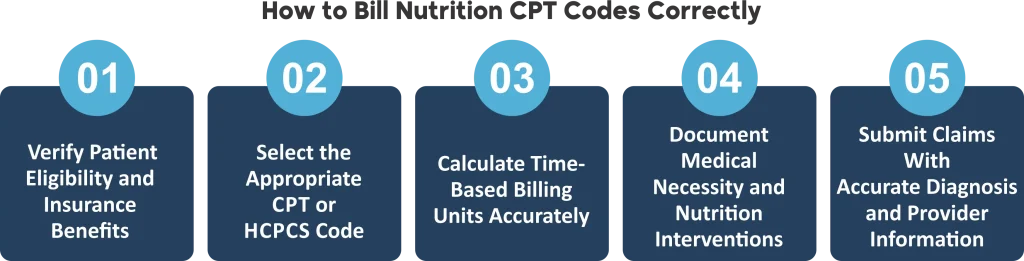
Step 1: Verify Patient Eligibility and Insurance Benefits
Before providing nutrition services, confirm the patient’s active insurance coverage and eligibility for the planned treatment.
Check whether the payer covers the service, requires a referral, or limits the number of sessions. Confirming these details early helps prevent claims from being submitted for noncovered services.
Step 2: Select the Appropriate CPT or HCPCS Code
Choose the procedure code that accurately represents the service provided.
For example, use CPT code 97802 for an initial individual MNT assessment, 97803 for individual reassessment and follow-up, and 97804 for group MNT.
When additional Medicare MNT services are medically necessary because of a qualifying change in condition, determine whether G0270 or G0271 is appropriate.
Avoid selecting codes based solely on reimbursement rates. The billed code must match the documented service.
Step 3: Calculate Time-Based Billing Units Accurately
Many nutrition billing codes are time-based, making accurate time documentation essential.
For example, a qualifying 45-minute individual MNT follow-up may support three units of CPT code 97803.
Providers should document the actual service duration and apply the payer’s unit calculation rules. Unsupported units or incorrect time reporting may result in reduced reimbursement or denied claims.
Step 4: Document Medical Necessity and Nutrition Interventions
Complete clinical documentation supports the services billed and helps demonstrate why nutritional treatment was necessary.
A well-documented nutrition visit should include the patient’s relevant medical history, nutritional assessment, treatment goals, interventions, progress, and follow-up recommendations.
Documentation should also identify the date of service, actual treatment duration, and required provider information.
Step 5: Submit Claims With Accurate Diagnosis and Provider Information
Before submitting the claim, review the CPT or HCPCS code, ICD-10-CM diagnosis, billing units, provider identifiers, and insurance information.
Confirm that required referrals, authorizations, and supporting records are available.
A final claim review can help identify errors before submission, reducing unnecessary corrections and payment delays.
Nutrition Telehealth Billing Codes and Guidelines
Telehealth has made nutrition counseling more accessible by allowing patients to receive dietary assessments, medical nutrition therapy, and follow-up care remotely.
However, nutrition telehealth billing requires careful attention to insurance policies, approved procedure codes, service delivery methods, and claim reporting requirements.
Several MNT codes, including 97802, 97803, and 97804, are recognized for Medicare telehealth services when applicable conditions are met.
When billing nutrition telehealth services, providers should consider the following requirements:
- Eligible CPT codes: Confirm that the payer covers the specific nutrition service when delivered remotely.
- Place-of-service codes: Use the appropriate POS designation, such as POS 02 or POS 10, when required by the payer.
- Telehealth modifiers: Apply modifiers only when required by the applicable insurance policy.
- Service documentation: Record the appointment duration, service modality, nutritional interventions, and relevant clinical findings.
- Provider eligibility: Confirm that the rendering professional meets the payer’s telehealth billing and credentialing requirements.
Medicare and commercial insurers may apply different rules to virtual nutrition appointments. Providers should review current policies before submitting telehealth claims.
Common Nutrition Billing Mistakes That Cause Claim Denials
Even experienced healthcare providers can encounter reimbursement problems when nutrition claims contain coding, documentation, or eligibility errors.
Identifying common nutrition billing mistakes can help dietitians improve claim accuracy and protect practice revenue.

Using Incorrect CPT Codes for Initial and Follow-Up Visits
Confusing initial assessments with follow-up appointments is a common coding mistake.
For example, reporting CPT code 97802 for a routine follow-up service instead of the appropriate reassessment code may result in a denied or incorrectly processed claim.
How to avoid it: Review the patient’s treatment history and verify whether the appointment qualifies as an initial assessment, reassessment, or group service.
Billing Unsupported Time Units
Time-based billing errors occur when providers report more units than the documented treatment duration supports.
These discrepancies may trigger payer reviews, payment reductions, or denials.
How to avoid it: Maintain accurate start and end times or total qualifying service duration, and apply the insurer’s time-based billing requirements.
Missing Referrals or Prior Authorizations
Some insurance plans require physician referrals or prior authorization before nutrition services can be reimbursed.
Submitting claims without the necessary documentation may result in nonpayment, even when the service was medically appropriate.
How to avoid it: Verify referral and authorization requirements before treatment and track authorization expiration dates.
Reporting Incorrect or Unsupported Diagnosis Codes
A mismatch between the billed nutrition service and the patient’s documented diagnosis may lead to medical necessity denials.
For instance, a diagnosis may be clinically relevant to nutritional counseling but not qualify for coverage under a particular insurance benefit.
How to avoid it: Select diagnosis codes supported by the medical record and verify applicable payer coverage policies.
Exceeding Insurance Coverage Limits
Patients may have annual visit limits, time restrictions, or authorization limits for nutrition therapy.
Claims submitted beyond these limits may be denied unless additional services are approved or otherwise qualify for coverage.
How to avoid it: Track previously billed visits, remaining covered hours, and authorization balances throughout the treatment period.
Submitting Claims With Incomplete Documentation
Missing treatment notes, incorrect provider identifiers, and incomplete patient information can delay claim processing.
Inadequate documentation may also make it difficult to defend claims during payer audits.
How to avoid it: Establish standardized documentation and claim review procedures to confirm that required information is complete before submission.
Best Practices to Improve Nutrition Billing Reimbursement
Improving reimbursement starts with consistent billing practices, accurate clinical documentation, and proactive revenue cycle management.
Registered dietitians and healthcare organizations can strengthen their billing performance by implementing the following strategies:
- Maintain accurate patient records: Keep complete nutrition assessments, treatment plans, service durations, and progress notes to support every billed service.
- Verify insurance coverage regularly: Review eligibility, covered benefits, referrals, and authorizations before appointments.
- Stay updated on coding requirements: Monitor changes to CPT codes, HCPCS codes, payer policies, and medical necessity requirements.
- Track claim denials: Identify recurring denial reasons and correct underlying workflow problems instead of repeatedly resubmitting similar claims.
- Conduct periodic billing audits: Review coding accuracy, documentation completeness, and reimbursement patterns to identify improvement opportunities.
- Train administrative staff: Ensure billing teams understand nutrition-specific coding rules, time-based units, and payer requirements.
By applying these practices consistently, nutrition practices can reduce preventable billing errors, support timely payments, and spend less administrative time correcting claims.
Simplify Claims With Professional Nutrition and Dietitian Billing Services
Managing nutrition billing requires careful coordination between clinical documentation, insurance verification, CPT code selection, and claim follow-up. As your practice grows, handling these responsibilities alongside patient care can become increasingly demanding.
Professional Nutrition and Dietitian Billing Services can help streamline claim submissions, manage insurance requirements, identify coding errors, and address reimbursement challenges. With specialized billing support, dietitians and nutrition practices can reduce administrative burdens, improve billing efficiency, and focus more attention on delivering quality patient care.
Closing Note
Nutrition billing CPT codes are essential to understand for accurate claim submissions and efficient revenue cycle management. From initial assessments under CPT code 97802 to follow-up visits, group therapy, and additional HCPCS services, selecting the appropriate code helps healthcare providers document and bill their services correctly.
However, successful nutrition billing also depends on verifying insurance coverage, maintaining accurate documentation, and following payer-specific reimbursement requirements. By adopting consistent billing practices and addressing common claim errors, dietitians and healthcare organizations can reduce avoidable denials, improve payment efficiency, and build a stronger financial foundation for their practices.
FAQs
Q: Can Registered Dietitians Bill Insurance Independently?
Ans: Yes. Registered dietitians can bill eligible insurance plans independently when they meet applicable licensing, credentialing, enrollment, and payer requirements.
Q: Is an NPI Required for Dietitian Insurance Billing?
Ans: Yes. An NPI is generally required for HIPAA-standard electronic healthcare claims, along with any applicable payer enrollment.
Q: Can Nutrition CPT Codes Be Billed on the Same Day as a Doctor’s Visit?
Ans: Yes, in some circumstances. Both services must meet payer requirements and be separately supported by documentation.
Q: Are Nutrition Counseling Services Subject to Patient Copays?
Ans: It depends on the insurance plan. Qualifying Medicare MNT services generally have no copay, coinsurance, or deductible.
Q: Can Dietitians Charge Patients for Missed Appointments?
Ans: Practices may charge cancellation or no-show fees when permitted by applicable laws, payer contracts, and properly disclosed office policies.
Q: Do Nutrition Billing CPT Codes Require Modifiers?
Ans: Not always. Modifiers are used when required by the payer or specific billing circumstances, including certain telehealth services.