A virtual therapy session can be clinically appropriate, properly documented, and still run into a billing problem. Did the claim use the correct place of service? Was modifier 95 required, or did the payer ask for a different code? Does the same rule apply when a psychiatrist conducts a video visit with a patient at home?
These details matter because telehealth mental health CPT codes, modifiers, and place of service (POS) codes must reflect the service delivered and the payer’s billing instructions. This guide explains how to select the right codes, distinguish modifiers 95 and GT, apply POS 02 and POS 10, and reduce avoidable claim errors in 2026.
What Are Telehealth Mental Health CPT Codes?
Telehealth mental health CPT codes identify the clinical service provided during a remote encounter. They do not, by themselves, describe every detail needed to bill the claim. Practices must also consider provider eligibility, documentation, the technology used, the patient’s location, coverage rules, and any applicable modifier or POS requirements.
Common mental health CPT codes
| Service | Common CPT code examples | Billing consideration |
| Psychiatric diagnostic evaluation | 90791, 90792 | Select the code that matches the evaluation performed and the provider’s role. |
| Individual psychotherapy | 90832, 90834, 90837 | Match the code to the documented session time and service delivered. |
| Psychotherapy with an E/M service | 90833, 90836, 90838 | These are add-on codes and must be billed with an eligible E/M service when requirements are met. |
| Family psychotherapy | 90846, 90847 | Confirm which participants were present and which service was performed. |
| Group psychotherapy | 90853 | Check coverage, provider qualifications, and payer-specific telehealth rules. |
This is a reference list, not a guarantee that every code is covered through telehealth by every payer. Review the current CMS Medicare telehealth services list and the applicable payer policy before submitting a claim.
How should you select the correct CPT code?
Start with the service documented in the clinical record, not the platform used for the appointment.
A video session does not automatically qualify for a particular psychotherapy code. The provider must have performed the service represented by that code, and the record must support the code’s time, content, and other applicable requirements.
For time-based psychotherapy services, document the actual time spent providing the service and select the code supported by the applicable CPT descriptor and coding rules. The appointment’s scheduled duration is not proof of the time spent delivering psychotherapy. If a session ends early or the service changes, code the service actually provided.
Modifier 95 vs. GT: What Is the Difference?
Telehealth modifiers communicate information about how a service was delivered. Modifier requirements depend on the payer, the claim type, and the applicable billing instructions.
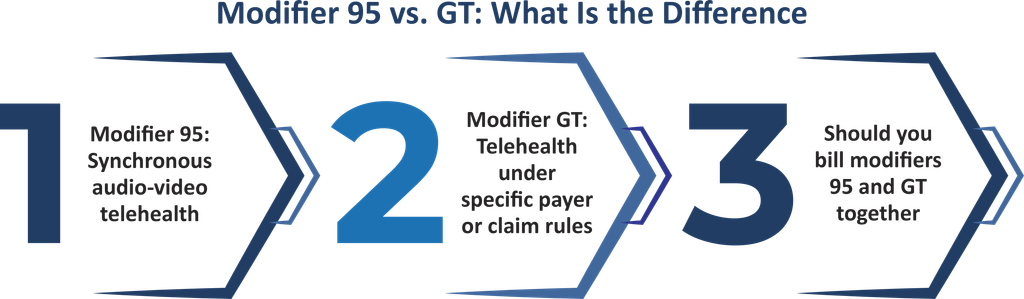
Modifier 95: Synchronous audio-video telehealth
Modifier 95 generally identifies a synchronous telehealth service furnished through real-time interactive audio-video technology when the payer requires or accepts it.
A typical example is a therapist and patient communicating live by secure video. The modifier does not replace the underlying psychotherapy CPT code, establish coverage by itself, or eliminate the need for appropriate documentation.
Before using modifier 95, confirm that the payer recognizes it for the service, provider type, and claim format involved.
Modifier GT: Telehealth under specific payer or claim rules
Modifier GT has specific uses in certain telehealth billing contexts, including particular institutional or facility-related arrangements. Its applicability depends on the claim type and the governing instructions.
Do not use GT automatically for a routine professional claim. Check the applicable CMS billing guidance or payer manual to determine whether GT is required, permitted, or inapplicable to the service.
Should you bill modifiers 95 and GT together?
Do not append both modifiers just to signal that a visit was virtual. Use the modifier or combination specifically supported by the payer’s instructions and the applicable claim rules.
A safe verification process is to check:
- Whether the payer covers the service when furnished by telehealth.
- Whether the payer requires modifier 95, GT, or another telehealth indicator.
- Whether the service was delivered through audio-video or audio-only communication.
- Whether additional modifiers are required for the provider type or claim setting.
- Whether the claim’s POS code matches the patient’s location during the encounter.
Modifier 93 is relevant to certain synchronous audio-only services. It should not be substituted for an audio-video modifier when the encounter was conducted by video.
Place of Service Code for Virtual Psychiatry: POS 02 vs. POS 10
The place of service code tells the payer where the patient received the service. For Medicare professional telehealth claims, POS 02 and POS 10 distinguish between telehealth furnished outside the patient’s home and telehealth furnished in the patient’s home.
| POS code | Meaning | Example |
| POS 02 | Telehealth provided somewhere other than the patient’s home | A patient joins a virtual appointment from a qualifying healthcare facility or another non-home location. |
| POS 10 | Telehealth provided in the patient’s home | A patient attends a video therapy session from their private residence. |
CMS explains these distinctions in its official telehealth billing guidance for POS 10.
When should you use POS 10?
Use POS 10 when the patient receives the telehealth service in their home, and the applicable payer’s rules require or permit that reporting. The provider’s work location does not determine whether the patient is at home.
For example, a therapist may provide a video session from a clinic while the patient participates from a private residence. For Medicare professional billing, verify the patient’s location and the current instructions for the service.
When should you use POS 02?
Use POS 02 when the patient receives the telehealth service somewhere other than their home, subject to the applicable payer rules. Confirm the actual patient location and the requirements for the service before selecting the code.
Do not assume that every location outside the patient’s house automatically qualifies without checking the payer’s definitions and the relevant claim requirements.
Does POS 10 always pay more than POS 02?
CMS adopted the non-facility payment rate for Medicare telehealth services furnished to patients in their homes under the relevant Physician Fee Schedule policy. However, the actual payment depends on the code, payer, contract, and applicable payment methodology.
Commercial insurers may use different policies. Practices should not promise a particular reimbursement amount based on POS alone.
How to Bill Online Therapy for Insurance in 2026
Accurate telehealth billing requires the clinical service, documentation, modifier, POS, and payer policy to align. A simple pre-submission review can catch many common problems before they become rejections, denials, or delayed payments.
Step 1: Verify the Patient’s Coverage
Confirm active benefits, network status, applicable cost-sharing, authorization requirements, and any coverage limits for telehealth mental health services.
Step 2: Confirm Provider and Service Eligibility
Check that the provider is eligible to furnish the service and that the payer covers it through the intended telehealth modality.
Step 3: Document the Encounter
Record the service delivered, clinical rationale, relevant treatment details, actual psychotherapy time when applicable, and the telehealth information required by the payer.
Step 4: Select the Correct CPT Code
Match the code to the service actually performed and the applicable coding requirements. If psychotherapy is billed with an E/M service, verify that both services and any required add-on coding are supported.
Step 5: Verify Modifier and POS
Use the payer’s current instructions to select the appropriate modifier and place of service. Confirm the patient’s location and the modality used during the encounter.
Step 6: Review the Claim Before Submission
Check the CPT code, diagnosis, provider information, modifier, POS, authorization, and payer-specific edits. If a claim is rejected or denied, identify the underlying reason and document the correction.
Common Telehealth Mental Health Billing Errors
Using the wrong POS code
A claim may list POS 02 even though the patient was at home, or POS 10 when the service occurred at another location. Verify the patient’s location during the encounter rather than relying on the provider’s office address.
Applying modifier 95 or GT automatically
The fact that an appointment was virtual does not mean the same modifier is correct for every payer. Build payer-specific instructions into the billing workflow and update them when policies change.
Selecting a psychotherapy code that the note does not support
A scheduled 60-minute appointment is not automatically a 60-minute psychotherapy service. The code should reflect the actual service and documented time under the applicable coding rules.
Treating audio-only and audio-video visits the same
These modalities can have different coverage, coding, and modifier requirements. Record the method used and check the payer’s instructions before submitting the claim.
Assuming commercial payer rules match Medicare
Medicare fee-for-service, Medicare Advantage, Medicaid, and commercial plans may differ in covered services, eligible providers, modifiers, POS requirements, and documentation. Maintain separate payer guidance where necessary.
A Practical Telehealth Claim Review Checklist
Before submitting an online therapy or virtual psychiatry claim, confirm the following:
- Does the CPT code reflect the service actually delivered?
- Does the documentation support the service and its time requirements?
- Is the provider eligible to bill the service?
- Was the encounter audio-video or audio-only?
- Does the payer require modifier 95, GT, 93, or another modifier?
- Does the POS reflect where the patient received the service?
- Have eligibility, authorization, and coverage requirements been checked?
- Does the claim follow the current payer policy for the date of service?
If any answer is uncertain, resolve it before the claim is submitted.
How ORCM Supports Mental Health Billing
Mental health practices need billing workflows that account for psychotherapy time, evaluation and management services, telehealth modifiers, place of service, payer-specific requirements, and ongoing denial follow-up.
ORCM provides Mental Health Billing Services to support coding review, claim submission, denial management, payment posting, and accounts receivable follow-up. A structured billing process can help practices identify recurring errors and improve visibility into unresolved claims.
The goal is not to add more steps to the clinician’s day. It is to make sure the billing process accurately reflects the care delivered and follows the applicable payer requirements.
Final Takeaway
Accurate telehealth mental health billing starts with the service performed and ends with a claim that matches the documentation and payer requirements. CPT selection, modifiers 95 and GT, and POS 02 and POS 10 each serve a different purpose, so they should never be assigned by habit.
A consistent pre-bill review helps mental health practices catch mismatches before submission, reduce preventable rework, and maintain a clearer view of their revenue cycle. Because telehealth rules can change, confirm the current policy for the payer and date of service before billing.
Frequently Asked Questions
What CPT codes are commonly used for telehealth mental health services?
Common examples include 90791 and 90792 for psychiatric diagnostic evaluations, 90832, 90834, and 90837 for individual psychotherapy, and 90846, 90847, and 90853 for certain family and group services. Coverage through telehealth depends on the payer, provider, service, and current policy.
What is the difference between modifier 95 and GT?
Modifier 95 generally identifies synchronous audio-video telehealth when required or accepted by the payer. GT has specific uses in certain billing contexts. Check the current instructions for the claim type and payer before selecting either modifier.
Should I use POS 02 or POS 10 for virtual psychiatry?
For Medicare professional telehealth claims, POS 02 generally applies when the patient is somewhere other than home, while POS 10 applies when the patient receives the service at home. Confirm the applicable payer rules and the patient’s actual location before submitting the claim.
Can I bill modifier 95 and GT together?
Do not use both automatically. Report only the modifier or combination permitted by the payer and the applicable claim rules.
Is modifier 95 required for every online therapy claim?
No. Requirements vary by payer, service, claim type, and modality. Some payers require a telehealth modifier, while others may specify different billing instructions.
Can psychotherapy be billed with an E/M service during telehealth?
It may be possible when the provider is eligible, the services meet the applicable coding requirements, and the documentation supports both the E/M service and the psychotherapy add-on. Do not bill an add-on code without the required primary service.