A psychiatry visit that mixes medication management with therapy produces two services in one sitting. The claim, though, has to be built as one E/M line plus one add-on line, and there is exactly one right way to do it. Build it any other way and an edit eats part of the visit. Most of the psychiatry denials we see trace back to that single structural choice, so it is worth slowing down on.
Here is the shape of the problem. 90833, 90836, and 90838 are add-on codes. They never travel alone. They attach to an E/M service rendered by the same provider on the same date, which is why the structure defines psychiatry E/M with psychotherapy CPT codes as a pairing rather than two separate claims.
What the add-on codes cover, and what they refuse
Three facts frame the family. First, eligibility. Only a clinician who bills E/M can use these codes. A psychiatrist, a psychiatric nurse practitioner, a physician assistant, yes. An LCSW or LPC billing a therapy session, no. Therapists without an E/M scope bill 90832, 90834, or 90837 instead, which are the standalone versions of the same time bands. Second, pairing. The add-on needs its E/M on the same claim, same date. An add-on submitted alone gets cut by an edit almost every time.
Third, exclusivity. The standalone code and the add-on for the same band are mutually exclusive. 90832 beside 90833 is not a thing. 90834 beside 90836 is not a thing. One encounter, one structure. Under Medicare contractor guidance, both components must be significant and separately identifiable, and each service’s time must be documented on its own. Minutes or start and stop times, per service.
The time bands pick the code
| Code | Psychotherapy time | Bills with |
| 90833 | 16 to 37 minutes | An E/M service, same provider, same day |
| 90836 | 38 to 52 minutes | An E/M service, same provider, same day |
| 90838 | 53 minutes or more | An E/M service, same provider, same day |
The therapy time decides. Not the length of the appointment, the therapy block inside it. Below 16 minutes there is no add-on at all; the visit bills as the E/M by itself. Thirty-five minutes of therapy supports 90833. At 38 the band moves to 90836, and 90838 starts at 53.
Pricing, roughly: Medicare paid 90833 around $70 to $85 non-facility in 2026 depending on locality, and a 99214 plus 90833 combination usually lands near $200 all in. Commercial contracts vary more. CPT code 90833 billing guidelines fit in two sentences. Pick the E/M level by medical decision-making, not by throwing the therapy minutes into the total. And never count E/M work as therapy time, because the codes book their minutes separately.
Psychiatric diagnostic evaluation coding rules
The intake side runs on different logic. 90791 is a psychiatric diagnostic evaluation with no medical services. 90792 adds the medical component, which is usually the prescriber’s version. Either one is a complete visit on its own.
Two restrictions follow, and both bite. Medicare contractor policy will not pay a diagnostic evaluation beside psychotherapy codes or beside an E/M from the same provider on the same date. And the add-on psychotherapy codes never pair with 90791 or 90792, only with E/M. If therapy happened inside the evaluation, 90792 already covers it. There is nothing to add. So the pattern in most psychiatry practices ends up clean: 90792 at intake, then E/M plus an add-on code on every follow-up.
Medication management and psychotherapy same day billing
The combined follow-up is the moneymaker and the denial magnet. The claim itself is simple. E/M first, usually 99213 or 99214 established-patient, then the add-on that matches the therapy minutes.
The note is where it gets won or lost. CERT reviewers sample processed Medicare claims, and what they want is two services visible in the record. A medical component with its history, exam, and medication reasoning. A therapy component with the intervention, its minutes, and how the patient took it. The note that says “spent 50 minutes with the patient” and stops there supports neither standard, because it never separated the two. One more trap: prolonged services cannot be reported on an encounter that already reports psychotherapy with E/M, even when the visit ran long.
Modifier 25, briefly
Modifier 25 marks an E/M as significant and separately identifiable from another service on the same date. Do the add-on psychotherapy codes need it on the E/M? It depends on the payer. Some require it. Others treat the add-on pairing as sufficient on its own and never ask. The workable approach is to read each major payer’s policy once, document to the separately identifiable standard everywhere, and append the modifier wherever a policy says to.
Why these claims deny
| Denial trigger | What clears it |
| Add-on on the claim with no E/M beside it | Bill the E/M and add-on together, same date |
| One blended time total in the note | Separate minutes, or start and stop times, per service |
| E/M level justified by therapy minutes | Select the E/M by medical decision-making |
| Standalone code next to the add-on | One structure per encounter, never both |
| Therapy block under 16 minutes | No add-on; bill the E/M alone |
| Modifier 25 missing where the payer asks | Match the payer’s stated position |
The unbundling trap
The costliest habit is billing 99214 with 90834, or any standalone therapy code next to an E/M, on the same date. It reads like padding a longer session out of parts. Edits treat it as unbundling and deny, and the frustrating part is that the correct pair already exists for this exact visit. The add-on codes were invented so nobody has to assemble that claim from pieces.
A claim that holds up
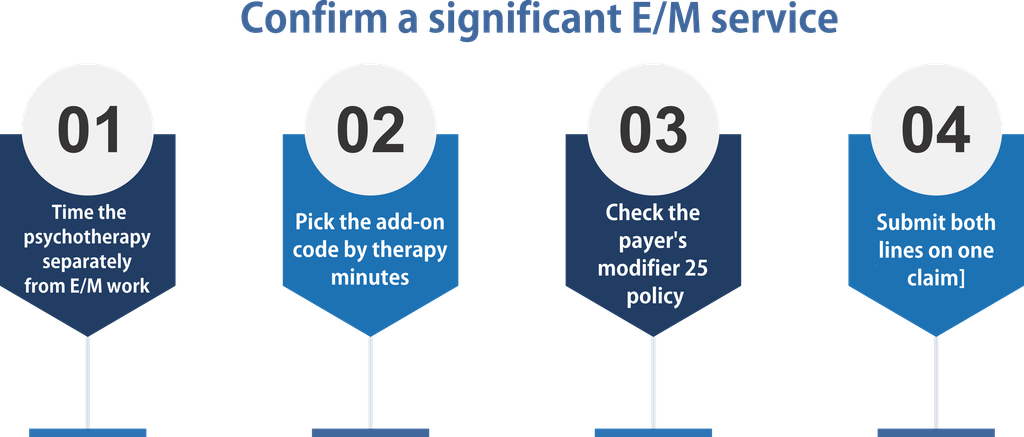
Confirm the E/M stands on its own. Time the therapy separately from the medical work, in clock terms. Choose the add-on by therapy minutes alone. Check the payer’s modifier 25 stance once, then bill to it. Submit the pair on one claim.
Practices that run this pattern every day tend to hand the pairing and documentation review to a specialist team, code pairing and payer-specific modifier calls included.
Conclusion
Two services in one visit, two lines on one claim, and a note that keeps them visibly apart. The time bands are fixed and the pairing rules are fixed. What moves the denial rate is documentation that treats the hour as one blended block. Separate it, and both lines pay on the first pass. And when the pairing and payer rules feel like a second job, Psychotherapy billing services take that workload off the practice.
FAQs
Can 90833 and 90832 go on the same claim?
No. Standalone and add-on psychotherapy codes are mutually exclusive within one encounter. A combined visit bills the E/M with the add-on. A therapy-only visit bills the standalone code.
Does modifier 25 go on the E/M or on 90833?
On the E/M, where the payer asks for it. Payer policies differ with the add-on codes; some require 25 on the E/M, others accept the pairing without it. Document to the separately identifiable standard regardless.
Can I bill 90836 with a 90792?
No. The add-on codes pair with E/M services only. Psychotherapy inside a diagnostic evaluation is covered by 90792 itself, which already includes the medical component.
What if therapy ran 35 minutes?
90833 covers 16 to 37 minutes, so 35 minutes supports 90833. At 38 minutes the correct code becomes 90836.
Do therapy minutes count toward the E/M level?
They do not. With a psychotherapy add-on, the E/M level comes from medical decision-making, and E/M time cannot be booked as therapy time.
Who bills the add-on psychotherapy codes?
Clinicians with an E/M scope: psychiatrists, psychiatric NPs, and PAs. Therapists who cannot bill E/M, like LCSWs and LPCs, use the standalone codes.