Accurate billing is one of the most important aspects of running a successful mental health practice. However, many providers struggle with psychotherapy CPT codes, especially when it comes to time-based billing, documentation requirements, and proper modifier usage. Even small coding mistakes, like choosing the wrong session duration or missing required documentation, can lead to insurance claim denials, delayed reimbursements, and compliance risks.
Exploring how to correctly use CPT codes 90832, 90834, and 90837 can significantly improve your billing accuracy and help ensure your practice gets paid for the services you provide. These psychotherapy codes are strictly time-based, which means the length of the therapy session directly determines the code that should be billed.
In this article, we’ll break down everything providers need to know about psychotherapy billing, including session time requirements, documentation best practices, modifier usage (95, GT, and 59), and the most common reasons insurance companies deny psychotherapy claims.
What Are Psychotherapy CPT Codes?
Psychotherapy CPT codes are standardized medical billing codes used by mental health professionals to report therapy services provided to patients. These codes are part of the Current Procedural Terminology (CPT) system, which allows healthcare providers to communicate specific services to insurance companies for reimbursement.
In mental health billing, psychotherapy CPT codes help insurers understand:
- What type of therapy service was delivered
- How long the therapy session lasted
- Whether the service meets medical necessity requirements
The three most commonly used psychotherapy CPT codes for individual therapy sessions include:
- 90832: Psychotherapy, 30 minutes
- 90834: Psychotherapy, 45 minutes
- 90837: Psychotherapy, 60 minutes
These codes are widely used by:
- Psychologists
- Psychiatrists
- Licensed therapists
- Licensed clinical social workers (LCSWs)
- Behavioral health providers
Because these codes are time-based services, the correct code selection depends on the actual duration of the psychotherapy session with the patient. Accurate documentation of session time is essential to ensure claims are accepted and reimbursed correctly.
Time-Based Psychotherapy CPT Codes
One of the most important aspects of psychotherapy billing is understanding that these CPT codes are time-based services. Insurance providers reimburse therapy sessions based on the amount of time the provider spends delivering psychotherapy to the patient.
This means therapists must carefully track the duration of each session to ensure the correct code is used.
Below are the three primary psychotherapy CPT codes used for billing individual therapy sessions.
CPT Code 90832: 30 Minute Psychotherapy
CPT code 90832 is used for shorter psychotherapy sessions.
Time Range: 16–37 minutes
This code is typically used when the therapy session is brief but still provides meaningful clinical intervention.
Common scenarios where 90832 may be appropriate include:
- Short follow-up therapy sessions
- Focused behavioral interventions
- Brief check-ins for anxiety or stress management
- Therapy sessions addressing a specific short-term concern
Providers must ensure the session lasts at least 16 minutes to bill this code.
CPT Code 90834: 45 Minute Psychotherapy
CPT code 90834 represents the standard psychotherapy session length in most outpatient mental health practices.
Time Range: 38–52 minutes
This code is widely used because many therapy appointments are scheduled for approximately 45 minutes.
Typical use cases include:
- Weekly psychotherapy sessions
- Cognitive Behavioral Therapy (CBT)
- Treatment for anxiety, depression, or mood disorders
- Ongoing psychotherapy treatment plans
Because this code reflects the most common therapy session duration, it is frequently billed by mental health providers.
CPT Code 90837: 60 Minute Psychotherapy
CPT code 90837 is used for extended psychotherapy sessions.
Time Range: 53 minutes or longer
This code is appropriate when therapy sessions require additional time due to the complexity of the patient’s condition or treatment needs.
Common situations where 90837 may be used include:
- Trauma therapy or PTSD treatment
- Complex mental health cases
- Crisis intervention sessions
- Intensive psychotherapy sessions
Since 90837 typically has higher reimbursement rates, insurance companies may review these claims more closely. Providers should ensure their documentation clearly supports the medical necessity and duration of the session.
Psychotherapy Billing Time Rules Providers Must Follow
When billing psychotherapy CPT codes, providers must follow strict time-based billing guidelines. Failing to meet these requirements can lead to claim denials or compliance issues.
Face-to-Face Time Only
Psychotherapy billing must reflect direct interaction between the provider and the patient.
This includes:
- In-person therapy sessions
- Telehealth psychotherapy visits
However, certain activities cannot be counted toward billable time, such as:
- Reviewing patient charts
- Writing clinical notes
- Scheduling appointments
- Administrative tasks
Only the time spent actively providing psychotherapy can be used when selecting the appropriate CPT code.
Minimum Time Thresholds
Each psychotherapy CPT code has a minimum time requirement that must be met before it can be billed.
| CPT Code | Minimum Session Time |
| 90832 | 16 minutes |
| 90834 | 38 minutes |
| 90837 | 53 minutes |
For example, if a therapy session lasts 35 minutes, the provider must bill 90832, not 90834.
Selecting a code that does not match the session length is a common billing error that can trigger claim denials.
Document Start and Stop Times
Accurate documentation of therapy session duration is essential for billing compliance.
Providers should record:
- Session start time
- Session end time
- Total session length
Example documentation:
Psychotherapy session conducted from 10:00 AM to 10:47 AM. Session focused on CBT techniques to address anxiety symptoms and coping strategies.
Clear time documentation helps support the CPT code billed and protects providers during audits.
Documentation Requirements for Psychotherapy Billing
Proper documentation plays a crucial role in ensuring psychotherapy claims are approved by insurance companies. Incomplete or vague therapy notes can lead to claim denials, payment delays, or compliance issues.
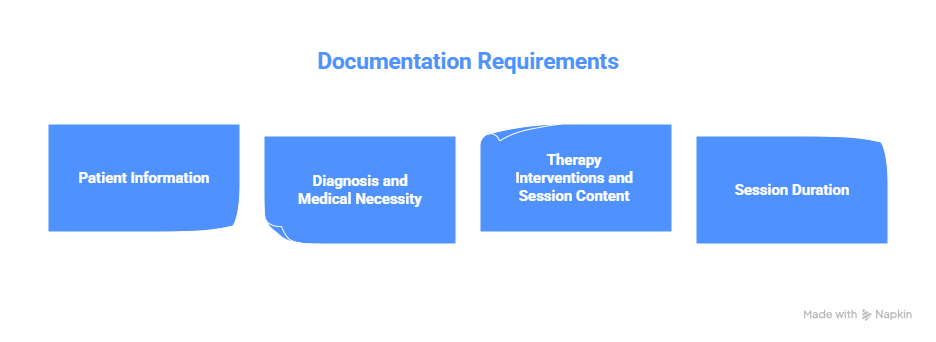
A well-documented psychotherapy session should include the following components.
Patient Information
Every psychotherapy note should begin with basic patient details, including:
- Patient name
- Date of service
- Provider name and credentials
- Location of service (office or telehealth)
This information confirms who received the service and who provided it.
Diagnosis and Medical Necessity
Insurance companies require proof that psychotherapy services are medically necessary.
Documentation should include:
- The patient’s mental health diagnosis (ICD-10 code)
- Symptoms or conditions being treated
- Clinical justification for psychotherapy services
Clear documentation helps insurers understand why therapy is required for the patient’s condition.
Therapy Interventions and Session Content
Providers must document what occurred during the therapy session.
This includes:
- Therapeutic approach used (CBT, psychotherapy, behavioral therapy, etc.)
- Treatment goals addressed
- Patient response to interventions
- Progress toward treatment goals
Detailed session notes demonstrate that a legitimate psychotherapy service was performed.
Session Duration
Finally, providers must record the exact duration of the therapy session, including start and stop times.
Example:
Session duration: 2:00 PM – 2:52 PM (52 minutes).
This documentation supports the time-based CPT code billed and ensures compliance with payer requirements.
Modifiers Used With Psychotherapy CPT Codes
Modifiers are two-character codes added to CPT codes to provide additional details about how a service was performed. In psychotherapy billing, modifiers help insurance companies understand whether the therapy session was delivered through telehealth, combined with another service, or performed as a distinct procedure.
Using the correct modifier can significantly reduce the chances of claim rejections or payment delays.
Modifier 95: Telehealth Service
Modifier 95 indicates that psychotherapy was provided through real-time telehealth technology using secure audio and video communication.
Telehealth therapy has become increasingly common, especially for patients who cannot attend in-person sessions. When billing psychotherapy CPT codes such as 90832, 90834, or 90837 for virtual sessions, many insurance payers require the 95 modifier.
Common telehealth platforms used for psychotherapy include:
- HIPAA-compliant video conferencing tools
- Online therapy platforms
- Secure telemedicine systems
Providers must also ensure their documentation includes details about:
- The telehealth platform used
- Confirmation that the session occurred via live audio and video
- The location of both the provider and the patient
Proper use of Modifier 95 helps ensure that telehealth psychotherapy services are recognized and reimbursed appropriately by insurance providers.
Modifier GT: Telehealth via Interactive Audio and Video
Modifier GT is another telehealth modifier used by some insurance companies to indicate that psychotherapy services were delivered through interactive audio and video telecommunications systems.
Although many payers now prefer Modifier 95, some insurance plans still require GT for telehealth psychotherapy claims.
Providers should always verify payer-specific guidelines, as telehealth billing policies can vary between insurance companies.
Using the wrong telehealth modifier may result in automatic claim denial or processing delays.
Modifier 59: Distinct Procedural Service
Modifier 59 is used when psychotherapy services are provided in addition to another procedure on the same day, but the services are separate and medically necessary.
This modifier tells insurance companies that the psychotherapy session should not be bundled with another billed service.
For example, a psychiatrist may provide:
- Medication management
- Psychotherapy during the same appointment
In such cases, Modifier 59 may be used to indicate that the psychotherapy service was distinct from medication management and should be reimbursed separately.
Proper documentation is essential when using Modifier 59, as insurers often review these claims closely.
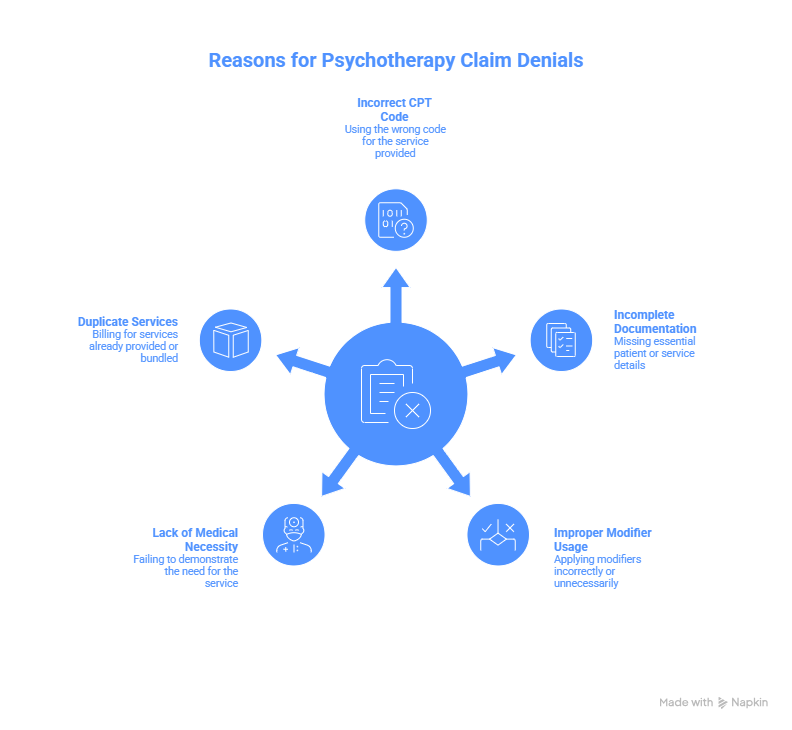
Common Reasons Psychotherapy Claims Get Denied
Even when therapy services are delivered correctly, billing errors can still cause insurance claim denials. Understanding the most common denial reasons can help providers improve clean claim rates and avoid revenue loss.
Incorrect CPT Code Selection
One of the most common mistakes in psychotherapy billing is choosing the wrong CPT code for the session duration.
For example:
- Billing 90837 (60 minutes) for a session that lasted 40 minutes
- Billing 90834 (45 minutes) when the session lasted 30 minutes
Insurance companies strictly follow time-based coding guidelines, so mismatched codes often result in claim denials.
Missing or Incomplete Documentation
Incomplete therapy notes are another major cause of claim rejection.
Insurance companies may deny psychotherapy claims if documentation does not include:
- Start and stop times
- Treatment interventions used
- Patient progress or response
- Diagnosis supporting medical necessity
Detailed documentation helps demonstrate that the therapy session met payer requirements for reimbursement.
Improper Modifier Usage
Incorrect or missing modifiers can cause automatic claim rejections.
Examples include:
- Failing to include Modifier 95 for telehealth sessions
- Using GT when the payer requires 95
- Not applying Modifier 59 when psychotherapy is performed alongside another service
Always confirm payer-specific modifier rules before submitting claims.
Lack of Medical Necessity
Insurance companies only reimburse psychotherapy services that are considered medically necessary.
If documentation does not clearly show:
- The patient’s mental health condition
- The need for therapy
- Clinical improvement or treatment goals
The claim may be denied.
Duplicate or Bundled Services
Sometimes psychotherapy claims are denied because insurers believe the service is duplicated or bundled with another procedure.
This can happen when psychotherapy is billed along with:
- Psychiatric evaluations
- Medication management services
- Other behavioral health procedures
Using appropriate modifiers and documentation helps clarify that the services were distinct and separately billable.
Best Practices for Accurate Psychotherapy Billing
Maintaining accurate psychotherapy billing practices is essential for reducing claim denials, improving reimbursement rates, and maintaining compliance with insurance regulations.
Below are some best practices mental health providers should follow.
Verify Insurance and Payer Policies
Different insurance companies may have unique billing requirements for psychotherapy services. Before submitting claims, providers should verify:
- Covered psychotherapy CPT codes
- Telehealth billing rules
- Required modifiers
- Documentation standards
Checking payer policies can help prevent avoidable claim denials.
Document Therapy Sessions Thoroughly
Clear and detailed documentation strengthens the likelihood of claim approval.
Therapy notes should include:
- Patient symptoms and diagnosis
- Treatment goals
- Interventions used during the session
- Patient progress
- Exact session duration
Strong documentation also protects providers during insurance audits.
Track Session Time Accurately
Because psychotherapy CPT codes are time-based, accurate session tracking is critical.
Providers should consistently document:
- Session start time
- Session end time
- Total therapy duration
This ensures the correct CPT code is selected and prevents billing discrepancies.
Conduct Regular Coding Audits
Internal audits help identify billing errors before claims are submitted.
Practices should periodically review:
- CPT code accuracy
- Modifier usage
- Documentation completeness
- Denial trends
Routine audits improve overall billing accuracy and compliance.
Efficient billing processes are essential for maintaining the financial health of any mental health practice. Proper coding, documentation, and claim management can significantly reduce denials and improve reimbursement rates.
Closing Note
Correctly billing psychotherapy CPT codes 90832, 90834, and 90837 requires a clear understanding of time-based therapy rules, documentation standards, and modifier usage. Because these codes are based on session duration, providers must ensure that therapy sessions meet the required time thresholds and are supported by detailed clinical notes.
By following best practices like accurate session tracking, thorough documentation, and regular billing audits, mental health providers can significantly reduce claim denials and maintain a smoother revenue cycle.
If your practice is looking to streamline billing processes and maximize reimbursement, professional support can make a significant difference. Learn more about specialized services here: https://orcm.us/mental-health/psychotherapy-billing-services/