Billing psychiatric services accurately starts with understanding the correct use of psychiatric evaluation and Evaluation & Management (E/M) CPT codes. Many behavioral health providers face claim denials not because the service wasn’t performed, but because the wrong code was used, documentation was incomplete, or payer guidelines weren’t followed.
Codes such as 90791, 90792, and 99202–99215 are frequently used for psychiatric assessments and medical visits, yet confusion around when and how to use them remains one of the biggest challenges in mental health billing.
Another common issue is the misunderstanding between evaluation services and psychotherapy sessions. While both are essential in behavioral health treatment, they are billed differently and require distinct documentation.
Using evaluation or E/M codes incorrectly can lead to compliance risks, reimbursement delays, and recurring payer denials.
Overview of Psychiatric Evaluation & E/M CPT Codes
Psychiatric billing relies on specific CPT codes that describe the type of evaluation or medical service provided to a patient. These codes allow insurers to understand the complexity of the visit and determine the appropriate reimbursement.
In behavioral health settings, psychiatric providers typically use diagnostic evaluation codes for initial assessments and E/M codes for medical visits involving clinical decision-making or medication management.
The CPT codes discussed in this guide focus specifically on psychiatric evaluations and E/M services, helping providers avoid confusion with psychotherapy billing codes.
CPT Codes Covered in This Guide
| CPT Code | Description |
| 90791 | Psychiatric diagnostic evaluation (without medical services) |
| 90792 | Psychiatric diagnostic evaluation with medical services |
| 99202–99205 | New patient E/M visits |
| 99212–99215 | Established patient E/M visits |
| 99417 | Prolonged services add-on code |
Codes 90791 and 90792 are commonly used during initial psychiatric assessments, where the provider gathers diagnostic information and develops a treatment plan. On the other hand, E/M codes (99202–99215) are typically used for follow-up visits or medical management appointments where providers assess symptoms, adjust medications, and make clinical decisions.
Psychiatric Diagnostic Evaluation Codes (90791 vs 90792)
Psychiatric diagnostic evaluation codes are used when a provider conducts a comprehensive mental health assessment to determine a patient’s diagnosis and treatment plan. These codes are typically billed during the initial encounter when the provider gathers detailed clinical information about the patient’s condition.
Although 90791 and 90792 may appear similar, they represent different levels of service and are used by different types of providers.
CPT Code 90791: Psychiatric Diagnostic Evaluation
CPT code 90791 is used when a provider performs a psychiatric diagnostic evaluation without medical services. This code is commonly billed by psychologists, licensed clinical social workers, therapists, and counselors who conduct an initial mental health assessment but do not prescribe medication.
The purpose of this evaluation is to establish a clear understanding of the patient’s psychological condition and create a structured treatment plan.
Typical components of a 90791 evaluation include:
- Review of the patient’s psychiatric and medical history
- Assessment of current symptoms and behavioral concerns
- Mental status examination
- Evaluation of psychosocial factors affecting mental health
- Diagnostic formulation and clinical impressions
- Development of an initial treatment plan
Because this code does not include medical services, it cannot be used for medication management or medical decision-making activities.
CPT Code 90792: Psychiatric Diagnostic Evaluation With Medical Services
CPT code 90792 represents a psychiatric diagnostic evaluation that includes medical services. This code is used by providers who are qualified to perform medical assessments and prescribe medications, such as psychiatrists, psychiatric nurse practitioners, and physician assistants.
In addition to the standard diagnostic assessment, this evaluation may include medical components that influence treatment planning.
Examples of medical services included in a 90792 visit may involve:
- Prescribing or adjusting psychiatric medications
- Ordering laboratory tests
- Evaluating potential medical causes of psychiatric symptoms
- Conducting a medical review of systems
- Assessing medication risks and side effects
Because the evaluation includes medical decision-making, documentation must clearly show that medical services were performed during the visit.
Key Differences Between 90791 and 90792
Although both codes represent psychiatric diagnostic evaluations, the presence of medical services is the primary factor that distinguishes them.
| Feature | 90791 | 90792 |
| Medical services | Not included | Included |
| Medication management | Not allowed | Allowed |
| Typical providers | Therapists, psychologists | Psychiatrists, NPs |
| Purpose | Diagnostic assessment | Diagnostic + medical evaluation |
Using the wrong code can lead to claim denials, especially when a provider bills 90792 without documenting medical decision-making. Ensuring the correct code is selected helps prevent billing issues and improves reimbursement accuracy.
Psychiatry Evaluation & Management (E/M) CPT Codes (99202–99215)
Evaluation and Management (E/M) codes are widely used in psychiatry when a visit involves medical decision-making, medication management, or clinical assessment beyond an initial diagnostic evaluation. These codes apply to both new and established patient visits and are determined based on the complexity of the encounter.
Recent E/M coding guidelines emphasize two main factors when selecting the correct code level:
- Medical Decision Making (MDM)
- Total time spent with the patient on the date of the encounter
Psychiatric providers frequently use E/M codes for medication management appointments, follow-up evaluations, and ongoing care.
New Patient E/M Codes (99202–99205)
New patient E/M codes apply when a patient has not received professional services from the provider or another provider of the same specialty within the past three years.
These codes reflect varying levels of clinical complexity.
| Code | MDM Level | Typical Use |
| 99202 | Straightforward | Basic psychiatric consultation |
| 99203 | Low complexity | Mild mental health symptoms |
| 99204 | Moderate complexity | Psychiatric conditions requiring treatment adjustments |
| 99205 | High complexity | Severe or complex psychiatric disorders |
Higher-level codes require more complex medical decision-making, detailed evaluation, and greater time spent managing the patient’s condition.
Established Patient E/M Codes (99212–99215)
Established patient codes are used when the patient has already received services from the provider within the last three years. These visits are common in psychiatric practices because they often involve ongoing treatment, medication monitoring, and symptom management.
| Code | MDM Level | Typical Use |
| 99212 | Straightforward | Routine follow-up |
| 99213 | Low complexity | Medication monitoring |
| 99214 | Moderate complexity | Treatment adjustments |
| 99215 | High complexity | Severe psychiatric conditions requiring extensive management |
Because E/M codes depend heavily on medical decision-making, documentation should clearly explain clinical reasoning, treatment adjustments, and risk assessment related to the patient’s condition.
Prolonged Services CPT Code 99417
In some psychiatric cases, patient visits require significantly more time than a typical Evaluation & Management (E/M) appointment. When a provider spends extended time evaluating a complex psychiatric condition, coordinating care, or managing high-risk treatment decisions, CPT code 99417 may be used to report prolonged services.
CPT 99417 is an add-on code that allows providers to bill for additional time spent beyond the maximum time threshold of certain E/M codes, specifically 99205 and 99215. It cannot be billed independently and must always be reported alongside the primary E/M service.
When to Use CPT Code 99417?
Providers may report CPT 99417 when the total time spent with a patient exceeds the standard time range associated with the base E/M code. This typically occurs in complex psychiatric cases where extensive evaluation and treatment planning are required.
Common scenarios where prolonged services may apply include:
- Managing severe psychiatric disorders such as bipolar disorder or schizophrenia
- Evaluating patients with multiple mental health diagnoses
- Addressing psychiatric crises or safety concerns
- Coordinating care with other healthcare providers or family members
- Conducting detailed risk assessments and treatment planning
Example of Billing Prolonged Services
For example, if a psychiatrist spends 80 minutes evaluating and managing a patient with severe depression and medication complications, the provider may report:
- 99205 for the initial high-complexity E/M service
- 99417 for the additional prolonged service time
Accurate time documentation is critical when billing for prolonged services. Providers must record the total time spent on the date of the encounter, including both face-to-face and qualifying non-face-to-face activities related to the visit.
Psychiatric Evaluation vs Psychotherapy Coding
One of the most frequent sources of confusion in behavioral health billing is the distinction between psychiatric evaluations and psychotherapy services. While both play important roles in mental health treatment, they represent different types of services and require separate coding guidelines.
Understanding this difference is essential to avoid billing errors and payer denials.
| Service Type | Purpose | Code Category |
| Psychiatric Evaluation | Assessment, diagnosis, treatment planning | 90791 / 90792 |
| Medical Psychiatric Visit | Clinical decision-making, medication management | E/M codes |
| Psychotherapy | Therapeutic counseling and behavioral treatment | Psychotherapy codes |
Psychiatric evaluation codes such as 90791 and 90792 focus primarily on diagnosis and clinical assessment. These services typically involve gathering detailed information about the patient’s mental health history, evaluating symptoms, and determining an appropriate treatment strategy.
In contrast, psychotherapy services focus on therapeutic interventions, including cognitive behavioral therapy, counseling, and behavioral treatment techniques.
E/M codes differ from both because they involve medical decision-making, which may include evaluating treatment risks, adjusting medications, and monitoring clinical progress.
Maintaining clear documentation that separates evaluation activities from therapy services helps prevent coding overlap and reduces the risk of claim denials.
Documentation Requirements for Psychiatric Evaluation & E/M Codes
Strong documentation is one of the most important factors in preventing billing errors and claim denials in behavioral health services. Insurance payers require detailed clinical documentation to confirm that the services billed accurately reflect the care provided.
Incomplete or vague records are one of the leading causes of rejected psychiatric claims.
Documentation Requirements for CPT 90791 and 90792
When billing psychiatric diagnostic evaluation codes, providers must clearly document the elements used to assess and diagnose the patient’s mental health condition.
Typical documentation should include:
- Chief complaint and reason for the visit
- Detailed history of present illness
- Psychiatric history and relevant medical history
- Mental status examination
- Psychosocial and environmental factors
- Diagnostic impressions or provisional diagnoses
- Treatment recommendations and care plan
For 90792, documentation must also demonstrate that medical services were provided, such as medication management or a medical evaluation of the patient’s condition.
Documentation Requirements for E/M Codes
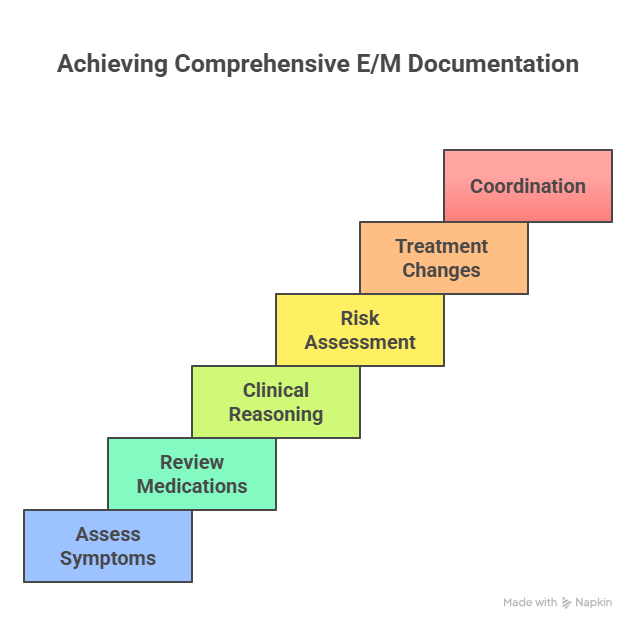
When billing E/M codes (99202–99215), documentation should support the level of medical decision-making or total time spent on the visit.
Key documentation components include:
- Assessment of the patient’s psychiatric symptoms
- Review of medications and treatment response
- Clinical reasoning and decision-making process
- Risk assessment and safety considerations
- Changes to treatment plans or medications
- Coordination with other healthcare providers
Clear documentation ensures that the billed code accurately reflects the complexity of the service provided. This not only helps justify reimbursement but also protects providers during audits or payer reviews.
New vs Established Patients in Psychiatric Billing
Correctly identifying whether a patient is new or established is critical when selecting E/M codes. Misclassifying patient status is a common coding error that can lead to claim denials or reimbursement delays.
New Patient Definition
A patient is considered new if they have not received any professional services from the provider or another provider of the same specialty within the same practice within the past three years.
New patient visits typically require more comprehensive evaluations because the provider must collect detailed medical and psychiatric information before establishing a treatment plan.
Established Patient Definition
A patient is considered established if they have received services from the same provider or another provider in the same specialty within the previous three years.
Established patient visits usually involve:
- Monitoring ongoing treatment progress
- Reviewing medication effectiveness
- Adjusting treatment plans when necessary
- Addressing new symptoms or concerns
Because providers already have a clinical history for established patients, these visits often require less extensive evaluation than new patient encounters.
Common Claim Denials for Psychiatric Evaluation Codes
Even when services are properly performed, billing errors or documentation issues can lead to denied claims. Understanding the most common denial triggers can help behavioral health practices reduce revenue loss and streamline their billing processes.
Billing 90791 Too Frequently
Many insurance payers limit how often psychiatric diagnostic evaluations can be billed. Typically, 90791 or 90792 is allowed once per episode of care, unless a significant change in the patient’s condition requires a new evaluation.
Billing this code too frequently can trigger automatic payer denials.
Incorrect Use of CPT 90792
Another common denial occurs when providers bill 90792 without documenting medical services. Since this code requires medical decision-making, documentation must clearly indicate activities such as medication prescribing, medical assessments, or diagnostic testing.
If no medical services were provided, payers may deny the claim or request recoding to 90791.
Missing or Incomplete Documentation
Claims are often rejected when essential documentation elements are missing. Examples include:
- Incomplete mental status examinations
- Missing diagnosis codes
- Lack of treatment plans
- Insufficient clinical notes supporting medical necessity
Ensuring that all required documentation is included in the patient record helps reduce the likelihood of denials.
Incorrect Use of E/M Code Levels
Selecting an E/M code that does not match the complexity of the visit is another common billing mistake. For example, billing 99215 without documentation supporting high-level medical decision-making may result in downcoding or claim rejection.
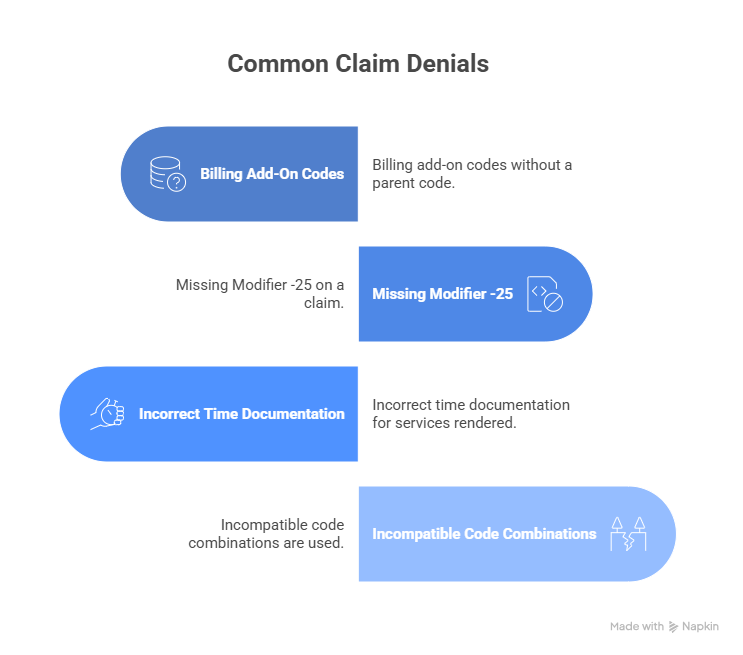
Accurate code selection should always be supported by clear documentation of clinical complexity, time spent, and treatment decisions.
Best Practices to Prevent Psychiatric Coding Denials
Preventing claim denials in behavioral health billing requires more than just selecting the correct CPT code. Providers must ensure that documentation, coding accuracy, and payer guidelines align with the services delivered. Implementing proactive billing practices can significantly improve claim acceptance rates and reduce administrative burdens.
Below are several best practices that psychiatric providers can follow to minimize billing errors and prevent denials.
Use Structured Documentation Templates
Standardized documentation templates can help providers capture all required clinical information during psychiatric evaluations and E/M visits. Templates ensure that key elements, such as mental status examinations, medical decision-making, and treatment plans, are consistently documented.
This approach reduces the risk of missing information that insurers require for claim approval.
Verify Payer Guidelines Before Billing
Insurance policies for psychiatric evaluations and E/M services can vary between payers. Some insurers limit the frequency of diagnostic evaluations, while others require specific documentation for medical decision-making.
Verifying payer guidelines before submitting claims can help practices avoid preventable denials and reimbursement delays.
Clearly Document Medical Necessity
Medical necessity is a critical factor in behavioral health reimbursement. Providers should clearly document why a particular evaluation or E/M service was required based on the patient’s symptoms, diagnosis, and treatment needs.
Including details about symptom severity, treatment risks, and clinical decision-making helps demonstrate the necessity of the service provided.
Separate Evaluation and Therapy Documentation
When practices offer both evaluation services and psychotherapy, maintaining separate documentation for each service type is essential. Mixing evaluation notes with therapy documentation can create confusion during claim reviews and increase the likelihood of billing errors.
Keeping these records distinct helps ensure that claims accurately reflect the services performed.
Conduct Regular Coding Audits
Routine internal coding audits can help identify documentation gaps, incorrect code selection, or patterns of denied claims. Audits allow practices to correct issues early and strengthen compliance with payer regulations.
By reviewing coding practices regularly, behavioral health providers can improve billing accuracy and reduce financial risk.
When to Consider Professional Mental Health Billing Support
Behavioral health billing can quickly become complex due to evolving CPT coding rules, payer-specific guidelines, and strict documentation requirements. Many psychiatric practices struggle to keep up with these changes while also focusing on patient care.
Outsourcing billing tasks to specialists can help practices streamline their revenue cycle, improve claim accuracy, and reduce administrative workload. Experienced billing teams understand payer policies, manage claim submissions efficiently, and work to resolve denials before they impact revenue.
Practices looking to improve reimbursement efficiency can explore professional mental health billing services that specialize in psychiatric coding, claim management, and compliance support.
The Bottom Line
Correctly billing psychiatric evaluation and E/M CPT codes is essential for maintaining compliance and ensuring accurate reimbursement in behavioral health practices. Understanding the differences between 90791, 90792, and E/M codes (99202–99215) helps providers select the appropriate code for each patient encounter.
Equally important is maintaining strong documentation that clearly supports medical decision-making, diagnostic evaluations, and treatment planning. Without proper documentation, even correctly coded services can result in claim denials or delayed payments.
For practices seeking a more efficient billing workflow and reduced denial rates, partnering with professionals specializing in behavioral health billing services can provide the expertise needed to optimize reimbursement and maintain compliance.