Do you spend extra time managing complex mental health sessions but struggle to determine whether your documentation supports additional reimbursement? Incorrect time reporting, outdated CPT codes, and unsupported add-on codes can cause claim denials and compliance concerns. For psychiatrists, psychologists, clinical social workers, and medical billers, accurate coding starts with understanding the service and applicable billing rules.
A critical 2026 update: CPT +99354 and +99355 were deleted effective January 1, 2023. (CMS) confirms that prolonged-service codes are no longer valid for psychotherapy sessions under its applicable Medicare guidance. Meanwhile, CPT 90785 addresses qualifying interactive complexity, not simply longer appointments or challenging patient encounters.
This guide explains the historical use of +99354 and +99355, current prolonged-service coding considerations, and documentation requirements for 90785. You’ll also learn how telehealth modifiers, place-of-service codes, and payer policies affect claims, helping your team identify errors before submission.
Which Are Mental Health Prolonged Services CPT Codes?
Mental health prolonged services CPT codes relate to reporting eligible services that extend beyond standard time limits when current coding rules permit additional reporting.
Understanding the history of +99354 and +99355 is essential because older billing references may no longer reflect current requirements.
What CPT 99354 and 99355 Historically Covered
CPT +99354 was historically used to report the first hour of qualifying prolonged face-to-face outpatient services beyond the usual service time. CPT +99355 was an add-on code for each additional 30 minutes, subject to the applicable coding requirements.
These codes appeared in older billing guidance for certain prolonged evaluation and management services and psychotherapy-related circumstances.
Why CPT 99354 and 99355 Were Deleted in 2023
The American Medical Association deleted CPT 99354 and 99355 effective January 1, 2023. Therefore, practices should not submit these codes for current services simply because an appointment exceeded its usual duration.
Older payer policies, EHR templates, and online coding articles may still reference them, so verify the rules applicable to the date of service.
What Current Prolonged-Service Coding Rules Apply?
Current reporting depends on the primary service, documented time, medical necessity, payer policy, and applicable CPT or Medicare guidance. Do not assume that a replacement code applies to every former use of 99354 or 99355. Review the current code set and payer instructions before billing.
For psychotherapy, distinguish prolonged-service eligibility from CPT 90785, which addresses qualifying interactive complexity rather than session length alone.
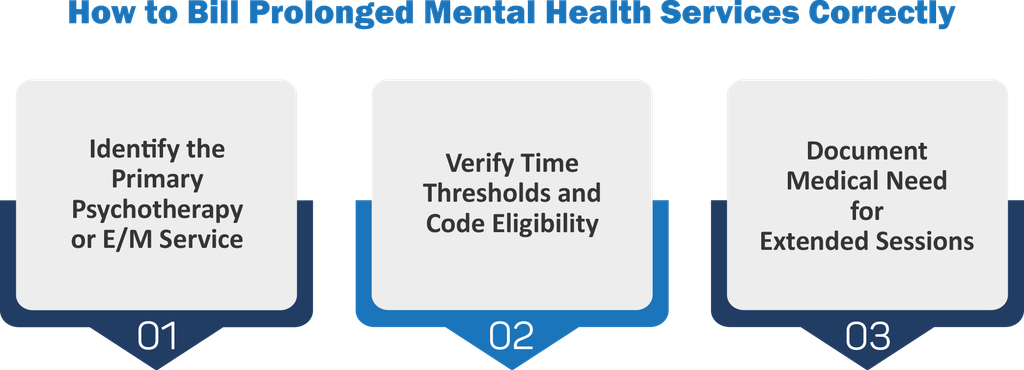
How to Bill Prolonged Mental Health Services Correctly
Accurate billing starts with identifying the service performed, checking current code requirements, and confirming that the documentation supports the claim.
Extra session time alone does not guarantee eligibility for additional reimbursement.
Identify the Primary Psychotherapy or E/M Service
First, determine whether the encounter involved psychotherapy alone or an evaluation and management (E/M) service. Psychotherapy services may use CPT 90832, 90834, or 90837, while eligible psychotherapy performed with E/M may require an appropriate E/M code and add-on code. Do not assume that prolonged-service reporting applies to every long session.
Verify Time Thresholds and Code Eligibility
Check the current CPT guidance and payer policy for the specific service and date of care. CPT +99354 and +99355 were deleted effective January 1, 2023, so they should not be submitted for current services.
Do not select a replacement code without confirming that it applies to the documented service. Medicare and commercial insurers may follow different reporting rules.
Document Medical Need for Extended Sessions
The clinical record should explain why additional time was necessary and support the service billed. Include:
- Start and stop times or other time records required by the applicable rules.
- The clinical issue that required extended care.
- Services performed and the patient’s response.
- Medical necessity and the relationship between the documentation and the selected code.
When to Use CPT 90785 for Interactive Complexity
CPT 90785 is an add-on code for qualifying communication-related complications during certain psychiatric services. It does not represent extra session time alone; the clinical circumstances and documentation must support its use.
Four Situations That May Support Interactive Complexity
CMS guidance identifies circumstances that may support reporting 90785, including:
Communication barriers: Maladaptive communication among participants complicates delivery of care.
Caregiver interference: A caregiver’s behavior or emotions interfere with treatment.
Third-party reporting: A sentinel event requires reporting to a third party, such as a child protection agency.
Communication assistance: An interpreter, translator, or other communication aid is needed to address significant barriers.
The circumstances must meet applicable CPT requirements. A difficult conversation or a lengthy appointment does not automatically qualify.
Documentation Requirements for CPT 90785
Record the communication problem, the people involved, how the issue affected the psychiatric service, and the steps taken to address it. The note should support the medical necessity of the service and the use of the add-on code.
Follow current CPT guidance and payer documentation rules.
Common Code Pairing Restrictions
CPT 90785 must be reported with an eligible primary service, not by itself. CMS guidance also restricts its use with psychiatric crisis codes and with E/M services when no psychotherapy service is reported.
Before submitting a claim, verify the permitted code combinations, provider eligibility, and payer policy for the date of service.
Psychotherapy Telehealth Modifiers 2026
Telehealth claims require accurate coding of the service, communication method, and patient location. Before submission, verify the payer’s current modifier, place-of-service, coverage, and documentation requirements to reduce avoidable denials.
Modifier 95 and Modifier 93: When to Check Their Use
Modifier 95 and Modifier 93 identify different telehealth communication methods. Mental health providers and medical billers should verify current payer rules, eligible services, and documentation requirements before submitting claims.
| Modifier | Telehealth method | When to check its use |
| 95 | Synchronous, real-time audio and video | When psychotherapy or another eligible service is delivered by live video |
| 93 | Synchronous, real-time audio-only communication | When an eligible service is delivered by telephone without video |
| Either modifier | Depends on the communication method | Before submitting a telehealth claim |
Place of Service Code for Virtual Psychiatry: POS 02 vs. POS 10
CMS distinguishes the two codes by the patient’s location:
POS 02: Telehealth provided when the patient is not at home.
POS 10: Telehealth provided when the patient is at home.
Select the code that reflects the patient’s location during the service and follow payer instructions. Correct POS reporting does not, by itself, establish coverage.
Billing Online Therapy Insurance Requirements
Before billing online therapy, verify:
- Provider eligibility and payer enrollment.
- Coverage for the specific psychotherapy service and telehealth modality.
- Authorization or referral requirements, if applicable.
- Correct CPT code, modifier, and POS.
- Documentation of the service, time when required, medical necessity, and patient location.
Mental Health Prolonged Services CPT Codes (Comparison Table)
Extended mental health sessions do not automatically qualify for prolonged-service billing. Use this table to distinguish deleted codes from current psychotherapy and eligible prolonged E/M codes before submitting a claim.
| CPT/HCPCS code | Service category | What billers need to know |
| +99354 | Historical prolonged-service add-o | Deleted effective January 1, 2023. Do not report for current dates of service. |
| +99355 | Historical additional prolonged-service add-on | Deleted effective January 1, 2023. Do not use it for current claims. |
| 90832 | Individual psychotherapy | Generally represents 16–37 minutes of psychotherapy. |
| 90834 | Individual psychotherapy | Generally represents 38–52 minutes of psychotherapy. |
| 90837 | Individual psychotherapy | Generally represents 53 minutes or more of psychotherapy. |
| 90833, 90836, 90838 | Psychotherapy with E/M | Report with an eligible E/M service when both services are performed and documented. |
| 90785 | Interactive complexity add-on | May apply when qualifying communication-related complications occur during an eligible psychiatric service. It does not represent extra time alone. |
| 99417 | Prolonged outpatient E/M service | Consider only when the primary E/M service, time threshold, CPT rules, and payer requirements permit it. |
| G2212 | Medicare prolonged outpatient E/M service | Used for eligible Medicare claims when CMS time and reporting requirements are met. It is not a general replacement for prolonged psychotherapy billing. |
Conclusion: Verify the Code Before Submitting the Claim
Accurate mental health billing starts with choosing the correct code for the service performed. CPT +99354 and +99355 were deleted in 2023, while CPT 90785 applies to qualifying interactive complexity—not simply longer sessions or challenging patient encounters.
Before submitting a claim, verify current CPT guidance, documented service time, medical necessity, code eligibility, and payer-specific requirements. These checks help mental health billing services, CPCs, and billing teams reduce coding errors, avoid preventable denials, and support compliant reimbursement.
Consistent claim reviews also help practices identify outdated EHR code sets, missing documentation, and payer-specific billing issues before submission. Keep your billing team informed of coding updates to support accurate claims and protect your practice from avoidable compliance risks.
FAQs
Can you bill CPT +99354 and +99355 in 2026?
No, CPT +99354 and +99355 were deleted effective January 1, 2023. Check current CPT guidance and payer policies to determine the appropriate code for the service provided.
What code replaced CPT +99354 for prolonged psychotherapy?
There is no universal replacement for +99354 for prolonged psychotherapy. Code selection depends on the service performed, documented time, current coding rules, and payer requirements.
When can CPT 90785 be billed with psychotherapy?
CPT 90785 may be reported with an eligible psychiatric service when qualifying communication-related complications occur. Documentation must support the circumstances and meet applicable CPT and payer requirements.
What is the difference between modifiers 93 and 95 for mental health telehealth?
Modifier 93 generally identifies eligible synchronous audio-only services, while modifier 95 generally identifies eligible synchronous audio-video services. Verify payer-specific rules and coverage before submitting the claim.
Which place of service code should be used for virtual psychiatry?
POS 02 generally applies when the patient receives telehealth somewhere other than home, while POS 10 applies when the patient is at home. Confirm the patient’s location during the service and follow payer billing instructions.