Precise medical coding is the foundation of efficient healthcare reimbursement, and few cardiovascular procedure codes are used as frequently as CPT Code 93000. Whether you’re a physician, medical coder, biller, practice manager, or healthcare administrator, understanding when and how to report this code correctly can help reduce claim denials, improve compliance, and ensure appropriate reimbursement.
Since electrocardiograms (ECGs), also known as EKGs, are commonly performed in physician offices, urgent care centers, and outpatient clinics, even minor coding errors can lead to delayed payments or unnecessary audits.
In this article, you’ll learn exactly what CPT Code 93000 is, its official description, when it should be reported, how it differs from 93005 and 93010, applicable CMS billing requirements, reimbursement considerations, documentation standards, modifier usage, and common coding mistakes to avoid.
What Is CPT Code 93000?
CPT Code 93000 is used to report a routine 12-lead electrocardiogram (ECG/EKG) when the same healthcare provider performs both the technical component (recording the ECG tracing) and the professional component (interpreting the results and preparing a written report). It is considered the global service code because it includes the complete ECG procedure.
Healthcare providers commonly use CPT Code 93000 in physician offices, outpatient clinics, urgent care centers, and other ambulatory settings to evaluate the electrical activity of the heart. The test helps detect a wide range of cardiac conditions, including arrhythmias, myocardial ischemia, conduction abnormalities, electrolyte imbalances, and other cardiovascular disorders.
Official Description of CPT Code 93000
The official CPT description for CPT Code 93000 is:
“Electrocardiogram, routine ECG with at least 12 leads; with interpretation and report.”
This description highlights four essential elements that must be present for proper reporting:
- A routine electrocardiogram is performed.
- The ECG includes at least 12 leads.
- The physician or qualified healthcare professional interprets the tracing.
- A written interpretation and report are documented in the patient’s medical record.
Failure to document the interpretation and report may result in claim denials or reimbursement issues, even if the ECG tracing was successfully obtained.
ECG vs. EKG: Is There Any Difference?
Many healthcare professionals and patients use the terms ECG and EKG interchangeably, leading to confusion about whether they represent different procedures. In reality, there is no clinical or coding difference between the two.
ECG stands for Electrocardiogram, while EKG comes from the German spelling, Elektrokardiogramm. The abbreviation “EKG” was adopted to avoid confusion with another common medical abbreviation, EEG (Electroencephalogram).
Regardless of whether a provider refers to the test as an ECG or an EKG, the procedure, documentation requirements, and CPT coding remain exactly the same.
ECG vs. EKG at a Glance
| ECG | EKG |
| Stands for Electrocardiogram | Derived from the German word “Elektrokardiogramm” |
| Commonly used in medical literature | Frequently used in clinical practice |
| Measures the heart’s electrical activity | Measures the heart’s electrical activity |
| Uses the same CPT codes | Uses the same CPT codes |
Whether your practice documents the procedure as an ECG or an EKG, CPT Code 93000 is reported when the provider performs both the recording and interpretation of a routine 12-lead study.
When Should CPT Code 93000 Be Used?
CPT Code 93000 should be reported when a healthcare provider performs a medically necessary routine 12-lead ECG and completes both the technical recording and professional interpretation during the same encounter.
An ECG is often one of the first diagnostic tests ordered when a patient presents with symptoms that may indicate an underlying cardiac condition. It provides rapid, non-invasive information about the heart’s rhythm, conduction system, and electrical activity.
Common situations where CPT Code 93000 may be appropriate include:
- Chest pain or suspected cardiac ischemia
- Heart palpitations
- Irregular heartbeat (arrhythmias)
- Syncope or unexplained fainting
- Dizziness or lightheadedness
- Shortness of breath with possible cardiac involvement
- Hypertension requiring cardiac evaluation
- Suspected myocardial infarction
- Follow-up monitoring of known heart disease
- Pre-operative cardiac assessment when medically necessary
Clinical Examples
| Clinical Condition | Is CPT Code 93000 Appropriate? |
| Chest pain evaluation | Yes |
| Palpitations | Yes |
| Suspected arrhythmia | Yes |
| Syncope | Yes |
| Shortness of breath with cardiac symptoms | Yes |
| Routine screening without medical necessity | Generally No |
Medical necessity should always be supported by the patient’s signs, symptoms, diagnosis, or physician documentation to support accurate billing and reimbursement.
Components Included in CPT Code 93000
One of the most important aspects of billing CPT Code 93000 is understanding exactly what the code includes. Unlike component codes that report only part of the service, CPT Code 93000 represents the complete ECG service.
Services Included
| Component | Included in CPT 93000 |
| 12-lead ECG tracing | ✔ Yes |
| Technical component | ✔ Yes |
| Physician interpretation | ✔ Yes |
| Written report | ✔ Yes |
| Global service | ✔ Yes |
Technical Component
The technical component includes preparing the patient, placing the electrodes, obtaining the ECG tracing, ensuring image quality, and recording the electrical activity of the heart.
Professional Component
The professional component involves reviewing the ECG tracing, identifying abnormalities, documenting clinical findings, and preparing a formal interpretation that becomes part of the patient’s medical record.
Global Service
Since CPT Code 93000 combines both components, providers should report this code only when they perform the complete service. If another provider or facility performs either the tracing or interpretation separately, different CPT codes are used instead.
Understanding these components helps prevent duplicate billing and ensures claims accurately reflect the services provided.
CPT Code 93000 vs. 93005 vs. 93010
One of the most common questions in ECG coding is understanding the difference between 93000, 93005, and 93010. Although all three codes relate to routine 12-lead electrocardiograms, each represents a different portion of the service.
| CPT Code | What It Includes | Typically Billed By |
| 93000 | ECG tracing, interpretation, and written report | Physician office or clinic performing the complete service |
| 93005 | Technical component (ECG tracing only) | Hospital, outpatient facility, or diagnostic testing center |
| 93010 | Professional component (interpretation and report only) | Physician or cardiologist interpreting the ECG |
When to Report CPT Code 93000
Use CPT Code 93000 when the same provider or practice performs both the ECG recording and the interpretation. This is the most common scenario in physician offices, family medicine practices, cardiology clinics, and urgent care centers.
When to Report CPT Code 93005
Report CPT Code 93005 when only the ECG tracing is performed. The technical component is often billed by hospitals or outpatient facilities when another physician will review and interpret the results.
When to Report CPT Code 93010
Use CPT Code 93010 when a physician provides only the interpretation and written report for an ECG that was recorded elsewhere. Cardiologists frequently report this code when interpreting ECGs obtained by hospitals or emergency departments.
Common Billing Errors to Avoid
- Billing CPT Codes 93000 and 93010 for the same ECG by the same provider.
- Reporting CPT Code 93000 when another entity performed the tracing.
- Billing CPT Code 93005 without appropriate documentation of the technical service.
- Submitting claims without a documented physician interpretation and written report.
- Reporting duplicate ECG services for the same patient encounter without medical necessity.
Selecting the correct CPT code depends on who performed the technical component, who completed the interpretation, and whether both services were furnished by the same provider or by different entities.
CPT Code for EKG in Office
One of the most common places where an electrocardiogram (ECG/EKG) is performed is the physician’s office. In primary care practices, cardiology clinics, family medicine offices, internal medicine clinics, and urgent care centers, providers frequently use ECGs to evaluate patients with cardiovascular symptoms or monitor existing heart conditions.
If the physician’s office owns the ECG machine, performs the 12-lead tracing, and the physician or qualified healthcare professional interprets the results and documents a written report, CPT Code 93000 should generally be reported because it includes both the technical and professional components of the service.
When to Bill CPT Code 93000 in an Office Setting
CPT Code 93000 is appropriate when:
- The ECG is medically necessary.
- A routine 12-lead ECG is performed.
- The physician’s office performs the tracing.
- The physician interprets the ECG.
- A signed written interpretation is included in the patient’s medical record.
Office Billing Examples
| Practice Setting | Appropriate CPT Code |
| Family Medicine Office performs ECG and interpretation | 93000 |
| Internal Medicine Clinic performs complete ECG | 93000 |
| Cardiology Office performs tracing and interpretation | 93000 |
| Urgent Care performs complete ECG | 93000 |
Hospital vs. Office Billing
The billing process differs when the ECG is performed in a hospital or outpatient facility.
| Scenario | CPT Code |
| Physician office performs complete ECG | 93000 |
| Hospital performs tracing only | 93005 |
| Physician interprets hospital ECG | 93010 |
Understanding who performed each portion of the service is essential for accurate coding and avoiding duplicate claims.
CPT Code 93000 Reimbursement
Accurate reimbursement for CPT Code 93000 depends on more than simply submitting the correct procedure code. Payers evaluate multiple factors before determining payment, including medical necessity, documentation quality, provider setting, geographic location, and payer-specific reimbursement policies.
Since CPT Code 93000 represents the global ECG service, reimbursement includes payment for both obtaining the ECG tracing and providing the physician’s interpretation and written report.
Factors That Affect Reimbursement
Several variables influence how much a provider may receive for CPT Code 93000, including:
- Medicare Physician Fee Schedule (MPFS)
- Geographic Practice Cost Indices (GPCI)
- Facility versus non-facility billing
- Commercial insurance contracts
- Medical necessity
- Accurate ICD-10 diagnosis coding
- Proper documentation
- National Correct Coding Initiative (NCCI) edits
Because reimbursement rates are updated regularly and vary by payer and locality, providers should always verify current payment amounts using the Medicare Physician Fee Schedule or the patient’s insurance fee schedule rather than relying on historical reimbursement figures.
CMS Guidelines for CPT Code 93000
The Centers for Medicare & Medicaid Services (CMS) require that all diagnostic tests, including ECGs reported with CPT Code 93000, meet specific coverage and documentation requirements before reimbursement is approved. Simply performing an ECG does not guarantee payment. Providers must demonstrate that the service was medically necessary and properly documented.
Medical Necessity
CMS generally covers CPT Code 93000 when the ECG is ordered to evaluate or manage a patient’s medical condition. Common indications include:
- Chest pain
- Palpitations
- Syncope
- Suspected arrhythmias
- Shortness of breath with possible cardiac involvement
- Hypertension with suspected cardiac complications
- Follow-up evaluation of known heart disease
Routine screening ECGs performed without a documented medical indication are generally not covered unless they qualify under a specific Medicare-covered preventive benefit or another applicable coverage policy.
Documentation Requirements
To support medical necessity, providers should document:
- The patient’s signs, symptoms, or diagnosis.
- Why the ECG was ordered.
- The complete ECG tracing.
- A physician interpretation.
- A written report.
- The provider’s signature and date.
Incomplete documentation can result in claim denials even if the ECG was clinically appropriate.
Compliance Considerations
Providers should also ensure that:
- The ECG is performed by qualified personnel.
- Documentation supports the billed service.
- The interpretation is separately documented rather than simply stating “ECG reviewed.”
- Claims comply with payer-specific billing rules and applicable National Correct Coding Initiative (NCCI) edits.
Following CMS documentation standards helps reduce audit risk while improving reimbursement accuracy.
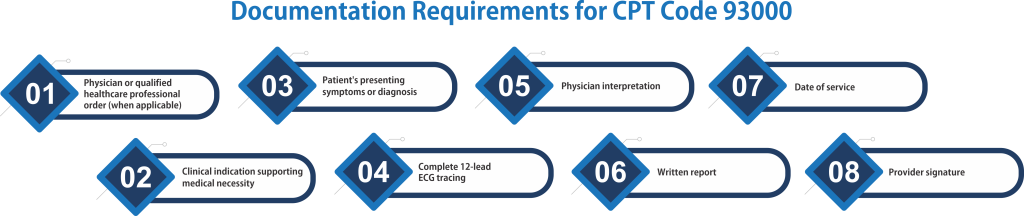
Documentation Requirements for CPT Code 93000
Proper documentation is one of the most important factors in successful ECG billing. Even when the correct CPT code is selected, insufficient documentation may lead to payment delays, claim denials, or compliance concerns.
The patient’s medical record should clearly demonstrate why the ECG was performed and what clinical findings were identified.
Documentation Checklist
A complete record should include:
✔ Physician or qualified healthcare professional order (when applicable)
✔ Patient’s presenting symptoms or diagnosis
✔ Clinical indication supporting medical necessity
✔ Complete 12-lead ECG tracing
✔ Physician interpretation
✔ Written report
✔ Date of service
✔ Provider signature
✔ Clinical impression and recommendations, when appropriate
Sample Documentation
Reason for ECG: Patient presents with intermittent chest pain and palpitations.
Interpretation: Normal sinus rhythm at 72 beats per minute. No ST-segment elevation or depression. No acute ischemic changes. PR, QRS, and QT intervals within normal limits.
Impression: Normal 12-lead ECG. Correlate clinically with patient’s symptoms.
A detailed interpretation not only supports reimbursement but also strengthens the medical record during audits and payer reviews.
CPT Code 93000 Modifiers
Although CPT Code 93000 already represents the complete ECG service, there are situations where modifiers may be required to accurately describe the circumstances surrounding the procedure. However, modifiers should only be appended when supported by payer policies and the clinical documentation.
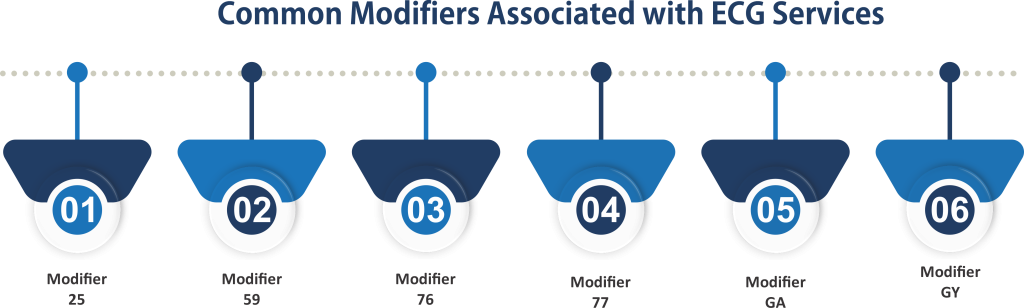
Common Modifiers Associated with ECG Services
Modifier 25
Modifier 25 may be reported when a significant, separately identifiable Evaluation and Management (E/M) service is performed on the same day as the ECG. The documentation must clearly show that the E/M service was above and beyond the work associated with performing the ECG.
Modifier 59
Modifier 59 is used only in limited situations to identify a distinct procedural service when appropriate. It should not be applied routinely and should only be used when supported by documentation and payer guidelines.
Modifier 76
Modifier 76 indicates that the same physician repeated the ECG on the same day because the patient’s condition required another medically necessary evaluation.
Modifier 77
Modifier 77 is reported when another physician repeats the ECG on the same day due to medical necessity.
Modifier GA
Modifier GA may be required when an Advance Beneficiary Notice (ABN) has been obtained for services that Medicare may not cover.
Modifier GY
Modifier GY is used when the service is statutorily excluded or otherwise not covered by Medicare.
Do Modifier 26 or TC Apply to CPT Code 93000?
A common coding mistake is appending Modifier 26 (Professional Component) or Modifier TC (Technical Component) to CPT Code 93000.
These modifiers are generally not appropriate because CPT Code 93000 already represents the global service. When only one portion of the ECG is performed, providers should report the appropriate component code instead:
- 93005: Technical component (tracing only)
- 93010: Professional component (interpretation and report only)
Using the correct code instead of an unnecessary modifier helps ensure accurate billing and minimizes the risk of claim denials.
Key Takeaways
CPT Code 93000 is essential for accurate ECG billing, proper reimbursement, and regulatory compliance. Since this code represents the complete global service, providers should use it only when they perform both the ECG tracing and the physician interpretation.
To improve coding accuracy, remember these key points:
- CPT Code 93000 includes both the technical and professional components of a routine 12-lead ECG.
- Use 93005 when only the tracing is performed and 93010 when only the interpretation and report are provided.
- Ensure every claim is supported by medical necessity and thorough documentation.
- Include a complete physician interpretation and written report in the patient’s medical record.
- Select ICD-10-CM diagnosis codes that accurately reflect the patient’s clinical condition.
- Avoid duplicate billing, incorrect modifier usage, and incomplete documentation.
- Stay informed about current payer policies and reimbursement updates to minimize claim denials and maintain compliance.
By following these best practices, healthcare providers, coders, and billing professionals can improve claim accuracy, reduce reimbursement delays, and ensure that ECG services are coded correctly every time.