Healthcare providers today face growing administrative pressures, complex insurance requirements, and increasing claim denials that can severely impact revenue. Managing billing in-house often leads to errors, delayed reimbursements, and staff burnout, ultimately pulling attention away from patient care.
A professional medical billing company acts as a strategic partner, helping healthcare practices streamline their revenue cycle, minimize claim rejections, and improve financial performance. From accurate coding and claim submission to denial management and compliance support, the right billing partner ensures providers are paid faster and more accurately.
Outsourcing medical billing is no longer just a convenience; it is a revenue optimization strategy. Whether you operate a small clinic, specialty practice, or multi-provider facility, understanding the services a reliable billing company provides can help you reduce administrative burden, increase collections, and enhance the patient experience.
Role of a Medical Billing Company in Healthcare
A medical billing company is a specialized service provider that manages the financial and administrative tasks required to ensure healthcare providers receive accurate and timely reimbursement for their services. Acting as an extension of your practice, these professionals handle claim preparation, submission, payment tracking, and insurance follow-ups so providers can focus on delivering quality patient care.
Medical billing companies work closely with healthcare practices, insurance payers, and patients to streamline the entire billing workflow. By combining industry expertise, advanced billing software, and regulatory knowledge, they help minimize costly errors, prevent compliance issues, and optimize revenue cycle performance.
Why Healthcare Providers Outsource Medical Billing
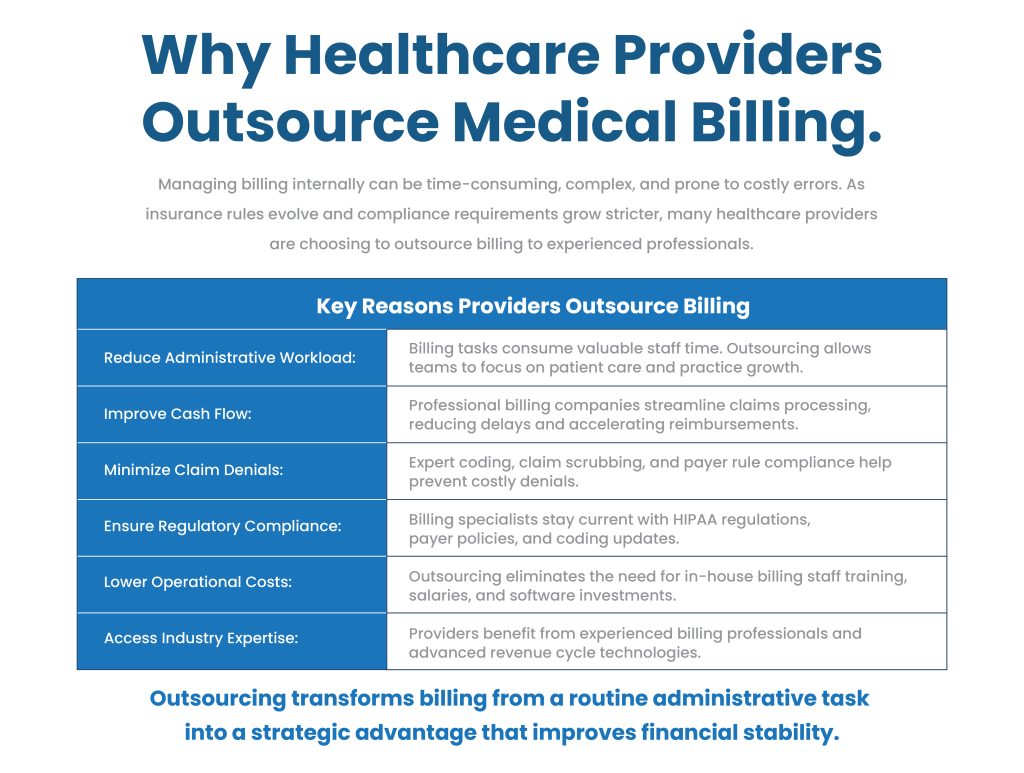
Managing billing internally can be time-consuming, complex, and prone to costly errors. As insurance rules evolve and compliance requirements grow stricter, many healthcare providers are choosing to outsource billing to experienced professionals.
Key Reasons Providers Outsource Billing
Reduce Administrative Workload: Billing tasks consume valuable staff time. Outsourcing allows teams to focus on patient care and practice growth.
Improve Cash Flow: Professional billing companies streamline claims processing, reducing delays and accelerating reimbursements.
Minimize Claim Denials: Expert coding, claim scrubbing, and payer rule compliance help prevent costly denials.
Ensure Regulatory Compliance: Billing specialists stay current with HIPAA regulations, payer policies, and coding updates.
Lower Operational Costs: Outsourcing eliminates the need for in-house billing staff training, salaries, and software investments.
Access Industry Expertise: Providers benefit from experienced billing professionals and advanced revenue cycle technologies.
Outsourcing transforms billing from a routine administrative task into a strategic advantage that improves financial stability.
Core Services Provided by a Medical Billing Company
A good medical billing company delivers comprehensive revenue cycle support designed to optimize reimbursements and streamline operations. Below are the foundational services that ensure billing accuracy and financial efficiency.
1. Patient Registration & Insurance Verification
Accurate patient and insurance information is the first step toward successful reimbursement.
Services include:
- Patient demographic data entry and validation
- Insurance eligibility verification
- Coverage and benefits confirmation
- Prior authorization assistance
Why it matters: Incorrect or inactive insurance information is one of the leading causes of claim denials. Proper verification prevents delays and revenue loss.
2. Medical Coding Services
Accurate coding ensures that services are billed correctly and reimbursed appropriately.
Includes:
- ICD-10 diagnosis coding
- CPT and HCPCS procedure coding
- Specialty-specific coding expertise
- Coding accuracy and compliance audits
Benefits:
✔ Reduces claim rejections
✔ Ensures regulatory compliance
✔ Maximizes reimbursement accuracy
3. Charge Entry & Claim Submission
Once services are coded, billing professionals prepare and submit claims to insurance payers.
Key tasks:
- Charge capture and entry
- Claim creation and formatting
- Electronic claim submission
- Clearinghouse coordination
Result: Faster claim processing, improved acceptance rates, and fewer billing errors.
4. Claims Scrubbing & Error Prevention
Before claims are submitted to insurance payers, they undergo a thorough quality review process known as claims scrubbing. This step ensures accuracy, compliance, and adherence to payer-specific guidelines.
Process includes:
- Code validation and accuracy checks
- Modifier verification
- Duplicate claim detection
- Payer rule and compliance review
Impact: Clean claims significantly improve first-pass acceptance rates and reduce costly rework.
5. Payment Posting & Reconciliation
Accurate payment posting ensures that all received payments are correctly recorded and matched against submitted claims.
Services include:
- Electronic Remittance Advice (ERA) posting
- Explanation of Benefits (EOB) reconciliation
- Patient payment posting
- Identification of underpayments
Why it matters: Proper reconciliation helps identify discrepancies, ensuring providers receive the full reimbursement they deserve.
6. Denial Management & Appeals Processing
Claim denials can lead to significant revenue losses if not handled promptly and strategically. A professional billing company actively manages denials to recover revenue and prevent recurring issues.
Denial management services include:
- Root cause analysis of denied claims
- Correction and resubmission of claims
- Appeals preparation and submission
- Denial trend tracking and reporting
Goal: Recover lost revenue and reduce future denial rates through process improvements.
7. Accounts Receivable (AR) Management
Efficient accounts receivable management ensures that outstanding claims are followed up on and payments are collected on time.
Includes:
- Insurance follow-ups on unpaid claims
- Aging report monitoring and analysis
- Resolution of delayed or rejected claims
- AR performance improvement strategies
Result: Reduced aging balances and improved cash flow stability.
8. Patient Billing & Customer Support
A good medical billing company enhances the patient’s financial experience by providing clear billing communication and support.
Services offered:
- Patient statement preparation and delivery
- Billing inquiries and support services
- Payment plan assistance
- Online payment facilitation
Benefit: Improves patient satisfaction and increases patient payment collections.
9. Compliance & Regulatory Support
Healthcare billing must comply with strict regulatory requirements and patient privacy laws. A reliable billing partner ensures compliance and reduces legal risk.
Compliance services include:
- HIPAA-compliant billing processes
- Fraud and abuse prevention measures
- Documentation and coding compliance audits
- Implementation of regulatory updates
Why it matters: Compliance protects practices from penalties, audits, and reputational damage.
10. Revenue Cycle Reporting & Performance Analytics
Data-driven insights enable healthcare providers to monitor financial health and identify opportunities for improvement.
Reporting includes:
- Revenue performance dashboards
- First-pass claim acceptance rates
- Denial trends and root causes
- Payer reimbursement analysis
- Financial forecasting metrics
Benefit: Enables informed decision-making and continuous revenue optimization.
11. Credentialing & Provider Enrollment Support
Proper credentialing ensures providers are authorized to bill insurance payers and receive reimbursements without delays.
Services include:
- Provider enrollment with insurance networks
- CAQH profile management
- Credentialing application submission and tracking
- Re-credentialing and updates
Impact: Prevents reimbursement delays and ensures uninterrupted revenue flow.
12. Prior Authorization & Referral Management
Many procedures require prior approval from insurance companies. Billing companies help streamline this process.
Includes:
- Prior authorization submissions
- Referral coordination
- Documentation verification
- Payer follow-ups for approval status
Result: Prevents claim denials due to missing authorizations.
13. Revenue Cycle Optimization & Consulting
Beyond processing claims, top billing companies provide strategic guidance to improve financial performance.
Consulting services include:
- Workflow efficiency analysis
- Denial reduction strategies
- Fee schedule optimization
- Process improvement recommendations
Value: Helps practices achieve long-term financial stability and operational excellence.
Complete Revenue Cycle Management (RCM) Coverage
A good medical billing company provides end-to-end Revenue Cycle Management (RCM), from patient intake and insurance verification to final payment reconciliation and performance reporting.
RCM lifecycle coverage includes:
✔ Patient scheduling & registration
✔ Insurance verification & authorizations
✔ Medical coding & charge entry
✔ Claims submission & scrubbing
✔ Payment posting & reconciliation
✔ Denial management & appeals
✔ AR follow-ups & collections
✔ Patient billing & support
✔ Compliance & audit readiness
✔ Reporting & revenue optimization
With a complete RCM solution, healthcare providers gain financial clarity, operational efficiency, and the freedom to focus on patient care.
Benefits of Hiring a Professional Medical Billing Company
Partnering with a professional medical billing company provides more than administrative support; it delivers measurable financial and operational improvements that strengthen your practice.
Faster Reimbursements: Clean claim submission, accurate coding, and proactive follow-ups accelerate payment cycles and reduce delays.
Reduced Administrative Burden: Outsourcing billing tasks frees your staff from time-consuming paperwork, allowing them to focus on patient care and front-office efficiency.
Improved Claim Acceptance Rates: Expert claim scrubbing and coding accuracy increase first-pass acceptance rates and minimize costly rejections.
Increased Revenue & Cash Flow: Professional denial management and AR follow-ups ensure that no earned revenue is left uncollected.
Compliance & Risk Reduction: Billing experts stay current with HIPAA regulations, payer policies, and coding updates, protecting your practice from penalties and audits.
Enhanced Patient Experience: Clear billing statements, flexible payment options, and responsive support improve patient satisfaction and trust.
Cost Savings & Scalability: Eliminates hiring, training, and software expenses while providing scalable solutions as your practice grows.
Specialty-Specific Medical Billing Services
Different medical specialties have unique coding requirements, payer rules, and reimbursement structures. A good billing company offers specialty-focused expertise to ensure accuracy and optimal reimbursements.
Common Specialties Supported
- Family & Internal Medicine: Preventive services, chronic care management, E/M coding
- Cardiology: Diagnostic testing, interventional procedures, complex coding
- Dermatology: Procedure coding, biopsy billing, cosmetic vs. medical distinctions
- Orthopedics: Surgical billing, global periods, and modifier usage
- Mental & Behavioral Health: Telehealth billing, therapy session coding, compliance rules
- Radiology: Technical vs. professional components, imaging compliance
- Urgent Care: High-volume claim processing and payer variation handling
Why specialty expertise matters: Accurate specialty coding prevents underbilling, compliance issues, and reimbursement delays.
How to Choose the Right Medical Billing Company
Selecting the right billing partner is essential for maximizing revenue and maintaining operational efficiency. Not all billing companies offer the same level of expertise, transparency, or support.
✔ Evaluate Industry Experience: Choose a company with proven success in your specialty and practice size.
✔ Verify Technology & Security Standards: Ensure secure systems, EHR integration, data encryption, and HIPAA compliance.
✔ Ask About Reporting & Transparency: Regular performance reports and revenue insights provide financial visibility.
✔ Assess Denial Management Capabilities: A strong denial recovery process protects your revenue.
✔ Review Communication & Support: Responsive customer support and dedicated account managers improve workflow efficiency.
✔ Understand Pricing Structure: Most billing companies charge 4%–9% of collections, depending on services and complexity.
The Bottom
A good medical billing company provides complete Revenue Cycle Management services, from patient registration and coding to denial management and financial reporting. By outsourcing billing to experienced professionals, healthcare providers can reduce administrative stress, improve cash flow, maintain compliance, and focus on delivering exceptional patient care.
If your practice is ready to improve efficiency, increase collections, and eliminate billing challenges, partnering with an expert billing provider is a strategic step toward long-term growth.
Frequently Asked Questions
Q: What does a medical billing company do?
Ans: A medical billing company manages coding, claim submission, payment processing, denial resolution, and revenue cycle management to ensure providers are reimbursed accurately and promptly.
Q: How does outsourcing medical billing increase revenue?
Ans: Outsourcing reduces billing errors, improves claim acceptance rates, speeds reimbursements, and strengthens denial recovery processes.
Q: Is outsourcing medical billing HIPAA compliant?
Ans: Yes. Reputable billing companies use secure systems and follow strict HIPAA regulations to protect patient data.
Q: How much do medical billing services cost?
Ans: Fees typically range from 4% to 9% of monthly collections, depending on practice size, specialty, and service scope.
Q: Can a billing company reduce claim denials?
Ans: Absolutely. Accurate coding, claims scrubbing, and denial management strategies significantly reduce denial rates and recover lost revenue.
Q: Will outsourcing affect patient satisfaction?
Ans: No, in fact, professional billing support improves patient communication, billing clarity, and payment convenience.