Medical billing goes beyond assigning the right CPT or HCPCS codes; it also requires the correct revenue codes to identify the hospital department or service area where care was provided. These four-digit codes play a vital role in institutional billing, helping hospitals, outpatient facilities, and insurance payers process claims accurately, determine reimbursement, and maintain compliance with Medicare and other payer guidelines. Even a minor error in revenue coding can lead to claim denials, delayed payments, or compliance issues. Partnering with professional medical billing services can help healthcare facilities streamline these complex institutional claims and secure maximum reimbursement.
In this article, you’ll learn what revenue codes in medical billing are, why they matter, how they differ from CPT codes, and where they’re used across hospital departments such as the emergency room, laboratory, radiology, surgery, and pharmacy.
We’ll also provide a practical revenue codes list, explain Medicare-specific requirements, highlight common billing mistakes, and share best practices to help you improve claim accuracy and maximize reimbursements.
What Are Revenue Codes in Medical Billing?
Revenue codes are four-digit numeric codes used in institutional medical billing to identify the department or cost center where a healthcare service was provided. Unlike CPT or HCPCS codes, which describe the specific procedure or service performed, revenue codes indicate the location or category of service within a healthcare facility, such as the emergency department, laboratory, radiology department, operating room, or pharmacy.
These codes are primarily used on the UB-04 (CMS-1450) claim form, which hospitals, outpatient facilities, skilled nursing facilities, rehabilitation centers, and other institutional providers submit to Medicare, Medicaid, and commercial insurance companies. By pairing revenue codes with the appropriate CPT or HCPCS codes, healthcare providers give payers a complete picture of both where and what services were delivered, ensuring accurate claim adjudication and reimbursement.
Why Revenue Codes Matter in Medical Billing?
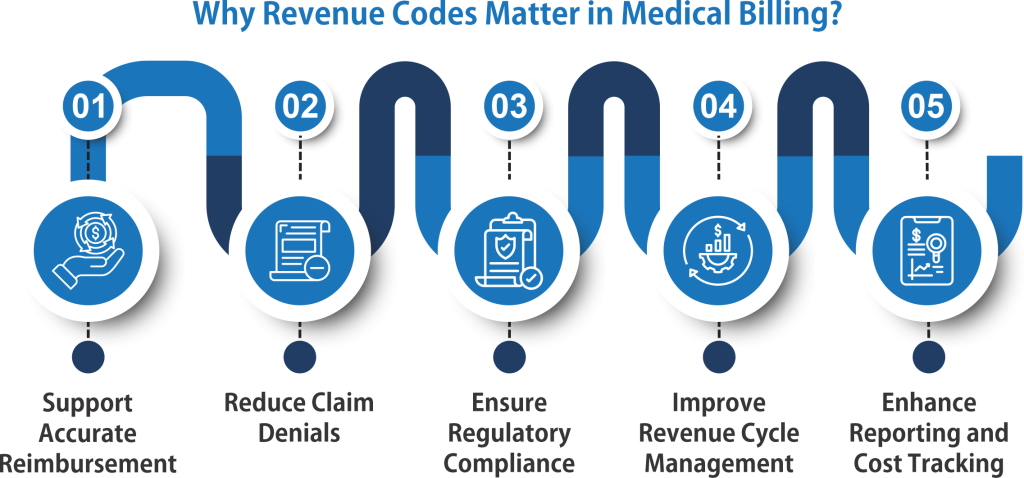
Revenue codes play a critical role in ensuring healthcare providers receive timely and accurate reimbursement for the services they deliver. They provide insurers with essential information about the department responsible for a charge, allowing claims to be processed correctly and reducing the likelihood of payment delays or denials.
Here are some of the key reasons revenue codes are important:
- Support Accurate Reimbursement: Revenue codes help insurers determine the appropriate payment based on the type of facility and department where the service was rendered.
- Reduce Claim Denials: Missing or incorrect revenue codes can result in rejected or denied claims, delaying reimbursement and increasing administrative work.
- Ensure Regulatory Compliance: Medicare and other payers require institutional claims to include valid revenue codes that align with billing guidelines.
- Improve Revenue Cycle Management: Correct revenue coding minimizes billing errors, speeds up claims processing, and enhances overall financial performance.
- Enhance Reporting and Cost Tracking: Hospitals use revenue codes to monitor departmental revenue, analyze service utilization, and improve operational efficiency.
Without accurate revenue codes, even correctly coded medical procedures may face reimbursement issues because insurers cannot identify the facility department responsible for the charges.
How Revenue Codes Work?
Revenue codes work alongside CPT and HCPCS codes to provide a complete picture of a patient’s healthcare services. While procedure codes explain what treatment was performed, revenue codes identify where the service was provided within the healthcare facility.
The typical billing workflow looks like this:
- A patient receives medical care at a hospital or outpatient facility.
- The service is provided by a specific department, such as the emergency room, laboratory, radiology department, or operating room.
- The hospital assigns the appropriate revenue code to identify the department responsible for the charge.
- The corresponding CPT or HCPCS code is assigned to describe the exact procedure, test, or service performed.
- Both codes are included on the UB-04 claim form and submitted to the insurance payer.
- The payer reviews the claim, verifies the coding, and determines reimbursement based on the submitted information and the patient’s benefits.
This coordinated use of revenue codes and procedure codes enables insurers to process institutional claims more efficiently while reducing coding discrepancies and payment delays.
Where Are Revenue Codes Used?
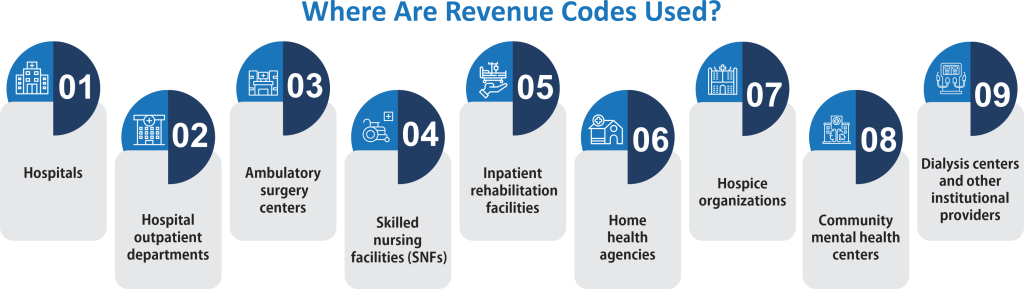
Revenue codes are used primarily in institutional healthcare billing, where services are billed on the UB-04 (CMS-1450) claim form. They help identify the department or service area responsible for each charge, making them essential for facility-based reimbursement.
Common healthcare settings that use revenue codes include:
- Hospitals
- Hospital outpatient departments
- Ambulatory surgery centers
- Skilled nursing facilities (SNFs)
- Inpatient rehabilitation facilities
- Home health agencies
- Hospice organizations
- Community mental health centers
- Dialysis centers and other institutional providers
It’s important to note that revenue codes are generally not used for professional physician billing. Physicians typically submit claims using the CMS-1500 form, which relies primarily on CPT, HCPCS, and ICD-10-CM codes. Institutional providers, however, use the UB-04 form, where revenue codes are a required component of most claims.
Difference Between Revenue Code and CPT Code
Although revenue codes and CPT codes often appear on the same institutional claim, they serve entirely different purposes. Knowing the difference is essential for accurate medical billing and reimbursement.
| Revenue Code | CPT Code |
| Identifies the hospital department or cost center where the service was provided. | Identifies the specific medical procedure or service performed. |
| Consists of four numeric digits. | Consists of five numeric digits. |
| Used primarily on the UB-04 (CMS-1450) claim form. | Used on both CMS-1500 and UB-04 claims, depending on the provider. |
| Represents the facility or service category. | Represents the exact procedure, test, or treatment. |
| Assigned by institutional healthcare facilities. | Assigned by physicians, coders, and healthcare providers based on the services rendered. |
Example
Imagine a patient visits the emergency department after a fall and receives an X-ray.
- Revenue Code 0450 indicates that the service was provided in the Emergency Room.
- Revenue Code 0320 identifies that diagnostic radiology services were used.
- The CPT code specifies the exact X-ray procedure performed.
Together, these codes tell the insurance payer where the services occurred and what services were provided, allowing the claim to be processed accurately and reimbursed appropriately. This is why most institutional claims require both revenue codes and CPT or HCPCS codes to ensure complete and compliant billing.
Revenue Codes List (Most Common)
Revenue codes are organized into categories that represent specific hospital departments, service areas, or types of care. While there are hundreds of revenue codes maintained by the National Uniform Billing Committee (NUBC), only a subset is used regularly in everyday medical billing. Understanding these commonly used codes helps medical billers assign charges accurately and reduce claim errors.
Below are some of the most frequently used revenue codes in medical billing.
| Revenue Code | Description |
| 0001 | Total Charges (Claim Summary Line) |
| 0100 | All-Inclusive Room and Board |
| 0110 | Room and Board – Private Room |
| 0120 | Room and Board – Semi-Private Room |
| 0200 | Intensive Care Unit (ICU) |
| 0210 | Coronary Care Unit (CCU) |
| 0250 | Pharmacy – General Classification |
| 0251 | Pharmacy – Generic Drugs |
| 0252 | Pharmacy – Non-Generic Drugs |
| 0257 | Pharmacy – Intravenous (IV) Solutions |
| 0270 | Medical/Surgical Supplies – General |
| 0300 | Laboratory – General Classification |
| 0301 | Chemistry Laboratory |
| 0305 | Hematology Laboratory |
| 0306 | Bacteriology/Microbiology |
| 0310 | Pathology |
| 0320 | Diagnostic Radiology |
| 0321 | Diagnostic X-Ray |
| 0324 | Diagnostic Ultrasound |
| 0350 | CT Scan Services |
| 0360 | Operating Room Services |
| 0361 | Minor Surgery |
| 0370 | Anesthesia Services |
| 0420 | Physical Therapy |
| 0430 | Occupational Therapy |
| 0440 | Speech Therapy |
| 0450 | Emergency Room Services |
| 0456 | Urgent Care |
| 0490 | Ambulatory Surgical Care |
| 0636 | Drugs Requiring Detailed Coding (HCPCS) |
| 0762 | Specialty Clinic Services |
The revenue code identifies the department or service category, not the specific procedure. Most institutional claims require a corresponding CPT or HCPCS code to describe the exact service provided.
Hospital Revenue Codes
Hospitals use revenue codes to categorize charges generated by different departments, making it easier for insurance companies to identify where patient services were delivered. Since a single hospital visit often involves multiple departments, several revenue codes may appear on the same claim.
Common hospital revenue code categories include:
- Room and Board (0100–0219): Covers inpatient accommodations, including private rooms, semi-private rooms, ICU, and CCU services.
- Pharmacy (0250–0259): Includes medications, IV drugs, and pharmaceutical supplies.
- Medical and Surgical Supplies (0270–0279): Covers disposable medical supplies and equipment used during patient care.
- Laboratory (0300–0319): Includes blood work, pathology, microbiology, and diagnostic testing.
- Radiology (0320–0359): Covers X-rays, ultrasounds, CT scans, MRI services, and other diagnostic imaging.
- Operating Room (0360–0369): Represents surgical facility charges for inpatient and outpatient procedures.
- Therapy Services (0420–0449): Includes physical, occupational, and speech therapy.
- Emergency Services (0450–0459): Used for emergency department and urgent care facility charges.
- Ambulatory Surgery (0490–0499): Covers same-day surgical procedures performed in outpatient settings.
By accurately assigning hospital revenue codes, facilities can ensure proper reimbursement while maintaining compliance with payer and Medicare billing requirements.
Lab Revenue Codes
Laboratory revenue codes identify diagnostic testing services performed by hospital laboratories. These codes are commonly paired with CPT pathology and laboratory procedure codes to describe the exact tests completed.
Some of the most commonly used lab revenue codes include:
| Revenue Code | Laboratory Service |
| 0300 | Laboratory – General Classification |
| 0301 | Chemistry |
| 0302 | Immunology |
| 0305 | Hematology |
| 0306 | Bacteriology/Microbiology |
| 0307 | Urology |
| 0309 | Clinical Laboratory Services |
| 0310 | Pathology |
Examples of laboratory services billed using these revenue codes include:
- Complete Blood Count (CBC)
- Blood glucose testing
- Lipid panels
- Urinalysis
- Blood cultures
- Tissue pathology examinations
- Microbiology testing
Accurate laboratory revenue coding helps ensure diagnostic services are reimbursed correctly while supporting medical necessity documentation and payer compliance.
Radiology Revenue Codes
Radiology revenue codes are assigned to diagnostic imaging services provided within hospitals and outpatient facilities. These codes identify the imaging department responsible for the charges, while CPT codes specify the imaging procedure performed.
Common radiology revenue codes include:
| Revenue Code | Imaging Service |
| 0320 | Diagnostic Radiology – General |
| 0321 | Diagnostic X-Ray |
| 0322 | Contrast Studies |
| 0324 | Diagnostic Ultrasound |
| 0350 | CT Scan Services |
| 0610* | Magnetic Resonance Technology (facility-specific usage may vary) |
Radiology revenue codes may be used for services such as:
- X-rays
- Ultrasounds
- CT scans
- MRI examinations
- Fluoroscopy
- Diagnostic imaging studies
For example, if a patient receives a chest X-ray in the emergency department, the claim may include:
- Revenue Code 0450 for the emergency department.
- Revenue Code 0321 for diagnostic X-ray services.
- The appropriate CPT code identifying the chest X-ray performed.
Using both revenue and procedure codes provides insurers with a complete picture of the patient’s care, resulting in more accurate claims processing and reimbursement.
Surgery Revenue Codes
Surgery revenue codes identify facility charges associated with surgical procedures performed in hospitals and ambulatory surgery centers. These codes represent the operating room or surgical department where the procedure took place, while CPT or HCPCS codes identify the specific surgical procedure performed.
Some of the most commonly used surgery revenue codes include:
| Revenue Code | Surgical Service |
| 0360 | Operating Room Services – General |
| 0361 | Minor Surgery |
| 0362 | Organ Transplant Services |
| 0367 | Kidney Transplant |
| 0369 | Other Operating Room Services |
| 0490 | Ambulatory Surgical Care – General |
For example, if a patient undergoes a laparoscopic appendectomy, the claim may include:
- Revenue Code 0360 to indicate the use of the operating room.
- The appropriate CPT code to identify the appendectomy procedure.
- Additional revenue codes for anesthesia, recovery room services, laboratory testing, or pharmacy charges, if applicable.
Accurate surgery revenue coding ensures hospitals receive appropriate reimbursement for facility resources used during surgical procedures while maintaining compliance with payer guidelines.
Emergency Room Revenue Codes
Emergency room (ER) revenue codes identify charges related to emergency department services. Since emergency visits often involve multiple hospital departments, such as laboratory, radiology, and pharmacy, a single claim may contain several revenue codes in addition to the primary ER revenue code.
Below are some commonly used emergency room revenue codes:
| Revenue Code | Description |
| 0450 | Emergency Room – General Classification |
| 0451 | EMTALA Emergency Medical Screening Services |
| 0452 | ER Services Beyond EMTALA Screening |
| 0456 | Urgent Care |
| 0459 | Other Emergency Room Services |
| 0981 | Professional Fees – Emergency Room (facility-specific reporting where applicable) |
A typical emergency department claim may include:
- 0450: Emergency room services
- 0320: Diagnostic radiology for imaging
- 0300: Laboratory testing
- 0250: Pharmacy charges
- Relevant CPT/HCPCS codes for all procedures, tests, and medications
Proper revenue coding helps insurers distinguish facility charges from professional services, improving claim accuracy and reimbursement.
Pharmacy Revenue Codes
Pharmacy revenue codes are used to report medications, intravenous (IV) therapy, biological products, and other pharmaceutical services provided during a patient’s stay. These codes help payers identify medication-related facility charges and are often paired with HCPCS codes when required.
Common pharmacy revenue codes include:
| Revenue Code | Description |
| 0250 | Pharmacy – General Classification |
| 0251 | Generic Drugs |
| 0252 | Non-Generic Drugs |
| 0254 | Drugs Incident to Other Diagnostic Services |
| 0255 | Drugs Incident to Radiology Services |
| 0257 | Intravenous (IV) Solutions |
| 0258 | IV Therapy |
| 0636 | Drugs Requiring Detailed Coding (HCPCS) |
Examples of services billed using pharmacy revenue codes include:
- Prescription medications
- Injectable drugs
- Chemotherapy medications
- IV fluids
- Biological products
- Specialty medications
- High-cost outpatient drugs
Revenue Code 0636 is particularly important because it requires the associated HCPCS code to identify the specific drug being billed, especially for Medicare and many commercial payers.
Medicare Revenue Codes
Medicare requires institutional healthcare providers to use revenue codes when submitting claims on the UB-04 (CMS-1450) claim form. These codes help Medicare identify the department where services were provided and determine reimbursement under its payment systems.
For outpatient hospital services, Medicare generally processes claims through the Outpatient Prospective Payment System (OPPS), which groups services into Ambulatory Payment Classifications (APCs). Revenue codes, combined with CPT or HCPCS codes, play a key role in assigning services to the correct APC for payment.
When billing Medicare, providers should follow these best practices:
- Use valid and current revenue codes approved by the NUBC.
- Pair revenue codes with the appropriate CPT or HCPCS codes whenever required.
- Report HCPCS codes with Revenue Code 0636 for separately payable drugs.
- Ensure revenue codes accurately reflect the department where services were provided.
- Review Medicare billing guidelines regularly to stay compliant with annual coding updates.
Failure to follow Medicare revenue code requirements can result in claim edits, payment reductions, reimbursement delays, or claim denials. Regular coding audits and staff education are essential for maintaining compliance and optimizing reimbursement.
Best Practices for Accurate Revenue Code Billing
Accurate revenue coding is essential for maintaining compliance, minimizing claim denials, and maximizing reimbursement. By following industry best practices, healthcare organizations can improve coding consistency and strengthen their revenue cycle.
Here are some proven best practices:
- Verify the correct department before assigning a revenue code.
- Pair revenue codes with the appropriate CPT or HCPCS codes whenever required.
- Follow Medicare, Medicaid, and commercial payer billing guidelines for institutional claims.
- Use the latest NUBC revenue code updates to avoid obsolete or invalid codes.
- Review the UB-04 claim form carefully before submission to identify missing or incorrect information.
- Perform regular internal coding audits to detect recurring errors and improve billing accuracy.
- Provide ongoing training for medical billers and coders to keep them informed about coding changes and payer requirements.
- Maintain detailed documentation that supports every billed service and corresponding revenue code.
Implementing these best practices helps healthcare providers submit cleaner claims, reduce administrative costs, and receive payments more quickly. If revenue code discrepancies or billing bottlenecks do lead to unpaid claims, specialized medical accounts receivable services can step in to recover outstanding revenues effectively.
Revenue Codes vs. HCPCS Codes
Revenue codes and HCPCS codes are often used together on institutional claims, but they serve different purposes. Understanding how they complement each other is essential for accurate medical billing.
| Revenue Code | HCPCS Code |
| Identifies the hospital department or cost center. | Identifies the specific product, supply, medication, or service provided. |
| Four-digit numeric code. | Alphanumeric code (Level II) or CPT code (Level I). |
| Used primarily on UB-04 claims. | Used on both institutional and professional claims. |
| Represents the service category or location. | Represents the exact item, procedure, or supply. |
| Assigned by healthcare facilities. | Assigned based on nationally recognized coding standards. |
Example
A patient receives an injectable medication during an outpatient hospital visit.
- Revenue Code 0636 indicates that the hospital is billing for a drug that requires detailed coding.
- The HCPCS code identifies the specific medication and dosage administered.
Together, these codes provide insurers with both the billing category and the exact item or service delivered, ensuring accurate reimbursement.
Conclusion
Revenue codes are a foundational component of institutional medical billing, helping healthcare facilities communicate where services were provided, while CPT and HCPCS codes explain what services were performed. Together, these coding systems enable insurance companies to process claims accurately, determine reimbursement, and ensure compliance with Medicare and commercial payer requirements.
Whether you’re billing for emergency room visits, laboratory tests, radiology services, surgeries, or pharmacy charges, selecting the correct revenue code is essential for reducing claim denials and maintaining a healthy revenue cycle.
By understanding the purpose of revenue codes, recognizing common coding errors, and following industry best practices, medical billers and healthcare organizations can improve claim accuracy, streamline reimbursement, and support long-term financial performance.