If you’re covered by more than one health insurance plan, understanding primary vs secondary insurance can save you from unexpected medical bills, claim delays, and unnecessary confusion. Many people assume both insurance plans split costs equally or that they can choose which one to use first, but that’s not how health insurance works.
In most cases, one plan is designated as your primary insurance, meaning it pays first, while the other acts as your secondary insurance, covering eligible remaining costs after the first claim is processed. Knowing how these plans work together can help you avoid denied claims, reduce out-of-pocket expenses, and make the most of your coverage. For medical practices managing multi-payer environments, leveraging professional payer contract management services ensures clear payment hierarchies and smoother financial operations.
In this article, you’ll learn what primary and secondary insurance are, how they work, the rules that determine which plan pays first, what happens if your primary insurance denies a claim, and answers to the most common questions people have about coordinating multiple health insurance plans.
What Is Primary Insurance?
Primary insurance is the health insurance plan that pays first when you receive medical care. Whenever you visit a doctor, undergo a medical procedure, or fill a prescription, your healthcare provider submits the claim to your primary insurer before any other insurance plan.
The primary insurance company reviews the claim based on your policy’s benefits, provider network, deductibles, copayments, coinsurance, and coverage limits. After processing the claim, it pays its share of the eligible medical expenses and issues an Explanation of Benefits (EOB) that outlines what was covered, how much was paid, and whether any remaining balance may be eligible for secondary insurance.
Having primary insurance doesn’t necessarily mean it covers every healthcare expense. Depending on your plan, you may still be responsible for deductibles, copays, coinsurance, or services that aren’t covered. If you also have secondary insurance, that plan may help pay some or all of these remaining eligible costs.
What Does Primary Insurance Typically Cover?
Your primary insurance may cover:
- Doctor and specialist visits
- Hospital stays
- Emergency medical care
- Preventive services
- Prescription medications
- Diagnostic tests and laboratory services
- Surgeries and outpatient procedures
The exact coverage depends on your policy’s terms and conditions.
Example of Primary Insurance
Imagine you have employer-sponsored health insurance and visit a specialist for a consultation costing $400. Your primary insurance reviews the claim and pays $320 after applying its coverage rules. The remaining eligible balance may then be sent to your secondary insurance for further review, leaving you with a lower out-of-pocket expense.
What Is Secondary Insurance?
Secondary insurance is an additional health insurance plan that processes your claim after your primary insurance has paid its portion. It doesn’t replace your primary coverage; instead, it acts as a supplement by helping cover certain remaining healthcare costs that your primary insurer doesn’t fully pay.
Once the primary insurer processes a claim, the remaining eligible balance is forwarded to the secondary insurer. The secondary insurance company then reviews the claim according to its own policy rules and determines whether it will pay some, all, or none of the remaining costs.
It’s important to understand that secondary insurance does not automatically pay every unpaid balance. Coverage depends on the benefits, exclusions, deductibles, and limitations outlined in the secondary policy.
Secondary Insurance May Help Cover
- Remaining coinsurance
- Copayments
- Eligible deductibles
- Additional covered medical expenses
- Costs left after the primary insurer’s payment
Some expenses may still remain your responsibility if neither insurance policy covers them.
Example of Secondary Insurance
Suppose your medical procedure costs $2,000. Your primary insurance pays $1,500, leaving $500 unpaid. Your secondary insurance reviews the remaining balance and pays $350 because it’s covered under its policy. You would only be responsible for the remaining $150, provided it isn’t covered by either plan.
Primary vs Secondary Insurance: Key Differences
Although both insurance plans work together to reduce your healthcare costs, they serve different purposes. The primary plan is always responsible for reviewing and paying eligible claims first, while the secondary plan only considers the remaining balance after the primary insurer has processed the claim.
The following comparison highlights the most important differences between the two.
| Feature | Primary Insurance | Secondary Insurance |
| Payment Order | Pays first | Pays after the primary insurance |
| Claim Processing | Reviews and processes the original claim | Reviews the remaining eligible balance |
| Main Purpose | Provides the first level of coverage | Supplements the primary plan |
| Deductible | Has its own deductible | May have its own deductible depending on the policy |
| Copays & Coinsurance | Applies according to the policy | May help cover eligible remaining amounts |
| Can It Be Used First? | Yes | No, except in rare circumstances defined by Coordination of Benefits rules |
| Covers All Remaining Costs? | No | Not always; coverage depends on the policy |
| Determines Initial Payment | Yes | No |
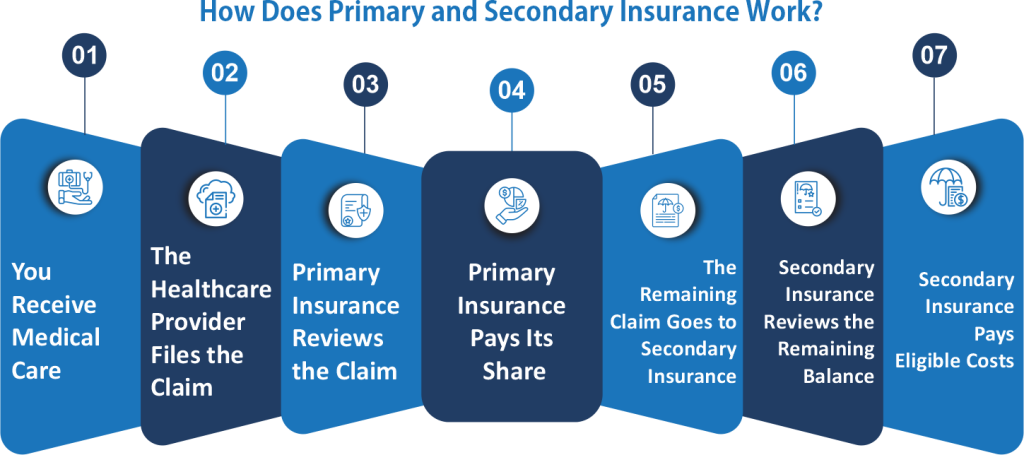
How Does Primary and Secondary Insurance Work?
When you have two health insurance plans, they don’t pay your medical bills at the same time. Instead, they follow a structured process known as Coordination of Benefits (COB) to determine which insurer pays first and how much the second insurer may contribute.
Here’s how the process typically works:
Step 1: You Receive Medical Care
You visit a doctor, hospital, or other healthcare provider for treatment.
Step 2: The Healthcare Provider Files the Claim
Your provider submits the medical claim to your primary insurance first. This is the only insurer that reviews the claim initially.
Step 3: Primary Insurance Reviews the Claim
The primary insurer evaluates the claim based on your policy’s coverage, deductibles, copays, coinsurance, network rules, and medical necessity.
Step 4: Primary Insurance Pays Its Share
If the service is covered, the insurer pays its approved portion and issues an Explanation of Benefits (EOB) detailing what it paid and any remaining balance.
Step 5: The Remaining Claim Goes to Secondary Insurance
After the primary claim has been processed, the remaining eligible amount is submitted to your secondary insurance. In many cases, healthcare providers handle this automatically, though some plans may require you to submit the claim yourself.
Step 6: Secondary Insurance Reviews the Remaining Balance
The secondary insurer applies its own coverage rules to determine whether the remaining expenses qualify for payment.
Step 7: Secondary Insurance Pays Eligible Costs
If the remaining balance is covered under the secondary policy, it pays all or part of the outstanding amount.
Step 8: You Pay Any Remaining Balance
If there are still costs not covered by either insurance plan, such as excluded services or remaining deductibles, you are responsible for paying those expenses.
Simple Example
Imagine your hospital bill is $5,000.
- Primary insurance pays $3,800.
- The remaining $1,200 is sent to secondary insurance.
- Secondary insurance pays $900.
- You pay the remaining $300, assuming it isn’t covered by either policy.
This step-by-step process helps ensure both insurance plans work together while preventing duplicate payments for the same medical expense.
Include a flowchart here showing the claim journey: Medical Service → Primary Insurance → Primary Payment → Secondary Insurance → Secondary Payment → Patient Responsibility.
What Are Primary and Secondary Insurance Rules?
The order in which insurance companies pay claims isn’t based on your preference. Instead, insurers follow a standardized process called Coordination of Benefits (COB) to determine which policy is primary and which is secondary.
These rules help prevent duplicate payments, reduce billing disputes, and ensure claims are processed accurately.
Employer-Sponsored Insurance Rule
If you’re covered under your own employer’s health insurance plan and also covered as a dependent on your spouse’s plan, your employer-sponsored plan is generally considered your primary insurance. Your spouse’s plan typically becomes secondary.
Birthday Rule for Dependent Children
When a child is covered under both parents’ health insurance plans, the birthday rule often determines which plan is primary.
The parent whose birthday (month and day, not year) falls earlier in the calendar year usually provides the child’s primary insurance.
For example:
- Parent A’s birthday: March 10
- Parent B’s birthday: September 18
In most cases, Parent A’s insurance would be the child’s primary coverage.
Active Employee Rule
If you’re actively employed and also covered under a retiree health plan, your active employer-sponsored insurance generally pays first, while the retiree plan acts as secondary.
Medicare Rules
Whether Medicare is primary or secondary depends on factors such as:
- Employer size
- Employment status
- Age
- Disability eligibility
For example, if you’re still working for a large employer and have employer-sponsored coverage, that employer plan may pay first, with Medicare acting as secondary. In other situations, Medicare may become the primary payer.
Medicaid Rules
In most cases, Medicaid is the payer of last resort, meaning it generally pays only after all other available health insurance plans have processed the claim.
COBRA Coverage Rule
If you have COBRA continuation coverage along with another employer-sponsored health plan, the active employer’s insurance generally serves as the primary payer, while COBRA becomes secondary.
Court Order Rule
If a court order specifies which parent is responsible for a child’s healthcare coverage following a divorce or separation, insurers generally follow that order when determining which policy is primary.
Military Coverage Rule
Individuals covered by military health benefits, such as TRICARE, may have different payment rules depending on whether they also have employer-sponsored insurance, Medicare, or other qualifying coverage. The order of payment varies based on federal regulations and the type of coverage involved.
Why These Rules Matter
Understanding these rules helps you:
- Avoid claim processing delays.
- Prevent denied or duplicate claims.
- Reduce unexpected medical bills.
- Ensure healthcare providers bill the correct insurance first.
- Maximize the benefits available under both insurance plans.
If you’re unsure which policy is primary, contact both insurance companies before receiving medical care. Confirming your Coordination of Benefits information in advance can save time and help prevent billing issues later.
How Do You Know Which Insurance Is Primary or Secondary?
Determining which health insurance plan is primary or secondary isn’t something you can choose on your own. Insurance companies follow Coordination of Benefits (COB) rules to decide the order of payment based on your specific coverage situation.
The following scenarios explain how insurers typically determine which plan pays first.
If You Have Your Own Employer Health Insurance and Your Spouse’s Plan
If you’re covered by your employer’s health insurance and are also listed as a dependent on your spouse’s plan, your employer-sponsored insurance is generally your primary insurance. Your spouse’s plan usually acts as secondary coverage.
If You’re Covered Under Two Employer Health Plans
If you have coverage through two different employers, the primary insurer is determined according to Coordination of Benefits rules, which may consider factors such as the length of coverage, employment status, and specific policy provisions. The order isn’t based on which plan has better benefits or lower premiums.
If a Child Is Covered by Both Parents’ Insurance
When both parents cover the same child under separate health insurance plans, insurers often apply the birthday rule.
The parent whose birthday falls earlier in the calendar year typically provides the child’s primary insurance, unless a court order or other legal agreement specifies otherwise.
If You Have Medicare and Employer Insurance
The order of payment depends on factors such as:
- Whether you’re actively employed
- Your employer’s size
- Your age
- Whether Medicare eligibility is based on age or disability
In some situations, employer insurance pays first. In others, Medicare becomes the primary payer.
If You Have Medicaid and Another Insurance Plan
Because Medicaid is generally the payer of last resort, your other health insurance usually pays first, with Medicaid potentially covering eligible remaining costs afterward.
If You Have COBRA Coverage
If you’re covered by both COBRA and an active employer-sponsored health plan, the employer plan generally pays first, while COBRA acts as secondary insurance.
If You’re Covered by TRICARE or Other Military Health Coverage
Military health benefits coordinate with other insurance plans according to federal rules. Depending on your circumstances, employer-sponsored insurance, Medicare, or TRICARE may serve as the primary payer.
Can You Have Primary and Secondary Insurance?
Yes, it’s completely legal to have more than one health insurance plan. Many individuals and families have both primary and secondary insurance to reduce out-of-pocket healthcare costs and expand their overall coverage.
However, having two insurance plans doesn’t mean you receive double payments or that every medical expense will be covered. Instead, both plans coordinate their benefits according to established insurance rules.
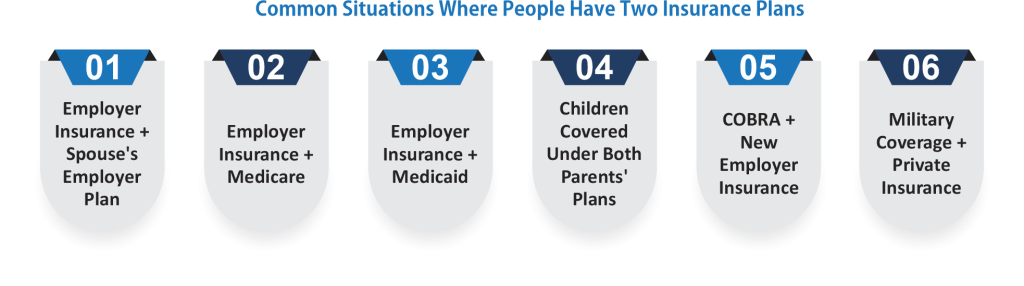
Common Situations Where People Have Two Insurance Plans
Employer Insurance + Spouse’s Employer Plan
One of the most common situations occurs when someone has health insurance through their own employer while also being covered as a dependent under their spouse’s employer-sponsored plan.
Employer Insurance + Medicare
Many people continue working after becoming eligible for Medicare. Depending on their employment status and employer size, they may have both employer insurance and Medicare.
Employer Insurance + Medicaid
Individuals with limited income or specific eligibility requirements may qualify for Medicaid while also maintaining private employer-sponsored health insurance.
Children Covered Under Both Parents’ Plans
Children are often enrolled in both parents’ health insurance plans, especially when each parent has separate employer-sponsored coverage.
COBRA + New Employer Insurance
Someone who starts a new job while still covered under COBRA may temporarily have two active insurance plans.
Military Coverage + Private Insurance
Military members, retirees, and their families may have both military health benefits and private health insurance.
Benefits of Having Two Insurance Plans
Having primary and secondary insurance may provide several advantages, including:
- Lower out-of-pocket medical expenses.
- Reduced copays and coinsurance.
- Additional protection against large healthcare bills.
- Broader access to covered healthcare services.
- Greater financial security during unexpected medical emergencies.
Potential Drawbacks
Although dual coverage offers benefits, it can also create additional responsibilities.
Some common challenges include:
- More paperwork during enrollment.
- Coordination of Benefits requirements.
- Longer claim processing times.
- Confusion over which insurance pays first.
- Separate deductibles and policy limitations.
Before enrolling in multiple health insurance plans, compare the costs and benefits to determine whether maintaining dual coverage makes financial sense for your situation.
Can I Use My Secondary Insurance as Primary?
In most cases, no, you cannot choose to use your secondary insurance as your primary insurance. The order of payment is determined by Coordination of Benefits (COB) rules rather than personal preference.
Even if your secondary insurance offers better benefits or lower out-of-pocket costs, healthcare providers and insurance companies are generally required to bill the primary insurance first.
Why Can’t You Choose?
Insurance companies have agreements and regulations that prevent duplicate payments and ensure claims are processed fairly.
When you receive medical treatment, the claim must follow the correct order:
- Primary insurance processes the claim first.
- Secondary insurance reviews any eligible remaining balance.
- You pay any remaining amount that neither plan covers.
Skipping the primary insurer can result in delays, denied claims, or requests to resubmit the claim through the proper order.
What Happens If You Bill the Wrong Insurance First?
Submitting a claim to your secondary insurance before your primary insurer has processed it can lead to several issues, including:
- Claim denial.
- Payment delays.
- Requests for additional documentation.
- Billing confusion between providers and insurers.
- Additional administrative work to correct the claim.
Are There Any Exceptions?
Some insurance arrangements have unique Coordination of Benefits rules that determine which plan pays first. These situations are based on policy terms and applicable regulations, not on the policyholder’s preference.
If you’re uncertain about the payment order, it’s best to confirm with both insurance companies before receiving treatment.
If Primary Insurance Denies a Claim, Will Secondary Insurance Pay?
A common misconception is that if primary insurance denies a claim, secondary insurance will automatically cover it. In reality, the answer depends on why the primary insurer denied the claim and whether the service is covered under the secondary policy. For clinics dealing with recurring denials from primary payers, robust denial management services are essential for properly scrubbing and resubmitting claims across coordinated networks.
Each insurance company reviews claims independently based on its own coverage rules, exclusions, and eligibility requirements.
Scenario 1: Primary Insurance Doesn’t Cover the Service
If the primary insurer denies the claim because the service isn’t included in your policy, the secondary insurance may still pay if that service is covered under its own plan.
Example: Your primary plan excludes a specific therapy, but your secondary plan includes it as a covered benefit. In this case, the secondary insurer may provide payment after reviewing the claim.
Scenario 2: Prior Authorization Wasn’t Obtained
Many insurance plans require prior authorization for certain treatments or procedures.
If your primary insurer denies the claim because the required authorization wasn’t obtained, the secondary insurer may also deny payment, especially if it follows similar coverage requirements.
Scenario 3: Out-of-Network Provider
If the primary insurance denies payment because you used an out-of-network provider, the secondary insurer will review the claim according to its own network rules.
Depending on the policy, it may:
- Pay all eligible costs.
- Pay only a portion.
- Deny the claim altogether.
Scenario 4: Claim Was Submitted Too Late
Insurance companies have filing deadlines for medical claims.
If the primary insurer denies a claim because it was submitted after the deadline, the secondary insurer may also deny payment, particularly if the late filing prevented proper claim coordination.
Scenario 5: Policy Exclusions
Some medical services are excluded under specific insurance policies.
If the primary insurer denies coverage due to a policy exclusion, the secondary insurer will determine whether the same exclusion applies under its own policy. If the service is covered, it may pay eligible costs.
Conclusion
Once you understand the difference between primary and secondary insurance, the claims process becomes much easier to follow. Your primary insurance is responsible for paying first, while your secondary insurance may help cover eligible remaining costs based on its own policy terms. The order of payment is determined by Coordination of Benefits (COB) rules, not personal preference, making it important to keep both insurers updated and ensure your healthcare providers have accurate insurance information.
Whether you have coverage through your employer, a spouse’s plan, Medicare, Medicaid, or another qualifying policy, knowing which insurance pays first can help you avoid claim denials, reduce unexpected medical bills, and maximize the value of your benefits.
If you’re ever uncertain about your coverage, contact your insurance companies before receiving treatment to confirm the payment order and understand what each plan covers. Taking this simple step can save you time, money, and unnecessary stress while ensuring your healthcare claims are processed correctly.