Maintaining an efficient healthcare ecosystem relies heavily on precise documentation and streamlined financial workflows. Even small medical billing and coding discrepancies can delay insurance reimbursements, increase claim denial rates, and significantly leak practice revenue—making absolute administrative accuracy essential for long-term financial stability. Understanding the operational differences between medical billing vs medical coding is critical for healthcare professionals, clinical coders, and managers looking to secure their revenue cycles.
While both functions work toward maximizing practice revenue, they require completely distinct technical skill sets. Medical coding focuses on translating clinical documentation into a universal, standardized language for insurance carriers. Medical billing manages the outward administrative journey, transforming those codes into clean insurance claims to ensure the practice receives timely reimbursement.
Medical Billing vs Medical Coding
Medical billing and coding are critical to the healthcare revenue cycle. Mistakes in either process can cause delayed payments, denied claims, and lost revenue for providers. This section highlights the key differences, responsibilities, and value each role brings to healthcare operations.
What Is Medical Coding
Medical coding converts diagnoses, procedures, and treatments into standardized ICD-10, CPT, and HCPCS codes that support accurate claim processing and reimbursement. These codes effectively convey patient care to clinicians, payers, and government programs. Accurate coding avoids claim errors and helps to ensure compliance with rules.
- Coders use ICD-10, CPT, and HCPCS codes to document care.
- ICD-10-CM is used for outpatient diagnoses, and ICD-10-PCS for inpatient procedures.
- Coding ensures that claims accurately reflect services, which reduces denials and promotes timely reimbursement.
- In 2026, demand for skilled coders continues to expand rapidly, with the market projected at $20.8 billion due to healthcare digitization and accelerated AI-assisted coding workflows.
What Is Medical Billing
Medical billing uses the codes assigned by coders to submit claims to insurance companies, track payments, and manage patient billing. Effective billing ensures providers receive proper reimbursement while maintaining smooth revenue cycles. As reimbursement requirements become increasingly complex, many healthcare organizations rely on professional medical billing services and automation systems to protect claim accuracy, lower administrative overhead, and speed up turnaround times.
- Billers verify insurance eligibility, calculate co-pays, and prepare claims.
- They track submitted claims, resolve denials, and follow up on unpaid invoices.
- In 2026, the U.S. medical billing market is valued at $22.48 billion, driven heavily by increasing electronic claim submission volumes and complex provider reimbursement workflows.
- Billers often communicate directly with patients, providers, and insurers to resolve discrepancies and clarify billing questions.
How Medical Billing and Medical Coding Work Together in the Revenue Cycle
Understanding the difference between medical billing and medical coding is critical for healthcare operations. Errors in coding or billing can delay payments, cause claim denials, and reduce revenue. This section examines how these roles interact within the revenue cycle and why their accuracy matters.
Workflow Breakdown From Documentation to Payment
Medical coding and billing form sequential steps in the revenue cycle. Coders translate patient diagnoses, procedures, and treatments into ICD-10, CPT, and HCPCS codes, creating a universal language for payers. Accurate coding ensures claims reflect actual services provided.
Once clinical coding is completed, medical billers step in to navigate the administrative steps required to clear the balance. Managing this workflow with complete transparency requires rigorous ledger tracking, which is why top-tier practices connect their workflows directly to expert payment posting services to reconcile insurance payments, track patient balances, and eliminate financial discrepancies.
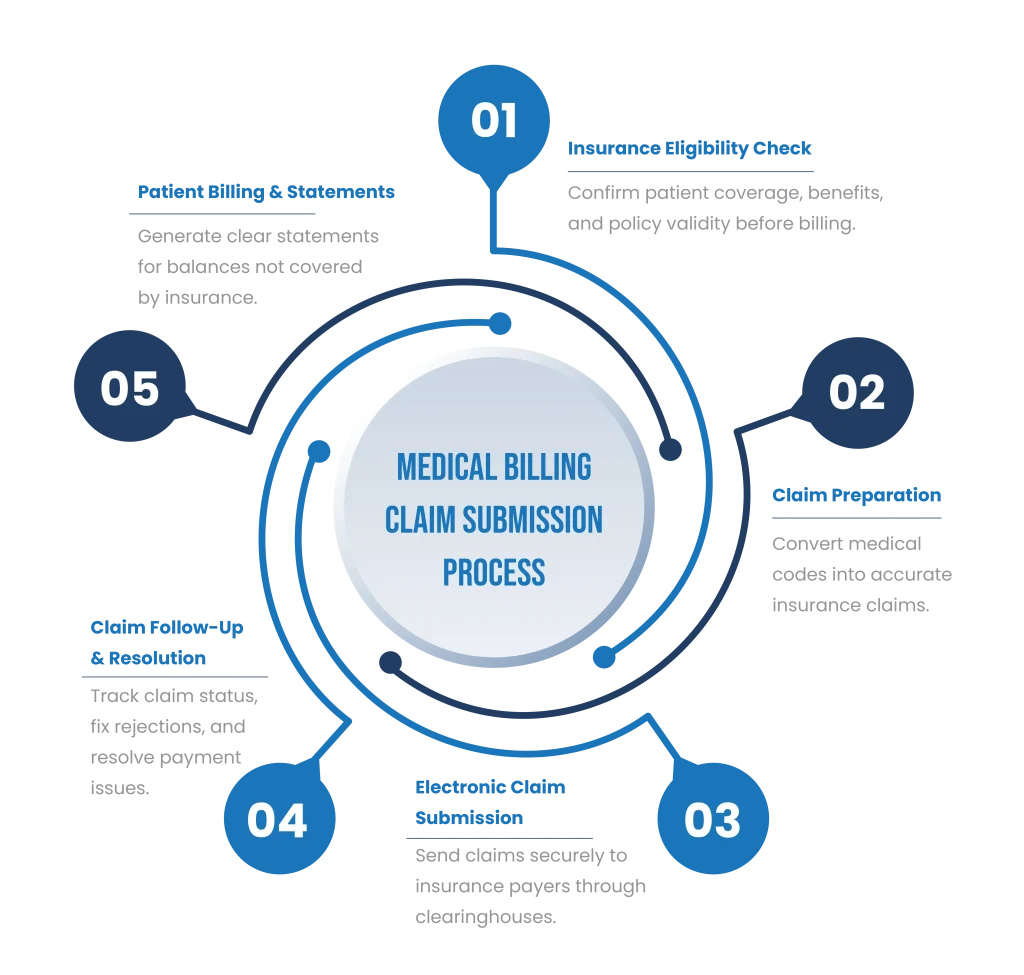
The core billing workflow functions in direct alignment with standard administrative practices:
Insurance Eligibility Check: Confirming the patient’s insurance eligibility, co-pays, and coverage caps prior to the clinical encounter.
Claim Preparation: Extracting the validated ICD-10, CPT, and HCPCS codes from the documentation to build the primary claim file.
Electronic Claim Submission: Transmitting the completed claim securely through automated billing platforms or clearinghouses straight to the insurance payer.
Claim Follow Up & Resolution: Tracking the live status of submitted claims and working immediately to resolve any unexpected rejections or partial payments.
Patient Billing & Statements: Issuing clear, itemized financial statements to patients for any remaining deductibles or outstanding balances not covered by insurance.
Impact on Denials and Reimbursement
Many claim denials result from coding inaccuracies, missing documentation, eligibility issues, or billing errors. Accurate coding combined with proper claim submission significantly improves first-pass acceptance rates and accelerates reimbursement.
Key factors impacting denials and reimbursement include:
- Misused or outdated codes.
- Missing documentation or incomplete records.
- Insurance-specific billing rules and payer policies.
Compliance and Risk in Medical Billing and Medical Coding
Compliance and risk management are essential components of both medical billing and medical coding. Mistakes in either process can lead to fines, audit exposure, and delayed reimbursements. This section explains the regulatory risks and financial accountability healthcare organizations face.
Audit Exposure and Regulatory Oversight
Healthcare providers are subject to audits from CMS, private insurers, and federal agencies. Accurate medical coding ensures that claims accurately reflect the actual services, thereby reducing audit findings. Errors in code selection or documentation can trigger:
- Claim denials
- Overpayment recoupment
- Legal penalties for fraud or abuse
Financial Accountability
Maintaining financial accountability requires accurate coding, complete documentation, and consistent billing workflows. Healthcare organizations should establish internal quality controls, regularly train staff on payer requirements, verify claims before submission, and monitor reimbursement trends to minimize revenue leakage and compliance risks.
Summary Table: Medical Billing vs Medical Coding
| Feature | Medical Coding | Medical Billing |
| Definition | Converts medical diagnoses, procedures, and services into standardized codes (ICD, CPT, HCPCS). | Submits claims to payers using coded data to secure reimbursement. |
| Primary Purpose | Ensure accurate documentation and compliance for each patient encounter. | Ensure timely and correct payment from insurance providers and patients. |
| Role in Revenue Cycle | Provides coding that underpins claim creation and compliance. | Processes claims, tracks payments, and manages denials. |
| Key Skills | Knowledge of coding systems, medical terminology, anatomy, and regulatory guidelines. | Insurance knowledge, claim management, patient communication, and financial tracking. |
| Patient Interaction | Minimal; primarily works behind the scenes. | Frequent; communicates with patients, providers, and payers. |
| Error Impact | Incorrect codes can lead to claim denials, audits, or regulatory penalties. | Incorrect billing can delay payment, affect cash flow, and increase revenue loss. |
| Certification | CPC, CCS, and CIC are recommended for coding accuracy and compliance. | CPB, billing certifications recommended for claim processing expertise. |
| 2026 Insights | Accurate coding reduces audit exposure; CMS audits over 15% of claims annually. | Denial rates remain 8–12% per claim; effective billing reduces financial risk. |
Conclusion
Medical billing and medical coding serve different purposes, but both are essential to a healthy revenue cycle. Accurate coding ensures healthcare services are documented correctly, while effective billing transforms those coded services into timely reimbursements. By investing in experienced professionals, maintaining compliance with payer requirements, and continuously monitoring billing performance, healthcare organizations can reduce denials, improve cash flow, and strengthen long-term financial stability.
FAQs
What is the difference between medical billing and medical coding?
Medical coding translates diagnoses, procedures, and treatments into standardized codes. Medical billing uses these codes to submit claims and track payments.
Why is accurate medical coding important for healthcare providers?
Accurate coding ensures claims reflect patient services correctly, reduces denials, supports regulatory compliance, and minimizes audit risks.
How does medical billing affect revenue cycle management?
Medical billing manages claim submission, payment tracking, and patient invoicing, ensuring timely reimbursement and reducing financial losses.
What certifications are recommended for medical coders and billers?
Coders typically pursue CPC, CCS, or CIC credentials. Billers benefit from CPB or billing-specific certifications to improve accuracy and efficiency.
How can errors in billing or coding impact healthcare organizations?
Mistakes can delay payments, increase denials, trigger audits, and result in lost revenue, affecting the financial stability of the practice or organization.
Which comes first, medical coding or medical billing?
Medical coding comes first. After a healthcare provider documents a patient encounter, a medical coder assigns the appropriate ICD-10, CPT, and HCPCS codes. A medical biller then uses those codes to prepare, submit, and track insurance claims for reimbursement, ensuring accurate payment and compliance with payer requirements.