Have you seen claims that Florida has repealed Personal Injury Protection (PIP) insurance? This confusion can lead to coverage mistakes, delayed medical care, denied claims, billing errors, and unexpected expenses for drivers and healthcare providers.
As of 2026, Personal Injury Protection (PIP) is not being repealed in Florida. Most registered vehicle owners must still carry $10,000 in PIP and $10,000 in Property Damage Liability (PDL) coverage, and the 2026 legislative session did not repeal the state’s no-fault insurance law.
This guide explains whether PIP is still required in Florida, who must carry it, what it covers, and how current rules affect drivers and healthcare proviWhy Do People Think PIP Was Repealedders. It also covers documentation, billing requirements, and common claim issues to help reduce denials and support proper reimbursement.
Is PIP Still Required in Florida?
Florida continues to require Personal Injury Protection (PIP) coverage for most registered vehicle owners. This section explains the current law and the minimum insurance requirements that drivers and healthcare providers should understand.
Current Florida Law
Yes, PIP is still required in Florida. As of 2026, Personal Injury Protection (PIP) is not being repealed in Florida, and the state continues to operate under its no-fault insurance system. Most owners of vehicles registered in Florida must maintain $10,000 in PIP coverage and $10,000 in Property Damage Liability (PDL) coverage. PIP generally pays 80% of reasonable medical expenses, 60% of lost wages, and provides a $5,000 death benefit, subject to Florida law and policy terms.
To qualify for benefits, injured individuals must receive initial medical treatment within 14 days of the accident. Understanding these requirements helps drivers remain compliant and enables healthcare providers to support accurate billing and timely reimbursement.
Minimum Insurance Requirements
Florida law requires the following minimum automobile insurance coverage for most registered vehicles:
- $10,000 Personal Injury Protection (PIP) for eligible medical expenses and lost wages.
- $10,000 Property Damage Liability (PDL) for damage caused to another person’s property.
- Initial medical treatment must begin within 14 days after the accident to preserve PIP eligibility.
- Additional insurance, such as Bodily Injury Liability (BIL), may be recommended but is not required for most private passenger vehicles under current Florida law.
Why Do People Think PIP Was Repealed?
Many drivers and healthcare providers have seen reports claiming Florida ended its no-fault insurance system. This section explains why that belief continues and clarifies the current law.
Previous Repeal Bills
Several bills introduced in the Florida Legislature proposed replacing the no-fault insurance system with a fault-based model. In 2021, lawmakers passed legislation to repeal Personal Injury Protection (PIP), but the Governor vetoed the bill before it became law.
Additional repeal proposals were introduced in later legislative sessions, creating confusion among drivers, insurers, and healthcare providers. Because these proposals received public attention, many people mistakenly believed the law had already changed.
Why Repeal Efforts Failed
Supporters of repeal argued that the change could reduce insurance fraud and replace PIP with mandatory Bodily Injury Liability (BIL) coverage. Opponents raised concerns that the proposal could increase insurance premiums, reduce access to immediate medical benefits after an accident, and create uncertainty for policyholders and healthcare providers. As a result, the proposed changes did not become Florida law.
Current Legal Status
As of 2026, Personal Injury Protection (PIP) is not being repealed in Florida. Florida remains a no-fault insurance state, and most registered vehicle owners must continue carrying the required $10,000 in PIP and $10,000 in Property Damage Liability (PDL) coverage.
For anyone asking, “Is PIP still required in Florida?”, the answer is yes. Drivers, healthcare providers, and medical billing professionals should continue following current Florida PIP requirements for coverage, documentation, and claims processing until any future law is officially enacted.
What Does Florida PIP Insurance Cover?
Florida Personal Injury Protection (PIP) helps pay certain expenses after a covered motor vehicle accident, regardless of who caused the crash. Understanding what PIP covers and excludes helps drivers and healthcare providers make informed decisions about treatment, billing, and claims.
Medical Expenses
Florida PIP generally pays 80% of reasonable and necessary medical expenses related to injuries from a covered motor vehicle accident, up to the policy limit. Covered services may include emergency care, physician visits, hospital treatment, diagnostic testing, surgery, chiropractic services, physical therapy, and medically necessary rehabilitation.
To qualify for benefits, the injured person must receive initial medical care within 14 days of the accident.
Lost Wages
If an injury prevents the insured person from working, Florida PIP generally pays 60% of lost income, subject to policy limits and eligibility requirements. Supporting medical records and employer documentation are commonly required to verify wage loss.
Death Benefits
If a covered individual dies because of injuries sustained in a motor vehicle accident, Florida PIP may provide a $5,000 death benefit in addition to eligible medical benefits, subject to policy terms and applicable state law.
Services That Are Not Covered
Florida PIP does not pay every accident-related expense. Coverage exclusions and payment limits apply under Florida law and the insurance policy.
| Covered Under Florida PIP | Generally Not Covered Under Florida PIP |
| 80% of eligible medical expenses | Vehicle repair or replacement costs |
| 60% of eligible lost wages | Damage to another person’s vehicle or property |
| Emergency medical services | Pain and suffering damages |
| Hospital and physician services | Non-medically necessary treatment |
| Diagnostic imaging and laboratory services | Medical care received after the 14-day treatment window (unless otherwise permitted by law) |
| Chiropractic care and physical therapy, when covered | Expenses exceeding policy limits or excluded by the policy |
| Medically necessary rehabilitation | Attorney fees and court-awarded damages under standard PIP benefits |
What Happens After a Florida Auto Accident?
The steps you take after a Florida auto accident can affect your medical benefits and insurance claim. Acting promptly helps protect your health and supports accurate medical billing and reimbursement.
14-Day Treatment Rule
Florida PIP requires injured individuals to receive initial medical treatment within 14 days of a motor vehicle accident to qualify for PIP benefits. Delaying care beyond this period may result in the loss of PIP coverage, even if the injury is related to the accident. Healthcare providers should document the date of injury, initial evaluation, diagnosis, and treatment to support the claim.
Emergency Medical Condition (EMC)
An Emergency Medical Condition (EMC) determination affects the amount of PIP benefits available. If an authorized healthcare provider determines that the patient has an EMC, eligible PIP benefits may be available up to the $10,000 policy limit.
Without an EMC determination, available medical benefits are generally limited under Florida law. Complete clinical documentation is important to support medical necessity and claim review.
When PIP Benefits Apply
PIP generally applies when an insured driver, resident relative, passenger, or certain pedestrians are injured in a covered motor vehicle accident. Benefits are paid regardless of who caused the accident, provided the policy is active, and Florida’s eligibility requirements are met. Covered services may include medically necessary treatment, diagnostic testing, rehabilitation, and eligible wage-loss benefits within the policy limits.
Florida PIP Timeline After an Auto Accident
| Time | Action | Why It Matters |
| Day 0 | Motor vehicle accident occurs | Creates the basis for a potential PIP claim. |
| Within 14 Days | Obtain initial medical evaluation and treatment | Required to remain eligible for Florida PIP benefits. |
| After Initial Evaluation | Provider documents diagnosis and, when appropriate, determines an Emergency Medical Condition (EMC) | Supports benefit eligibility and medical necessity. |
| During Treatment | Medical claims are submitted with supporting documentation | Helps support timely claim processing and reimbursement. |
| After Claim Review | Insurer reviews eligibility and issues payment or requests additional information. | Complete documentation can reduce claim delays and denials. |
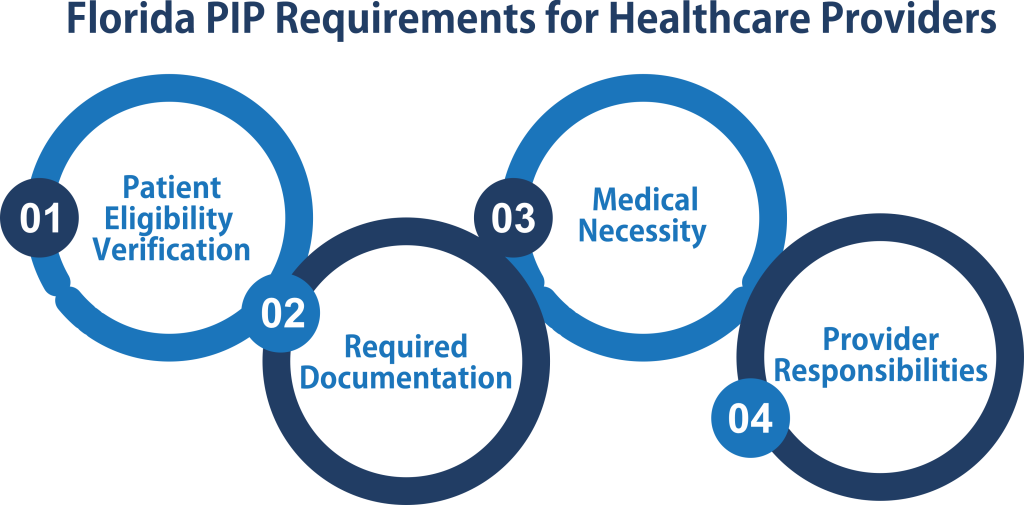
Florida PIP Requirements for Healthcare Providers
Healthcare providers play an important role in supporting accurate PIP claims and timely reimbursement. Following Florida PIP requirements helps reduce billing errors, claim denials, and compliance concerns.
1. Patient Eligibility Verification
Before providing non-emergency treatment, verify the patient’s active Florida PIP coverage and collect accident-related information. Confirm the insurance carrier, policy details, date of the accident, and whether the patient received initial treatment within the required 14-day period. Accurate eligibility verification supports correct claim submission and payment.
2. Required Documentation
Complete and accurate medical records are essential for PIP claims. Documentation should include the patient’s history, examination findings, diagnosis, treatment plan, progress notes, and dates of service. Providers should also maintain supporting records for medical necessity, diagnostic testing, referrals, and any Emergency Medical Condition (EMC) determination when applicable.
2. Medical Necessity
Florida PIP generally covers medically necessary services related to injuries sustained in a covered motor vehicle accident. Providers should ensure that all treatment is clinically appropriate, supported by documentation, and consistent with the patient’s condition. Proper use of CPT®, HCPCS Level II, and ICD-10-CM codes, along with complete clinical records, helps support reimbursement and reduces claim disputes.
3. Provider Responsibilities
Healthcare providers should follow Florida PIP billing requirements throughout the course of treatment. Key responsibilities include:
- Verify patient eligibility and insurance information before billing.
- Maintain complete, accurate, and timely medical documentation.
- Submit claims with appropriate CPT®, HCPCS Level II, and ICD-10-CM codes.
- Support medical necessity with clear clinical records.
- Respond promptly to insurer requests for additional documentation.
- Monitor claim status and address payment delays or denials in accordance with Florida PIP requirements.
Conclusion
As of 2026, Personal Injury Protection (PIP) is still required in Florida, and the state’s no-fault insurance system remains in effect. Understanding current PIP requirements, coverage limits, and treatment deadlines helps drivers stay compliant and supports timely claims processing.
Healthcare providers, medical billing professionals, and practice administrators should continue to follow Florida PIP documentation, coding, and billing requirements to reduce claim denials and ensure accurate reimbursement. Staying informed about future legislative changes will help ensure ongoing compliance and effective patient care.
FAQs
Is PIP still required in Florida?
Yes. As of 2026, Florida continues to require most registered vehicle owners to carry $10,000 in Personal Injury Protection (PIP) and $10,000 in Property Damage Liability (PDL) coverage under the state’s no-fault insurance law.
Has Personal Injury Protection (PIP) been repealed in Florida?
No. Personal Injury Protection (PIP) is not being repealed in Florida. Although repeal bills have been introduced in previous legislative sessions, none have changed the current law, and PIP remains mandatory for most registered vehicles.
What does Florida PIP insurance cover?
Florida PIP generally covers 80% of reasonable medical expenses, 60% of lost wages, and a $5,000 death benefit, subject to policy limits and eligibility requirements. Initial medical treatment must generally begin within 14 days of the accident.
What happens if I do not seek medical treatment within 14 days of a Florida auto accident?
If initial medical treatment is not received within 14 days, you may lose eligibility for Florida PIP benefits. Prompt medical evaluation is important to preserve coverage and support the insurance claim.
What should healthcare providers do before submitting a Florida PIP claim?
Healthcare providers should verify the patient’s PIP coverage, document medical necessity, maintain complete clinical records, and submit claims using accurate CPT®, HCPCS Level II, and ICD-10-CM codes to support timely reimbursement and reduce claim denials.