Are Florida PIP claim denials, delayed reimbursements, or billing errors affecting your practice? Missing filing deadlines, incomplete documentation, or incorrect coding can delay or reduce payment. In Q1 2026, CMS denied 27,355 Medicare Fee-for-Service claims that did not meet billing rules and found $850 million in excess payments.
Florida will remain a no-fault insurance state in 2026, with most registered vehicle owners required to carry $10,000 in Personal Injury Protection (PIP) and $10,000 in Property Damage Liability (PDL) coverage. To ensure reimbursement, providers must conform to the 14-day treatment rule, Emergency Medical Condition (EMC) standards, and related billing deadlines.
This guide explains Florida PIP billing guidelines from a healthcare provider’s perspective. It covers timely filing, documentation, CPT, HCPCS, and ICD-10-CM coding considerations, reimbursement rules, common billing errors, and compliance practices to help providers submit accurate claims and reduce payment delays.
What Are Florida PIP Billing Guidelines?
Florida PIP billing guidelines explain the legal and billing requirements providers must follow when treating patients injured in motor vehicle accidents. This section outlines the basics of PIP coverage, identifies who must follow these rules, and explains which healthcare professionals may provide reimbursable treatment.
What is Florida Personal Injury Protection (PIP)?
Florida Personal Injury Protection (PIP) is mandatory no-fault auto insurance that helps pay eligible medical expenses and certain other benefits after a motor vehicle accident, regardless of who caused the crash. Most Florida drivers must carry $10,000 in PIP coverage and $10,000 in Property Damage Liability (PDL) to register and operate a vehicle.
To qualify for PIP medical benefits, the injured person generally must receive initial medical services within 14 days of the accident. An Emergency Medical Condition (EMC) determination may affect whether medical benefits are limited to $2,500 or are available up to $10,000.
Which Healthcare Providers Can Treat PIP Patients?
Florida law allows several licensed healthcare professionals to evaluate and treat patients covered by PIP benefits, provided services are within their scope of practice. Depending on the clinical situation and statutory requirements, eligible providers may include physicians, chiropractors, dentists, physician assistants, advanced practice registered nurses (APRNs), hospitals, and licensed medical facilities.
Accurate documentation, appropriate CPT, HCPCS, and ICD-10-CM coding, and timely claim submission are essential for reimbursement.
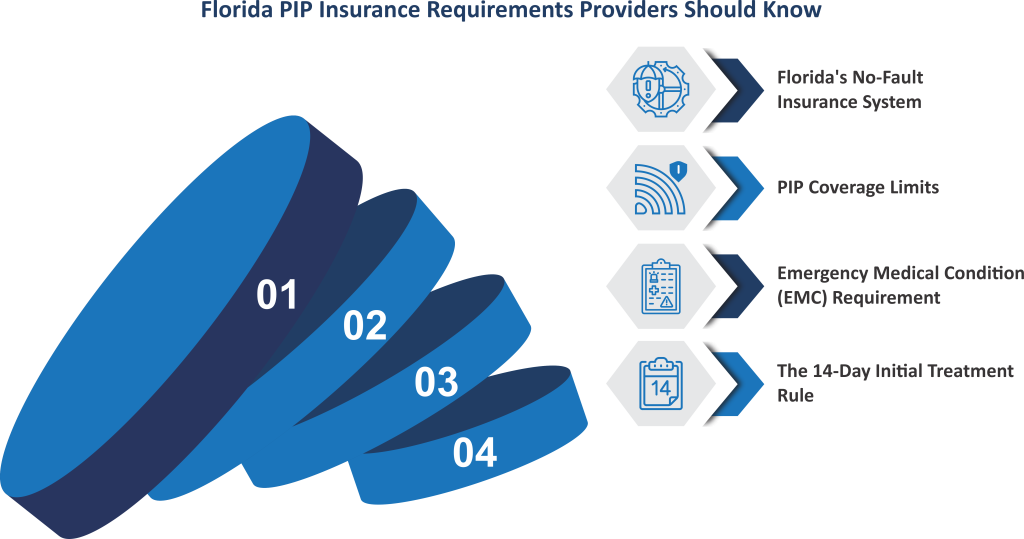
Florida PIP Insurance Requirements Providers Should Know
Florida PIP insurance requirements affect how providers document, bill, and submit claims after a motor vehicle accident. Understanding these rules helps reduce claim denials, payment delays, and compliance issues.
Florida’s No-Fault Insurance System
Florida follows a no-fault insurance system, which requires most owners of registered motor vehicles to carry $10,000 in Personal Injury Protection (PIP) and $10,000 in Property Damage Liability (PDL) coverage. PIP generally pays eligible medical expenses regardless of who caused the accident.
Providers should verify active coverage before treatment and maintain complete documentation to support reimbursement.
PIP Coverage Limits
Florida PIP generally pays 80% of eligible medical expenses and 60% of lost wages, subject to policy terms and statutory limits. Without a qualifying Emergency Medical Condition (EMC), medical benefits are generally limited to $2,500.
A documented EMC may allow access to the full $10,000 PIP medical benefit when other requirements are met.
Emergency Medical Condition (EMC) Requirement
An Emergency Medical Condition (EMC) is a clinical finding that may affect the amount of available PIP medical benefits. Florida law permits qualified healthcare professionals, including physicians (MDs and DOs), dentists, physician assistants (PAs), and advanced practice registered nurses (APRNs), to determine whether an EMC exists.
The determination should be clearly documented in the patient’s medical record.
The 14-Day Initial Treatment Rule
To qualify for Florida PIP medical benefits, an injured person generally must receive initial medical services within 14 days of the motor vehicle accident. Delayed treatment may result in the loss of PIP medical benefits.
Providers should record the accident date, first treatment date, clinical findings, and supporting documentation before submitting the claim.
Florida PIP Timely Filing Requirements
Florida PIP timely filing requirements determine whether a provider is eligible for reimbursement. Missing statutory billing deadlines may lead to unpaid claims, even when medical services are medically necessary.
How Long Do Providers Have to Bill PIP in Florida?
Florida PIP claims must be billed within the timeframes established by state law. Providers should submit claims as soon as documentation and coding are complete. Delayed billing increases the risk of payment delays, denials, and compliance issues.
35-Day Billing Requirement
After receiving treatment, providers generally should submit a completed claim or statement within 35 days of the date services are rendered to preserve reimbursement rights under Florida PIP requirements. Claims should include accurate patient information, CPT®, HCPCS, and ICD-10-CM codes, supporting documentation, and applicable modifiers when required.
Notice of Initiation of Treatment
If billing cannot be completed within the initial billing period, providers may submit a Notice of Initiation of Treatment (NIT) to notify the insurer that treatment has started. The notice should be sent within the statutory timeframe and contain the information required under Florida law. Failure to submit the notice on time may affect reimbursement eligibility.
75-Day Billing Rule
When a timely Notice of Initiation of Treatment has been submitted, providers may have up to 75 days from the date of service to furnish the completed bill and supporting documentation, as permitted by Florida PIP law. Practices should monitor billing timelines and maintain records confirming when notices and claims were sent.
Common Filing Deadline Mistakes
Common errors that delay or prevent reimbursement include:
- Missing the 35-day or applicable 75-day billing deadline
- Delaying the Notice of Initiation of Treatment
- Submitting incomplete or inaccurate documentation
- Using incorrect CPT®, HCPCS, or ICD-10-CM codes
- Failing to verify insurance information before billing
- Omitting required medical records or supporting reports
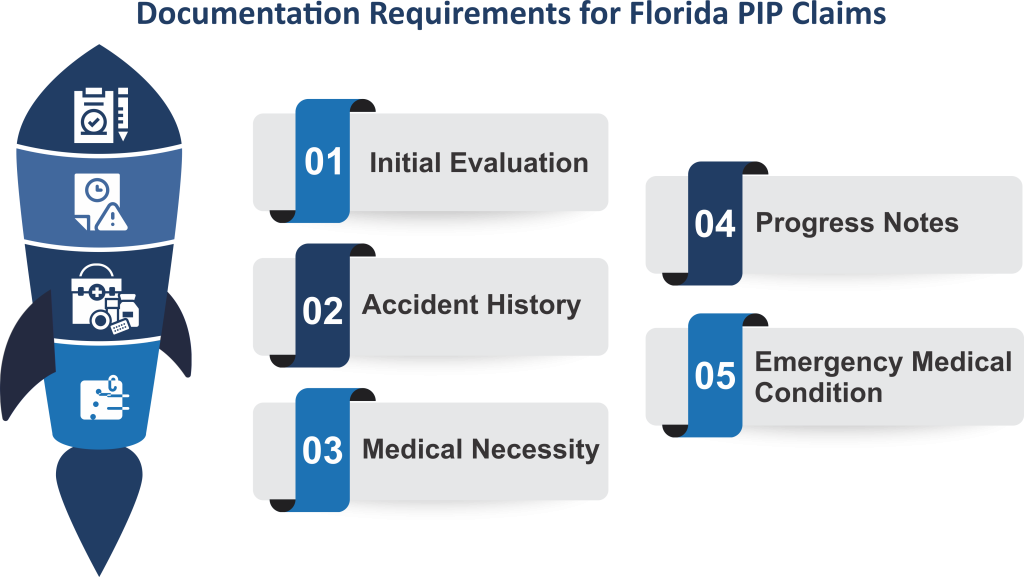
Documentation Requirements for Florida PIP Claims
Complete and accurate documentation supports Florida PIP reimbursement and helps reduce claim denials. Every medical record should clearly support the services billed, medical necessity, and the patient’s condition.
1. Initial Evaluation
The initial evaluation should record the patient’s chief complaint, accident date, injury history, physical examination findings, diagnosis, and treatment plan. Providers should also document the date of the first visit to confirm compliance with Florida’s 14-day treatment requirement.
2. Accident History
Record how the motor vehicle accident occurred, the reported symptoms, affected body areas, and any previous related injuries. Include the date, time, and mechanism of injury because these details help support medical necessity and establish a connection between the accident and the services provided.
3. Medical Necessity
Each visit should explain why the treatment was medically necessary. Clinical findings, diagnosis, patient progress, and the planned course of care should support every billed service. Florida law also allows insurers to request records and sworn statements supporting the reasonableness and medical necessity of treatment.
4. Progress Notes
Progress notes should be completed for every encounter. Document the patient’s response to treatment, changes in symptoms, objective findings, procedures performed, and recommendations for continued care. Medical records should be detailed to support the diagnosis, treatment, and clinical decision-making.
5. Emergency Medical Condition (EMC) Documentation
If an Emergency Medical Condition (EMC) is identified, the determination should be clearly documented by a qualified healthcare professional. The record should include the supporting clinical findings, diagnosis, and the provider’s assessment because EMC documentation may affect the available PIP medical benefits.
Rules for PIP Billing in Florida
Florida PIP billing follows specific statutory and documentation requirements. Following these rules helps providers submit accurate claims, reduce denials, and improve reimbursement.
1. Verify PIP Coverage Before Treatment
Confirm the patient’s active PIP coverage, policy information, accident date, and insurer details before providing non-emergency services. Early verification helps prevent billing errors and payment delays.
2. Meet the 14-Day Treatment Requirement
An injured person generally must receive initial medical services within 14 days of the motor vehicle accident to qualify for PIP medical benefits. Record the first treatment date and maintain documentation that supports timely care.
3. Submit Claims Within Required Timeframes
Providers should submit claims within the billing deadlines established under Florida PIP law. Delayed claim submission or missing required notices may result in denied or reduced reimbursement.
4. Use Accurate CPT, HCPCS, and ICD-10-CM Codes
Report services using the appropriate CPT, HCPCS Level II, and ICD-10-CM codes that match the medical record. Incorrect coding, unsupported modifiers, or diagnosis mismatches may delay claim processing or trigger denials.
5. Maintain Complete Medical Documentation
Medical records should support every billed service. Include the initial evaluation, diagnosis, treatment plan, progress notes, medical necessity, and any required Emergency Medical Condition (EMC) documentation.
6. Keep Billing and Patient Records
Maintain copies of claims, medical records, correspondence, and payment information according to applicable record retention requirements. Organized records help support payer reviews, audits, and claim appeals when needed.
How Long Do Providers Have to Bill PIP in Florida?
Florida PIP billing deadlines directly affect reimbursement eligibility. Providers should understand these time limits and submit claims promptly to avoid payment denials.
Standard Billing Timeframe
Florida Statute Section 627.736 states that providers cannot bill insurers for treatment or services rendered more than 35 days before the postmark date or the electronic transmission date of the statement of charges. Claims submitted after this deadline may be refused, unless a statutory exception applies.
Notice of Initiation of Treatment
If a provider submits a Notice of Initiation of Treatment (NIT) to the insurer within 21 days after the patient’s first examination or treatment, Florida law permits an extended billing period. Filing the notice on time helps preserve reimbursement rights when billing cannot be completed within the standard timeframe.
Extended 75-Day Billing Rule
After a timely Notice of Initiation of Treatment is submitted, the statement of charges may include treatment or services rendered up to 75 days before the claim’s postmark or electronic transmission date. This extension does not apply automatically and depends on meeting the statutory notice requirement.
Best Practices for Timely Filing
To reduce billing delays and denials:
1. Verify PIP coverage before treatment.
2. Record the accident date and first treatment date.
3. Submit the Notice of Initiation of Treatment within the required period, when applicable.
4. File complete claims with supporting medical documentation.
5. Monitor outstanding claims and respond promptly to insurer requests.
Conclusion
Accurate Florida PIP billing depends on timely claim submission, complete documentation, correct CPT, HCPCS, and ICD-10-CM coding, and compliance with state requirements. Following these guidelines helps reduce claim denials, improve reimbursement, and support efficient revenue cycle management.
Healthcare providers, medical billers, coders, and practice managers should regularly review Florida PIP billing requirements and update their workflows as regulations change. A consistent, compliant billing process improves claim accuracy, supports payer requirements, and helps practices receive appropriate reimbursement for covered services.
FAQs
What are Florida PIP billing guidelines?
Florida PIP billing guidelines are the legal and billing requirements healthcare providers must follow when submitting Personal Injury Protection (PIP) claims. They cover timely filing, documentation, coding, and reimbursement rules.
How long do providers have to bill PIP in Florida?
Under Florida law, providers generally must submit PIP claims within the applicable statutory billing deadlines. Timely filing and any required notices are essential to preserve reimbursement eligibility.
What is the Florida PIP 14-day rule?
The 14-day rule requires an injured person to receive initial medical services within 14 days of a motor vehicle accident to qualify for PIP medical benefits. Missing this deadline may result in the loss of available benefits.
What is an Emergency Medical Condition (EMC) under Florida PIP?
An Emergency Medical Condition (EMC) is a clinical determination made by a qualified healthcare professional. A documented EMC may allow eligible patients to access the full $10,000 PIP medical benefit instead of the lower benefit limit.
What documentation is required for Florida PIP claims?
Providers should maintain complete medical records, including the initial evaluation, accident history, diagnosis, treatment plan, progress notes, medical necessity, and any required EMC documentation. Accurate CPT®, HCPCS, and ICD-10-CM coding should also support every claim.