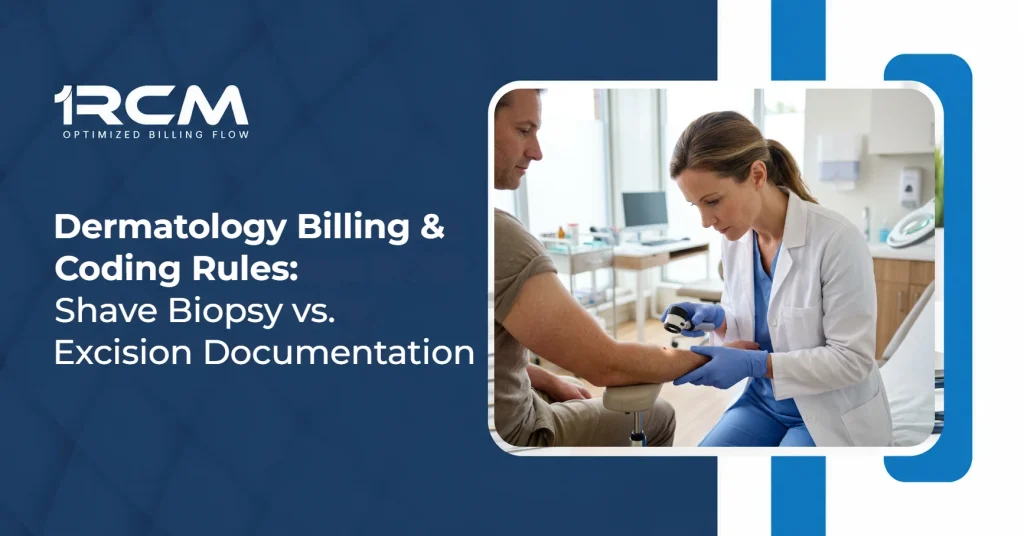
Dermatology billing and coding rules turn on one distinction: did the physician sample the lesion or remove it? A shave biopsy (CPT 11102) takes tissue for diagnosis, while an excision (benign 11400 to 11446, malignant 11600 to 11646) removes the whole lesion with margins through the full thickness of the skin. Payers treat these as different services with different payment, documentation and medical necessity standards. As a result, the intent recorded in the procedure note decides which code the claim supports.
The difference shows up on every claim line. Biopsy codes carry a 0-day global period, so a practice can bill a separate, significant E/M service the same day with modifier 25. Excision codes carry a 10-day global period, and National Correct Coding Initiative (NCCI) policy includes a same-day biopsy of the same lesion in the excision. This guide covers code selection, margin measurement, pathology linkage and the documentation that keeps each line payable.
Key Takeaways on Dermatology Billing and Coding Rules
- Intent decides the code: diagnostic sampling is a biopsy, while complete removal is a shave removal or an excision.
- Size an excision by the excised diameter: the lesion plus twice the narrowest margin.
- Choose the benign or malignant excision family only after the pathology report comes back.
- Do not bill a biopsy of a lesion you remove at the same visit.
- Modifier 25 holds only when the E/M is significant and separately documented.
Shave Biopsy vs. Lesion Excision Coding: Intent Decides the Code
Under dermatology billing and coding rules, the CPT code set separates skin sampling from lesion removal by intent, not by instrument. Tangential biopsies use 11102 for the first lesion and 11103 for each additional lesion. They include shave, saucerization and curettage techniques that remove a sample for diagnosis. Shave removals (11300 to 11313) remove a benign lesion completely for therapeutic reasons, even though the blade technique looks similar. Excisions cut through the full thickness of the skin and remove the lesion with margins.
Three dermatology billing and coding rules follow from this structure:
- One lesion, one family. A biopsy and a shave removal of the same lesion on the same date are not both billed. Under NCCI policy, the removal includes any tissue taken from the same lesion at that visit.
- Code the completed procedure. If a procedure starts as one method and becomes another, report only the code for the finished procedure. For example, if a tangential biopsy becomes a full excision, report the excision alone.
- Bill different lesions separately. A biopsy of a different lesion in the same session is reportable, as long as the note identifies each lesion.
CPT 11102 Shave Biopsy Documentation Rules
A payable 11102 line needs a note that meets dermatology billing and coding rules and answers an auditor’s questions. First, identify the lesion by anatomic site. Then describe the technique as tangential (shave, saucerization or curettage), record the lesion’s clinical size, state that the purpose was diagnosis, and confirm that the specimen went to pathology.
Because 11102 is the primary code and 11103 is the add-on for each additional biopsy, the note must make each lesion separately identifiable by site and appearance. Otherwise, the additional lines will not survive review. Local anesthesia and simple hemostasis are part of every biopsy and are never billed separately.
Watch the intent language. When a physician shaves a lesion to remove it completely, the correct family is 11300 to 11313, not the biopsy codes, and the note should say so.
Benign vs. Malignant Lesion Excision Margin Measurement
Under dermatology billing and coding rules, you size an excision code by the excised diameter: the lesion’s greatest clinical diameter plus twice the narrowest margin, measured before the excision. For example, a 1.2 cm lesion on the back removed with a 0.2 cm margin is a 1.6 cm excision (1.2 + 0.2 + 0.2). That places it in the 1.1 to 2.0 cm band, so the code is 11402 if benign or 11602 if malignant. The pathology report’s specimen measurements do not change the size.
Benign versus malignant, however, does come from pathology. Code the excision after the pathology report returns, so the family matches the final diagnosis. Until then, the note should still record the clinical suspicion that justified removing the lesion.
Dermatology Excision Coding Rules at a Glance
| Code family | Lesion type | Anatomic site | Size bands |
|---|---|---|---|
| 11400 to 11406 | Benign | Trunk, arms, legs | 0.5 cm or less, 0.6–1.0, 1.1–2.0, 2.1–3.0, 3.1–4.0, over 4.0 cm |
| 11420 to 11426 | Benign | Scalp, neck, hands, feet, genitalia | Same bands |
| 11440 to 11446 | Benign | Face, ears, eyelids, nose, lips, mucous membrane | Same bands |
| 11600 to 11646 | Malignant | Same three site groups (11600, 11620, 11640 series) | Same bands |
| 11102 / 11103 | Tangential biopsy | Any site | No size criterion |
| 11300 to 11313 | Shave removal | By site | By lesion diameter |
The most common excision documentation gap is a size note without the margins. Record the lesion diameter, the narrowest margin and the resulting excised diameter, in that order, so the code is visible on the page. For more detail, see our guide to benign lesion excision CPT codes.
Dermatology Same Day E/M Modifier 25
Few dermatology billing and coding rules draw more audits than modifier 25. An E/M service on the same day as a skin procedure is billable only when it is significant and separately identifiable. Modifier 25 signals that. The E/M needs its own documentation of medical decision making or total time that goes beyond deciding to perform the procedure. Since the 2021 E/M changes, practices level office visits by medical decision making or time, so document one of those on its own terms.
Global periods shape the decision. Biopsies carry 0-day globals, so a same-day E/M is possible, but only if the visit addressed more than the lesion being sampled. Excisions carry 10-day globals, and routine preoperative evaluation is part of the procedure payment. In both cases, an E/M for a different problem, such as a rash or medication management, is the clearest support. If modifier 25 keeps drawing audits, a coding review from dermatology billing services can flag overuse and underuse before payers do.
Dermatology Medical Necessity Documentation for Billing and Coding
Medical necessity is where dermatology billing and coding rules meet clinical judgment. It rests on what the record says about the lesion: color, border, size and change over time. Then the note explains which procedure the physician chose and why, with an ICD-10-CM code that matches that reasoning. A biopsy of a changing or suspicious lesion rarely draws questions. By contrast, removal of a benign-looking lesion is where payers look harder.
Many Medicare Administrative Contractor (MAC) policies list the findings they expect for benign lesion removal, such as bleeding, rapid growth, irritation or symptoms that interfere with function. Write that justification at the time of service, not in an appeal later. Payer policies differ and change, so the record should stand on its own.
Dermatopathology Report Cross Referencing
Dermatology billing and coding rules treat the biopsy claim and the pathology claim as two services linked by one specimen. Pathologists usually report skin specimens with surgical pathology code 88305. The pathologist bills the professional component with modifier 26, and the lab bills the technical component with modifier TC, unless one entity bills globally.
Cross referencing closes the diagnosis loop. Use the same specimen label on the procedure note and the requisition, so each report matches its lesion. When the report returns, later claims should reflect the confirmed diagnosis. Payers expect a biopsy billed with a sign or symptom code, followed by an excision billed with the confirmed diagnosis. An excision note that cites the earlier biopsy date and result is also easier to defend when a payer questions medical necessity.
Multiple Lesion Excision Billing Guidelines
Practices bill multiple lesions in one session per lesion, but the mechanics differ by code family. Biopsies use a true add-on structure: 11102 for the first lesion and 11103 for each additional one, with no modifier on the add-on. Excisions follow multiple-procedure payment rules: payers pay the highest-valued excision in full and reduce the others. Medicare applies the reduction itself, while some commercial payers still require modifier 51 on the secondary lines.
The note carries the weight. Each lesion needs its own site, size, technique and outcome, so the coder can map one code to one lesion. A summary such as “several lesions treated” gives no basis for the additional lines.
Dermatology Billing and Coding Rules for Multiple Procedures
| Same-session scenario | Code structure | Modifier |
|---|---|---|
| Three lesions biopsied by tangential technique | 11102 plus 11103 x2 | None on the add-ons |
| Two benign excisions | Higher-valued excision code plus the second code | 51 only if the payer requires it |
| Biopsy plus destruction on different lesions | Biopsy code plus destruction code | 59 or XS where an edit applies |
| Biopsy plus excision of the same lesion | Excision code only | None; the excision includes the biopsy |
Dermatology Claim Rejection Reasons and Fixes
Most skin lesion denials come from breaking a few dermatology billing and coding rules on documentation and pairing:
- Not medically necessary: the claim lacked the lesion findings the payer’s policy requires. Fix it by documenting the findings at the visit.
- Bundling: the claim billed a biopsy and a removal of the same lesion together. Fix it by reporting only the completed procedure.
- Wrong excision size: the coder sized the code from the lesion alone. Fix it by adding twice the narrowest margin.
- Modifier errors: a same-day E/M without modifier 25, or modifier 59 used without a separate lesion. Fix it with lesion-specific notes.
Fix all of these before the claim goes out, not after. Clear notes on size, site, margin and intent, plus a coding check that maps each lesion to a code, stop most rejections. Our denial management services can help when they still come back.
Dermatology Billing and Coding Rules That Hold Up in Audit
Put together, these dermatology billing and coding rules fit on one card. Every lesion procedure note records the site, size, technique and intent. Excision notes add the narrowest margin and the excised diameter. Each specimen has a label that matches its pathology report. Then the coder selects the family the intent names, sizes the excision correctly, waits for pathology on excisions, and applies the NCCI same-lesion and multiple-lesion rules.
CMS updates the NCCI edits every quarter. Check current pairs on the CMS NCCI edits page, and review global period rules in the CMS Global Surgery booklet.
Conclusion: Applying Dermatology Billing and Coding Rules
Dermatology billing and coding rules reward practices that document intent precisely. A shave biopsy tells the payer that diagnosis was the goal. An excision tells the payer that the lesion and its margins came out together. When the note states which happened, records the sizes the codes require, and links the pathology report, coding follows the record instead of becoming an argument after a denial.
Need Help With Dermatology Coding?
ORCM’s coders review biopsy, shave removal and excision notes against current CPT and NCCI rules before claims go out. We also manage modifier 25 support and pathology linkage, and appeal the denials that slip through.
Explore ORCM’s dermatology billing services or our broader medical billing and RCM support.
Frequently Asked Questions
No. Under NCCI policy, the removal of a lesion includes its same-visit biopsy, so report only the excision. You can bill a biopsy of a different lesion in the same session separately.
No. The size comes from the clinical measurement before excision: the greatest lesion diameter plus twice the narrowest margin. However, the pathology diagnosis decides whether the benign or malignant code family applies.
Only when the E/M is significant and separately identifiable. The note should show its own medical decision making, such as evaluation of a different problem, not just the decision to biopsy.
The shave removal family, 11300 to 11313, not the biopsy codes. The intent stated in the note decides between the two.
Payers pay the highest-valued excision in full and reduce the others under multiple-procedure rules. Medicare applies the reduction itself, and some commercial payers require modifier 51. Each lesion still needs its own documentation.