
In a healthcare environment, even small inefficiencies in medical billing can lead to delayed payments, revenue leakage, and unnecessary administrative burden. One of the most common and costly areas of confusion for providers and billing teams is the difference between delegated and non-delegated credentialing.
Have you ever thought about why a provider engaged three months ago may still not be seeing patients, and whether that delay is costing your practice money? In 2026, research of more than 580 healthcare leaders revealed that 69% of hospitals and provider groups reported losing $1,000–$5,000 per provider per day due to credentialing constraints that slowed enrollment and patient treatment. Many organizations claim annual losses of more than $1 million due to weak credentialing architectures.
Delegated credentialing becomes a critical structural liability when accountability is misunderstood. Many healthcare organizations believe that when credentialing tasks are outsourced, the underlying risk and regulatory oversight also move. This false assumption causes compliance gaps, National Practitioner Data Bank (NPDB) breaches, payer audits, and delayed or rejected claims.
According to a 2026 industry survey, approximately one-third of firms attribute 25–50% of denials directly to payer registration problems, highlighting the massive impact of inefficient credentialing on revenue cycles and billing performance.
A detailed breakdown is needed for providers, credentialing specialists, and billing teams to understand delegated credentialing, its differences from non-delegated models, and where liability is legally fixed. This guide explains the contrasts, demonstrates how they impact compliance and revenue cycle outcomes, and highlights where delegated credentialing improves operational efficiency while introducing specific financial and regulatory risks.
What Is Delegated Credentialing?
This section explains what delegated credentialing is, its regulatory basis, and where accountability resides. You will understand authority transfer, NPDB rules, and legal exposure.
Definition and Authority Transfer
Delegated credentialing occurs when one healthcare entity gives another entity the authority to carry out provider credentialing tasks. The delegated entity verifies professional qualifications, state licensing, board certifications, work history, sanctions, and other critical credentialing data. The intent is to shorten approval time and accelerate payer enrollment.
The delegating organization signs a formal agreement that defines exactly what tasks are transferred and what obligations remain. This authority transfer directly affects reporting, oversight, and decision documentation.
Regulatory Foundation and NPDB Rules
The National Practitioner Data Bank (NPDB) establishes strict guidelines for delegated credentialing activity. Only the entity with ultimate credentialing authority may query the NPDB and use the results for decision-making.
- A delegating payer cannot receive NPDB responses from a query run under delegation.
- Hospitals or provider groups acting as delegates must submit NPDB queries themselves or through an authorized agent.
- Any attempt to share NPDB data outside the direct credentialing decision pathway violates federal policy and may trigger severe audit findings.
Credentialing, Accountability, and Legal Exposure
Delegated credentialing transfers operational tasks but does not transfer ultimate legal responsibility. The delegating entity remains accountable for compliance with payer agreements, standards from the National Committee for Quality Assurance (NCQA), and CMS audit outcomes.
Failure to meet verification requirements or reporting timelines can result in immediate delegation loss, contracted financial penalties, or provider network disruptions. Credentialing and billing staff must maintain complete documentation and align credentialing files with payer and regulatory timelines to protect revenue and legal standing.
Delegated Credentialing vs. Non-Delegated Credentialing
This section compares delegated and non-delegated credentialing. It highlights operational differences, responsibilities, and the impact on provider onboarding, billing, and compliance.
Delegated Credentialing
Delegated credentialing allows a healthcare organization to transfer credentialing tasks to a qualified entity. The delegated entity verifies licenses, board certifications, work and malpractice history, and other professional credentials. The process shortens approval timelines and enables providers to join payer networks faster. Responsibilities and reporting requirements are clearly defined in a delegated credentialing agreement. This arrangement reduces administrative workload for payers and accelerates revenue cycle processes.
- Primary Verification: The delegated entity performs primary source verification.
- Enrollment: Provider enrollment can occur in bulk.
- Liability: The delegating entity remains legally responsible for compliance.
- Timeline: Timelines are generally faster, often completed within 4–6 weeks.
Non-Delegated Credentialing
Non-delegated credentialing occurs when the payer manages the entire credentialing process. Providers submit credentials individually to the insurer. This method is common for smaller practices with limited staff or infrastructure. Approval and network inclusion timelines are longer, often 90–120 days. This increases risk for claim delays and impacts cash flow. Administrative work remains with the payer, but providers may face repeated verification requests if they work with multiple payers.
- Primary Verification: Payer conducts all credentialing and verification.
- Timeline: Processing times are slower, typically exceeding 90 days.
- Enrollment: Limited administrative responsibility for providers, but revenue may be delayed.
- Liability: Compliance is managed entirely by the payer.
Key Differences Between Delegated and Non-Delegated Credentialing
Here are the key factors that differentiate the delegated and non-delegated credentialing.
| Factor | Delegated Credentialing | Non-Delegated Credentialing |
| Authority | The delegated entity conducts verification | Payer performs verification |
| Timeline | Faster, often 4–6 weeks | Slower, 90–120 days |
| Accountability | Delegating entity responsible for compliance | Payer responsible |
| Administrative Load | Reduced for payers, increased for delegated entity | Minimal for providers, high for payers |
| Revenue Impact | Accelerates claims and reimbursement | Potential delays in billing and collections |
The Delegated Credentialing Workflow
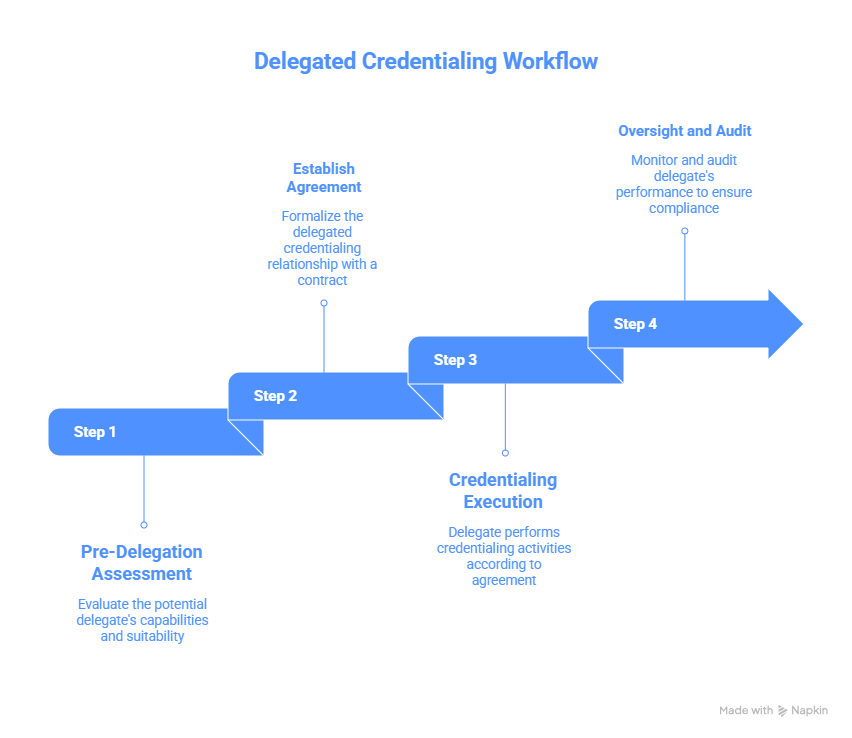
The following step-by-step workflow maps the operational timeline for delegated credentialing, detailing tasks, responsibilities, and timelines to ensure compliance and faster provider enrollment.
Step 1: Pre-Delegation Assessment
Internal Systems & Policy Audit
Before any delegation occurs, healthcare organizations must audit their internal policies and systems. Evaluate staffing, credentialing software, and primary source verification procedures against NCQA, CMS, or payer standards. Identifying gaps early ensures the organization meets baseline regulatory requirements and can handle delegated tasks without audit risks.
Step 2: Establish Delegated Credentialing Agreement
Contractual Enforcements
A formal, written agreement must be active before delegation begins. The agreement clearly defines exact tasks, reporting schedules, data-sharing protocols, audit requirements, and compliance expectations. Both delegating and delegated entities must execute the contract to enforce regulatory accountability.
Step 3: Credentialing Execution
Primary Source Verification
The delegated entity conducts deep verification for provider licensure, DEA registration, board certifications, work and malpractice history, and hospital affiliations. All data is cross-verified directly against primary sources. The delegated entity then packages and submits provider rosters and credentialing reports to the delegating organization and payers within agreed intervals.
Step 4: Oversight and Audit
Continuous Compliance Monitoring
Because the delegating organization remains ultimately responsible for compliance, annual oversight audits by NCQA, CMS, or payers are conducted to verify strict adherence to credentialing standards. Discrepancies must be addressed promptly via corrective action plans to prevent provider network suspension and reimbursement delays.
Compliance Risks in Delegated Credentialing
This section highlights the key compliance risks associated with delegated credentialing. It explains how errors can impact audits, revenue, and provider liability.
Regulatory Compliance Challenges
Delegated credentialing shifts operational responsibility to the provider organization, but oversight remains critical. Failure to tightly follow NCQA, CMS, or payer rules can trigger severe fines, extensive audits, or frozen reimbursements.
- Non-compliance with NCQA or CMS guidelines exponentially increases audit risk.
- Inaccurate provider demographic data leads to systematic claim denials.
- Missing active licensure or DEA verification exposes the entity to direct legal liability.
Audit and Reporting Obligations
Delegated entities must maintain accurate documentation and submit reports on time. Delayed or incomplete reporting can result in financial penalties, contract terminations, and delayed provider onboarding.
- Maintain comprehensive, unalterable credentialing logs for all providers.
- Submit timely, encrypted provider roster reports to payers and delegating entities.
- Track ongoing audit findings and immediately implement documented corrective actions.
Legal Exposure and Liability
Even when tasks are delegated, the contracting healthcare organization retains ultimate responsibility. Mistakes in credentialing can lead to legal action, reimbursement disputes, or regulatory penalties.
- The delegating organization remains fully accountable for credentialing omissions or background verification errors.
- Legal disputes can arise from improper verification of provider qualifications or malpractice histories.
- All delegated staff must be thoroughly trained and continuously aware of evolving compliance standards.
Impact on Medical Billing and Revenue Cycle
This section explains how delegated credentialing affects billing workflows and revenue cycle management. Proper implementation reduces claim delays and protects cash flow.
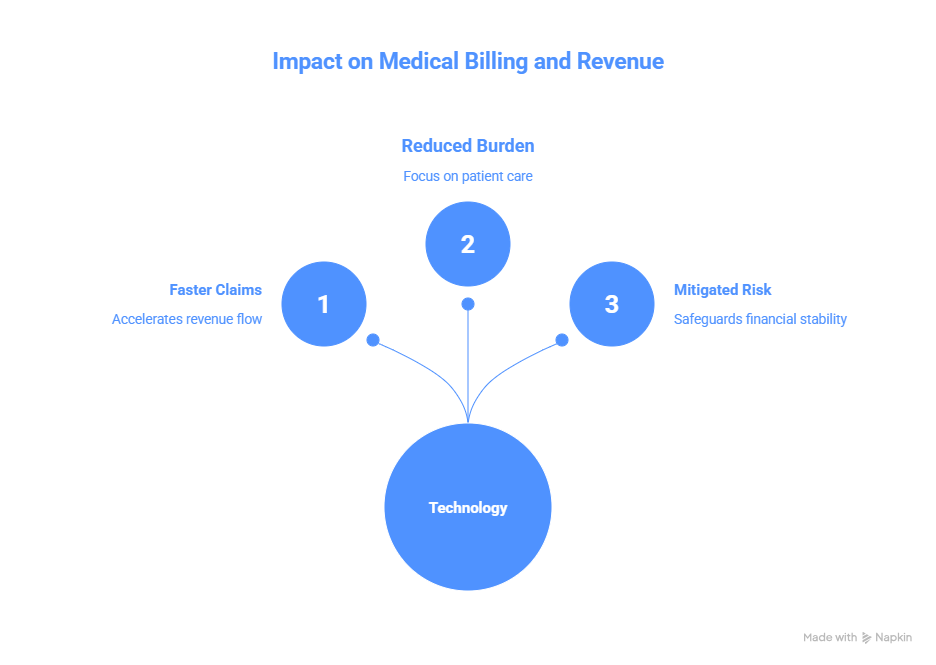
Faster Claims Processing
Delegated credentialing accelerates provider enrollment, ensuring claims are submitted with verified credentials. This reduces the risk of initial denials and speeds up reimbursements.
- Immediate Submission: Verified provider data allows immediate claim submission post-service.
- Denial Reduction: Significantly reduces rejected claims due to “Provider Not Credentialed” errors.
- Velocity: Supports timely payer adjudication and faster payment posting cycles.
Reduced Administrative Burden
By delegating credentialing tasks, organizations can focus resources on front-end billing, coding accuracy, and accounts receivable collections instead of primary source verification work.
- Eliminates duplicate data entry for billing and scheduling staff.
- Reduces payer follow-ups regarding credential verification delays.
- Allows revenue cycle teams to prioritize aging accounts receivable management.
Mitigating Financial Risk
Errors in credentialing directly impact revenue. Structured Revenue Cycle Management Services help reduce denials and maintain reimbursement consistency. Delegated credentialing with proper oversight reduces compliance risks, minimizes claim denials, and secures consistent revenue flow.
- Prevents severe revenue loss from delayed provider panel approvals.
- Reduces exposure to retroactive payer audits and reimbursement clawbacks.
- Improves financial reporting accuracy and cash flow predictability.
When Delegated Credentialing Is Appropriate
This section highlights the scenarios where delegated credentialing provides real operational value, helping organizations reduce delays, optimize workflows, and improve compliance.
Large Healthcare Systems and Hospitals
Delegated credentialing is highly effective for hospitals, large groups, and multi-provider health systems that manage high volumes of providers.
- Supports faster onboarding for dozens or hundreds of providers simultaneously.
- Reduces duplicate credentialing checks across multiple internal departments.
- Allows specialized internal teams to focus strictly on overall quality and compliance oversight.
Organizations with Adequate Resources
Delegated credentialing requires significant infrastructure and personnel for continuous audits, compliance tracking, and reporting.
- Internal teams must monitor delegated entities and ensure secure, compliant NPDB checks.
- Credentialing software and standardized databases are required to maintain accuracy.
- It is best suited for practices that can sustain ongoing oversight obligations without strained overhead.
Network Expansion and Timely Reimbursement Needs
When rapid enrollment and faster revenue flow are top organizational priorities, delegation is a clear strategic advantage.
- Speeds provider approval for major commercial and government insurance panels.
- Minimizes initial claim denials resulting from incomplete credentialing records.
- Ensures clean revenue cycle efficiency and lowers days in accounts receivable (AR).
Conclusion
When used with clear monitoring and compliance controls, delegated credentialing can greatly speed up provider onboarding and improve revenue cycle performance. Healthcare companies can lower claim denials and safeguard financial stability by coordinating their resources, auditing procedures, and delegated agreements.
Credentialing professionals, billing teams, and administrators can distribute tasks efficiently by knowing the operational differences between delegated and non-delegated credentialing. Effective management promotes timely patient treatment and effective revenue flow while guaranteeing strict adherence to NPDB, NCQA, and payer standards.
FAQs
What is delegated credentialing in healthcare?
Delegated credentialing allows a healthcare entity to assign another organization or specialized group to verify provider qualifications. Crucially, the delegating entity always remains legally responsible for ultimate compliance.
How does delegated credentialing differ from non-delegated credentialing?
Delegated credentialing transfers the administrative verification tasks to a third party or internal system to shorten enrollment timelines to 4–6 weeks. Non-delegated credentialing is handled completely by the payer, often taking 90–120 days.
What compliance risks exist in delegated credentialing?
Mistakes in primary source verification, improper NPDB data-sharing, or missed reporting deadlines can trigger massive audits and immediate claim denials. Delegating entities retain ultimate legal and financial liability.
How does delegated credentialing impact medical billing and the revenue cycle?
Proper delegated credentialing ensures accurate, rapid provider data configuration for clean claims submission. This reduces initial denials, accelerates payer reimbursement, and stabilizes cash flow.
When is delegated credentialing appropriate for a healthcare organization?
It is highly appropriate for large medical networks, hospitals, or organizations with sufficient administrative resources to execute consistent compliance oversight and manage reporting workloads.