
Unexpected medical bills are one of the biggest concerns for Medicare patients. Many assume Medicare will cover every recommended service, until a claim is denied and the financial burden falls on them. This is exactly where the Advance Beneficiary Notice of Non-coverage (ABN) becomes essential.
An ABN is a written notice given before treatment when a provider believes Medicare may not pay for a service. It informs the patient of potential out-of-pocket costs and allows them to decide whether to proceed, refuse the service, or explore alternative options. In short, it protects patients from surprise expenses while helping providers stay compliant with Medicare billing rules.
If you work in medical billing, provide healthcare services, or are a Medicare beneficiary, understanding ABNs is critical. This guide explains what an ABN is, when it must be signed, why it matters, and how it helps prevent costly misunderstandings, so patients can make informed decisions and providers can avoid claim disputes.
What Is an Advance Beneficiary Notice (ABN)?
An Advance Beneficiary Notice of Non-coverage (ABN) is a written notice given to patients enrolled in Original Medicare before providing services that Medicare may not pay for. This standardized form alerts beneficiaries that they could be financially responsible if Medicare denies the claim.
The ABN ensures transparency in healthcare billing by informing patients about potential costs before receiving care. It also gives them the freedom to decide whether to proceed with the service.
Healthcare providers use the official CMS-R-131 form to issue ABNs when they believe Medicare will likely deny payment due to medical necessity rules, frequency limits, or coverage restrictions.
An ABN becomes valid only when it is reviewed and signed appropriately. The document is signed by:
- The Medicare beneficiary (patient)
- A legal representative (if the patient is unable to sign)
- The healthcare provider or authorized staff member
By signing, the patient acknowledges they understand that Medicare may not cover the service and that they may be responsible for payment.
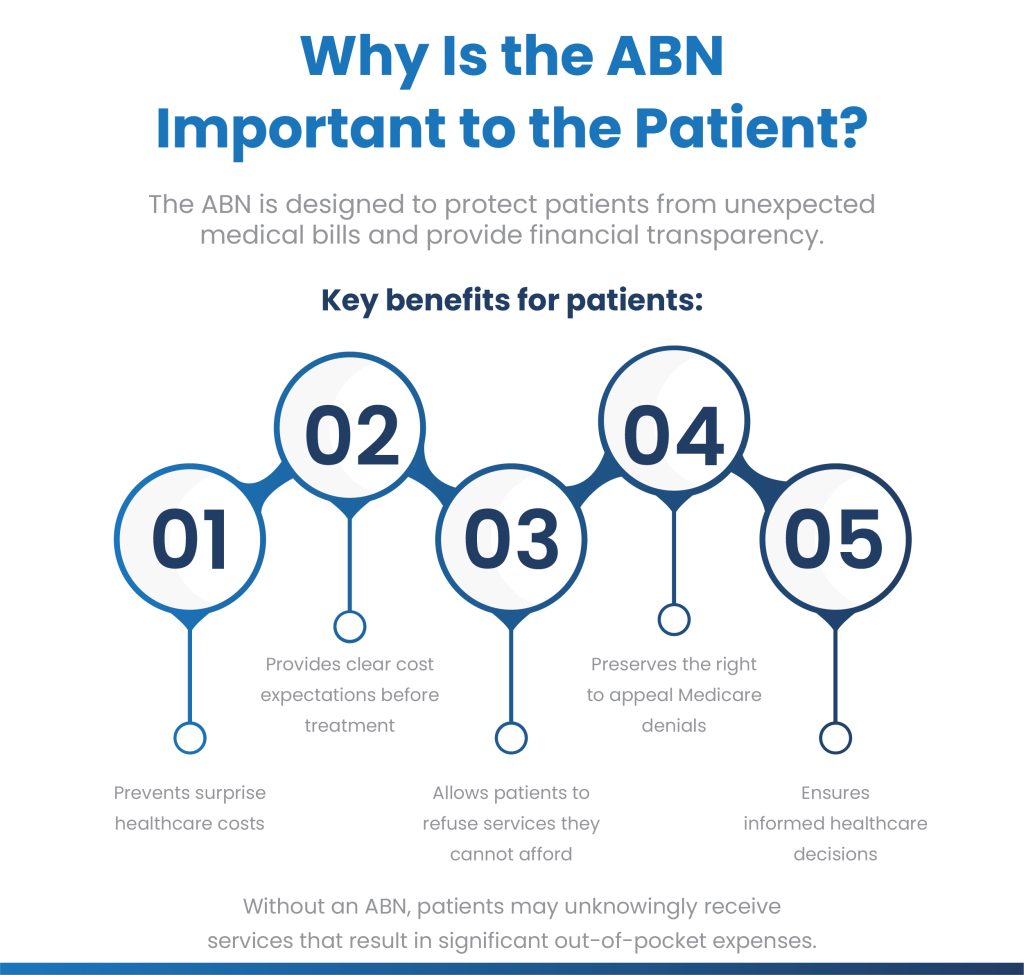
Why Is the ABN Important to the Patient?
The ABN is designed to protect patients from unexpected medical bills and provide financial transparency.
Key benefits for patients:
✔ Prevents surprise healthcare costs
✔ Provides clear cost expectations before treatment
✔ Allows patients to refuse services they cannot afford
✔ Preserves the right to appeal Medicare denials
✔ Ensures informed healthcare decisions
Without an ABN, patients may unknowingly receive services that result in significant out-of-pocket expenses.
When Should an ABN Be Signed?
An ABN must be signed before the service is provided and early enough for the patient to make an informed decision.
Providers should never issue an ABN after treatment, as it becomes invalid and cannot transfer financial responsibility to the patient.
An ABN should be issued when:
- Medicare may deny the service
- The service may not be medically necessary
- Frequency limits have been exceeded
- Coverage criteria are not met
- Services are considered custodial care
Providing the ABN in advance ensures compliance and protects both the patient and the provider.
Medicare ABN Rules
Medicare has strict guidelines governing the use of ABNs. Failure to follow these rules may result in claim denials or provider financial liability.
Core Medicare ABN Rules
✔ Must be provided before delivering the service
✔ Must clearly explain why Medicare may deny payment
✔ Must include an estimated cost of the service
✔ Must use the current CMS-approved ABN form
✔ Must allow the patient time to consider options
Important compliance notes:
- ABNs cannot be issued routinely to every patient
- Verbal notices alone are not valid
- Blank or incomplete forms invalidate liability transfer
- ABNs apply only to Original Medicare, not Medicare Advantage plans
Following these rules ensures legal compliance and protects reimbursement.
ABN Requirements for Medicare
For an ABN to be considered valid, it must contain specific required elements.
Required components:
✔ Patient’s name
✔ Description of the service or item
✔ Reason Medicare may deny coverage
✔ Estimated cost the patient may owe
✔ Patient options and selection
✔ Signature and date
✔ Provider or facility information
Providers must review the form with the patient and ensure they understand the information before signing.
When Is an Advance Beneficiary Notice Required?
An ABN is required when a provider believes Medicare is likely to deny payment for a service.
Common situations requiring an ABN include:
- Services lacking medical necessity
- Experimental or investigational treatments
- Services exceeding Medicare coverage limits
- Custodial or non-skilled care
- Home health or hospice eligibility issues
Issuing an ABN in these scenarios allows patients to decide whether to proceed with potential financial responsibility.
Services That Require an ABN for Medicare
Certain services frequently require an ABN because they may not meet Medicare coverage criteria.
Common examples include:
- Laboratory tests are not considered medically necessary
- Therapy sessions exceeding annual limits
- Durable medical equipment is not covered
- Preventive services are performed too frequently
- Non-covered home health services
Providers should evaluate coverage criteria carefully before issuing an ABN.
Which Patient Would Most Likely Be Asked to Sign an ABN?
Not every Medicare patient needs to sign an ABN. The notice is typically required when there is a strong possibility that Medicare will deny coverage.
Patients most likely to be asked to sign an ABN include:
✔ Medicare beneficiaries receiving services beyond coverage limits
✔ Patients requesting services not considered medically necessary
✔ Individuals seeking preventive services more frequently than allowed
✔ Patients receiving durable medical equipment that may not qualify
✔ Hospice or home health patients who do not meet eligibility criteria
Issuing an ABN in these situations ensures patients understand their potential financial responsibility before care is provided.
IF A Medicare Patient Receives Treatment That Isn’t Covered by Medicare
When Medicare denies payment for a service, what happens next depends on whether an ABN was signed.
If an ABN was signed:
- The patient chose to receive the service despite possible non-coverage
- The provider may submit the claim to Medicare
- If Medicare denies payment, the patient becomes responsible for the cost
- The patient retains the right to appeal the denial
If an ABN was NOT issued when required:
- The provider may be financially responsible
- The patient may not be billed for the denied service
This highlights why ABNs are critical for both compliance and financial clarity.
When an ABN Is NOT Required?
There are situations where an ABN is not mandatory.
ABNs are generally NOT required for:
❌ Services that Medicare never covers
❌ Emergency or urgent care services
❌ Patients enrolled in Medicare Advantage plans
❌ Services expected to be covered
However, providers may issue a voluntary notice as a courtesy to inform patients about potential costs for non-covered services.
How to Explain ABN to Patients?
Many patients feel anxious when presented with an ABN. Clear communication helps them understand the purpose and make confident decisions.
“Medicare may not cover this service. This notice explains the possible cost and allows you to decide whether you want to receive the service and pay if Medicare denies it.”
Best practices for providers:
✔ Use plain, non-technical language
✔ Clearly explain the estimated cost
✔ Give patients time to consider their options
✔ Encourage questions
✔ Avoid pressuring the patient
Effective communication builds trust and prevents misunderstandings. Many practices strengthen patient communication and reimbursement accuracy by integrating standardized workflows through professional Medical Billing Services.
Advance Beneficiary Notice of Non-Coverage vs Other Medicare Notices
Medicare uses several notices to communicate coverage decisions. The ABN is often confused with other forms.
| Notice | Purpose |
| ABN | Warns that Medicare may not cover a service |
| NOMNC | Notifies patients that services are ending |
| SNFABN | Informs of non-coverage in skilled nursing facilities |
| HINN | Hospital notice of non-coverage |
Understanding these differences helps ensure proper compliance and patient communication.
Common ABN Mistakes to Avoid
Improper use of ABNs can lead to compliance issues and financial liability. Regular claim reviews and structured Denial Management Services can help providers identify recurring Medicare documentation issues before they result in payment disputes.
Common mistakes include:
❌ Issuing the ABN after the service is provided
❌ Failing to include a cost estimate
❌ Using outdated forms
❌ Asking every patient to sign routinely
❌ Not explaining the form to the patient
❌ Leaving sections incomplete
Avoiding these errors ensures the ABN remains valid and enforceable.
Final Verdict
An Advance Beneficiary Notice of Non-coverage (ABN) is essential for both Medicare patients and healthcare providers. This simple yet powerful document ensures transparency by informing patients when a service may not be covered and giving them the choice to proceed or decline care.
When used correctly, ABNs prevent unexpected medical bills, support informed decision-making, and protect providers from billing disputes. By following Medicare guidelines and clearly communicating with patients, providers can build trust while maintaining compliance and financial clarity.
FAQs
Q: Is an ABN required for every Medicare patient?
Ans: No. It is only required when Medicare payment is expected to be denied.
Q: Can a patient refuse to sign an ABN?
Ans: Yes. The provider may decline to provide the service or proceed with a witness signature.
Q: Can a provider bill a patient without an ABN?
Ans: Only if the service is never covered by Medicare. Otherwise, the provider may be financially responsible.
Q: Does signing an ABN guarantee Medicare will deny payment?
Ans: No. It only notifies the patient of possible denial and transfers financial responsibility if denied.
Q: Can ABNs be used for private insurance patients?
Ans: No. ABNs apply only to Original Medicare beneficiaries.