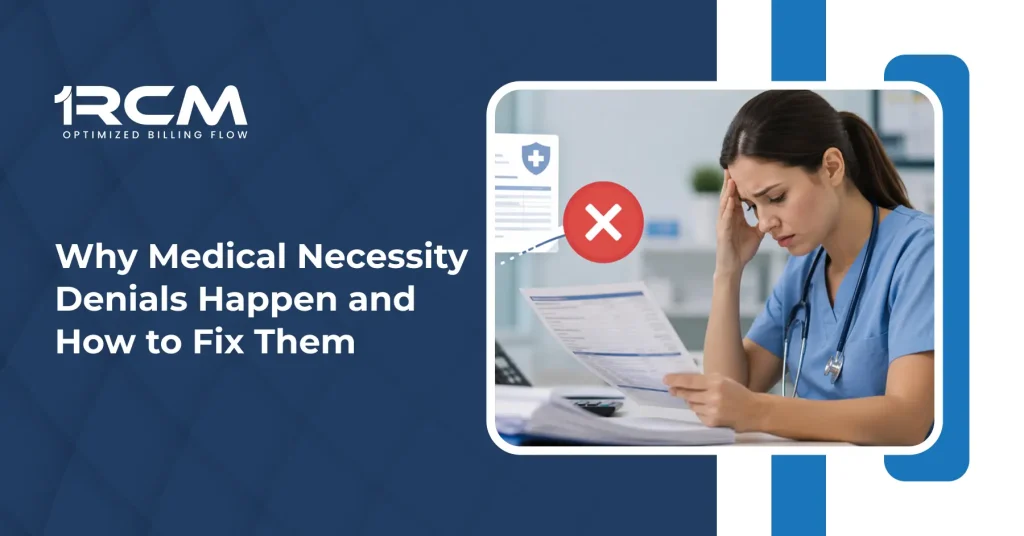
Why would a payer decide your care was unnecessary when the chart explains exactly why the patient needed it?
Because most medical necessity denials are not really about the care. They are about proof. The payer concludes the service was not reasonable and necessary for that patient. The claim comes back on the remittance as a “not medical necessity” denial, coded CO 50.
Medicare’s own standard is simple. Care must be needed to diagnose or treat the condition. It must meet accepted standards of practice. And it must not exist mainly for anyone’s convenience. Most come from documentation gaps, not from real gaps in clinical need. That makes medical necessity denials the most contestable denials in revenue cycle management.
This article covers the codes, the first decision on every denial, and the prevention standards. It explains how to fix medical necessity denials through both Medicare appeal processes, with deadlines current for 2026.
Why These Denials Keep Rising in 2026
The volume keeps climbing. Change Healthcare’s Revenue Cycle Denials Index put the initial denial rate at 11.8% of claims in 2024. The 2020 baseline was 10.2%. The same index puts first-submission denials at roughly $262 billion a year. That figure is money in motion, not money lost. Premier’s national survey found hospitals spent $25.7 billion working through denied claims in 2023. That was up 23% in a single year. The average administrative cost per denied claim reached $57.23.
Two forces drive the rise in medical necessity denials. The first is payer policy churn. More than 100,000 payer policy and reimbursement changes landed between March 2020 and March 2022 alone. That churn has continued ever since. The second is heavier utilization review. The American Medical Association’s 2025 survey found each physician now handles about 40 prior authorization requests a week. That work consumes roughly 13 hours of physician and staff time.
The spread between payers matters as much as the average. KFF reviewed 2023 marketplace data. In-network denial rates ranged from 1% to 54% by insurer. Florida’s insurers spanned 8% to 54%, the widest spread of any state. Two practices in the same city can face very different denial realities. Industry surveys put the share of denied claims never reworked at 50 to 65%. KFF found that fewer than 1% of denied claims are appealed at all. When appeals were filed, insurers upheld the original denial 56% of the time. The rest were overturned.
The Denial Codes That Matter Most
Payers speak in Claim Adjustment Reason Codes and Remittance Advice Remark Codes. Each code points to the right fix. The table below covers the codes a medical necessity workflow actually meets.
| Code | What the payer is saying | Your first move |
| CO 50 | Not deemed a medical necessity by the payer | Pull the coverage policy for that CPT code before touching the claim |
| N115 | Remark code: the decision rested on an LCD | Get that LCD and compare the claim to its covered diagnoses |
| CO 11 | The diagnosis is inconsistent with the procedure | Check the diagnosis pointer and the ICD-10 to CPT linkage |
| CO 151 | The record does not support this many services or this frequency | Verify units against MUE limits and LCD frequency caps |
| CO 55 | The service is deemed experimental or investigational | This one works differently. Start by reviewing the payer’s experimental policy |
| CO 197 | Precertification or authorization was absent | Route to the authorization workflow, not the appeal workflow |
| CO 204 | The service is not covered under this benefit plan | This is a benefits question, not a clinical argument |
CO 50 and N115 often arrive as a pair on the same denial. CO 50 says the payer judged the service not medically necessary. N115 names the Local Coverage Determination behind that decision. That LCD lists the diagnosis codes, clinical conditions, and frequency limits the payer accepts. The strongest appeal maps the medical record onto those criteria, point by point.
A few of these codes sound similar but lead to different fixes. CO 151 is a frequency and units code, not a general documentation code. CO 55 belongs to the experimental family. CO 204 is a benefits question. Sorting these correctly on day one avoids appeals that were never going to work.
First Decision: Coverage Gap or Documentation Failure
Every medical necessity denial is one of two problems. They look identical on the remittance. They demand opposite responses, so sort every denial before touching it.
Tell Them Apart in Five Minutes
A coverage gap means the payer excludes the service for that diagnosis, setting, or frequency. No amount of documentation changes that. A documentation failure means the service was covered. The record just did not prove the patient met the criteria. Open the EOB and the policy for the CPT code. Ask one question: could any chart note have supported this claim? If yes, it is a documentation failure, and an appeal can win. If no, the honest options are an ABN, a patient-pay conversation, or a different service.
What to Pull for Each Type
For a documentation failure, pull the clinical notes and prior treatment history. Add test results and a letter of medical necessity from the treating physician. For a coverage gap, pull the policy and the benefits detail. Add a cost estimate for the patient conversation.
A quick example of the difference. A patient presents with left knee pain. The provider performs a joint aspiration and also orders a chest x-ray. The note documents knee pain only. The aspiration pays. The x-ray is denied under CO 50, because nothing in the record supports it. The care may have been defensible. The documentation was not, and the payer cannot approve what the chart never said.
What Payers Measure Your Claim Against
Every medical necessity decision rests on a written coverage standard.
LCDs and NCDs, the Written Standard
Medicare publishes its coverage rules as National Coverage Determinations and Local Coverage Determinations. An NCD applies nationwide. An LCD comes from the Medicare Administrative Contractor for your region. It applies inside that jurisdiction. Both list covered diagnosis codes, clinical conditions, frequency limits, and documentation requirements. The Medicare Coverage Database is the official lookup. Checking it before high-cost services is the highest-value prevention habit on this page.
In early 2021, CMS published a formal federal definition of reasonable and necessary. It withdrew the rule in November 2021. Treat any article citing that definition as out of date. The standard now lives in the Social Security Act, the Program Integrity Manual, and the coverage determinations themselves. In practice, the standard describes care that is:
- Safe and effective.
- Not experimental or investigational.
- Furnished to accepted standards of medical practice.
- Provided in a setting appropriate to the patient’s needs.
- Ordered and furnished by qualified personnel.
- Meeting, but not exceeding, the patient’s need.
Commercial Policies and Criteria Sets
Commercial payers do not use LCDs or NCDs. They publish medical policies that do the same job. Many also license commercial criteria sets to screen requests. Two payers can read the same chart differently. Both can point to a written policy. Your prevention file needs the policy per payer, per high-cost service, reviewed on a schedule.
How Medicare Advantage Handles Medical Necessity
Medicare Advantage plans must apply Traditional Medicare coverage rules. Those are the NCDs, the LCDs, and general benefit conditions. The 2024 contract year rule limits internal coverage criteria. They are allowed only where Medicare has not fully established its own. Those criteria must be public. They must rest on current evidence in widely used guidelines. The requirement sits at 42 CFR 422.101.
That gives you a concrete appeal argument. Watch for a plan that stacks internal criteria on top of an existing NCD or LCD. That plan applied a standard it was not allowed to use. CMS proposed tighter definitions and AI guardrails for 2026. It declined to finalize those provisions in April 2025. The 2024 requirements still govern. A denial letter citing vague plan criteria instead of a named policy gives your appeal a concrete basis.
Prevent Denials Before the Visit
Prevention beats appeal, and it starts with three habits.
Verify More Than Eligibility
Eligibility says the patient is insured. It says nothing about the service. For high-cost services, verify the benefit and the coverage rule. Record each check with a date and the payer’s response.
Check the Policy at Scheduling
Pull the LCD or medical policy before the visit, not after the denial. Confirm the diagnosis is a covered indication. Confirm any required prior steps, such as conservative treatment, are done and documented. Five minutes here stops the denial before it exists. Few practices hold that discipline across every high-cost service. That is the gap denial management services exist to close.
Match the Authorization to the Claim
An approved authorization does not guarantee payment. The clinical basis of the authorization must match the final claim: same CPT code, same diagnosis, same units. A mismatch turns an approval into a denial at adjudication.
Documentation That Survives Review
The medical record is the evidence a reviewer sees.
Link Every Procedure to a Diagnosis
Every service line needs a diagnosis that supports it. On the CMS-1500, the diagnosis pointer sits in Box 24E. It connects each service line to an ICD-10 code in Box 21. The classic failure: one documented diagnosis, several ordered tests, and no visible reason for half of them.
Record Objective Findings and Failed Alternatives
Reviewers weigh objective evidence. Measurements, imaging, test results, and functional status carry weight that narrative alone does not. Reviewers also look for conservative care that failed before the higher-cost service. Severity, duration, prior treatments, and effect on daily function belong in the note. Write them as specifics, not summaries.
Never Change a Diagnosis to Match Coverage
Swapping a diagnosis code to fit a covered indication is not the answer. Every code must be supported by the medical record. The better path is to strengthen the documentation. When coverage truly is not there, a signed notice keeps the patient informed.
How the ABN Protects the Practice and the Patient
The Advance Beneficiary Notice decides who pays when Medicare is expected to deny a service. The trigger is a denial as not reasonable and necessary. A valid ABN is signed before the service. When Medicare denies, financial responsibility moves to the patient. Without one, the practice absorbs the charge. The current form lives on CMS’s ABN page.
The March 2026 Form Update
CMS issued an updated ABN, form CMS-R-131, on March 13, 2026, valid through March 31, 2029. The previous version became invalid for notices issued on or after May 13, 2026. A practice still printing old stock risks notices that cannot shift liability. Those denials then land on the practice. No appeal fixes a bad form.
The Four Modifiers That Decide Who Pays
- GA: a valid ABN is on file. If Medicare denies, the patient can be billed.
- GX: a voluntary notice was issued for a service Medicare never covers.
- GY: the service is statutorily excluded. The patient can be billed without a notice.
- GZ: no ABN was issued, and a medical necessity denial is expected. The practice takes the loss.
The ABN belongs to Original Medicare. Medicare Advantage, Medicaid, and commercial plans use their own notice forms.
How to Appeal an Original Medicare Denial
Original Medicare gives you five levels. Start strong at the first two levels. Both reward documentation over rhetoric. Miss a deadline and the remaining levels close. The dates matter more than the arguments.
| Level | Who decides | File within | Decision target |
| 1. Redetermination | Medicare Administrative Contractor | 120 days | 60 days |
| 2. Reconsideration | Qualified Independent Contractor | 180 days | 60 days |
| 3. ALJ hearing | Administrative law judge | 60 days | 90 days |
| 4. Appeals Council | Departmental Appeals Board | 60 days | 90 days |
| 5. Federal district court | Federal judge | 60 days | Varies |
The money thresholds matter near the top. An ALJ hearing requires at least $200 in controversy for 2026. Federal court requires at least $1,960. CMS set both figures in a December 2025 Federal Register notice, and they reset each January.
What a Strong Redetermination Contains
A redetermination is a fresh review by the same contractor. Send the claim number, the denial codes, and the relevant LCD or policy section. Add the clinical notes mapped to that section, plus a short argument in plain language. Keep it factual. Reviewers read for criteria, not emotion. File within 120 days of the remittance. Calendar the 60-day decision target so follow-up happens on schedule.
How to Appeal Medicare Advantage and Commercial Denials
Medicare Advantage and commercial plans have their own appeal path.
Reconsideration and Automatic Independent Review
An MA appeal starts with reconsideration by the plan itself. The request window is 60 days from the denial notice. Standard decisions on service requests are due within 30 days. Expedited reviews are due within 72 hours. If the plan misses its deadline, the case moves automatically to an Independent Review Entity. The same happens when the plan upholds its denial. Commercial plans follow a similar shape. The internal appeal comes first. External review by an Independent Review Organization comes second, and its decision binds the insurer.
Peer-to-Peer Review and the External Option
Before or during an appeal, request a peer-to-peer review. The treating physician talks through the case with the payer’s medical reviewer. It clears up clinical misunderstandings a paper file cannot. It can also resolve the case in one call. Persistence pays off in external review. A 2020 Maryland report found 64% of externally appealed denials reversed.
Conclusion
Medical necessity denials look clinical, but they usually come down to process. Sort every denial into coverage gap or documentation failure before acting. Prevent what you can with policy checks, matched authorizations, and specific documentation. Appeal what you must, on time, through the correct levels. Practices that work this way turn a denial queue into a recovery line. You can also hand this work to specialists who do it every day. ORCM resolves medical necessity denials, files appeals, and prevents future ones.
FAQs
Can a CO 50 denial be overturned?
Yes. Most medical necessity denials are documentation failures. A redetermination with the right records wins a meaningful share. Insurers upheld only 56% of appealed denials in KFF’s 2023 data.
Does prior authorization guarantee payment?
No. Payment depends on the final claim matching the authorization, the policy, and the documentation. An authorization confirms intent, not adjudication.
What is the difference between CO 50 and CO 151?
CO 50 is the denial code for not medically necessary determinations. CO 151 means the record did not support the number or frequency of services billed. The first is a clinical argument. The second is a units and limits argument.
Can the patient be billed after a medical necessity denial?
In Original Medicare, only with a valid ABN on file, billed with modifier GA. Without one, the practice absorbs the cost. Other payer types follow their own notice and contract rules.